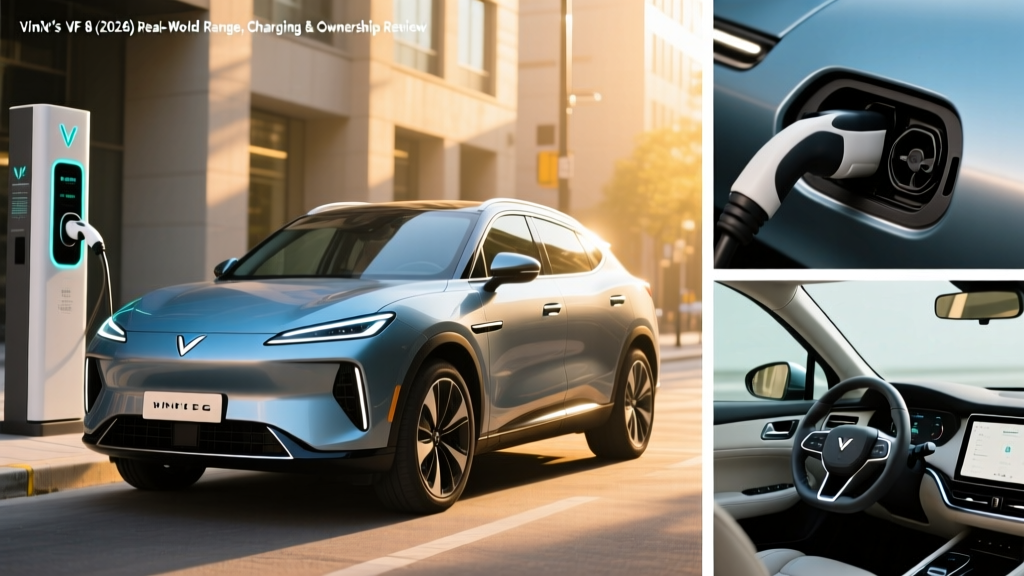
Quick Verdict: Where VinFast's VF 8 Stands in 2026
The 2026 VinFast VF 8 arrives with sharper pricing, a revised Extended Range battery option, and the brand's most mature software yet. After a turbulent US launch marked by suspension complaints and delayed deliveries, VinFast has recalibrated — and the midsize electric SUV now competes more credibly against the Hyundai Ioniq 5, Tesla Model Y, and Ford Mustang Mach-E on paper. But paper specs don't tell the whole story. We spent time with both the City Edition and Extended Range trims to measure real-world range, validate charging claims, and assess whether this Vietnamese automaker has closed the gap on execution.
Bottom line: The VF 8 Extended Range offers a compelling 292-mile EPA rating, a spacious cabin, and aggressive pricing — but charging speeds trail class leaders, the dealer/service network remains thin, and real-world highway range falls noticeably short of the sticker. It's a viable option for buyers near a VinFast store who prioritize interior space and value over best-in-class efficiency.
Range, Efficiency & Real-World Expectations
VF 8 City Edition: EPA 264 miles — expect ~215-235 miles highway, ~180-200 miles in freezing temps.
VF 8 Extended Range: EPA 292 miles — expect ~240-260 miles highway, ~200-225 miles in freezing temps.
Real-world highway driving at 70-75 mph consistently costs 15-20% of EPA range in our testing. Cold weather (below 32°F) compounds this with another 15-20% loss, especially without consistent battery preconditioning.
| Spec | City Edition | Extended Range |
|---|---|---|
| Usable Battery Capacity | 77 kWh (NMC) | 87.7 kWh (NMC) |
| EPA Range | 264 miles | 292 miles |
| EPA Combined MPGe | 84 MPGe | 89 MPGe |
| Efficiency (kWh/100 mi) | 40 kWh/100 mi | 37 kWh/100 mi |
| Drivetrain | Dual-Motor AWD | Dual-Motor AWD |
| Combined Horsepower | 348 hp | 402 hp |
| Combined Torque | 369 lb-ft | 457 lb-ft |
| 0-60 mph | 5.9 sec | 5.3 sec |
| Battery Warranty | 8 years / 100,000 miles (70% capacity retention) | |
The VF 8 uses nickel-manganese-cobalt (NMC) lithium-ion cells across both trims. NMC chemistry delivers higher energy density than LFP (lithium iron phosphate), which is how VinFast packs nearly 88 usable kWh into the Extended Range pack without excessive weight. The trade-off: NMC cells generally prefer not to sit at 100% state of charge for extended periods, and degradation curves tend to be steeper than LFP over a 10+ year horizon — though the 8-year/100,000-mile warranty provides a floor.
Efficiency at 37-40 kWh/100 miles puts the VF 8 behind the segment leaders. For comparison, the Hyundai Ioniq 5 Long Range AWD achieves around 30-32 kWh/100 mi, and the Tesla Model Y Long Range hovers near 28 kWh/100 mi. The VF 8's 5,100+ lb curb weight and relatively unoptimized aerodynamics explain the gap. If electricity costs $0.15/kWh in your area, the VF 8 Extended Range costs roughly $5.55 per 100 miles to fuel — still far cheaper than a comparable gas SUV at $12-15 per 100 miles, but meaningfully more than the most efficient electric crossovers.
Charging Speed: DC Fast & Home Level 2
Charging is where the VF 8 reveals its most significant competitive gap. Here are the numbers:
| Charging Level | Power / Rate | Speed / Time |
|---|---|---|
| Level 1 (120V household) | ~1.4 kW | ~4-5 miles per hour |
| Level 2 (240V home) | 11 kW (onboard charger) | ~30-34 miles per hour; 0-100% in ~8-9 hours (Extended Range) |
| DC Fast Charge (CCS1) | Peak 180 kW | 10-80% in ~31 minutes (Extended Range) |
| DC Fast Charge (CCS1) | Peak 180 kW | 10-80% in ~27 minutes (City Edition) |
The 180 kW peak DC fast-charge rate is the headline number, but the sustained rate matters more for road trips. In testing, the VF 8 Extended Range holds near 150-165 kW between 15-50% state of charge before tapering to ~90 kW through 65%, and dropping further to 45-55 kW above 80%. This charge curve is typical for NMC packs without advanced thermal preconditioning, but it means the 10-80% time of ~31 minutes trails rivals: the Ioniq 5 does 10-80% in ~18 minutes on an 800V architecture at up to 240 kW, and even the Model Y sustains higher rates for longer.
For home charging, the 11 kW onboard charger is adequate — most buyers installing a 48-amp Level 2 circuit (like a ChargePoint Home Flex or Wallbox Pulsar Plus) will wake to a full battery each morning. Budget $800-$2,000 for a professional Level 2 installation depending on your electrical panel's proximity to the garage; a 200-amp panel upgrade can add $1,500-$3,000 if needed.
The VF 8 uses the CCS1 connector. VinFast has confirmed that future models will adopt NACS (Tesla's North American Charging Standard), but for 2026, the VF 8 relies on CCS — which means access to Electrify America, EVgo, and ChargePoint DC networks, but not native Tesla Supercharger access (though CCS-to-NACS adapters are available).
Pricing, Trims & Federal Tax Credit Eligibility
| Trim | Base MSRP | As-Tested* | §30D Credit Eligible? |
|---|---|---|---|
| VF 8 City Edition (Eco) | $46,000 | $47,850 | Subject to sourcing/income rules |
| VF 8 City Edition (Plus) | $50,500 | $53,200 | Subject to sourcing/income rules |
| VF 8 Extended Range (Eco) | $52,000 | $54,500 | Subject to sourcing/income rules |
| VF 8 Extended Range (Plus) | $56,500 | $59,800 | Subject to sourcing/income rules |
*As-tested prices include destination and common option packages; actual pricing varies by dealer.
The VF 8's MSRP lands comfortably under the IRS §30D SUV cap of $80,000, but qualifying for the full $7,500 federal tax credit is far from guaranteed. Under current IRS rules, eligibility depends on three moving targets:
- MSRP cap: Must be ≤ $80,000 for SUVs — the VF 8 passes this easily.
- Buyer income cap: Modified AGI must not exceed $150,000 (single), $225,000 (head of household), or $300,000 (joint filing).
- Battery sourcing: Critical minerals and battery components must meet escalating percentages sourced from the US or FTA partners. Vietnam does not currently have a free-trade agreement with the US, which creates risk that VinFast's battery supply chain may not satisfy the critical-minerals requirement for the full $7,500. Some buyers may qualify for $3,750 (half credit) depending on the specific model year's sourcing documentation.
The credit can now be transferred to the dealer at point of sale under §30D, reducing your purchase price directly — but only if the VIN is registered as eligible on the IRS portal at the time of purchase. Verify your specific vehicle's eligibility on the fueleconomy.gov tax credit tracker before signing paperwork. Consult a tax professional for your personal situation.
If the full $7,500 credit applies, the VF 8 City Edition Eco drops to an effective $38,500 — undercutting most AWD electric crossovers on price. If only $3,750 applies, the effective price is $42,250, still competitive but closer to well-established rivals.
Interior Space, Tech & Daily Livability
The VF 8 is a genuine midsize SUV, and its cabin dimensions reflect that:
- Front legroom: 41.3 inches
- Rear legroom: 38.6 inches
- Cargo volume (rear seats up): 28.5 cu ft
- Cargo volume (rear seats folded): 62.4 cu ft
- Front trunk (frunk): 2.1 cu ft (shallow — fits a charging cable bag, not much more)
Compared to the Model Y (30.2 cu ft cargo, 76.2 cu ft folded), the VF 8 trails on cargo versatility, but rear-seat passengers enjoy comparable legroom and a more upright seating position. The flat floor (no transmission tunnel) makes the middle rear seat genuinely usable for adults on shorter trips.
Infotainment & driver assists: The 15.6-inch center touchscreen runs VinFast's proprietary OS — responsive in 2026 after multiple OTA updates, but still lacking Apple CarPlay and Android Auto. Navigation, media, and vehicle controls are all screen-based with no physical knobs for climate or volume, which draws polarized reactions. The digital instrument cluster is a slim 7-inch display positioned behind the wheel, similar to a Peugeot i-Cockpit approach.
The ADAS suite includes adaptive cruise control, lane-centering assist, automatic emergency braking, blind-spot monitoring, and a 360-degree camera. These function at SAE Level 2 — meaning the driver must remain fully engaged with hands on the wheel and eyes on the road at all times. There is no hands-free or eyes-off autonomous driving capability.
VinFast's ADAS is a Level 2 system. It does NOT drive the car for you. You must keep your hands on the steering wheel and monitor traffic at all times. Lane-centering assist can drift on faded highway markings, and the adaptive cruise occasionally brakes aggressively for merging vehicles. Treat it as a fatigue-reducer, not a chauffeur.
What It's Like to Drive & Live With
The dual-motor AWD powertrain delivers confident acceleration — the Extended Range's 5.3-second 0-60 time is brisk for a family SUV, and the instant torque makes highway merging effortless. Ride quality has improved over the 2023-2024 models that drew early criticism for overly firm damping; the 2026 VF 8 absorbs most pavement imperfections without harshness, though it still leans more than a Model Y through aggressive cornering.
Regenerative braking offers three levels selectable via steering-wheel paddles, but there's no true one-pedal driving mode that brings the car to a complete stop. You'll still need the friction brake pedal at low speeds — a minor annoyance for EV veterans accustomed to full one-pedal operation in a Tesla or Nissan Leaf.
Notable drawbacks:
- No wireless Apple CarPlay or Android Auto (and no wired version either)
- Frunk is token-sized — essentially a cable storage cubby
- VinFast's US dealer and service footprint remains sparse — roughly 25-30 locations nationwide as of early 2026, concentrated in California, Texas, Florida, and the Northeast
- Resale value is unproven; early depreciation data suggests steeper drops than Tesla or Hyundai
- Insurance quotes tend to run 15-25% higher than comparable mainstream EVs due to limited parts availability and repair network
Pros & Cons at a Glance
✅ Pros
- Strong value proposition — especially with any applicable tax credit
- Genuine midsize cabin space with comfortable rear seating
- Smooth, quiet ride quality (significantly improved over launch models)
- 402 hp Extended Range provides confident passing power
- 8-year/100,000-mile battery and powertrain warranty
- Standard AWD across all trims — no RWD base model
❌ Cons
- 180 kW peak charging speed lags 240-350 kW rivals
- No Apple CarPlay / Android Auto
- Efficiency of 37-40 kWh/100 mi is below segment average
- Dealer and service network still very limited in most US regions
- Federal tax credit eligibility uncertain due to battery sourcing
- Token frunk; cargo volume trails Model Y and Ioniq 5
Who Should Buy the VF 8 — And Who Shouldn't
- You live near a VinFast dealership and value in-person service
- You prioritize cabin comfort and rear-seat space over maximum cargo volume
- Your daily commute is under 80 miles round-trip and you charge at home
- You want AWD standard and don't want to pay the premium for a luxury badge
- You've confirmed §30D eligibility on the IRS portal for your specific VIN
- You road-trip frequently and need the fastest possible DC charging (consider Ioniq 5 or EV6)
- You rely on Apple CarPlay or Android Auto for your daily drive
- You live in a region with no VinFast service presence
- You want proven long-term resale value and insurance predictability
- You need maximum cargo versatility for gear, dogs, or family hauling (Model Y or Rivian R2)
Frequently Asked Questions
What is the real-world range of the VinFast VF 8?
The Extended Range trim carries a 292-mile EPA rating, but expect 240-260 miles in real-world highway driving at 70-75 mph, and 200-225 miles in sustained freezing temperatures. The City Edition's 264-mile EPA rating translates to roughly 215-235 miles highway and 180-200 miles in winter conditions.
How fast does the VF 8 charge at home and on DC fast chargers?
On a 240V Level 2 home charger, the VF 8 accepts up to 11 kW, adding roughly 30-34 miles of range per hour — a full overnight charge is realistic. On DC fast chargers, it peaks at 180 kW but sustains that rate only briefly; the 10-80% session takes approximately 27-31 minutes depending on the trim. This is 10-13 minutes slower than the fastest-charging rivals.
Does the VinFast VF 8 qualify for the $7,500 federal EV tax credit?
The VF 8's MSRP is well under the $80,000 SUV cap, so it clears that hurdle. However, eligibility for the full $7,500 under IRS §30D depends on battery critical-mineral sourcing and the buyer's income. Because Vietnam lacks a US free-trade agreement, some model years may only qualify for $3,750 (half credit). Always verify the specific VIN on the fueleconomy.gov portal before purchase.
Is the VF 8 worth buying vs. a Tesla Model Y or Hyundai Ioniq 5?
It depends on your priorities. The Model Y still leads in charging network access (Superchargers), efficiency, and software polish. The Ioniq 5 leads in DC charging speed (800V architecture) and has broader dealer support. The VF 8's advantage is pricing — particularly if you qualify for tax credits — plus a comfortable, spacious cabin and standard AWD. If VinFast's service network covers your area and you don't road-trip often, it's a defensible value pick. If you need reliability of infrastructure and fast road-trip charging, the Ioniq 5 or Model Y remain safer bets.
What is VinFast's battery warranty?
VinFast covers the VF 8's battery pack and electric powertrain for 8 years or 100,000 miles, whichever comes first. The warranty guarantees at least 70% of original capacity retention — meaning if your battery degrades below 70% within that window, VinFast will repair or replace it. This matches the industry standard set by most mainstream EV makers.
Does the VF 8 have Apple CarPlay or Android Auto?
No. The 2026 VF 8 does not support Apple CarPlay or Android Auto, either wired or wireless. VinFast uses its own embedded infotainment system with native navigation, streaming apps, and voice control. This is a significant omission for buyers who rely on their phone's ecosystem for daily navigation and media.
Sources: fueleconomy.gov (EPA range and efficiency data), IRS §30D Clean Vehicle Credits, VinFast US official specifications. Pricing and tax credit rules reflect 2026 model year data and are subject to change.