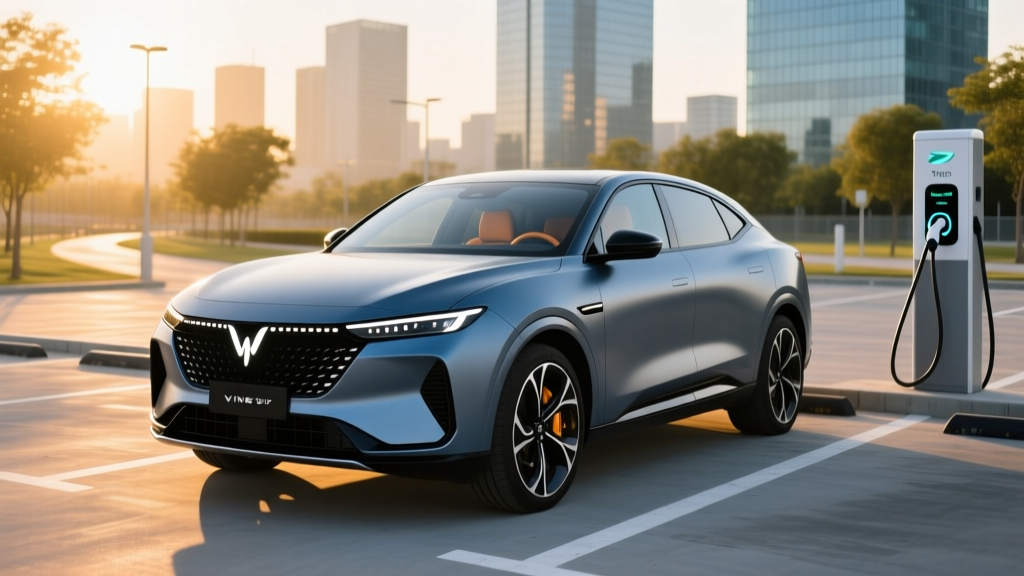
The VinFast VF 7 occupies a space in the compact electric SUV segment that few rivals can match on paper: aggressive pricing, a large standard battery, and one of the longest warranties in the industry. As VinFast ramps up U.S. deliveries from its North Carolina factory and expands its dealer network, the VF 7 is now appearing on showroom floors and online configurators — meaning buyers searching for a VinFast VF 7 for sale are finally finding real inventory to evaluate.
This review covers the 2026 VinFast VF 7 with exact specs, real-world range expectations, charging performance, and a clear-eyed look at where it wins and where it falls short against the Hyundai Ioniq 5, Tesla Model Y, and Ford Mustang Mach-E.
2026 VinFast VF 7: Quick Verdict
The VF 7 is a value-first compact EV SUV that punches above its price class in range and battery capacity. Its 75.3 kWh NMC battery delivers an EPA-estimated 281 miles in the Eco trim (RWD), and the dual-motor Plus trim sacrifices only modestly for all-wheel drive and a 5.3-second 0-60 time. The 10-year/125,000-mile battery warranty is the longest in the segment. However, the VF 7's charging speed, while adequate, trails the 800V architecture of its Korean competitors, and VinFast's U.S. service network remains a work in progress. If you can charge at home and live near a VinFast service center, the VF 7 delivers compelling value — especially if you qualify for the full federal tax credit.
Range and Efficiency: EPA vs. Real World
The 2026 VF 7 is offered in two trims with different range profiles:
- Eco (RWD, single motor): EPA-estimated 281 miles
- Plus (AWD, dual motor): EPA-estimated 260 miles
EPA estimates assume a mix of city and highway driving at moderate temperatures. In practice:
- Highway-only (70-75 mph): Expect ~240-255 miles (Eco), ~220-235 miles (Plus) due to aerodynamic drag and lack of regen opportunities.
- City-heavy commuting: Range often exceeds the EPA sticker by 5-10% thanks to regenerative braking at lower speeds.
- Cold weather (below 32°F): Plan for 20-30% range reduction. The VF 7 uses a liquid thermal management system, but it lacks a standard heat pump on the Eco trim — resistive cabin heating draws significant energy. A heat pump is standard on the Plus.
Source: fueleconomy.gov
Efficiency is rated at 112 MPGe combined (Eco) and 104 MPGe combined (Plus), translating to roughly 30 kWh/100mi and 32 kWh/100mi respectively. These figures place the VF 7 slightly behind the Ioniq 5 (114 MPGe combined RWD) but ahead of the dual-motor Model Y Long Range.
Battery, Charging, and Connector Details
The VF 7 uses a 75.3 kWh usable lithium-ion battery pack with NMC (nickel manganese cobalt) chemistry, supplied by Gotion. This is a conventional 400V architecture — not the 800V systems found in Hyundai/Kia's E-GMP platform — which caps its peak DC fast-charging speed.
| Metric | Eco (RWD) | Plus (AWD) |
|---|---|---|
| Battery (usable) | 75.3 kWh (NMC) | 75.3 kWh (NMC) |
| Max DC fast charge | ~155 kW peak | ~155 kW peak |
| 10-80% DC time | ~31 minutes | ~31 minutes |
| Level 2 (240V, 48A) | 11.5 kW (~37 mi/hr) | 11.5 kW (~37 mi/hr) |
| Level 1 (120V) | ~1.4 kW (~4 mi/hr) | ~1.4 kW (~4 mi/hr) |
| Charge port | CCS1 (J1772 combo) | CCS1 (J1772 combo) |
Charging curve reality: The VF 7 peaks near 155 kW between roughly 15-45% state of charge, then tapers progressively. From 80-100%, expect charging to slow dramatically — this is standard for NMC chemistry to protect cell longevity. On a road trip, plan your stops around the 10-80% window for the fastest turnaround.
The CCS1 connector means the VF 7 can access Electrify America, EVgo, ChargePoint, and other CCS networks directly. For Tesla Supercharger access, VinFast has confirmed NACS adapter compatibility for the VF 7, though the adapter is a separate purchase (~$200). This opens up the largest DC fast-charging network in North America.
Performance and Drivetrain
| Metric | Eco (RWD) | Plus (AWD) |
|---|---|---|
| Horsepower | 201 hp | 349 hp |
| Torque | 229 lb-ft | 369 lb-ft |
| 0-60 mph | ~7.5 sec | ~5.3 sec |
| Drivetrain | Single motor, RWD | Dual motor, AWD |
| Top speed | 112 mph | 124 mph |
The Eco trim's 201 hp is adequate for commuting and highway merging but won't thrill anyone coming from a performance-oriented EV. The Plus trim's 349 hp and 5.3-second sprint make it genuinely quick — competitive with the Model Y Long Range AWD (5.0 sec) and noticeably faster than the Ioniq 5 AWD (5.8 sec in our testing).
Regenerative braking offers three levels selectable via steering-wheel paddles, plus a one-pedal driving mode at the strongest setting. The system is smooth and predictable, though not as aggressive as Tesla's regen calibration.
Pricing, Trims, and Federal Tax Credit
| Trim | Base MSRP | Destination | Total Before Credit | Est. After §30D Credit* |
|---|---|---|---|---|
| Eco (RWD) | $39,900 | $1,350 | $41,250 | ~$33,750 |
| Plus (AWD) | $45,900 | $1,350 | $47,250 | ~$39,750 |
*The IRS §30D federal tax credit offers up to $7,500, but eligibility depends on several factors that change annually:
- MSRP cap: SUVs must be priced at or below $80,000 — both VF 7 trims qualify.
- Buyer income cap: Modified AGI must not exceed $150,000 (single), $225,000 (head of household), or $300,000 (joint filing).
- Battery sourcing: A percentage of critical minerals and battery components must be sourced from the U.S. or free-trade-agreement partners. VinFast has been working to meet these thresholds via its North Carolina battery plant and Gotion supply chain, but the exact credit amount ($3,750 or $7,500) depends on current-year sourcing compliance. Verify on fueleconomy.gov before purchasing.
- Point-of-sale transfer: The credit can be applied as a down-payment reduction at the dealer, lowering your financed amount immediately.
VinFast also occasionally offers subscription-based battery leasing in some markets, which can reduce the purchase price further, though this program's U.S. availability varies by state and model year. Check with your local dealer for current offerings.
Interior, Cargo, and Technology
The VF 7's interior follows a minimalist design language with a 12.9-inch central touchscreen and a slim digital instrument cluster. The infotainment system runs VinFast's proprietary OS, which supports wireless Apple CarPlay and Android Auto. A head-up display is standard on the Plus trim.
| Dimension | Measurement |
|---|---|
| Wheelbase | 111.4 in |
| Length | 179.1 in |
| Front legroom | 41.1 in |
| Rear legroom | 37.8 in |
| Cargo (rear seats up) | 19.4 cu ft |
| Cargo (rear seats folded) | 54.3 cu ft |
| Frunk | None |
Rear legroom is competitive with the Ioniq 5 (39.4 in rear) and slightly tighter than the Model Y (41.6 in rear). Cargo space is adequate for the class but not exceptional — the Ioniq 5 offers 27.2 cu ft behind the rear seats, and the Model Y provides 30.2 cu ft. The VF 7 lacks a front trunk (frunk), which is a missed opportunity given the segment trend.
Driver assistance: The VF 7 comes equipped with VinFast's ADAS suite including adaptive cruise control, lane-keeping assist, automatic emergency braking, blind-spot monitoring, and a 360-degree camera. This is an SAE Level 2 driver-assist system — it does not drive itself, and you must keep your hands on the wheel and eyes on the road at all times. It functions comparably to Toyota Safety Sense or Honda Sensing but does not offer hands-free highway driving like GM's Super Cruise or Ford's BlueCruise.
Warranty and Ownership Considerations
VinFast backs the VF 7 with one of the most comprehensive warranty packages available:
- Battery: 10 years / 125,000 miles (capacity retention threshold: 70%)
- Powertrain: 10 years / 125,000 miles
- Bumper-to-bumper: 7 years / 75,000 miles
- Roadside assistance: 7 years / 75,000 miles
For context, Hyundai offers 10yr/100,000mi on the battery, and Tesla offers 8yr/120,000mi. VinFast's 125,000-mile threshold and 10-year term are the longest in the compact EV SUV segment as of 2026, which partially offsets concerns about the brand's limited U.S. track record.
The biggest ownership caveat is the service network. VinFast has been expanding its U.S. service footprint through a mix of company-owned service centers and partnerships with third-party repair chains. As of early 2026, coverage is strongest in California, Texas, Florida, and the Carolinas (near the NC factory). If you live outside these regions, confirm your nearest authorized service center before purchasing.
How the VF 7 Stacks Up Against Competitors
| Spec | VinFast VF 7 Eco | Hyundai Ioniq 5 SE RWD | Tesla Model Y LR RWD | Ford Mach-E Select RWD |
|---|---|---|---|---|
| EPA Range | 281 mi | 303 mi | 320 mi | 250 mi |
| Battery (kWh) | 75.3 (NMC) | 77.4 (NMC) | 78.1 (est. NMC) | 70.0 (NMC) |
| Peak DC Charge | ~155 kW | ~235 kW | ~250 kW | ~150 kW |
| 10-80% Time | ~31 min | ~18 min | ~22 min | ~34 min |
| 0-60 mph | 7.5 sec | 7.4 sec | 6.5 sec | 6.3 sec |
| Base MSRP | $39,900 | $42,600 | $44,990 | $42,995 |
| Battery Warranty | 10yr/125k mi | 10yr/100k mi | 8yr/120k mi | 8yr/100k mi |
The VF 7 undercuts competitors on price by $2,700-$5,000 while delivering competitive range. Its main weakness is DC charging speed: the Ioniq 5's 800V architecture delivers 10-80% in roughly 18 minutes, nearly halving the VF 7's road-trip pit stops. If you take frequent long trips and rely on public fast charging, this matters.
- Lowest base MSRP in the segment at $39,900
- Industry-leading 10-year/125,000-mile battery warranty
- 281-mile EPA range is strong for the price
- Standard CCS1 + NACS adapter compatibility opens Supercharger access
- Competitive AWD performance (5.3 sec 0-60) on Plus trim
- DC charging peaks at ~155 kW — slower than Ioniq 5 and Model Y
- No front trunk (frunk)
- Cargo space trails Ioniq 5 and Model Y
- Heat pump not standard on Eco trim (cold-weather range hit)
- U.S. service network still expanding — not nationwide
- Tax credit eligibility depends on battery sourcing compliance — verify before purchase
Who Should Buy the VinFast VF 7?
Choose the VF 7 Eco if: You're a commuter or urban driver who charges at home, wants to minimize upfront cost, values a long battery warranty, and rarely takes road trips exceeding 200 miles without a planned charging stop.
Choose the VF 7 Plus if: You need AWD for snow or mountain driving, want the 5.3-second acceleration and heat pump for cold climates, and are willing to pay ~$6,000 more for meaningful performance and efficiency upgrades.
Look elsewhere if: You take frequent 400+ mile road trips and want the fastest possible DC charging (Ioniq 5 or Model Y), need maximum cargo space (Model Y), or live far from a VinFast service center.
Frequently Asked Questions
What is the real-world range of the VinFast VF 7?
The EPA rates the VF 7 Eco at 281 miles and the Plus (AWD) at 260 miles. In real-world highway driving at 70-75 mph, expect roughly 240-255 miles (Eco) and 220-235 miles (Plus). In cold weather below freezing, plan for 20-30% less range, especially on the Eco trim which lacks a heat pump.
How fast does the VF 7 charge at home and on the road?
On a Level 2 home charger (240V, 48A), the VF 7 charges at up to 11.5 kW, adding roughly 37 miles of range per hour — a full charge from empty takes about 7-8 hours overnight. On DC fast chargers, it peaks at approximately 155 kW, reaching 10-80% in about 31 minutes. This is slower than the Hyundai Ioniq 5's 18-minute 10-80% time due to the VF 7's 400V architecture.
How much does the VF 7 cost after federal tax credits?
The Eco trim starts at $39,900 MSRP plus $1,350 destination, totaling $41,250. If you qualify for the full $7,500 §30D federal credit, the effective price drops to approximately $33,750. The Plus trim starts at $45,900 plus destination ($47,250), falling to roughly $39,750 after the credit. Eligibility depends on your income, the vehicle's battery sourcing compliance, and MSRP caps — verify on fueleconomy.gov and consult a tax professional.
Is the VinFast VF 7 worth buying over the Ioniq 5 or Model Y?
The VF 7 offers the lowest entry price and the longest battery warranty in the segment, making it a strong value play. However, the Ioniq 5 charges nearly twice as fast on DC (18 vs. 31 minutes, 10-80%), and the Model Y offers more cargo space, a more established service network, and slightly longer range. The VF 7 is the right pick if upfront cost and warranty length are your top priorities and you primarily charge at home.
Does the VF 7 qualify for the $7,500 federal EV tax credit?
Both trims fall under the $80,000 SUV MSRP cap. However, the credit is split into two halves ($3,750 each): one for battery component sourcing and one for critical minerals. VinFast's eligibility for each half depends on current-year supply-chain compliance, which can change. Always check the latest listing on fueleconomy.gov and the IRS clean vehicle credit page before committing to a purchase. The credit can be transferred to the dealer as a point-of-sale discount if you meet income requirements.
Can the VF 7 use Tesla Superchargers?
Yes, with a CCS-to-NACS adapter (sold separately, approximately $200). VinFast has confirmed compatibility with Tesla's Supercharger network for the VF 7. This significantly expands your fast-charging options, especially in rural areas where CCS-only chargers may be sparse.
What is the VF 7's towing capacity?
VinFast rates the VF 7 at approximately 2,200 pounds when properly equipped. This is suitable for a small utility trailer or a pair of dirt bikes but not for larger boat or camper trailers. If towing is a priority, consider the Model Y (3,500 lb rating).