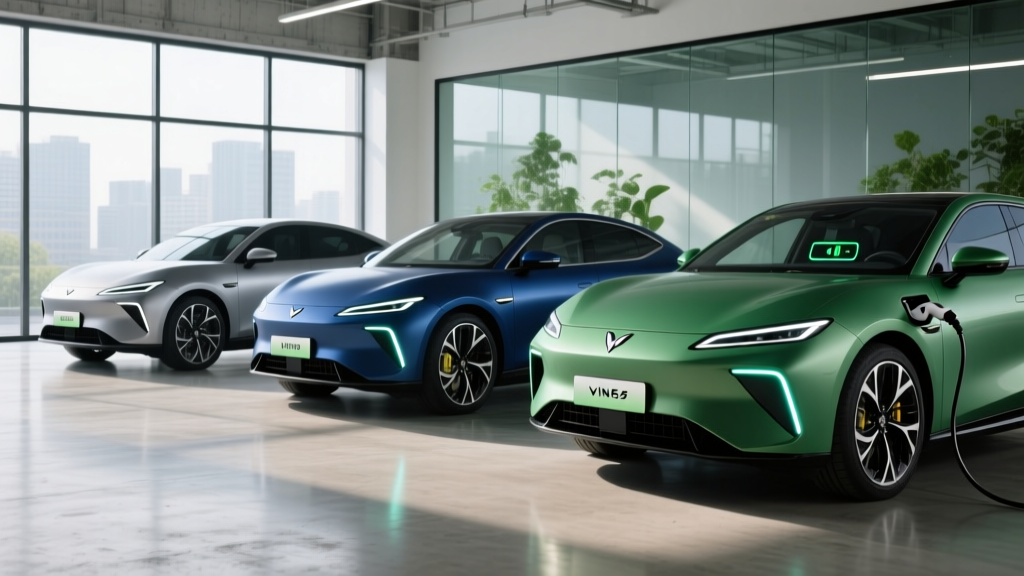
VinFast, the Vietnamese automaker backed by conglomerate Vingroup, has had one of the most turbulent trajectories in the modern EV industry. From a Nasdaq listing to rapid dealership expansion across the United States, the brand has pivoted aggressively to establish itself as a mainstream electric-vehicle contender. This VinFast company overview breaks down where the automaker stands in 2026 — its current U.S. models, real-world performance data, charging infrastructure, pricing, and whether its vehicles make financial sense against established competitors.
VinFast in 2026: Company Snapshot and U.S. Strategy
Founded in 2017 and headquartered in Hanoi, VinFast delivered its first U.S.-market vehicles in 2023. By 2026, the company operates a growing network of showrooms and service centers across California, Texas, Florida, New York, and several other states, alongside a direct-to-consumer online sales model. VinFast's U.S. lineup centers on two battery-electric SUVs: the midsize VF 8 and the three-row VF 9. A compact crossover, the VF 6, and a subcompact, the VF 5, have been announced for global markets but remain unavailable in the U.S. as of early 2026.
VinFast operates its own EV charging network in the U.S. with DC fast chargers deployed along major corridors, while also supporting access to Electrify America, EVgo, and — via adapter — the Tesla Supercharger network. The company shifted away from its controversial battery-subscription model in 2024, selling vehicles with batteries included, which simplified pricing and improved resale predictability.
2026 VinFast VF 8: Range, Battery, and Real-World Efficiency
The VF 8 is VinFast's volume play — a two-row midsize SUV targeting buyers cross-shopping the Tesla Model Y, Hyundai Ioniq 5, and Ford Mustang Mach-E. It rides on a dedicated EV platform with a skateboard-style battery pack and dual-motor all-wheel drive as standard.
| Spec | Value |
|---|---|
| EPA Estimated Range | 264 miles |
| Battery Capacity (Usable) | 82 kWh (NMC chemistry) |
| Drivetrain | Dual-motor AWD |
| Horsepower | 348 hp (Eco) / 402 hp (Plus) |
| 0–60 mph | 5.3 sec (Eco) / 4.6 sec (Plus) |
| Max DC Fast-Charge Rate | ~190 kW (peak) |
| 10–80% DC Fast Charge | ~31 minutes |
| Level 2 Home Charging | 11 kW (~30 miles/hr) |
| MPGe (Combined) | 92 MPGe |
| Efficiency | 36 kWh/100 mi |
| Cargo Volume (rear seats up) | 27.3 cu ft |
| Cargo Volume (rear seats folded) | 58.4 cu ft |
| Battery/Powertrain Warranty | 10 years / 125,000 miles |
| Base MSRP (Eco) | $43,990 |
| As-Tested (Plus, loaded) | ~$52,500 |
Efficiency is a weak point. At 36 kWh per 100 miles, the VF 8 consumes more energy per mile than the Model Y Long Range (~28 kWh/100 mi) or the Ioniq 5 (~30 kWh/100 mi). This translates directly into higher charging costs over time, especially on public DC fast chargers where per-kWh rates often exceed $0.40.
2026 VinFast VF 9: The Three-Row Flagship
The VF 9 is VinFast's largest offering, a three-row electric SUV aimed at families and buyers considering the Kia EV9, Rivian R1S, or Tesla Model X. It uses a larger battery pack and the same dual-motor AWD architecture.
| Spec | Value |
|---|---|
| EPA Estimated Range | 291 miles |
| Battery Capacity (Usable) | 92 kWh (NMC chemistry) |
| Drivetrain | Dual-motor AWD |
| Horsepower | 402 hp |
| 0–60 mph | 5.8 sec |
| Max DC Fast-Charge Rate | ~200 kW (peak) |
| 10–80% DC Fast Charge | ~34 minutes |
| Level 2 Home Charging | 11 kW (~28 miles/hr) |
| MPGe (Combined) | 86 MPGe |
| Cargo Volume (all rows up) | 14.8 cu ft |
| Cargo Volume (3rd row folded) | 45.2 cu ft |
| Cargo Volume (max) | 82.7 cu ft |
| Battery/Powertrain Warranty | 10 years / 125,000 miles |
| Base MSRP (Eco) | $59,990 |
| As-Tested (Plus, loaded) | ~$69,000 |
The VF 9's interior quality has improved noticeably over the 2024 launch model, with softer materials and better panel fitment. Third-row space accommodates children comfortably but is tight for adults on longer trips — a limitation shared with most three-row SUVs outside the Rivian R1S and Kia EV9.
Charging Speed and Network Access
Charging remains a critical purchase factor, and VinFast's numbers are competitive but not class-leading. Both the VF 8 and VF 9 use the CCS1 connector natively. A NACS adapter enables access to Tesla Superchargers, broadening route options significantly.
| Level | Power | VF 8 Speed | VF 9 Speed | Notes |
|---|---|---|---|---|
| Level 1 (120V) | ~1.4 kW | ~4 mi/hr | ~4 mi/hr | Emergency/trickle only |
| Level 2 (240V) | 11 kW | ~30 mi/hr | ~28 mi/hr | Full charge in ~8–9 hours |
| DC Fast Charge | Up to 190–200 kW | 10–80% in ~31 min | 10–80% in ~34 min | Peak rate tapers above 60% SoC |
The charge curve is the important detail here. Both vehicles hit peak charge rates only between roughly 10% and 40% state of charge. Above 60%, the rate tapers significantly — from ~190 kW down to under 80 kW — which is why the 10–80% time is over 30 minutes. This is typical for NMC packs without advanced thermal preconditioning. For comparison, the Hyundai Ioniq 5 with its 800-volt architecture achieves 10–80% in approximately 18 minutes at a 350 kW charger.
VinFast does not currently offer battery preconditioning for DC fast charging via navigation routing, a feature that competitors like Tesla and Porsche use to warm the pack before arrival at a charger. Without preconditioning, cold-weather DC charging speeds can be substantially slower — expect 10–80% times closer to 45–50 minutes when the battery is cold-soaked below 40°F.
Pricing, Tax Credits, and Total Cost
VinFast simplified its pricing structure by eliminating the battery-subscription option. All U.S. vehicles now include the battery in the purchase price.
| Model / Trim | Base MSRP | §30D Credit Eligible? | Est. After-Credit Price |
|---|---|---|---|
| VF 8 Eco | $43,990 | Likely ineligible* | $43,990 |
| VF 8 Plus | $49,990 | Likely ineligible* | $49,990 |
| VF 9 Eco | $59,990 | Likely ineligible* | $59,990 |
| VF 9 Plus | $67,990 | Likely ineligible* | $67,990 |
*Under IRS §30D rules, the federal EV tax credit of up to $7,500 requires that the vehicle's battery components and critical minerals meet specific North American sourcing thresholds. As of 2026, VinFast's battery supply chain (sourced primarily from Gotion High-Tech and other Asian suppliers) does not meet the critical-minerals or battery-component requirements for §30D eligibility. Additionally, buyers must meet income caps ($150K single / $300K joint) and the vehicle must be under the MSRP cap ($80K for SUVs). Always verify current eligibility on the IRS Clean Vehicle Credit page or with a tax professional before purchasing.
The lack of federal tax-credit eligibility is a significant disadvantage. A similarly equipped Hyundai Ioniq 5 or Ford Mustang Mach-E may qualify for the full $7,500 credit (depending on trim and sourcing), effectively reducing their out-of-pocket cost by thousands of dollars relative to the VF 8.
Tech, Safety, and Driver Assistance
Both the VF 8 and VF 9 feature a 15.6-inch central touchscreen running VinFast's proprietary infotainment OS. The system supports wireless Apple CarPlay and Android Auto, over-the-air updates, and a built-in virtual assistant. However, the interface has drawn criticism for requiring too many taps for basic climate and drive-mode adjustments — a common complaint with touchscreen-heavy EV interiors.
Driver assistance is provided by VinFast's ADAS suite, which includes adaptive cruise control, lane-centering assist, blind-spot monitoring, and automatic emergency braking. This is an SAE Level 2 system, meaning the driver must remain fully engaged with hands on the wheel and eyes on the road at all times. It is not autonomous driving.
As of early 2026, neither the VF 8 nor the VF 9 has received a full IIHS Top Safety Pick award. NHTSA crash-test results are available for select model years. Buyers prioritizing top-tier safety ratings should cross-reference IIHS and NHTSA databases before purchase.
Warranty and Ownership Considerations
VinFast offers one of the longest battery and powertrain warranties in the industry:
- Battery & Powertrain: 10 years / 125,000 miles (whichever comes first)
- Bumper-to-Bumper: 5 years / 60,000 miles
- Roadside Assistance: 5 years / 60,000 miles
- Capacity Retention Threshold: Warranty covers battery if capacity drops below 70% of original during the coverage period
The 10-year battery warranty is a strong signal, but it comes with a caveat: VinFast's U.S. service-center network is still expanding. In markets without a nearby VinFast service location, warranty repairs may require towing to the nearest authorized center or reliance on mobile service technicians with limited diagnostic capability. Before purchasing, verify service-center proximity to your home or workplace.
Insurance costs for VinFast vehicles have trended higher than segment averages. Industry data suggests VF 8 annual premiums run 15–25% above comparable Model Y or Ioniq 5 policies, reflecting limited actuarial data and higher repair-cost estimates. Obtain an insurance quote before committing to a purchase.
Who Should Consider a VinFast — and Who Shouldn't
Pros
- 10-year/125,000-mile battery warranty — among the best in the industry
- Standard dual-motor AWD on all trims
- Distinctive styling that stands out in a crowded SUV segment
- CCS1 native + NACS adapter for broad charging-network access
- Competitive 0–60 times, especially in Plus trim
- Improved interior quality in 2026 models over launch-year vehicles
Cons
- No federal §30D tax credit eligibility — adds $7,500 effective cost vs. qualifying rivals
- Below-average efficiency (36 kWh/100 mi for VF 8) increases charging costs
- No battery preconditioning for DC fast charging — cold-weather charging is slow
- ADAS is less refined than Tesla Autopilot, GM Super Cruise, or Ford BlueCruise
- Limited U.S. service-center network in many regions
- Higher-than-average insurance premiums
- No heat pump — cold-weather range loss is significant
Choose the VinFast VF 9 if: You need three rows, value the 10-year battery warranty, and are willing to accept the efficiency and tax-credit trade-offs vs. the Kia EV9 or Rivian R1S.
Look elsewhere if: Federal tax-credit eligibility is essential to your budget, you frequently drive in cold climates, you rely on public DC fast charging for road trips (where preconditioning and efficiency matter), or you need a mature service network.
Competitive Positioning: VF 8 vs. Key Rivals
| Spec | VinFast VF 8 Eco | Tesla Model Y LR AWD | Hyundai Ioniq 5 AWD | Ford Mach-E ER AWD |
|---|---|---|---|---|
| EPA Range | 264 mi | 320 mi | 290 mi | 290 mi |
| Battery (kWh) | 82 | 78 | 77.4 | 91 |
| 0–60 mph | 5.3 sec | 4.8 sec | 5.1 sec | 5.5 sec |
| DC Fast Charge (10–80%) | ~31 min | ~25 min | ~18 min | ~35 min |
| Efficiency (kWh/100mi) | 36 | 28 | 30 | 33 |
| Base MSRP | $43,990 | $47,990 | $49,950 | $48,995 |
| §30D Tax Credit | No | Partial/Yes* | Yes* | Yes* |
| Effective Price (after credit) | $43,990 | ~$40,490 | ~$42,450 | ~$41,495 |
*Tax-credit eligibility depends on battery sourcing, buyer income, and MSRP caps. Verify on irs.gov before purchase.
The comparison is stark: once the tax credit is factored in, the VF 8 is effectively the most expensive vehicle in this group while offering the shortest range and lowest efficiency. The Ioniq 5 charges nearly twice as fast. The Model Y offers the best range and Supercharger access. The Mach-E provides strong value with credit eligibility.
Frequently Asked Questions
What is the real-world range of VinFast EVs?
The VF 8 delivers approximately 220–240 miles in real-world highway driving and 180–200 miles in cold weather, against its 264-mile EPA estimate. The VF 9 achieves roughly 240–260 miles on the highway and 200–220 miles in cold conditions, against its 291-mile EPA figure.
How fast do VinFast vehicles charge?
On DC fast chargers, the VF 8 and VF 9 peak at approximately 190–200 kW and achieve 10–80% in 31–34 minutes under ideal conditions. Cold-weather DC charging can extend this to 45–50 minutes due to lack of battery preconditioning. On Level 2 home chargers (11 kW), both vehicles add roughly 28–30 miles of range per hour.
Does VinFast qualify for the $7,500 federal EV tax credit?
As of 2026, VinFast vehicles are generally ineligible for the IRS §30D Clean Vehicle Credit because their battery components and critical minerals do not meet the required North American sourcing thresholds. Always verify current eligibility on the IRS website or with a qualified tax professional.
Is VinFast a reliable brand?
VinFast's early U.S. models (2023–2024) faced significant software and build-quality complaints. The 2025 and 2026 model years show measurable improvement, but long-term reliability data is still limited given the brand's short U.S. history. The 10-year battery warranty provides a safety net, but service-network coverage remains uneven.
Where is VinFast headquartered, and who owns it?
VinFast is headquartered in Hanoi, Vietnam, and is a subsidiary of Vingroup, one of Vietnam's largest conglomerates. The company went public on the Nasdaq in August 2023 under the ticker VFS. It also operates manufacturing facilities in Vietnam and has announced plans for a production plant in North Carolina, though its operational status should be confirmed with the company directly.
Is the VF 8 or VF 9 worth buying over competitors?
For most buyers, the answer depends on tax-credit eligibility and local service access. If you cannot access the $7,500 federal credit through any vehicle (e.g., income phase-out), the VF 8's pricing becomes more competitive. If the credit is available to you, rivals like the Ioniq 5, Model Y, and Mach-E deliver better range, efficiency, and charging speed at a lower effective price.
For the latest EPA efficiency data on VinFast models, visit fueleconomy.gov. For safety ratings, consult NHTSA and IIHS.