The Real Cost of Going Electric in Vermont
Vermont is one of the most EV-friendly states in the country — cold winters and rural roads aside. Between the federal §30D Clean Vehicle Credit, Vermont's own incentive programs, and utility rebates from Green Mountain Power and Burlington Electric Department, the upfront price gap between an EV and a comparable gas car has narrowed significantly. But incentives are only half the equation. To make a smart purchase, you need the full picture: what you'll actually spend over five years on charging, insurance, maintenance, and depreciation — not just the sticker price minus a tax credit.
This guide breaks down every layer of EV ownership cost for Vermont buyers in 2026, with concrete numbers and the eligibility rules that determine whether you'll actually see that $7,500 federal credit.
Federal EV Tax Credit: IRS §30D Rules for 2026
The federal Clean Vehicle Credit under IRS §30D remains the single largest purchase incentive available to Vermont EV buyers. The maximum credit is $7,500 for a qualifying new battery-electric or plug-in hybrid vehicle, and as of 2024, it can be transferred to the dealer at the point of sale — meaning you can apply it as an immediate price reduction rather than waiting to claim it on your tax return.
But not every EV qualifies, and not every buyer qualifies. The rules are layered:
§30D Eligibility Checklist (2026 Tax Year)
- Buyer income caps (Modified AGI): $300,000 joint / $225,000 head of household / $150,000 single filer. If your MAGI exceeds these thresholds in either the purchase year or the prior year, you do not qualify.
- Vehicle MSRP caps: $80,000 for SUVs, vans, and pickups; $55,000 for sedans and other body styles. MSRP includes factory-installed options but excludes destination charges.
- Battery component sourcing: A percentage of battery components must be manufactured or assembled in North America (threshold increases annually — 100% by 2029).
- Critical minerals requirement: A percentage of critical minerals in the battery must be sourced from the U.S. or a free-trade-agreement partner (threshold also escalates yearly).
- Final assembly: The vehicle must undergo final assembly in North America. Check your VIN at NHTSA.gov to confirm.
- Point-of-sale transfer: You may elect to transfer the credit to the dealer for an immediate price reduction. The dealer must register with the IRS Energy Credits Online portal.
Each half of the credit — $3,750 for battery components and $3,750 for critical minerals — is evaluated independently. Some vehicles qualify for the full $7,500, others for $3,750, and some for $0 depending on their supply chain. The IRS updates the qualifying vehicle list periodically, so always verify at fueleconomy.gov before signing a purchase agreement.
Vermont State EV Incentives and Utility Rebates
Vermont does not currently offer a direct state purchase tax credit for new EVs in the same way states like Colorado or California do. However, the Green Mountain State has built a strong incentive ecosystem through other channels:
Vermont-Specific Incentive Programs (2026)
MileageSmart / Replace Your Ride: Vermont's income-targeted incentive program provides up to $5,000 for low- and moderate-income residents purchasing a new or used EV or PHEV. Eligibility is based on household income relative to the area median income. Administered through Capstone Community Action and other regional partners.
Used EV incentives: The federal §25E credit provides up to $4,000 (or 30% of the sale price, whichever is less) for qualifying used EVs purchased from a dealer for under $25,000. Income caps apply (half of §30D thresholds: $150k joint / $112.5k HOH / $75k single).
Utility rebates — Green Mountain Power (GMP): GMP has historically offered rebates of up to $1,500 for new EV purchases and additional incentives for Level 2 home charger installations. Check GMP's current program availability, as utility rebates are budget-limited and can change mid-year.
Utility rebates — Burlington Electric Department (BED): BED offers EV purchase incentives and discounted off-peak charging rates for residential customers. Contact BED directly for current rebate amounts.
Vermont offers reduced registration fees for EVs compared to some states that impose punitive EV registration surcharges. Vermont's approach is relatively EV-friendly at the DMV level.
State and utility incentive amounts change frequently. Verify current availability through the Vermont Natural Resources Council, Drive Electric Vermont, or your local utility before finalizing a purchase.
5-Year Total Cost of Ownership: EV vs. Gas in Vermont
To understand whether an EV actually saves you money in Vermont, we need to model a realistic five-year ownership period. Below is a comparison of a representative 2026 EV (a mid-range crossover like the Hyundai Ioniq 5, ~$42,000 MSRP before incentives) against a comparably priced gas crossover (like a Toyota RAV4 AWD, ~$34,000 MSRP).
| Cost Category | EV (Ioniq 5-class) | Gas (RAV4 AWD-class) |
|---|---|---|
| Purchase price (after incentives) | $34,500* | $34,000 |
| Fuel / charging (60k mi) | $3,240 | $7,800 |
| Maintenance | $1,400 | $3,500 |
| Insurance (5-year total) | $9,750 | $7,500 |
| Depreciation (est.) | $14,500 | $11,200 |
| 5-Year Total | $63,390 | $64,000 |
*Assumes $7,500 federal §30D credit applied at point of sale. Actual purchase price depends on trim, dealer fees, and credit eligibility.
The takeaway: at roughly the same effective purchase price (after incentives), the EV pulls ahead primarily on fuel and maintenance savings, but loses ground on insurance and depreciation. Over five years in Vermont, the total cost is essentially a wash — or slightly in the EV's favor — depending on your specific electricity rate, driving habits, and insurance quotes.
Charging vs. Gas: Per-Mile Cost in Vermont
Vermont's residential electricity rates average roughly $0.21/kWh as of early 2026, which is above the national average. That makes home charging more expensive here than in states like Idaho or Louisiana, but it still undercuts gasoline on a per-mile basis by a wide margin.
| Scenario | Rate | Efficiency | Cost/Mile |
|---|---|---|---|
| EV home charging (Level 2) | $0.21/kWh | 3.5 mi/kWh (120 MPGe) | $0.060 |
| EV public DC fast charging | $0.40/kWh avg | 3.5 mi/kWh | $0.114 |
| Gas car (28 MPG combined) | $3.30/gal | 28 MPG | $0.118 |
| Gas car (22 MPG, cold/hwy) | $3.30/gal | 22 MPG | $0.150 |
At home in Vermont, you're paying roughly half per mile compared to a gas car at $3.30/gallon. Even at public DC fast chargers (which are significantly more expensive), the per-mile cost is competitive with gasoline. The savings widen if you have access to off-peak utility rates — GMP and BED both offer time-of-use plans that can drop overnight charging below $0.15/kWh.
Cold-weather caveat for Vermont winters: Expect 20-30% range reduction in sustained sub-freezing temperatures. A vehicle rated at 300 miles EPA may deliver 210-240 real-world miles in a Vermont January. This doesn't change the per-mile cost math significantly (you still charge the same kWh), but it does mean more frequent charging sessions during winter months. A heat pump — standard on vehicles like the Ioniq 5, Tesla Model Y, and Nissan Ariya — mitigates some of this loss by using less energy for cabin heating.
Maintenance Savings: What You Actually Skip
EVs eliminate the most common recurring maintenance items that gas-car owners face. Here's the concrete breakdown:
| Service Item | Gas Car | EV |
|---|---|---|
| Oil changes (synthetic, ~$65 ea) | 6-8 changes = $390-$520 | $0 |
| Transmission fluid | $150-$250 | $0 (single-speed reducer) |
| Engine air filter | $50-$100 | $0 (no intake) |
| Spark plugs | $200-$400 | $0 |
| Brake pads (front) | $250-$400 at 40-50k mi | Often 80k+ mi (regen braking) |
| Cabin air filter | $40-$80 | $40-$80 (same) |
| Tire rotation | $25-$50 ea | $25-$50 ea (same; EVs may wear tires faster due to weight) |
| Coolant flush | $100-$150 | $100-$150 (battery thermal system) |
| Estimated 5-yr total | $2,800-$3,500 | $1,200-$1,500 |
Regenerative braking is the unsung hero of EV maintenance. Because the electric motor handles most deceleration, the friction brakes see far less use. Many EV owners report original brake pads at 60,000+ miles. However, EVs are heavier (a typical electric crossover weighs 4,500-5,000 lbs vs. 3,500-3,800 for a gas equivalent), which can accelerate tire wear. Budget for a tire replacement around 35,000-45,000 miles, especially if you choose high-torque performance trims.
Insurance Cost Reality for EVs in Vermont
This is where the EV cost story gets less rosy. EV insurance premiums typically run 15-25% higher than equivalent gas vehicles. In Vermont, where average annual auto insurance costs around $1,100-$1,300 for a gas car, expect to pay $1,300-$1,700 annually for a comparable EV.
Why the premium?
- Higher repair costs: EV battery packs and power electronics are expensive to replace after collision damage. Even minor rear-end impacts can trigger battery safety protocols that require costly inspections.
- Specialized labor: High-voltage system repairs require certified technicians, and fewer shops have this capability — especially in rural Vermont.
- Higher vehicle values: Comprehensive and collision coverage costs scale with vehicle price, and EVs still carry a price premium in many segments.
- Total-loss thresholds: Insurers may total an EV more readily if the battery pack is damaged, since replacement can exceed $15,000-$20,000.
Practical tip: Get insurance quotes before purchasing. Rates vary enormously by insurer, model, and driver profile. Tesla vehicles tend to be the most expensive to insure; mainstream EVs from Hyundai, Kia, and Ford are closer to gas-car premiums. Always quote the exact VIN and trim level.
EV Depreciation and Resale Value Trends
EV depreciation has been volatile. After Tesla's aggressive price cuts in 2023-2024 rippled through the used market, EVs experienced steeper-than-average depreciation for a period. By 2025-2026, the market has largely stabilized, but the data still shows:
- 5-year depreciation for mainstream EVs: 45-55% (compared to 35-45% for popular gas crossovers like the RAV4 or CR-V).
- Tesla depreciation: Higher than average due to frequent new-vehicle price adjustments and rapid tech iteration.
- Hyundai/Kia EVs: Holding value better than average for the EV segment, aided by strong warranty coverage (10-year/100,000-mile battery warranty).
- Plug-in hybrids (PHEVs): Depreciating more slowly than BEVs in some segments, as buyers hedge against range anxiety.
For Vermont buyers specifically, the used-EV market benefits from the state's EV-friendly culture and the presence of Drive Electric Vermont's education programs. Demand for used EVs in the Burlington, Montpelier, and Stowe corridors remains stronger than in many rural markets. If you plan to keep your EV for 8-10 years, depreciation matters less — and the battery warranty (typically 8 years / 100,000 miles with a 70% capacity retention guarantee) provides a floor of confidence.
Cold-Weather Range and Charging: Vermont-Specific Considerations
Vermont's climate is the wildcard in any EV ownership equation. Here's what the data shows for sub-freezing operation:
- Range loss at 20°F: Expect 20-30% reduction from EPA estimates. A 300-mile EPA vehicle delivers roughly 210-240 real-world miles. At 0°F, losses can reach 35-40% without preconditioning.
- Charging speed reduction in cold: Lithium-ion batteries charge significantly slower when cold. Without battery preconditioning, a DC fast charge session in January might peak at 50-80 kW instead of the vehicle's rated 150-250 kW. Always precondition via the vehicle's app or navigation routing before arriving at a charger.
- Heat pump advantage: Vehicles equipped with a heat pump (Hyundai Ioniq 5/6, Tesla Model Y/3, Nissan Ariya) use 30-40% less energy for cabin heating compared to resistive heaters, directly preserving range in cold weather.
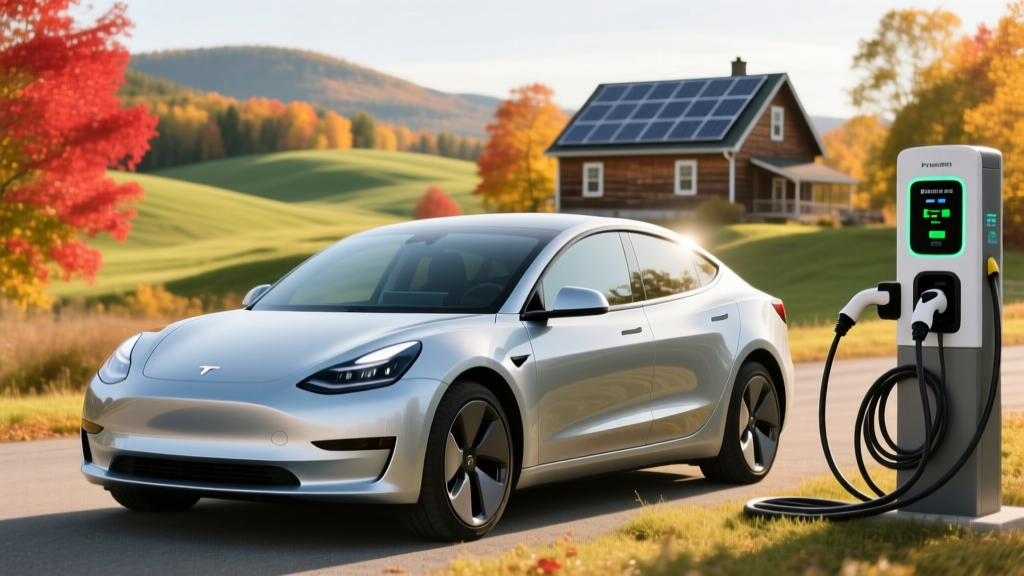
- Home charging is essential: In Vermont, Level 2 home charging (240V, 32-48A, 7.7-11.5 kW) is practically mandatory. Public charging infrastructure exists along I-89 and I-91 corridors, but rural routes between Burlington and the Northeast Kingdom have sparse DC fast-charger coverage. Budget $500-$1,500 for a Level 2 home charger installation (assuming your electrical panel has capacity).
Frequently Asked Questions
How much does it really cost to own an EV over 5 years in Vermont?
Based on our modeling of a mid-range EV crossover versus a comparable gas vehicle, the 5-year total cost of ownership is roughly comparable — within $500-$1,000 either direction — when the full $7,500 federal credit is applied. The EV saves $4,000-$5,000 on fuel and maintenance but costs $2,000-$2,500 more in insurance and typically depreciates $3,000-$4,000 more. The break-even point depends heavily on your electricity rate, annual mileage, and whether you qualify for the maximum federal credit.
Do I qualify for the federal EV tax credit?
You qualify for up to $7,500 under IRS §30D if: (1) your modified adjusted gross income is below $150k single / $300k joint / $225k head of household, (2) the vehicle's MSRP is under $55k for sedans or $80k for SUVs/trucks/vans, (3) the vehicle meets battery component and critical mineral sourcing thresholds, and (4) final assembly occurred in North America. Check the current qualifying vehicle list at fueleconomy.gov and verify your income against IRS rules — or consult a tax professional before relying on the credit.
How much do I save on fuel and maintenance with an EV in Vermont?
At Vermont's average residential electricity rate of ~$0.21/kWh, home charging costs roughly $0.06/mile for a typical EV — about half the $0.12/mile a 28-MPG gas car costs at $3.30/gallon. Over 60,000 miles, that's approximately $3,200 in charging vs. $7,800 in gasoline, saving roughly $4,500. Maintenance savings add another $1,500-$2,000 over five years from eliminated oil changes, fewer fluid services, and extended brake life.
Are EVs more expensive to insure in Vermont?
Yes, typically 15-25% more than a comparable gas vehicle. For a Vermont driver paying $1,200/year for gas-car insurance, expect $1,400-$1,500/year for an EV. The higher cost reflects expensive battery repairs, specialized labor requirements, and higher vehicle values. Always get model-specific insurance quotes before purchasing — premiums vary significantly between EV models.
How well do EVs hold their value?
EVs currently depreciate faster than popular gas vehicles — roughly 45-55% over five years vs. 35-45% for high-demand gas crossovers. The gap has narrowed since the 2023-2024 price disruption but hasn't closed entirely. If you plan to own your EV for 8+ years, long-term depreciation becomes less relevant, and the 8-year/100,000-mile battery warranty provides reassurance. PHEVs tend to hold value slightly better than BEVs in the current market.
Does Vermont have its own state EV tax credit?
Vermont does not offer a direct state purchase tax credit like some other states. Instead, Vermont provides income-targeted incentives through programs like MileageSmart/Replace Your Ride (up to $5,000 for qualifying lower-income buyers), and utilities like Green Mountain Power and Burlington Electric Department offer purchase rebates and discounted charging rates. These programs change frequently — check Drive Electric Vermont and your local utility for current availability.