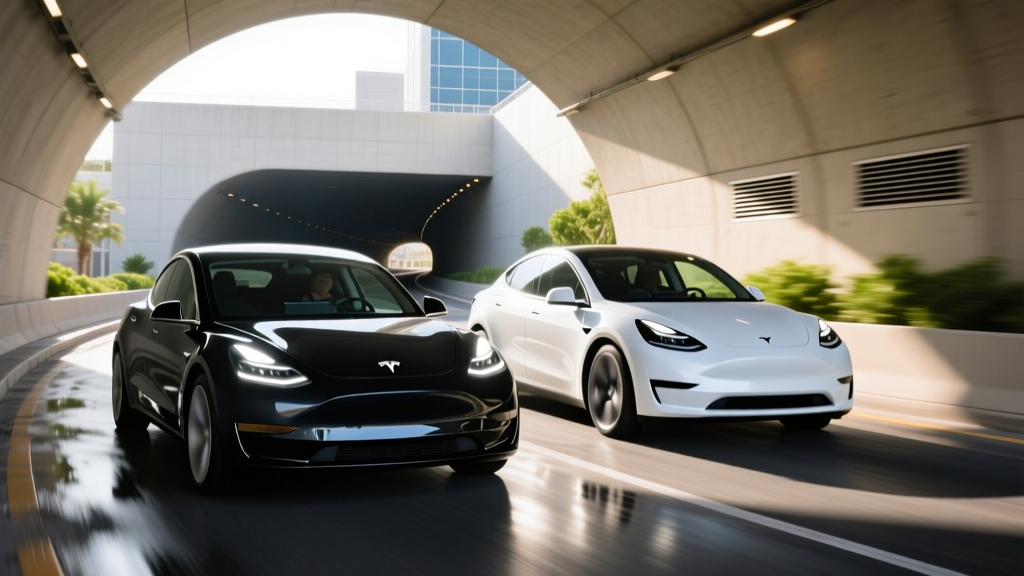
If you have searched for "vegas tunnel tesla" you have probably seen footage of Tesla Model 3 and Model Y SUVs ferrying convention-goers through narrow, neon-lit underground tunnels beneath the Las Vegas Convention Center. That system — officially called the LVCC Loop, built by The Boring Company — is the most visible example of Tesla vehicles operating in a semi-automated, high-throughput transit environment. But what are these cars actually like to ride in, and more importantly, what are they like to own in 2026?
This profile breaks down the two vehicles that power the Vegas tunnel experience — the 2026 Tesla Model 3 Long Range AWD and the 2026 Tesla Model Y Long Range AWD — with exact EPA range, charging speeds, battery chemistry, pricing, and federal tax credit eligibility. Whether you are planning a trip to CES or weighing a Tesla purchase for your own garage, here is the data you need.
What Is the Vegas Tunnel Tesla System (LVCC Loop)?
The LVCC Loop is a 1.7-mile (and expanding) network of tunnels beneath the Las Vegas Convention Center campus. Passengers hail a ride via an app or kiosk, step into a Tesla Model 3 or Model Y, and are driven through the tunnel to their destination station. As of 2026, the vehicles are still driven by human operators in this environment — the system is not a Level 4 autonomous robotaxi. The Boring Company has discussed future autonomous operation, but current rides rely on SAE Level 2 driver-assist features at most, with a professional driver behind the wheel.
For riders, the experience is essentially a premium rideshare through a dedicated right-of-way: climate-controlled, quick (end-to-end in roughly 2-3 minutes), and free during convention events. For EV buyers, the real question is whether the same Model 3 and Model Y make sense for your daily driving.
2026 Tesla Model 3 Long Range AWD: Full Spec Breakdown
The Model 3 remains Tesla's entry sedan and the vehicle most frequently spotted in the LVCC Loop fleet. The 2026 Long Range AWD variant is the volume seller for buyers who want maximum range without stepping up to the Performance trim.
| Specification | 2026 Model 3 Long Range AWD |
|---|---|
| EPA Range | 341 miles |
| Battery (usable) | ~75 kWh, NMC (nickel manganese cobalt) |
| Max DC Fast Charge | 250 kW peak (V3 Supercharger) |
| 10–80% DC Charge Time | ~27 minutes |
| Level 2 Home Charging | 11.5 kW / 48A (~44 mi/hr) |
| 0–60 mph | 4.2 seconds |
| Horsepower | ~346 hp (dual motor) |
| Drivetrain | Dual-motor AWD |
| Efficiency | 132 MPGe combined / 25 kWh/100 mi |
| Cargo Volume | 23 cu ft (trunk + frunk) |
| Rear Legroom | 35.2 inches |
| Battery Warranty | 8 years / 120,000 miles (70% retention) |
| Base MSRP | $47,740 (before destination) |
2026 Tesla Model Y Long Range AWD: The Tunnel Workhorse
The Model Y is the crossover sibling and the more common sight in Vegas tunnel fleets thanks to its easier ingress/egress and larger cargo area. Convention attendees with rolling equipment bags or groups of four appreciate the extra headroom.
| Specification | 2026 Model Y Long Range AWD |
|---|---|
| EPA Range | 320 miles |
| Battery (usable) | ~75 kWh, NMC |
| Max DC Fast Charge | 250 kW peak |
| 10–80% DC Charge Time | ~28 minutes |
| Level 2 Home Charging | 11.5 kW / 48A (~40 mi/hr) |
| 0–60 mph | 4.8 seconds |
| Horsepower | ~384 hp (dual motor) |
| Drivetrain | Dual-motor AWD |
| Efficiency | 122 MPGe combined / 27 kWh/100 mi |
| Cargo Volume | 76 cu ft (rear seats folded) + 4.1 cu ft frunk |
| Rear Legroom | 41.6 inches |
| Battery Warranty | 8 years / 120,000 miles (70% retention) |
| Base MSRP | $48,630 (before destination) |
Source: EPA Fuel Economy — Tesla Model Y
Charging Speed: What Tunnel Riders and Buyers Need to Know
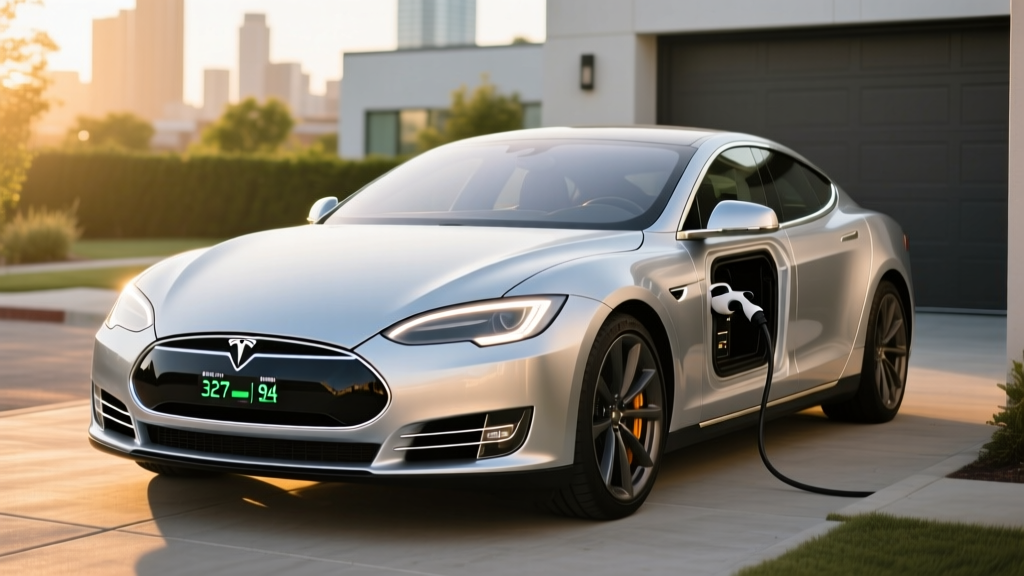
The LVCC Loop vehicles charge overnight at Tesla's on-site depot, so riders never see the charging process. For private owners, charging speed is the single most important ownership variable after range.
| Charging Level | Power (kW) | Miles Added per Hour | Typical Use Case |
|---|---|---|---|
| Level 1 (120V) | ~1.4 kW | 3–5 mi/hr | Emergency / trickle |
| Level 2 (240V, 48A) | 11.5 kW | 40–44 mi/hr | Home overnight (8–10 hrs for full) |
| DC Fast (V3 Supercharger) | 250 kW peak | ~200 mi in 15 min | Road trips (10–80% in ~27 min) |
Charging-curve reality: The 250 kW peak is only sustained from roughly 10–30% State of Charge. Above 50%, the rate tapers significantly — by 80% you are typically pulling 60–80 kW. This is why Tesla's navigation system preconditions the battery when you route to a Supercharger, warming it to accept peak rates upon arrival. Skipping preconditioning on a cold battery can add 10–15 minutes to your stop.
For home Level 2 installation, budget $500–$1,500 for the Tesla Wall Connector plus $800–$2,500 for electrician labor depending on your panel's proximity to the garage. A 200-amp panel is usually sufficient; older homes with 100-amp service may need a $2,000–$4,000 upgrade.
Pricing, Trims, and Federal Tax Credit Eligibility
Both the Model 3 and Model Y sit near the $48,000–$49,000 mark before options, which places them squarely in IRS §30D federal tax credit territory — but with important caveats.
| Trim | MSRP | Est. After §30D Credit | MSRP Cap Status |
|---|---|---|---|
| Model 3 Long Range AWD | $47,740 | ~$40,240* | Under $55,000 sedan cap ✓ |
| Model 3 Performance | $54,630 | ~$47,130* | Under $55,000 sedan cap ✓ |
| Model Y Long Range AWD | $48,630 | ~$41,130* | Under $80,000 SUV cap ✓ |
| Model Y Performance | $53,130 | ~$45,630* | Under $80,000 SUV cap ✓ |
*Estimated price assumes full $7,500 credit eligibility. Actual credit depends on battery-sourcing and critical-minerals requirements, which change annually. Verify on IRS.gov §30D.
- Income caps: Modified AGI must not exceed $150,000 (single), $225,000 (head of household), or $300,000 (joint).
- Battery sourcing: A percentage of critical minerals and battery components must be sourced from the US or FTA partners. These thresholds increase each year — check the DOE's qualifying vehicle list for the current month.
- Point-of-sale transfer: As of 2024+, you can transfer the credit to the dealer at purchase, reducing your out-of-pocket cost immediately rather than waiting for tax filing.
Tech, Driver Assists, and the Vegas Tunnel Experience
Riding in a Vegas tunnel Tesla is a glimpse at what Tesla's tech stack can do in a controlled environment — but it is not a demonstration of full autonomy.
Standard tech features on both models:
- 15.4-inch center touchscreen (Model 3) / 15.4-inch center + optional rear screen (Model Y)
- Tesla Autopilot (SAE Level 2): Traffic-Aware Cruise Control, Autosteer, Auto Lane Change
- FSD (Supervised) available as a $8,000 add-on or $99/month subscription — still requires full driver attention
- Over-the-air updates, Sentry Mode, Dog Mode, Tesla app remote climate
- HEPA air filtration (Model Y), premium audio with 14–17 speakers
Who Should Buy the Vegas Tunnel Tesla Models?
Choose Model 3 Long Range If:
- You prioritize maximum range (341 mi EPA) and efficiency (132 MPGe)
- You commute solo or with one passenger
- You want the lowest price of entry into Tesla's Long Range lineup
- Cargo needs are modest (23 cu ft)
Choose Model Y Long Range If:
- You need family-friendly cargo space (76 cu ft with seats folded)
- Easy ingress/egress matters (higher seating position)
- You regularly carry 3–5 passengers
- You value the extra 6.4 inches of rear legroom
Model 3 vs. Model Y: Side-by-Side Comparison
| Attribute | Model 3 LR AWD | Model Y LR AWD | Winner |
|---|---|---|---|
| EPA Range | 341 mi | 320 mi | Model 3 |
| Efficiency | 132 MPGe | 122 MPGe | Model 3 |
| 0–60 mph | 4.2 sec | 4.8 sec | Model 3 |
| Cargo Space | 23 cu ft | 76 cu ft | Model Y |
| Rear Legroom | 35.2 in | 41.6 in | Model Y |
| Base Price | $47,740 | $48,630 | Model 3 |
| Towing | Not rated | 3,500 lbs | Model Y |
Frequently Asked Questions
Is the Vegas tunnel Tesla self-driving?
No. The LVCC Loop Teslas are driven by human operators. Tesla's Autopilot and FSD (Supervised) are SAE Level 2 driver-assist systems that require constant driver engagement. The Boring Company has discussed future autonomous operation, but as of 2026, a professional driver is behind the wheel for every ride.
What is the real-world range of the Model 3 and Model Y?
The Model 3 Long Range AWD achieves an EPA-estimated 341 miles, but expect 280–305 miles at sustained highway speeds and 250–275 miles in cold weather. The Model Y Long Range AWD is EPA-rated at 320 miles, with real-world highway range of approximately 265–290 miles.
How fast do these Teslas charge at home and on the road?
At home on a Level 2 charger (11.5 kW), the Model 3 adds roughly 44 miles per hour and the Model Y adds about 40 miles per hour — enough for a full overnight charge. On a V3 Supercharger (250 kW peak), both vehicles charge from 10–80% in approximately 27–28 minutes, though the charge rate tapers significantly above 50% SoC.
Do the Model 3 and Model Y qualify for the $7,500 federal tax credit?
Both vehicles are under their respective MSRP caps ($55,000 for sedans, $80,000 for SUVs). However, eligibility depends on your income (under $150K single / $300K joint), the vehicle's battery-sourcing compliance for the current year, and point-of-sale transfer rules. Always verify on IRS.gov before purchasing.
Is the Model 3 or Model Y better for my needs?
Choose the Model 3 if range and efficiency are your top priorities and you do not need large cargo capacity. Choose the Model Y if you need family-friendly space, a higher seating position, towing capability (3,500 lbs), or regularly carry more than two passengers.
Can I ride the Vegas tunnel Tesla without attending a convention?
The LVCC Loop primarily serves convention attendees during events. The Boring Company has been expanding the Vegas loop system to connect additional venues, hotels, and the airport, which may broaden public access in the future. Check the Boring Company's Vegas Loop page for current availability.
Pros and Cons: Vegas Tunnel Tesla Models at a Glance
Pros
- Class-leading range and efficiency (Model 3: 341 mi EPA)
- 250 kW Supercharger network with reliable uptime
- OTA updates continuously improve the vehicle
- Strong §30D tax credit eligibility (MSRP under caps)
- 8-year / 120,000-mile battery warranty
- Minimal maintenance vs. ICE vehicles
Cons
- No physical buttons — all controls via touchscreen
- Rear visibility limited in Model 3 (no rear wiper on some trims)
- Insurance premiums 15–30% higher than ICE equivalents
- FSD (Supervised) is expensive ($8,000) and still Level 2
- NMC battery degrades faster than LFP if habitually charged to 100%
- Tesla service center wait times can be long in some markets
Sources: EPA Fuel Economy (fueleconomy.gov), Tesla.com specifications, IRS §30D Clean Vehicle Credits. Prices and credit eligibility reflect 2026 model year data and are subject to change.