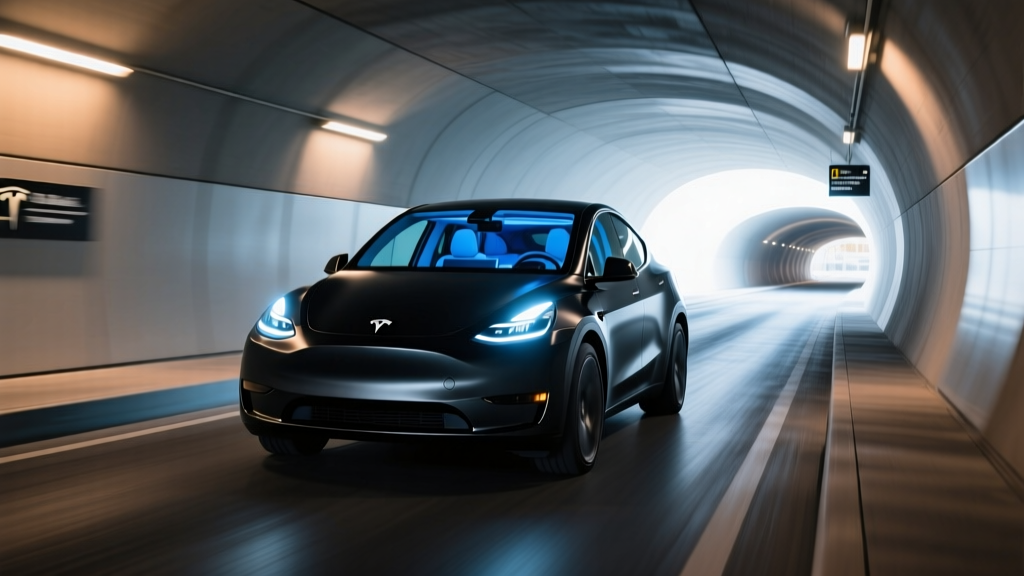
The Boring Company's expanding tunnel network beneath Las Vegas — colloquially known as the Vegas Tesla Loop — has become one of the most visible real-world showcases for Tesla's Model Y. But beyond the novelty of underground transit, the 2026 Tesla Model Y remains one of the best-selling electric vehicles in America for good reason. In this review, we break down the Model Y Long Range AWD with the exact numbers buyers need: EPA range versus real-world highway and cold-weather expectations, DC fast-charging curves, battery chemistry, tax credit eligibility under current IRS §30D rules, and whether it still outguns rivals like the Hyundai Ioniq 5 and Ford Mustang Mach-E.
2026 Tesla Model Y: Quick Verdict
The refreshed Model Y (internally dubbed "Juniper") carries over its core strengths — class-leading efficiency, access to the Supercharger network, and over-the-air updates — while addressing prior complaints about ride quality and cabin noise. For buyers eyeing the Vegas Tesla Loop as a daily commuting backdrop or simply wanting a versatile electric crossover, the Long Range AWD trim hits the sweet spot at 320 miles of EPA-rated range. The Performance trim sacrifices roughly 20 miles for sharper handling and a 3.5-second 0-60 time. Both trims qualify for the full $7,500 federal tax credit for eligible buyers, bringing effective pricing closer to $40,000.
Range, Battery, and Real-World Efficiency
| Spec | Long Range AWD | Performance AWD |
|---|---|---|
| EPA Range | 320 mi | 298 mi |
| Battery (usable) | ~78 kWh, NMC | ~78 kWh, NMC |
| Efficiency | 28 kWh/100 mi (120 MPGe) | 30 kWh/100 mi (112 MPGe) |
| Drivetrain | Dual-motor AWD | Dual-motor AWD |
| Horsepower | 384 hp | 456 hp |
| 0-60 mph | 4.8 sec | 3.5 sec |
| Base MSRP | $47,990 | $52,490 |
| Battery Warranty | 8 yr / 120,000 mi | 8 yr / 120,000 mi |
The Model Y uses a nickel-manganese-cobalt (NMC) lithium-ion pack. NMC offers higher energy density than LFP (lithium iron phosphate), which is why Tesla reserves LFP for the rear-wheel-drive Standard Range trims. The trade-off: NMC batteries degrade slightly faster if routinely charged to 100%, so Tesla recommends daily charging to 80–90% and saving full charges for road trips.
Per fueleconomy.gov, the Long Range AWD achieves 120 MPGe combined. That translates to roughly $0.04–$0.06 per mile when charging at home on a national-average electricity rate of $0.16/kWh — about one-third the per-mile fuel cost of a comparable gas crossover getting 25 MPG at $3.50/gallon.
Charging Speed: DC Fast, Level 2, and Level 1
| Level | Power | Speed | Notes |
|---|---|---|---|
| DC Fast Charge (peak) | 250 kW | 10–80% in ~22 min | Peak rate tapers above 50% SoC; precondition via nav |
| DC Fast (sustained avg) | ~140 kW | ~175 mi added in 22 min | Average over the 10–80% session |
| Level 2 (home, 48A) | 11.5 kW | ~37 mi/hr | Requires NEMA 14-50 or hardwired wall connector |
| Level 2 (home, 32A) | 7.7 kW | ~25 mi/hr | Common on 40A circuit; full overnight charge |
| Level 1 (120V outlet) | ~1.4 kW | ~4 mi/hr | Emergency/top-up only; 80+ hours for full charge |
Tesla's 250 kW peak DC fast-charge rate on V3 Superchargers is competitive but not class-leading — the Hyundai Ioniq 5 and Kia EV6 can peak at 350 kW on 800V architecture, delivering 10–80% in roughly 18 minutes. The Model Y's 400V architecture means it sustains peak rate for a shorter window. In practice, you'll see 250 kW only between roughly 10–30% state of charge; after 50%, the rate drops to ~100 kW, and above 80% it slows to under 50 kW. This is the charge-curve taper every EV owner should understand.
One significant advantage: Tesla's native NACS connector and access to the Supercharger network. As of 2026, Tesla has opened most Supercharger stalls to non-Tesla EVs via Magic Dock adapters, but Tesla owners still benefit from seamless plug-and-charge with no adapter needed. For Vegas Tesla Loop commuters or road-trippers along I-15, Supercharger density in the Southwest is among the best in the country.
For home charging, Tesla's Wall Connector ($475) on a 60A circuit delivers 48A/11.5 kW, adding roughly 37 miles of range per hour. A full charge from 10% takes about 8.5 hours — easily accomplished overnight. Installation cost for a dedicated 60A circuit typically runs $800–$2,000 depending on panel proximity and local permitting, according to Qmerit's national averages. If your electrical panel is at capacity, a panel upgrade can add $1,500–$3,000.
The Vegas Tesla Loop: Context for Buyers
The Vegas Tesla Loop — The Boring Company's network of tunnels beneath the Las Vegas Convention Center, the Strip, and eventually Harry Reid International Airport — uses Tesla Model Y vehicles to ferry passengers between stations at speeds up to 35 mph underground. While this is a ride-hail/transit system (not a personal-vehicle tunnel), it has boosted the Model Y's visibility and demonstrated the platform's durability under high-cycle, fleet-style usage.
For individual buyers, the Loop's relevance is twofold. First, it validates the Model Y's powertrain longevity — these fleet vehicles accumulate mileage rapidly, and Tesla's 8-year/120,000-mile battery warranty is designed to cover such use. Second, it reinforces Tesla's NACS charging ecosystem as the de facto standard in North America, a factor that benefits all Tesla owners through network reliability and expanding stall counts.
If you're considering a Model Y and live near or frequently visit Las Vegas, the Loop doesn't change the vehicle's specs — but it does signal Tesla's broader ambitions in autonomous transit, which could eventually enhance resale value for vehicles on the Tesla platform.
Interior, Cargo, and Technology
The Juniper-refreshed Model Y interior addresses the most common critiques of the pre-2025 model. New acoustic glass, revised suspension bushings, and a ventilated-seat option make the cabin noticeably quieter and more comfortable on long highway stretches.
Cargo space remains a strong point:
- Rear cargo (seats up): 30.2 cu ft
- Rear cargo (seats folded): 72.1 cu ft
- Front trunk (frunk): 4.1 cu ft
- Rear legroom: 41.6 inches
- Front legroom: 41.8 inches
The 15.4-inch center touchscreen runs Tesla's latest software, which in 2026 includes a redesigned navigation interface, improved voice commands, and expanded app support. Wireless phone charging, USB-C ports (65W front, 27W rear), and a panoramic glass roof are standard.
On the driver-assistance front, Tesla's Autopilot (SAE Level 2) is standard and includes adaptive cruise control and lane-centering. Full Self-Driving (Supervised), a $8,000 add-on or $99/month subscription, adds automated lane changes, traffic-light recognition, and city-street navigation. Per NHTSA guidelines, FSD remains a Level 2 system — the driver must remain fully engaged, with hands on the wheel and eyes on the road. It is not autonomous driving.
Pricing, Trims, and Federal Tax Credit Eligibility
| Trim | Base MSRP | Destination | As-Tested* | §30D Credit | Effective Price |
|---|---|---|---|---|---|
| Long Range AWD | $47,990 | $1,390 | $49,380 | $7,500 | ~$41,880 |
| Performance AWD | $52,490 | $1,390 | $56,880† | $7,500 | ~$49,380 |
| *As-tested includes common options. †Performance as-tested includes FSD subscription not applied to purchase price. | |||||
Under the current IRS §30D rules, the Model Y qualifies for the full $7,500 federal tax credit, which can be applied as a point-of-sale price reduction through a registered dealer. However, eligibility is not universal:
- MSRP cap: SUVs/crossovers must be under $80,000 — both Model Y trims clear this.
- Buyer income cap: Modified AGI must not exceed $150,000 (single), $225,000 (head of household), or $300,000 (joint).
- Battery sourcing: Critical minerals and battery components must meet phased-in domestic/free-trade-agreement thresholds — Tesla's North American supply chain currently satisfies these requirements for the Model Y.
- Point-of-sale transfer: Buyers can elect to transfer the credit to the dealer at purchase, reducing the out-of-pocket price immediately rather than waiting for a tax refund.
Consult a tax professional to confirm your personal eligibility — income limits, prior credit usage, and state-level incentives (which vary by jurisdiction) can all affect your final cost.
Ownership Costs and Warranty
Tesla's warranty coverage for the 2026 Model Y:
- Basic vehicle: 4 years / 50,000 miles
- Battery & drive unit: 8 years / 120,000 miles (Long Range & Performance)
- Capacity retention threshold: Tesla warrants the battery will retain at least 70% of original capacity during the warranty period
Based on 15,000 miles/year and national-average electricity costs, annual fueling runs roughly $720–$900 — compared to $2,100+ for a gas crossover at 25 MPG and $3.50/gallon. Insurance premiums for the Model Y tend to run 15–25% higher than comparable gas crossovers, according to industry averages, so factor that into your total cost of ownership.
Maintenance is minimal: no oil changes, no transmission fluid, and regenerative braking significantly extends pad life. Tesla recommends cabin-air-filter replacement every 2–3 years and brake-fluid checks every 2 years. Tire rotation every 6,250 miles remains important — EVs' instant torque accelerates tire wear, particularly on the driven axles.
Pros, Cons, and Who Should Buy
Pros
- Class-leading efficiency at 28 kWh/100 mi
- Supercharger network — best public-charging reliability in the US
- 320 mi EPA range covers most road trips with one stop
- $7,500 federal tax credit brings effective price near $42K
- Spacious cargo area (72 cu ft max) and generous rear legroom
- Continuous OTA software improvements
Cons
- DC fast-charge peak (250 kW) lags 800V rivals (350 kW)
- FSD ($8K add-on) remains Level 2 — not autonomous
- No physical buttons — all controls via touchscreen
- Insurance premiums higher than segment average
- NMC battery requires 80–90% daily charge limit for longevity
- Minimal dealer service network vs. legacy brands
Who Should Buy the Model Y?
Choose the Model Y Long Range AWD if: You want maximum range and efficiency for commuting and road trips, value Supercharger network access, and can charge at home. Ideal for tech-forward buyers who prioritize software and charging infrastructure over traditional luxury materials.
Choose the Model Y Performance if: You want sports-car acceleration (3.5-sec 0-60) in a practical crossover and don't mind sacrificing ~22 miles of range.
Look at the Hyundai Ioniq 5 or Kia EV6 if: You want faster 800V DC charging (10-80% in ~18 min), prefer physical climate controls, or want a more conventional service-dealer network.
Look at the Ford Mustang Mach-E if: You prefer a more traditional driving feel and Ford's BlueCruise hands-free highway driving (also Level 2).
Frequently Asked Questions
What is the real-world range of the 2026 Tesla Model Y?
The EPA rates the Long Range AWD at 320 miles. In real-world highway driving at 75 mph, expect 265–280 miles. In cold weather below freezing, plan for 240–270 miles. City driving with regenerative braking can yield up to 330 miles.
How fast does the Model Y charge at home and on the road?
On a V3 Supercharger, it peaks at 250 kW and charges 10–80% in about 22 minutes. At home on a 48A Level 2 Wall Connector (11.5 kW), it adds roughly 37 miles per hour, reaching a full charge overnight in ~8.5 hours from 10%.
How much does the Model Y cost after tax credits?
The Long Range AWD starts at $49,380 including destination. With the $7,500 federal §30D credit (if you meet income and sourcing requirements), the effective price drops to approximately $41,880.
Does the Model Y qualify for the $7,500 federal EV tax credit?
Yes, as of 2026, both the Long Range and Performance trims qualify for the full $7,500 credit under IRS §30D, subject to buyer income caps ($150K single / $300K joint), the $80K SUV MSRP cap, and battery-sourcing requirements that Tesla currently meets. The credit can be applied at point of sale.
Is the Model Y worth buying vs. the Ioniq 5 or Mach-E?
The Model Y wins on efficiency, range, and charging-network access. The Ioniq 5 wins on DC charge speed (800V architecture) and interior ergonomics. The Mach-E wins on driving dynamics and BlueCruise availability. Your choice depends on whether you prioritize road-trip charging convenience (Tesla), fastest fill-ups (Hyundai/Kia), or traditional dealer service (Ford).
What is the Vegas Tesla Loop and does it affect my purchase?
The Vegas Tesla Loop is The Boring Company's underground transit system in Las Vegas using Model Y vehicles. It doesn't change the consumer Model Y's specs, but it demonstrates the platform's fleet durability and reinforces Tesla's NACS charging ecosystem. For buyers, it's a brand-visibility factor rather than a purchasing consideration.
What battery chemistry does the Model Y use?
The Long Range and Performance trims use NMC (nickel-manganese-cobalt) chemistry, which offers higher energy density than LFP. Tesla recommends charging NMC batteries to 80–90% daily and reserving 100% charges for trips to maximize long-term battery health.