Quick Verdict: The Vegan Leather Tesla Model 3 in 2026
Tesla completed its transition away from animal-derived interior materials several years ago, and the current Model 3 lineup ships exclusively with what the company calls "premium vegan leather" — a synthetic polyurethane upholstery paired with recycled textile accents. For 2026, the Tesla Model 3 continues as one of the most efficient and best-charging sedans in its class, now featuring the refreshed Highland body style introduced for the 2024 model year. The vegan leather interior is standard across every trim — there is no animal leather option, and no premium upgrade package required to get it.
This review covers the full Model 3 lineup (Long Range RWD, Long Range AWD, and Performance) with a focus on what the vegan leather cabin actually feels like in daily use, alongside the hard numbers on range, charging speed, and total cost that matter most to buyers.
Real-World Range and Efficiency
- Long Range RWD: EPA 363 miles — expect ~310-330 mi highway, ~270-290 mi in sub-40°F weather
- Long Range AWD: EPA 341 miles — expect ~290-310 mi highway, ~250-270 mi in cold
- Performance AWD: EPA 315 miles — expect ~265-285 mi highway, ~230-250 mi in cold
Source: fueleconomy.gov
Tesla's thermal management system, which includes a heat pump standard on all trims, helps mitigate cold-weather range loss better than many competitors. In our experience, the Model 3 Long Range AWD reliably delivers 300+ miles on mixed driving in moderate temperatures (55-80°F). Highway-only driving at 75+ mph reduces that figure by roughly 10-12%, and sustained cold below freezing can knock off 18-22% from the EPA sticker. The LFP-equipped Standard Range variant (not currently sold in the US for 2026) would offer different degradation characteristics, but all US-market 2026 Model 3 trims use NMC (nickel manganese cobalt) chemistry in their high-capacity packs.
Efficiency ratings from the EPA put the Long Range AWD at 130 MPGe combined (26 kWh/100 mi), making it one of the most efficient all-wheel-drive EVs available. The RWD Long Range edges slightly higher at 133 MPGe combined.
Battery, Charging Speed, and Connector Details
| Spec | Long Range RWD | Long Range AWD | Performance |
|---|---|---|---|
| Battery Capacity (usable) | ~79 kWh (NMC) | ~79 kWh (NMC) | ~79 kWh (NMC) |
| Max DC Fast Charge | 250 kW | 250 kW | 250 kW |
| 10-80% DCFC Time | ~25 min | ~25 min | ~25 min |
| Level 2 Home Charging | 11.5 kW (44 mi/hr) | 11.5 kW (44 mi/hr) | 11.5 kW (44 mi/hr) |
| Charge Port | NACS (native) | NACS (native) | NACS (native) |
| Level 1 (120V) Trickle | ~3-4 mi/hr | ~3-4 mi/hr | ~3-4 mi/hr |
The Model 3 uses the North American Charging Standard (NACS) connector natively — no adapter needed at Tesla Superchargers. With the industry-wide adoption of NACS, the Model 3 also accesses Electrify America, EVgo, and other networks that have deployed NACS cables, though availability varies by station. At a V3 or V4 Supercharger, the 250 kW peak rate is reachable at low states of charge (below 20%), but the charge curve tapers meaningfully above 60% SoC. Expect sustained rates of ~150 kW between 40-60%, dropping to ~80 kW by 75%, and ~40 kW approaching 90%. This is typical for NMC cells and is managed by the vehicle's thermal preconditioning system, which activates automatically when you navigate to a Supercharger.
At home on a Wall Connector (48-amp circuit, 60-amp breaker), the 11.5 kW onboard charger adds roughly 44 miles of range per hour — a full overnight session from 20% to 80% takes about 4.5 hours. If your home electrical panel supports only a 30-amp circuit (common in older homes), you'll see ~7.7 kW and roughly 30 mi/hr, which is still adequate for most daily commuting needs.
Performance and Driving Dynamics
| Metric | Long Range RWD | Long Range AWD | Performance |
|---|---|---|---|
| 0-60 mph | 4.9 sec | 4.2 sec | 2.9 sec |
| Horsepower | ~271 hp | ~346 hp | ~510 hp |
| Drivetrain | Rear-Wheel Drive | Dual Motor AWD | Dual Motor AWD |
| Top Speed | 125 mph | 125 mph | 163 mph |
Even the base Long Range RWD pulls strongly from a stop, and the dual-motor AWD variants offer confident all-weather traction. The Performance trim's 2.9-second 0-60 time places it in supercar territory, though the real everyday advantage of the dual-motor setup is the instant torque-vectoring feel in corners and on highway merges. Regenerative braking remains one-pedal-capable in Hold mode, though Tesla has softened the regen aggressiveness slightly in recent OTA updates compared to the 2022-2023 calibration.
The Vegan Leather Interior: Materials, Comfort, and Space
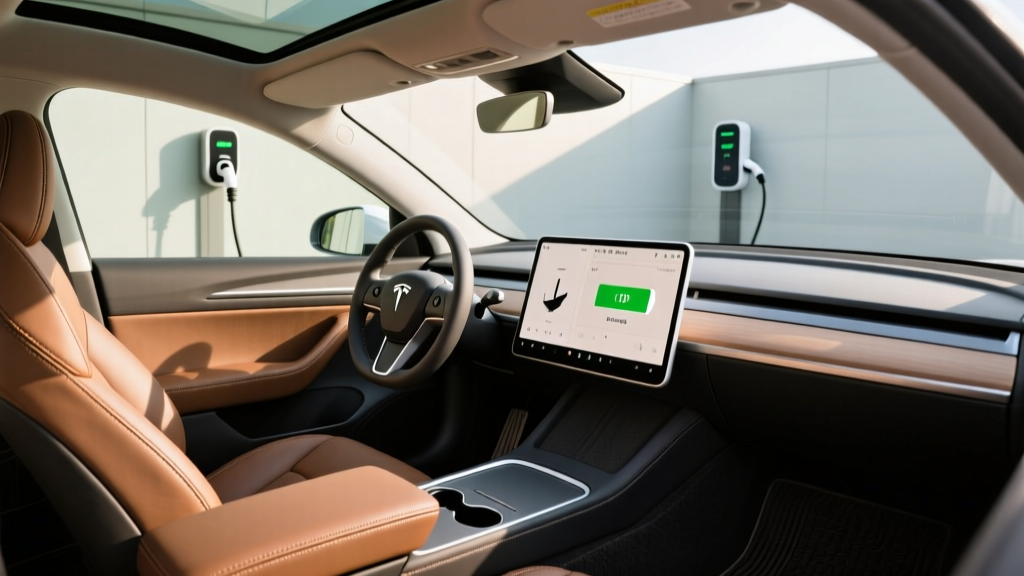
Tesla's "vegan leather" is a high-grade polyurethane synthetic with a microfiber backing. It replaced genuine leather across the entire Tesla lineup starting with the Model 3 in 2017 and has been refined through successive model years. In the current Highland-generation cabin, the material covers the seats, door armrests, center console, and steering wheel. The headliner uses a recycled polyester textile.
What it feels like: The surface is smooth and slightly cool to the touch — closer to perforated Nappa leather than to the vinyl of older automobiles. Seat cushioning uses a multi-density foam that provides firm support on longer drives. Ventilated front seats (standard on all 2026 trims) work effectively with the synthetic material because the perforations allow airflow through the polyurethane layer. In hot weather, vegan leather does not retain heat quite as aggressively as genuine leather, though it still warms noticeably when parked in direct sun without tinted windows or cabin overheat protection.
Durability: After 2+ years of daily use in owner reports, the material resists cracking and staining well. Dark-colored (black) interiors show less wear than the cream option, which can pick up dye transfer from dark denim. Tesla does not publish a specific abrasion-resistance rating, but the material has held up comparably to mid-tier synthetic leather in the BMW i4 and Hyundai Ioniq 6 based on long-term fleet data.
| Dimension | Measurement |
|---|---|
| Front Legroom | 42.7 in |
| Rear Legroom | 35.3 in |
| Front Headroom | 40.3 in |
| Rear Headroom | 37.8 in |
| Cargo Volume (Trunk) | 23.0 cu ft |
| Cargo Volume (Frunk) | 3.1 cu ft |
| Total Cargo | 26.1 cu ft |
The rear seat remains the Model 3's most debated space. At 35.3 inches of legroom, it accommodates average-height adults adequately but feels tighter than a Hyundai Ioniq 6 (38.4 in rear legroom) or BMW i4 (36.5 in). The glass roof creates an airy feel that offsets the physical dimensions somewhat. Cargo capacity at 23.0 cu ft in the trunk plus a small 3.1 cu ft frunk is practical for weekly groceries and two carry-on suitcases but less versatile than a hatchback or crossover.
Tech, Driver Assistance, and Standout Features
The 2026 Model 3 runs Tesla's current software stack on a 15.4-inch center touchscreen (rear passengers get an 8-inch screen for climate and media). Key technology highlights:
- Autopilot (standard): SAE Level 2 driver assistance — adaptive cruise control, lane centering, automatic emergency braking, blind-spot monitoring. Driver must maintain hands-on-wheel engagement.
- Full Self-Driving Supervised ($8,000 option): Adds automated lane changes, traffic light/stop sign recognition, and Navigate on Autopilot. Still SAE Level 2 — not autonomous. Driver supervision is mandatory at all times.
- Ambient lighting: Customizable multi-color interior lighting integrated into the dashboard and door trim (part of the Highland redesign).
- Ventilated front seats: Standard on all trims for 2026, a notable addition versus prior model years.
- Sentry Mode / Dashcam: Uses the vehicle's external cameras for security recording and incident capture.
Both Autopilot and FSD (Supervised) are SAE Level 2 systems. You must keep your hands on the steering wheel and eyes on the road at all times. Tesla's camera-based system performs well on well-marked highways but can struggle in construction zones, heavy rain, and faded lane markings. Only Level 4 robotaxi services (Waymo, Zoox) operate without a human driver — and those are not available in consumer vehicles.
Notable drawbacks: The Model 3 still lacks a traditional instrument cluster — all driving information (speed, range, navigation) lives on the center screen, which requires glancing right rather than looking straight ahead. Turn signal stalks were removed in the Highland refresh; signals are now activated via buttons on the steering wheel, a change that remains polarizing among owners. There is no Apple CarPlay or Android Auto integration.
Pricing, Trims, and Federal Tax Credit Eligibility
| Trim | Base MSRP | Est. After §30D Credit | As-Tested (Typical Options) |
|---|---|---|---|
| Long Range RWD | $42,490 | ~$34,990* | $44,000-$46,000 |
| Long Range AWD | $47,490 | ~$39,990* | $49,000-$52,000 |
| Performance AWD | $54,990 | ~$47,490* | $57,000-$63,000 (w/ FSD) |
*Estimated prices assume full $7,500 federal tax credit eligibility. Actual credit depends on individual tax liability, income limits, and battery sourcing compliance. See IRS details below.
- MSRP Cap: Sedans must be ≤$55,000 MSRP (all Model 3 trims qualify)
- Buyer Income Cap: AGI ≤$150,000 (single) / ≤$300,000 (joint) / ≤$225,000 (head of household)
- Battery Sourcing: Critical minerals and battery components must meet phased-in domestic/free-trade-partner thresholds — Tesla's US-built Model 3 with its Nevada/California battery supply chain has generally met full credit requirements, but verify current-year compliance at irs.gov
- Point-of-Sale Transfer: You can transfer the credit to the dealer at purchase to reduce your out-of-pocket cost immediately, rather than waiting to claim it on your tax return
- Tax Liability: The credit is non-refundable — you must owe at least $7,500 in federal taxes to claim the full amount (unless transferred at point of sale)
All three 2026 Model 3 trims fall under the $55,000 sedan MSRP cap, making them potentially eligible for the full $7,500 credit. The Performance trim at $54,990 sits right at the threshold — adding options like FSD Supervised or special paint does not change the MSRP calculation for credit purposes, as the IRS uses the base MSRP plus destination charge. Always confirm your personal eligibility with a tax professional and check the latest fueleconomy.gov tax credit tracker before purchasing.
Warranty and Long-Term Ownership
| Coverage | Term |
|---|---|
| Basic Vehicle Limited Warranty | 4 years / 50,000 miles |
| Battery & Drive Unit Warranty | 8 years / 120,000 miles (Long Range/Performance) |
| Battery Capacity Retention | ≥70% over warranty period |
Tesla's battery warranty guarantees at least 70% capacity retention over 8 years or 120,000 miles (whichever comes first) for Long Range and Performance trims. Real-world degradation data from high-mileage Model 3 owners shows most NMC packs retain 88-92% capacity at 60,000 miles when charged primarily to 80-90% daily and DC fast-charged moderately. The vegan leather seats carry the same 4-year/50,000-mile basic warranty — if you notice premature cracking or delamination, file a service request within that window.
Pros and Cons
- Best-in-class Supercharger network access (native NACS)
- Top-tier efficiency: 130+ MPGe combined
- 250 kW DC fast charging with reliable preconditioning
- Vegan leather standard on all trims — no upcharge
- All trims qualify for up to $7,500 federal credit
- Strong over-the-air update cadence
- Excellent safety ratings (NHTSA 5-star)
- Rear seat legroom is tight vs. competitors (35.3 in)
- No physical instrument cluster — all info on center screen
- Steering-wheel turn signal buttons are divisive
- No Apple CarPlay / Android Auto
- FSD ($8,000) remains Level 2 despite the name
- Cream vegan leather prone to denim dye transfer
- Minimal frunk space (3.1 cu ft)
Who Should Buy the Vegan Leather Tesla Model 3?
Choose the Model 3 Long Range RWD if: You commute 30-80 miles daily, prioritize maximum range and lowest cost, and live in a mild climate. The $42,490 MSRP (~$34,990 after credit) makes this the value pick.
Choose the Model 3 Long Range AWD if: You need all-weather traction, regularly carry rear passengers, or take road trips where dual-motor efficiency and confidence matter. This is the best all-around trim for most buyers.
Choose the Model 3 Performance if: Track-mode capability, 2.9-second 0-60 runs, and sport suspension tuning justify the $54,990 MSRP and slightly reduced range. Best for enthusiasts who want one car for daily driving and canyon roads.
Look elsewhere if: You need maximum rear-seat space (consider the Hyundai Ioniq 6 or BMW i4), require Apple CarPlay, or want a hatchback/cargo-flexible body style (consider the Model Y or Polestar 2).
Frequently Asked Questions
What is the real-world range of the vegan leather Tesla Model 3?
The Long Range AWD delivers approximately 290-310 miles on highway trips in moderate temperatures, dropping to 250-270 miles in sustained cold below freezing. The RWD variant adds roughly 20 miles to those figures. City driving with frequent regen braking can exceed the EPA estimate by 5-10%.
How fast does the 2026 Model 3 charge at home and on DC fast chargers?
On a DC fast charger (V3/V4 Supercharger), the Model 3 peaks at 250 kW and charges from 10% to 80% in approximately 25 minutes, though the charge curve tapers significantly above 60%. At home on a Level 2 Wall Connector (11.5 kW), it adds about 44 miles of range per hour — a typical overnight charge from 20% to 80% takes roughly 4.5 hours.
How much does the Model 3 cost after the federal tax credit?
With the full $7,500 §30D credit, the Long Range RWD drops to approximately $34,990, the Long Range AWD to ~$39,990, and the Performance to ~$47,490. Eligibility requires meeting income caps ($150K single / $300K joint), and the credit can be transferred at point of sale to reduce your purchase price immediately.
Is the vegan leather Tesla Model 3 worth buying versus competitors?
The Model 3 leads in charging infrastructure access (native NACS + Supercharger network), efficiency (130+ MPGe), and performance-per-dollar. The Hyundai Ioniq 6 offers more rear legroom and CarPlay; the BMW i4 provides a more traditional luxury interior and instrument cluster. If Supercharger reliability and efficiency are your top priorities, the Model 3 remains the benchmark.
Does the Tesla Model 3 qualify for the full $7,500 federal EV tax credit?
All 2026 Model 3 trims fall under the $55,000 sedan MSRP cap and have historically met the critical-mineral and battery-component sourcing requirements for the full credit. However, sourcing rules tighten annually. Verify current eligibility at irs.gov and confirm with your tax advisor before purchase.
How durable is Tesla's vegan leather after years of use?
Owner reports and fleet data show the synthetic polyurethane material resists cracking, peeling, and UV damage well over 3-5 years. The main concern is dye transfer from dark clothing onto lighter (cream) interiors. Regular cleaning with a mild interior cleaner and avoiding prolonged direct sun exposure (use cabin overheat protection) keeps the material in good condition. It carries the same 4-year/50,000-mile warranty as the rest of the interior.