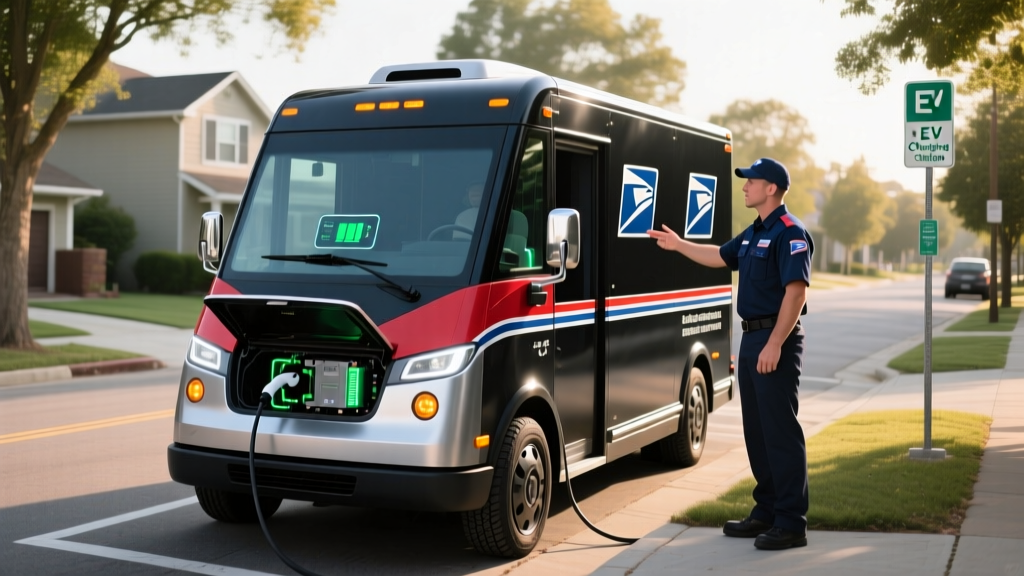
Quick Answer: The United States Postal Service is replacing its aging Grumman LLV fleet with up to 60,000 electric Next Generation Delivery Vehicles (NGDVs) built by Oshkosh Defense, part of a broader 106,000-vehicle procurement. The USPS EV transition began with pilot deployments in 2024 and scales through 2028. Each electric NGDV carries an estimated 70-mile real-world range on a 120 kWh battery pack, designed specifically for stop-and-go mail routes averaging 15-25 miles per day. This is a purpose-built commercial fleet vehicle — not available for consumer purchase — but its scale is reshaping the commercial EV charging and battery supply chain.
Why the USPS Is Going Electric
The Postal Service operates one of the largest civilian vehicle fleets on Earth: roughly 230,000 vehicles, of which approximately 190,000 are the iconic Grumman Long Life Vehicles (LLVs) built between 1987 and 1994. Those LLVs average 8.2 miles per gallon, lack modern safety features (no airbags, no ABS, no backup cameras), and cost an estimated $5,300 annually per vehicle in maintenance. The USPS Office of Inspector General has repeatedly flagged the fleet as a safety and financial liability.
Under Postmaster General Louis DeJoy's Delivering for America plan and with $3 billion in funding from the Inflation Reduction Act, the USPS committed to acquiring at least 60,000 electric NGDVs out of a total order of up to 106,000 vehicles. The contract, awarded to Oshkosh Defense (now operating the program through its subsidiary Oshkosh Defense), includes both battery-electric and low-emission internal combustion variants, though the EV ratio has steadily increased under political and environmental pressure.
USPS EV Specs: The Oshkosh NGDV Electric
The electric NGDV is a right-hand-drive, purpose-built delivery van — not a rebadged consumer vehicle. Here are the key specifications based on Oshkosh's published data and USPS environmental impact filings:
| Specification | NGDV Electric |
|---|---|
| Battery Capacity | ~120 kWh (usable), LFP chemistry |
| EPA-Estimated Range | ~70 miles (route-dependent) |
| Real-World Route Range | 55-70 miles (stop-and-go, HVAC load, climate) |
| Motor Output | ~200 kW (268 hp) single electric motor |
| Top Speed | 75 mph (electronically governed) |
| DC Fast Charge (Peak) | ~50 kW CCS1 |
| Level 2 Charge Rate | ~19.2 kW (overnight depot charging) |
| Cargo Volume | ~120 cu ft (right-hand-drive optimized) |
| Payload Capacity | ~2,000 lbs |
| GVWR | ~10,000 lbs (Class 2b/3) |
| Estimated Unit Cost | ~$60,000-$70,000 per vehicle |
Key context on range: The 70-mile figure sounds modest compared to consumer EVs posting 300+ EPA miles. But USPS routes average 15-25 miles per day, with carriers returning to the depot nightly. The NGDV doesn't need 300 miles — it needs enough range to handle a full shift in extreme heat (110°F in Phoenix) or cold (-20°F in Minneapolis) with HVAC running constantly and hundreds of stops requiring door-open cycles. The LFP battery chemistry is a deliberate choice: lower energy density than NMC, but superior cycle life (3,000+ full cycles), better thermal stability, and lower cost per kWh — ideal for a fleet vehicle charged daily for 15-20 years.
Real-World Range Reality: The 70-mile figure assumes moderate conditions. In cold-weather testing and hot-climate summer routes with full HVAC, expect 55-60 effective miles. For most USPS routes, this is still a 2x+ buffer over daily mileage needs. The risk isn't range — it's whether depot charging infrastructure can keep up with fleet-scale demand.
Charging Infrastructure: The Hidden Challenge
The USPS EV transition isn't really about the vehicles — it's about the charging. The Postal Service operates roughly 18,000 delivery units (post offices and processing facilities that dispatch carriers). Electrifying even a fraction of these requires massive electrical infrastructure upgrades:
| Charging Level | Power (kW) | Time to Full Charge (120 kWh) | USPS Use Case |
|---|---|---|---|
| Level 2 (Depot Overnight) | 19.2 kW | ~6-7 hours | Primary: vehicles return by 5 PM, depart by 7 AM |
| DC Fast Charge | 50 kW CCS1 | ~2.5 hours (0-100%) | Supplemental: mid-day top-ups for extended routes |
| Level 1 (120V) | 1.4 kW | ~86 hours | Not practical for fleet operations |
The overnight Level 2 depot charging model is the backbone of the USPS EV strategy. Vehicles return in the late afternoon, plug in, and are fully charged by morning. At 19.2 kW per vehicle, a depot with 50 NGDVs needs nearly 1 MW of continuous electrical capacity — equivalent to powering roughly 500 homes simultaneously. Many rural and older urban post offices lack the transformer capacity, panel infrastructure, or utility feed to support this without significant upgrades.
The USPS has allocated a substantial portion of its IRA funding toward charging infrastructure, partnering with utilities and the General Services Administration on site assessments. Industry estimates suggest $15,000-$40,000 per charging stall for commercial Level 2 installations (including trenching, conduit, panels, and permits), with total depot electrification costs running $500,000 to $2 million+ per facility depending on scale and existing electrical service.
USPS EV vs. Gas LLV: Cost and Emissions Comparison
The economic case for the USPS EV fleet hinges on total cost of ownership over a 15-20 year vehicle life. Here's how the electric NGDV stacks up against the legacy Grumman LLV on key metrics:
| Metric | Electric NGDV | Grumman LLV (Gas) |
|---|---|---|
| Fuel/Energy Cost per Mile | ~$0.10-$0.14 (at $0.12/kWh avg) | ~$0.38-$0.45 (at $3.50/gal, 8.2 MPG) |
| Annual Fuel/Energy (20 mi/day, 300 days) | ~$600-$840 | ~$2,280-$2,700 |
| Annual Maintenance | ~$1,500-$2,000 (est.) | ~$5,300 (USPS OIG data) |
| CO2 Emissions (Tailpipe) | 0 g/mile | ~1,085 g/mile |
| Vehicle Acquisition Cost | ~$60,000-$70,000 | ~$35,000-$45,000 (ICE NGDV variant) |
| Expected Service Life | 15-20 years | 15-20 years (many LLVs exceeded 30) |
The per-mile energy savings are stark: roughly $0.28-$0.31 per mile less than the gas LLV. Over a 6,000-mile annual route and 20 years of service, that's $33,600-$37,200 in fuel savings per vehicle. Combined with $66,000+ in maintenance savings (based on OIG figures), the total operational savings per vehicle can reach $100,000+ over its lifetime — well exceeding the ~$25,000 acquisition cost premium over the ICE variant.
The EPA reports that medium-duty vehicles are among the fastest-growing sources of transportation emissions. Electrifying 60,000 USPS delivery vehicles eliminates an estimated 1.2 million metric tons of CO2 annually once fully deployed.
Common Misconceptions About the USPS EV Fleet
| Myth | Fact |
|---|---|
| "The NGDV only goes 70 miles — that's not enough." | Average USPS routes are 15-25 miles/day. The 70-mile range provides a 2.8x-4.7x buffer, sufficient even for extreme weather days with HVAC load. |
| "They should have bought Rivian/Amazon vans instead." | The USPS held a full competitive procurement. Oshkosh won on price, service network, and fleet manufacturing scale. The Rivian EDV is built for Amazon's specific logistics model, not curb-line mail delivery with right-hand drive. |
| "Electric mail trucks can't handle rural routes." | The USPS ordered both BEV and ICE NGDV variants specifically to match vehicle to route. Long rural routes (80+ miles) will receive ICE or future extended-range variants; urban/suburban routes get BEVs. |
| "The batteries won't last in extreme cold." | LFP chemistry handles thermal stress well, and the NGDV includes active thermal management. Range drops 20-30% in sub-zero temps — still sufficient for most routes. Depot pre-conditioning while plugged in further mitigates cold loss. |
| "This is a political project, not practical." | The USPS Inspector General, multiple GAO reports, and internal fleet data have documented the LLV's unsustainable maintenance costs and safety failures for over a decade. Fleet replacement was inevitable; the EV share reflects IRA funding availability and lifecycle cost analysis. |
What This Means for Consumer EV Buyers
You can't buy a USPS NGDV — it's a government fleet vehicle with right-hand drive and no consumer variant planned. But the USPS EV program has significant ripple effects on the consumer EV market:
Charging infrastructure buildout: USPS depot electrification is driving utility upgrades and commercial charging installations in communities across the country. Many of these substations and feeder lines will increase local grid capacity, indirectly benefiting residential EV charging in the same service territories.
LFP battery supply chain: The NGDV's 120 kWh LFP packs represent massive demand for lithium iron phosphate cells. This helps drive down LFP cell costs, which are already appearing in consumer vehicles like the Tesla Model 3 Standard Range and Ford Mustang Mach-E Select. More LFP production means more affordable consumer EV options.
Fleet electrification precedent: When the nation's largest civilian fleet commits to 60,000 EVs, it normalizes electric delivery vehicles for UPS, FedEx, Amazon, and municipal fleets. This creates a secondary used-EV market down the line and drives commercial charging network expansion that consumer EV owners can access.
Right-hand-drive engineering: Oshkosh's NGDV platform could theoretically spawn commercial or specialty variants. While no consumer version is announced, the engineering investment in a purpose-built electric delivery chassis may influence future commercial van designs from other manufacturers.
Decision Framework: Fleet Managers and Commercial EV Buyers
While the NGDV itself isn't available to the public, the USPS's evaluation framework applies to any fleet considering electrification:
Choose battery-electric fleet vehicles if:
- Daily routes are under 80 miles with predictable return-to-depot patterns
- Depot has or can accommodate Level 2 charging infrastructure (19.2 kW per vehicle)
- Vehicles operate in urban/suburban areas with stop-and-go driving (maximizes regenerative braking efficiency)
- Total cost of ownership horizon is 10+ years (to recoup higher acquisition cost through fuel/maintenance savings)
- IRA or state fleet electrification incentives are available to offset upfront premium
Stick with ICE or hybrid fleet vehicles if:
- Routes regularly exceed 100+ miles with no mid-day charging opportunity
- Depot electrical service cannot be upgraded within budget (utility interconnection costs exceeding $500K+)
- Vehicles operate in extreme cold climates (-30°F+) with routes near the range ceiling
- Vehicle replacement cycle is under 5 years (insufficient time to recoup EV premium)
The Road Ahead: USPS EV Timeline
The USPS EV rollout is proceeding in phases:
- 2024-2025: Initial production and pilot deployments at select delivery units; charging infrastructure site assessments and utility coordination
- 2025-2026: Scaling production at Oshkosh's Spartanburg, SC facility; first major wave of depot electrification at high-volume urban facilities
- 2026-2028: Full-rate production targeting 10,000-15,000 NGDVs annually; majority of the 60,000 BEV target delivered
- 2028-2032: Continued procurement toward 106,000 total vehicles; LLV retirement accelerates as NGDVs reach operational scale
The program faces ongoing scrutiny from Congress, the USPS Board of Governors, and environmental groups regarding the BEV-to-ICE ratio, charging infrastructure readiness, and lifecycle emissions accounting. The Delivering for America plan commits to periodic reviews and adjustments based on operational data from early deployments.
FAQ: USPS Electric Vehicles
Can I buy a USPS NGDV electric delivery vehicle?
No. The NGDV is a purpose-built government fleet vehicle manufactured under a federal procurement contract. It features right-hand drive, specialized mail tray systems, and security features specific to postal operations. There is no consumer or commercial variant available, and Oshkosh has not announced plans for a civilian version.
How many electric vehicles is the USPS buying?
The USPS has committed to at least 60,000 battery-electric NGDVs out of a total procurement of up to 106,000 vehicles. The remaining vehicles will be low-emission internal combustion engine variants for routes where electrification isn't yet practical. This ratio may shift as charging infrastructure expands and battery technology improves.
What is the range of the USPS electric mail truck?
The electric NGDV has an estimated 70-mile range under moderate conditions from its ~120 kWh LFP battery pack. In extreme heat or cold with full HVAC operation, expect 55-60 effective miles. Since average USPS routes are 15-25 miles per day, this provides a substantial operational buffer.
Who builds the USPS electric delivery vehicle?
Oshkosh Defense, a subsidiary of Oshkosh Corporation, won the USPS Next Generation Delivery Vehicle contract in 2021. Production takes place at a dedicated facility in Spartanburg, South Carolina. Oshkosh is a major defense and specialty vehicle manufacturer, not a traditional automaker.
How much does the USPS EV program cost taxpayers?
The total NGDV program (vehicles + infrastructure) is estimated at $11-$12 billion over its lifecycle, with $3 billion funded through the Inflation Reduction Act. The remaining funding comes from USPS operating revenue and the Postal Service Fund. Per-vehicle acquisition costs are approximately $60,000-$70,000 for the BEV variant versus $35,000-$45,000 for the ICE variant, though lifecycle operational savings are projected to offset the premium.
Will USPS EVs charge on public networks like Electrify America or Tesla Superchargers?
Not as a primary strategy. USPS NGDVs are designed for overnight depot charging on dedicated Level 2 infrastructure at postal facilities. Public DC fast charging is a contingency option but not part of normal operations. The vehicles use CCS1 connectors for DC charging compatibility with most public networks if needed.