Quick Answer: USPS Electric Vehicle Rollout
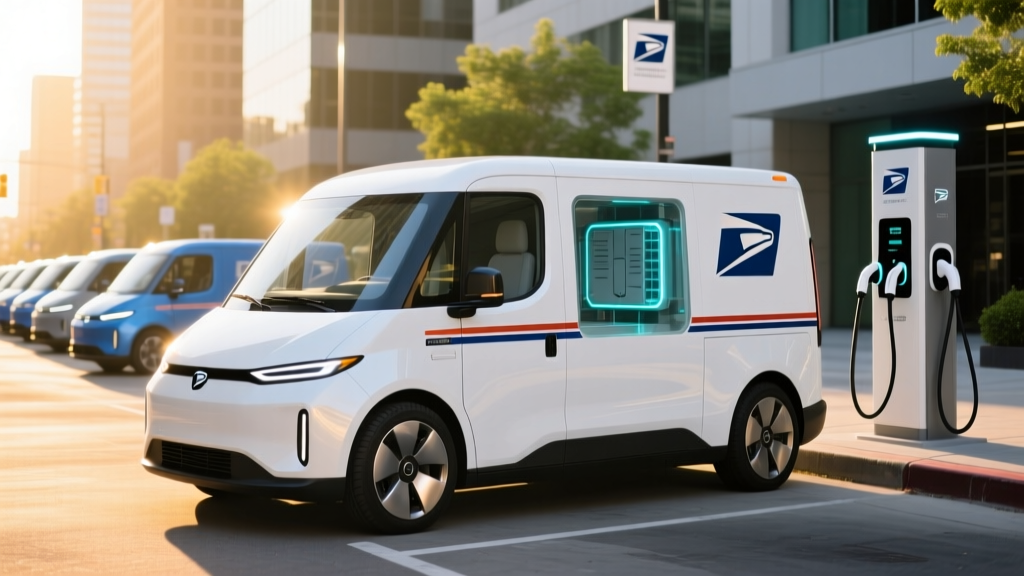
The USPS electric vehicle in question is the Oshkosh NGDV (Next Generation Delivery Vehicle), a purpose-built electric mail truck entering service across U.S. postal routes starting in 2024 with deliveries ramping through 2026 and beyond. The electric NGDV carries a 140 kWh LFP battery, an EPA-estimated 70-mile range under typical stop-and-go delivery conditions, and a Level 2 AC charging capability designed for overnight depot charging. The USPS committed to purchasing at least 66,000 battery-electric NGDVs out of a total 106,000-vehicle order through 2028, funded partly by the Inflation Reduction Act. If you're an EV shopper wondering how the USPS electric vehicle program affects you directly: it doesn't change consumer vehicle availability, but it signals massive federal fleet electrification momentum and validates LFP battery technology for commercial duty cycles.
Why the USPS Electric Vehicle Program Matters in 2026
The United States Postal Service operates one of the largest civilian vehicle fleets on Earth — roughly 230,000 vehicles, most of them the aging Grumman LLV (Long Life Vehicle) that has been delivering mail since 1987. Those LLVs average about 8 miles per gallon, cost an estimated $5,000+ per year per vehicle in maintenance, and have no airbags or modern safety features. Replacing them with the Oshkosh NGDV — available in both battery-electric and low-emission gas variants — is the single largest federal fleet electrification project ever undertaken.
The USPS initially planned to buy mostly gas-powered NGDVs. After scrutiny from the EPA, environmental groups, and Congress, Postmaster General Louis DeJoy revised the plan in late 2022 to commit to at least 66,000 battery-electric vehicles (BEVs) out of 106,000 total NGDV orders through 2028. Funding came from the Inflation Reduction Act and other appropriations, totaling roughly $3.4 billion earmarked for USPS fleet modernization.
For consumer EV buyers, the relevance is indirect but real: massive government fleet orders accelerate charging infrastructure build-out, drive down LFP battery costs through volume manufacturing, and normalize electric trucks in everyday American life. When your mail carrier drives an EV every day, range anxiety looks a little less rational.
USPS NGDV Electric Specs: Battery, Range, and Charging
The electric NGDV is not a consumer vehicle — you cannot buy one — but its specifications reveal what's possible with modern LFP (lithium iron phosphate) technology in a commercial duty cycle. Here's what we know from Oshkosh Defense and USPS disclosures:
| Specification | USPS Electric NGDV |
|---|---|
| Battery Chemistry | LFP (Lithium Iron Phosphate) |
| Battery Capacity | ~140 kWh (usable) |
| EPA-Estimated Range | ~70 miles (delivery route cycle) |
| Real-World Range Expectation | 55–70 mi depending on climate, load, HVAC use |
| Charging Method | Level 2 AC (depot overnight charging) |
| Charge Time (0–100%, L2) | ~10–14 hours at ~11–14 kW |
| DC Fast Charging | Not equipped (not needed for route duty) |
| Powertrain | Single electric motor, rear-wheel drive |
| Cargo Volume | ~120 cu ft |
| Top Speed | ~70 mph (governed) |
| Manufacturer | Oshkosh Defense |
| Contract Value | $6.2 billion (106,000 vehicles, mixed BEV/ICE) |
Why 70 Miles Is Enough
A 70-mile range sounds modest next to a Tesla Model 3 Long Range's 341 EPA miles. But USPS delivery routes are highly predictable: the average urban/suburban route covers 15 to 30 miles per day, with rural routes occasionally stretching to 50–60 miles. The NGDV returns to the same depot every night, plugs into a Level 2 charger, and is fully replenished by morning. There is no range anxiety when your daily drive uses less than half the battery.
This duty cycle — short, fixed routes with guaranteed overnight charging — is the ideal EV use case. It's why school buses, garbage trucks, and Amazon delivery vans are also going electric first.
LFP Chemistry: The Right Call for Fleet Duty
Oshkosh chose LFP batteries for the NGDV, and for good reason. Compared to NMC (nickel manganese cobalt) chemistry used in many consumer EVs, LFP offers:
- Longer cycle life: 3,000–5,000+ full charge cycles before significant degradation, versus ~1,000–2,000 for NMC
- Thermal stability: LFP is far less prone to thermal runaway — critical for fleet safety
- No cobalt or nickel: Eliminates supply-chain risk and ethical mining concerns
- Lower cost per kWh: LFP cells trade at a discount to NMC, important when buying 66,000 vehicles
The trade-off: LFP has lower energy density (heavier pack for the same kWh), which is acceptable in a large truck where weight is less critical than in a sedan. LFP also performs worse in extreme cold — expect 20–30% range loss in sub-freezing temperatures, just as you would in any EV. For mail routes in Minnesota or Maine, the USPS must account for this in route planning.
Cost Comparison: Electric NGDV vs. Gas Grumman LLV
The financial case for the USPS electric vehicle fleet rests on total cost of ownership (TCO), not just sticker price. Here's how the numbers break down on a per-vehicle, annual basis:
| Cost Factor | Grumman LLV (Gas) | Oshkosh NGDV (Electric) |
|---|---|---|
| Average Annual Mileage | ~5,000 mi | ~5,000 mi |
| Fuel Efficiency | ~8 MPG | ~2.0 kWh/mi (est.) |
| Annual Fuel/Energy Cost | ~$2,188 (at $3.50/gal) | ~$1,200 (at $0.12/kWh) |
| Annual Maintenance | ~$5,000+ | ~$1,500–$2,500 (est.) |
| Annual Fuel + Maintenance | ~$7,188 | ~$2,700–$3,700 |
| Estimated Annual Savings (EV) | $3,488–$4,488 per vehicle | |
Over a projected 15-year vehicle lifespan, that's $52,000–$67,000 in operational savings per truck — enough to offset a significant portion of the higher upfront purchase price. Multiply by 66,000 electric NGDVs, and the taxpayer savings reach into the billions.
For context on consumer vehicles, the same TCO math applies to your personal EV purchase: the U.S. Department of Energy estimates that EV drivers save an average of $0.05–$0.10 per mile on fuel compared to a 25-MPG gas car, with maintenance savings adding another $0.03–$0.06 per mile.
What the USPS EV Program Means for Consumer Buyers
You can't buy an NGDV, but the USPS electric vehicle program has ripple effects that touch every EV shopper in 2026:
1. LFP Battery Validation
When the federal government bets a $6.2 billion contract on LFP chemistry, it signals to the market that this technology is mature, safe, and durable. Consumer vehicles already using LFP — the Tesla Model 3 Standard Range, Ford Mustang Mach-E Select, and several BYD models sold globally — benefit from this validation. If you're choosing between LFP and NMC for your next EV, the USPS vote of confidence in LFP for 15-year fleet duty is meaningful.
2. Charging Infrastructure Spillover
USPS depot charging installations are funded through federal appropriations, not consumer charging networks. But the electrical contractors, utility upgrades, and permitting processes that support 66,000 depot chargers build regional expertise and grid capacity that benefits everyone. A utility that upgrades a substation for a USPS depot may have excess capacity for residential EV chargers in the same district.
3. Used Fleet Vehicles (Eventually)
Federal fleet vehicles eventually hit the surplus market through GSA Auctions. In 5–10 years, retired NGDVs could appear as quirky, ultra-durable used EVs — though their commercial configuration and lack of consumer comforts will limit appeal. More relevant: the USPS program accelerates the broader commercial EV market, pushing more electric vans and trucks into production, which eventually drives down costs for consumer electric trucks like the Ford F-150 Lightning and Rivian R1T.
Common Misconceptions About the USPS Electric Vehicle
| Myth | Fact |
|---|---|
| "70 miles of range isn't enough for a mail truck" | Average USPS delivery routes cover 15–30 miles/day. The NGDV has 2–4x the range needed for most routes, with overnight depot charging. |
| "Electric mail trucks will freeze and die in winter" | LFP batteries lose 20–30% range in extreme cold, but a 70-mile range on a 25-mile route still leaves ample buffer. The NGDV includes thermal management. |
| "The USPS is buying only electric trucks" | The contract includes ~40,000 low-emission gas NGDVs alongside 66,000 BEVs. Rural routes exceeding electric range will use gas variants. |
| "Taxpayers can't afford electric mail trucks" | The IRA and appropriations fund the purchase; operational savings of ~$3,500–$4,500/vehicle/year offset higher upfront costs over 15 years. |
| "You can buy a USPS electric vehicle" | The NGDV is a purpose-built federal fleet vehicle. It is not available for consumer purchase now or when retired (initially). |
Should You Buy an EV for Your Own "Mail Route"?
The USPS electric vehicle program proves a principle that applies directly to your purchase decision: EVs make the most sense when your driving pattern is predictable and you have reliable overnight charging.
EV Buying Decision Framework
- Choose a BEV (full electric) if: Your daily driving is under 80% of the vehicle's EPA range, you have home Level 2 charging (or confirmed workplace charging), and you want the lowest per-mile operating cost. Examples: Tesla Model 3 (341 mi EPA, from ~$38,990), Hyundai Ioniq 6 (361 mi EPA, from ~$37,500), Chevrolet Equinox EV (319 mi EPA, from ~$33,000).
- Choose a PHEV (plug-in hybrid) if: Your daily commute is under 30–40 miles (covering most PHEV electric-only ranges) but you regularly take longer road trips where charging infrastructure is uncertain. Examples: Toyota RAV4 Prime (42 mi electric-only, 38 MPG combined), Jeep Wrangler 4xe (22 mi electric-only, 20 MPG combined).
- Choose a HEV (standard hybrid) if: You cannot charge at home or work, you want better fuel economy without plug-in behavior changes, and upfront cost matters. Examples: Toyota Prius (57 MPG combined, from ~$28,000), Honda Accord Hybrid (48 MPG combined).
- Wait on an EV if: You live in an apartment without charging access, your daily drive exceeds 250+ miles with no en-route charging, or you're in a region with extreme cold and limited charging infrastructure.
Real-World Ownership Considerations for First-Time EV Buyers
Whether you're inspired by the USPS electric vehicle or just shopping for your first EV, these practical realities determine whether you'll love or regret the purchase:
Home Charging Is Non-Negotiable for Most Owners
Over 80% of EV charging happens at home. If you own a home with a garage or driveway, a Level 2 (240V) home charger installation typically costs $800–$2,500 total (equipment + electrician + permit), assuming your electrical panel has capacity. If you need a panel upgrade from 100A to 200A, add $1,500–$3,000. Without home charging, EV ownership becomes significantly less convenient — you're dependent on public DC fast charging, which costs 2–4x more per kWh than home electricity and adds 20–40 minutes to your routine.
Cold Weather Cuts Range — Plan for It
Every EV loses range in cold weather. At 20°F, expect 20–40% range reduction depending on the vehicle, whether you use cabin heat, and whether the battery has preconditioning. A vehicle rated at 300 EPA miles may deliver 180–240 real-world miles in a Minnesota January. The USPS accounts for this in route planning; you should too. If your worst-case winter round-trip commute exceeds 70% of the vehicle's cold-adjusted range, choose a longer-range model or a PHEV.
The Federal Tax Credit Has Strings Attached
The IRS §30D Clean Vehicle Credit offers up to $7,500 for qualifying new EVs, but eligibility depends on:
- MSRP caps: $55,000 for sedans; $80,000 for SUVs, trucks, and vans
- Income caps: $150,000 single / $300,000 married filing jointly (modified AGI)
- Battery sourcing: Increasing percentages of critical minerals and battery components must be sourced from the U.S. or free-trade-agreement countries — rules that tighten annually through 2032
- Point-of-sale transfer: As of 2024, you can transfer the credit to the dealer for an immediate price reduction rather than waiting for a tax refund
Always verify eligibility on the IRS website or with a tax professional before assuming you'll receive the credit.
Frequently Asked Questions
Can I buy a USPS electric NGDV?
No. The Oshkosh NGDV is manufactured exclusively for the United States Postal Service under a federal contract. It is not available for consumer purchase. Retired units may eventually appear on GSA surplus auctions, but likely not for 10–15 years.
How many electric mail trucks is USPS buying?
The USPS committed to at least 66,000 battery-electric NGDVs out of a total 106,000-vehicle order through 2028. The remaining ~40,000 will be low-emission internal combustion vehicles for routes where electric range is insufficient.
What battery does the USPS electric vehicle use?
The electric NGDV uses a ~140 kWh LFP (lithium iron phosphate) battery pack. LFP was chosen for its long cycle life, thermal safety, and lower cost — all priorities for a fleet vehicle expected to serve 15+ years of daily use.
How does the USPS charge its electric trucks?
NGDVs charge overnight at postal depot facilities using Level 2 AC charging (estimated 11–14 kW). A full charge takes roughly 10–14 hours, which aligns with the trucks' daytime operation and overnight parking schedule. DC fast charging is not included, as the duty cycle doesn't require it.
Does the USPS EV program affect consumer EV prices?
Indirectly, yes. A 66,000-vehicle LFP battery order drives manufacturing scale, reduces per-kWh battery costs, and validates electric commercial vehicles. These factors contribute to the broader cost reductions and consumer confidence that benefit all EV buyers over time.
What's the best EV for short daily routes like a mail carrier's?
If your daily driving mirrors a USPS route — under 40 miles, predictable, with home charging — virtually any modern EV works well. Budget-friendly options include the Chevrolet Equinox EV (~$33,000, 319 mi EPA), Hyundai Kona Electric (~$33,000, 261 mi EPA), and Nissan Leaf (~$28,000, 212 mi EPA). You'll use a fraction of the battery daily and charge overnight at home for roughly $1–$2 per day in electricity.