The USPS Electric Van at a Glance
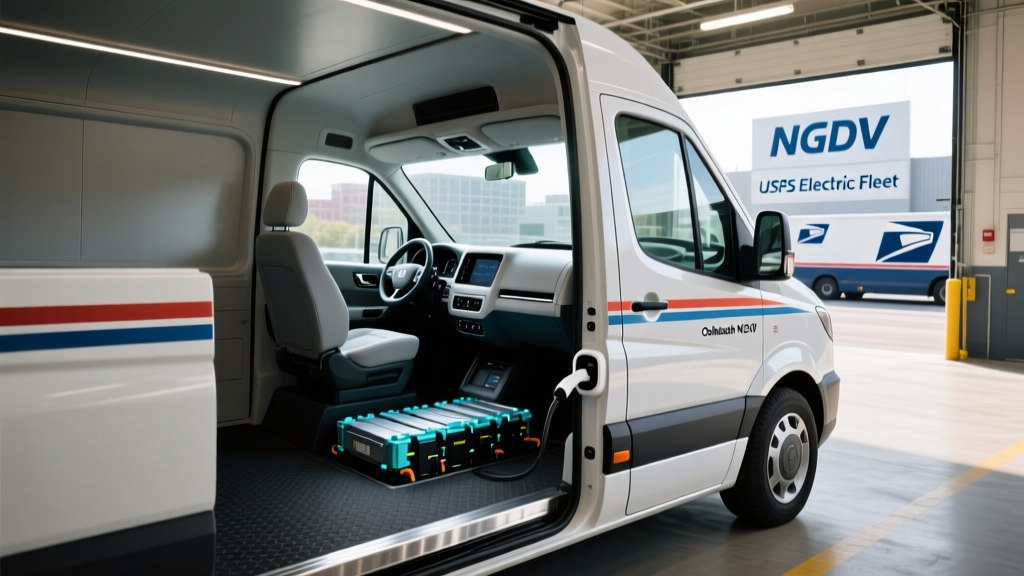
The USPS electric van is the Oshkosh NGDV (Next Generation Delivery Vehicle), a purpose-built electric mail carrier entering service beginning in 2024 and ramping through 2028. Out of the 106,000-vehicle USPS order, approximately 45,000 units are battery-electric (BEV) and 61,000 are low-emission gas-powered. The electric variant carries a 94 kWh LFP battery pack, delivers an EPA-estimated 70 miles of range, and charges on Level 2 AC at roughly 19.2 kW. It is not available for consumer purchase — it is a fleet-only vehicle built under a $482 million initial contract awarded to Oshkosh Defense.
Why the USPS Is Electrifying Its Fleet
The United States Postal Service operates one of the largest civilian vehicle fleets in the world — roughly 230,000 vehicles, many of them the aging Grumman LLV (Long Life Vehicle) built between 1987 and 1994. Those LLVs average around 8.2 miles per gallon on stop-and-go routes and have become increasingly expensive to maintain. The NGDV contract, initially announced in February 2021 and subsequently revised under environmental review pressure, represents the most significant fleet electrification commitment by any U.S. government agency.
By mid-2025, USPS had taken delivery of several thousand NGDVs across both electric and gas variants, with deployment concentrated at postal facilities that have completed charging infrastructure upgrades. The USPS NGDV program page tracks deployment milestones publicly.
USPS Electric Van: Full NGDV BEV Specifications
| Specification | NGDV BEV (Electric) |
|---|---|
| Battery Capacity | 94 kWh (LFP chemistry) |
| EPA Range | ~70 miles |
| Real-World Range (loaded, A/C, stop-start) | ~55–65 miles |
| Motor Output | ~200 kW (~268 hp) peak |
| Level 2 AC Charging | 19.2 kW (J1772/CCS inlet) |
| Full Charge Time (Level 2) | ~5 hours (0–100%) |
| DC Fast Charging | Not equipped |
| Cargo Volume | ~120 cu ft |
| Payload Capacity | ~2,000 lbs |
| Vehicle Length | ~198 inches |
| Turning Radius | ~25 feet (curb-to-curb) |
| Driver-Assist Features | AEB, 360° cameras, lane departure warning (SAE Level 0–1) |
| Warranty | Fleet contract terms (not consumer-applicable) |
Real-World Range: What 70 EPA Miles Actually Means
An EPA range of 70 miles may sound modest by consumer EV standards, but it maps closely to the operational reality of mail delivery. The average USPS urban carrier route covers 20 to 35 miles per day, with rural routes extending to roughly 50–60 miles. The NGDV's range provides a buffer, but that buffer shrinks under real conditions:
- Stop-and-go driving: Delivery routes involve hundreds of stops per day. Regenerative braking recovers some energy, but frequent acceleration from 0–25 mph is inherently less efficient than steady-state cruising.
- HVAC load: The NGDV cab and cargo area require heating in winter and cooling in summer. Unlike consumer EVs with heat pumps, fleet vehicles may rely on resistive heating, which can reduce range by 15–25% in cold climates.
- Payload weight: A fully loaded cargo area (up to 2,000 lbs of parcels) increases energy consumption, particularly on routes with elevation changes.
- Cold-weather degradation: LFP batteries experience more pronounced capacity reduction at freezing temperatures than NMC chemistries — expect 10–20% range loss in sub-30°F conditions without preconditioning.
Common Misconceptions About the USPS Electric Van
| Myth | Fact |
|---|---|
| "70 miles isn't enough for a delivery route." | Average urban routes run 20–35 miles daily; 70 EPA miles provides adequate buffer for most urban/suburban routes. |
| "The entire USPS fleet is going electric." | Only ~45,000 of the 106,000 NGDV order are BEV; the remaining 61,000 are gasoline-powered. |
| "You can buy one." | The NGDV is a fleet-only government vehicle — not available to consumers now or in the foreseeable future. |
| "It has DC fast charging." | The NGDV charges exclusively on Level 2 AC (~19.2 kW). It returns to the depot nightly and charges over ~5 hours. |
| "Electric vans cost more to operate." | At depot-charging electricity rates (~$0.08–$0.12/kWh), the NGDV BEV costs roughly $0.10–$0.15 per mile in energy vs. the LLV's $0.35–$0.45 per mile in fuel. |
Cost Breakdown: NGDV Electric vs. Gas vs. the Old LLV
The USPS fleet electrification is ultimately an economic calculation as much as an environmental one. Here is how the operating costs compare across vehicle types on a per-mile and annual basis:
| Cost Factor | Grumman LLV (Legacy) | NGDV Gas Variant | NGDV BEV (Electric) |
|---|---|---|---|
| Fuel/Energy per Mile | $0.35–$0.45 (gas at 8.2 MPG) | $0.18–$0.24 (~18 MPG) | $0.10–$0.15 (depot electricity) |
| Annual Fuel/Energy (30 mi/day, 260 days) | $2,730–$3,510 | $1,404–$1,872 | $780–$1,170 |
| Maintenance per Year (est.) | $3,500–$5,500 | $1,800–$2,500 | $900–$1,400 |
| Oil Changes | 4–6/year | 3–4/year | None |
| Transmission/Exhaust Repairs | Frequent (aging fleet) | Occasional | Not applicable |
| Estimated Annual Operating Cost | $6,230–$9,010 | $3,204–$4,372 | $1,680–$2,570 |
The BEV variant saves USPS an estimated $1,500–$2,500 per vehicle per year in operating costs compared to the gas NGDV, and $4,500–$6,500 per year versus the legacy LLV. Over a projected 15-year service life, that compounds to substantial savings — though it must be weighed against higher upfront acquisition costs and depot charging infrastructure investment.
Charging Infrastructure: The Hidden Bottleneck
The NGDV BEV does not use DC fast charging. It is designed for overnight depot charging on Level 2 AC at 19.2 kW. This is deliberate: USPS vehicles return to a central facility each evening, park for 10–14 hours, and depart each morning. There is no operational need for rapid mid-route charging.
However, equipping postal facilities with sufficient Level 2 infrastructure is a major undertaking:
- Charger cost: Commercial-grade 19.2 kW Level 2 stations cost $2,000–$5,000 per unit (hardware only).
- Electrical upgrades: Many older postal facilities require panel upgrades, new conduit runs, and transformer capacity increases. A facility adding 20–40 chargers may face $200,000–$800,000 in electrical infrastructure costs.
- Timeline: USPS has acknowledged that charging infrastructure deployment has lagged behind vehicle delivery in some regions, temporarily limiting BEV utilization at certain facilities.
This depot-charging model means the NGDV is irrelevant to the public charging network debate. It does not compete for Supercharger stalls or Electrify America kiosks. It charges behind the fence, at fleet electricity rates, on a predictable schedule.
How the NGDV Compares to Other Electric Commercial Vans
| Spec | USPS NGDV BEV | Ford E-Transit (Cargo Van) | BrightDrop Zevo 600 | Rivian EDV (Amazon) |
|---|---|---|---|---|
| Battery | 94 kWh (LFP) | 68 kWh (NMC) | 120+ kWh (NMC) | ~135 kWh (NMC) |
| EPA Range | ~70 mi | 108–126 mi | ~160 mi | ~150 mi |
| Level 2 Charge Rate | 19.2 kW | 11.3 kW | ~19.2 kW | ~11.5 kW |
| DC Fast Charge | No | Yes (115 kW peak) | Yes (~120 kW) | Yes (~150 kW) |
| Primary Use Case | Mail delivery (depot return) | Last-mile delivery | Parcel delivery (longer routes) | Amazon last-mile delivery |
| Available to Public | No (government fleet) | Yes (commercial sale) | Yes (commercial sale) | No (Amazon exclusive) |
The NGDV's range is the lowest in this comparison, but its use case is the most constrained and predictable. USPS carriers don't need 150 miles — they need 30–50 miles of extremely durable stop-and-go operation with a right-hand-drive configuration optimized for curbside mailbox access. The EPA's fueleconomy.gov database tracks consumer EV efficiency data, though fleet-specific vehicles like the NGDV are typically documented through manufacturer disclosures and government reports rather than standard consumer listings.
Decision Framework: What the NGDV Means for Different Readers
If you're a taxpayer or policy watcher:
The NGDV program represents a $6+ billion fleet modernization investment. The BEV portion reduces USPS operating costs and tailpipe emissions, but the 61,000 gas units mean the fleet will not be zero-emission. Track spending and deployment at the USPS sustainability page.
If you're a commercial fleet manager:
The NGDV itself isn't available to you, but its LFP battery choice and depot-charging strategy are instructive. LFP chemistry offers longer cycle life (3,000+ cycles to 80% SoH) and lower cost per kWh, making it ideal for vehicles with predictable daily routes and overnight charging access. Consider the Ford E-Transit, BrightDrop Zevo, or Ram ProMaster EV for similar use cases.
If you're a consumer curious about buying one:
You cannot purchase an NGDV. It is a government-contract fleet vehicle. If the postal route aesthetic appeals to you, look at the Ford E-Transit (starting ~$45,000) or the used-market Nissan NV200 as alternatives with a similar upright, utilitarian van profile.
If you're a postal worker or carrier:
Expect the NGDV BEV to feature air conditioning (a major upgrade over the LLV), a 360° camera system, automatic emergency braking, and a significantly quieter cab. The right-hand-drive configuration is retained for curbside delivery. Report any charging or range issues to your facility's fleet manager — early-deployment feedback helps USPS refine route assignments for BEV vs. gas units.
What First-Time EV Fleet Buyers Can Learn From the NGDV
Even though the NGDV isn't a consumer vehicle, its design philosophy reveals several principles that apply broadly to EV adoption:
- Match range to actual use, not aspirational use. USPS didn't spec a 250-mile battery for a 30-mile route. Oversizing batteries adds cost, weight, and charging time. Know your real daily miles.
- Depot charging beats public charging for predictability. If you can charge at home (Level 2, 240V), you replicate the NGDV's operational model: plug in at night, wake up full. Public DC fast charging is a supplement, not a primary strategy.
- LFP chemistry is a smart trade-off for fleet duty. Lower energy density than NMC, but far longer cycle life and no cobalt sourcing concerns. For vehicles driven daily on short routes, LFP's longevity advantage dominates.
- Infrastructure lead time is real. USPS's charging deployment delays mirror what many homeowners face — panel upgrades, utility coordination, and permitting can take weeks to months. Plan ahead.
Can I buy a USPS electric van for personal use?
No. The Oshkosh NGDV is manufactured exclusively under a federal contract for USPS fleet use. It is not street-sold, and there is no announced plan for a consumer variant. Surplus LLVs (the old mail trucks) occasionally appear at government auctions, but NGDVs are not expected to enter the secondary market for decades.
How much does the USPS electric van cost to build?
Exact per-unit costs are embedded in the Oshkosh Defense contract and have not been publicly itemized on a per-vehicle basis. The initial contract was $482 million for design and initial production; the total program cost across 106,000 vehicles (both BEV and gas) is estimated at $6–$7 billion including infrastructure. Per-unit BEV acquisition cost is likely in the $60,000–$80,000 range based on comparable commercial electric van pricing, though government contract pricing includes tooling and support.
Why doesn't the NGDV have DC fast charging?
DC fast charging adds hardware cost ($2,000–$5,000 more per vehicle for the onboard charge pathway), battery thermal stress, and operational complexity. Since USPS vehicles return to a depot nightly and are parked for 10+ hours, Level 2 AC charging at 19.2 kW fully replenishes the 94 kWh battery in approximately 5 hours — well within the overnight window. Fast charging would be unused capability, adding cost without benefit.
Is the USPS electric van made by Oshkosh or another company?
Oshkosh Defense (a subsidiary of Oshkosh Corporation) is the prime contractor and manufacturer. The vehicle was designed in partnership with Ford, which supplies some powertrain and platform components. The NGDV is assembled at Oshkosh's facility in Spartanburg, South Carolina.
What battery chemistry does the USPS electric van use?
The NGDV BEV uses LFP (lithium iron phosphate) battery cells. LFP offers longer cycle life, better thermal stability, and lower material cost compared to NMC (nickel manganese cobalt), but with lower energy density. For a vehicle with a fixed 70-mile route requirement and overnight charging, LFP's durability advantage outweighs the weight penalty.
How does cold weather affect the USPS electric van's range?
In sub-freezing temperatures, expect 10–20% range reduction from the 70-mile EPA estimate, bringing real cold-weather range to roughly 55–63 miles. LFP chemistry is more susceptible to cold-weather capacity loss than NMC. For routes in northern climates, USPS assigns gas NGDV variants or shorter routes to BEV units during winter months.
Does the USPS electric van qualify for the federal EV tax credit?
No. The IRS §30D Clean Vehicle Credit applies to qualifying vehicles purchased by individual taxpayers or businesses for personal/commercial use. Government fleet acquisitions like the NGDV are not eligible for — and do not need — consumer tax incentives.