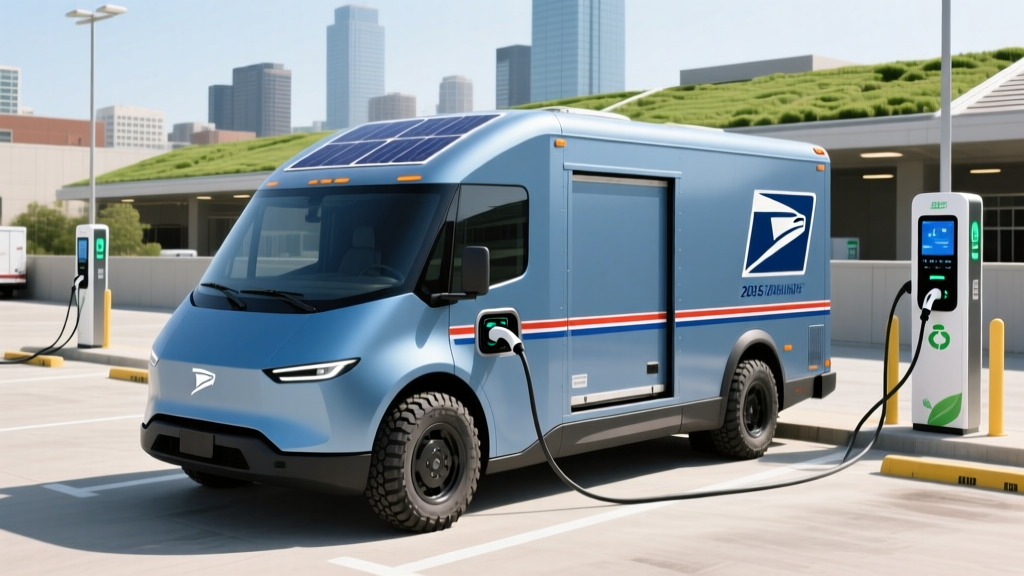
Quick Answer: The USPS electric trucks — officially the Oshkosh Next Generation Delivery Vehicle (NGDV) — carry a ~150 kWh NMC battery pack, an EPA-estimated range of roughly 70–110 miles depending on route and HVAC load, and recharge via Level 2 AC at up to 19.2 kW. As of 2026, over 9,000 NGDVs have entered service across more than 400 postal facilities, part of a contracted order for at least 45,000 electric units by 2028. These are fleet-only vehicles — not available to consumers — but their deployment signals where commercial EV logistics is heading.
Why the USPS Went Electric
The United States Postal Service operates one of the largest civilian vehicle fleets on Earth — over 230,000 vehicles covering 1.2 billion miles annually. The legacy Grumman LLV, a boxy aluminum mail truck dating to 1987, averages just 8.2 MPG and costs roughly $5,000 per year in fuel alone per vehicle. With routes that are predominantly short, stop-and-go, and return-to-depot daily, last-mile delivery is a textbook EV use case.
In 2021, the USPS awarded Oshkosh Defense a $6 billion contract to build the NGDV. After initial plans leaned heavily toward internal combustion, Congressional pressure and an EPA environmental review pushed the commitment to at least 45,000 battery-electric units (out of a total contract of up to 165,000 vehicles). By early 2026, production at Oshkosh's Spartanburg, South Carolina facility is ramping toward 10,000+ electric NGDVs per year.
NGDV Electric Specs: Battery, Range, and Charging
The electric NGDV is built on Oshkosh's purpose-designed commercial EV platform. Here are the confirmed and estimated specifications as of the 2026 production run:
| Specification | NGDV Battery Electric |
|---|---|
| Battery Capacity | ~150 kWh (NMC chemistry) |
| EPA-Estimated Range | 70–110 miles (route-dependent) |
| Motor Output | ~200 kW (~268 hp) |
| Level 2 AC Charging | Up to 19.2 kW (J1772 connector) |
| DC Fast Charging | Not equipped (fleet depot L2 overnight) |
| Level 2 Full Charge Time | ~8–10 hours (0–100%) |
| Payload Capacity | ~2,000 lbs cargo |
| Cargo Volume | ~120 cu ft |
| Top Speed | Governed to ~70 mph |
| GVWR | ~10,000 lbs (Class 2b–3) |
Range reality check: The 70–110 mile range spread is significant. A rural route with highway segments, full cargo load, and summer A/C running can push consumption to 2.0+ kWh/mile, yielding closer to 70–75 usable miles. A dense urban route with frequent regenerative braking opportunities and mild weather can stretch to 100–110 miles. The USPS designs routes to stay within the vehicle's daily range envelope, with most carrier routes running 20–40 miles per day — well within the battery's buffer.
Real-World Range Note: Cold-weather testing at USPS facilities in northern states shows range reduction of 20–35% when cabin and cargo-area heating is active. Lithium-ion NMC cells also experience slower charge acceptance below 32°F, though the NGDV's thermal management system mitigates this during overnight depot charging.
Cost Breakdown: Electric NGDV vs. Legacy Grumman LLV
The economic case for the electric NGDV rests on total cost of ownership, not sticker price. The per-unit acquisition cost of an electric NGDV is estimated at $65,000–$75,000, compared to roughly $45,000–$50,000 for the ICE variant. But operating costs tell a different story over a 15-year service life:
| Cost Factor (Per Vehicle/Year) | Electric NGDV | Legacy Grumman LLV (Gas) | NGDV ICE Variant |
|---|---|---|---|
| Acquisition (annualized over 15 yrs) | ~$4,700 | ~$3,000 | ~$3,300 |
| Fuel / Electricity | ~$600–$900 | ~$4,800–$5,500 | ~$4,200–$4,800 |
| Maintenance (oil, filters, exhaust, brakes) | ~$1,200 | ~$3,500 | ~$3,200 |
| Brake Wear (regen braking extends life) | ~$200 | ~$600 | ~$550 |
| Estimated Annual Total | ~$6,700–$7,000 | ~$11,900–$12,600 | ~$11,250–$11,850 |
The electric NGDV saves an estimated $5,000–$5,800 per vehicle per year in fuel and maintenance. Over a 15-year lifespan, that's $75,000–$87,000 in operational savings — far exceeding the $20,000–$25,000 acquisition premium. According to the USPS Office of Inspector General, the fleet-wide savings could reach into the billions once the full 45,000-vehicle electric commitment is deployed.
Charging Infrastructure: How the USPS Powers the Fleet
The USPS is investing approximately $1.3 billion in charging infrastructure across its network. The strategy is depot-based Level 2 charging — vehicles plug in when they return from routes each afternoon and fully charge overnight.
| Charging Level | Power (kW) | Miles Added Per Hour | NGDV Application |
|---|---|---|---|
| Level 1 (120V) | 1.4–1.9 kW | ~2–3 mi/hr | Not practical for fleet |
| Level 2 (208/240V) | 7.2–19.2 kW | ~10–28 mi/hr | Primary depot charging |
| DC Fast Charge | 50–350 kW | ~100–400 mi/hr | NGDV not equipped |
At 19.2 kW (80A circuit), a fully depleted 150 kWh battery charges in roughly 8 hours — adequate for overnight turnaround. Most USPS facilities are installing 10–50 Level 2 pedestals per site, with electrical service upgrades to 480V three-phase where necessary. The USPS has partnered with the U.S. Department of Energy and utility providers to coordinate grid load management, using smart-charging software to stagger charge initiation and avoid peak-demand surcharges.
Why no DC fast charging? DCFC hardware adds $5,000–$10,000 per vehicle in onboard equipment, increases weight, and isn't necessary for a vehicle that returns to the same depot every day. The cost-benefit math strongly favors slower, cheaper AC charging for predictable daily routes.
Electric vs. Gas: What the USPS Fleet Data Shows
The USPS now operates a natural A/B test — electric and ICE NGDVs running identical routes in overlapping territories. Early operational data reveals clear trade-offs:
| Factor | Electric NGDV | NGDV ICE Variant |
|---|---|---|
| Energy/Fuel Cost Per Mile | ~$0.09–$0.14 | ~$0.38–$0.48 |
| Daily Range Adequacy | Adequate for ~90% of routes | Unlimited (refuel in minutes) |
| Cold-Weather Performance | 20–35% range loss below 20°F | Minimal range impact |
| Noise / Operator Comfort | Significantly quieter, less vibration | Engine noise, exhaust heat |
| HVAC Energy Draw | High — direct battery drain | Waste heat from engine (free heating) |
| Maintenance Downtime | Lower (fewer moving parts) | Higher (oil, transmission, exhaust) |
| Upfront Vehicle Cost | ~$65,000–$75,000 | ~$45,000–$50,000 |
| Charging/Fueling Infrastructure | $15,000–$40,000 per depot stall | Existing gas stations |
The ICE variant wins on long rural routes exceeding 100 miles, extreme cold-climate operations, and flexibility for unscheduled detours. The electric variant dominates on dense urban routes, stop-and-go delivery patterns where regenerative braking maximizes efficiency, and regions with moderate climates.
Common Misconceptions About USPS Electric Trucks
| Myth | Fact |
|---|---|
| "The electric mail truck can't finish its route." | USPS designs daily routes within the vehicle's range envelope. Average carrier routes are 20–40 miles; the NGDV delivers 70–110 miles. |
| "They'll run out of charge in winter." | Cold weather does reduce range by 20–35%, but most routes still fall within the reduced envelope. The USPS assigns ICE NGDVs to extreme-climate, long-distance routes. |
| "Electric trucks cost taxpayers more." | Higher acquisition cost is offset by $5,000+ annual fuel/maintenance savings. Over 15 years, electric NGDVs save $75,000+ per vehicle. |
| "The grid can't handle charging thousands of trucks." | Depot charging uses managed, staggered overnight charging. Most facilities charge at 19.2 kW per stall during off-peak hours — equivalent to a few dozen homes. |
| "You can buy a USPS electric truck." | The NGDV is a fleet-only vehicle. Oshkosh does not sell it to consumers or private businesses. |
What This Means for Consumer EV Buyers
You can't buy an NGDV, but the USPS electrification program validates several principles that directly apply to consumer EV ownership:
- Short daily routes are EV-ideal. If your commute is under 60 miles round-trip and you can charge at home, a modern EV with 250+ miles of EPA range has massive buffer — just like the NGDV has for most postal routes.
- Level 2 home charging is sufficient for daily use. The USPS charges 150 kWh batteries overnight on Level 2. Your 75–100 kWh EV battery charges even faster on a home Level 2 unit (7.2–11.5 kW).
- Cold-weather range loss is real but manageable. The NGDV's 20–35% winter range reduction mirrors consumer EVs. Preconditioning, heat pumps, and route planning mitigate this.
- Total cost of ownership favors EVs in stop-and-go use. Regenerative braking, fewer fluids, and lower per-mile energy costs compound over years — whether you're delivering mail or commuting.
Consumer Decision Framework — Apply the USPS Logic to Your Purchase:
- Choose a BEV if: Your daily driving is under 80 miles, you have home Level 2 charging access, and your climate is moderate or you're willing to accept 20–30% winter range reduction.
- Choose a PHEV if: Your daily commute is under 30 miles (electric-only covers it) but you regularly take road trips exceeding 200 miles or live in extreme cold where range loss matters.
- Stick with gas/hybrid if: You lack reliable charging access (no home, no workplace charging), regularly drive 200+ miles between charging options, or your budget can't absorb the EV upfront premium even with the §30D federal tax credit (up to $7,500, subject to MSRP caps, income limits, and battery-sourcing requirements).
Frequently Asked Questions
Who makes the USPS electric truck?
Oshkosh Defense, a subsidiary of Oshkosh Corporation, manufactures the NGDV at its facility in Spartanburg, South Carolina. The electric powertrain components are sourced from multiple suppliers, with final integration by Oshkosh.
How many USPS electric trucks are on the road in 2026?
As of early 2026, approximately 9,000–12,000 electric NGDVs have been delivered and are in active service. The USPS has committed to at least 45,000 battery-electric units by 2028, with the total NGDV contract covering up to 165,000 vehicles across electric and ICE variants.
What is the range of the USPS electric truck?
The EPA-estimated range is approximately 70–110 miles depending on route profile, cargo load, and HVAC usage. Most USPS carrier routes run 20–40 miles daily, leaving substantial battery buffer. Cold weather reduces range by an estimated 20–35%.
Do USPS electric trucks use DC fast charging?
No. The electric NGDV charges exclusively via Level 2 AC at up to 19.2 kW, designed for overnight depot charging. This eliminates the added cost and weight of DC fast-charge hardware, which isn't needed for predictable daily routes with overnight turnaround.
Can I buy a USPS electric truck for personal use?
No. The NGDV is a government fleet vehicle manufactured under a federal contract. Oshkosh does not offer it for consumer or private commercial sale. Retired legacy Grumman LLVs are occasionally auctioned, but NGDVs are not expected to enter the surplus market for many years.
How much does a USPS electric truck cost?
The estimated per-unit cost of the battery-electric NGDV is $65,000–$75,000, compared to $45,000–$50,000 for the ICE variant. However, the electric version saves an estimated $5,000–$5,800 annually in fuel and maintenance, paying back the premium within 4–5 years of a planned 15-year service life.
What battery chemistry does the NGDV use?
The NGDV uses NMC (nickel manganese cobalt) lithium-ion cells, which offer higher energy density than LFP chemistry — important for a heavy commercial vehicle that needs maximum range from its battery pack. NMC is also the chemistry used in most long-range consumer EVs from manufacturers like Ford, GM, and Hyundai.