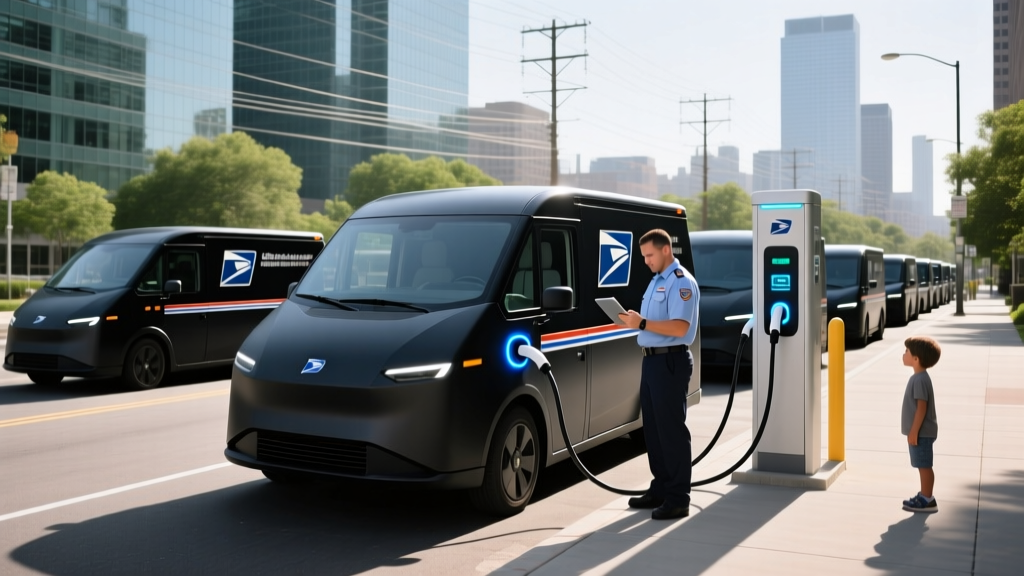
The short answer: The USPS is deploying up to 45,000 Next Generation Delivery Vehicles (NGDVs) by 2028, with a minimum of 10,015 being battery-electric. These USPS electric cars — built by Oshkosh Defense — feature an estimated 70-mile EPA range, ~90 kWh LFP battery packs, and Level 2 depot charging. For private EV buyers, the USPS fleet electrification signals growing LFP battery supply chains, expanded commercial charging infrastructure, and potential used-EV market trickle-down. But with a 70-mile range, these are strictly last-mile delivery vehicles, not consumer replacements.
Why the USPS Electric Car Rollout Matters in 2026
The United States Postal Service operates one of the largest civilian vehicle fleets on Earth — roughly 230,000 vehicles covering 4.3 billion miles annually. After years of controversy over an initial contract that favored gas-powered NGDVs, the USPS revised its plan under pressure from the EPA and the Biden administration's federal fleet electrification mandate. The current commitment: at least 10,015 battery-electric NGDVs in the first tranche, with the option to scale to 45,000 electric units across subsequent orders.
The NGDV is not a consumer vehicle. It is a purpose-built, right-hand-drive mail delivery van with a top speed around 75 mph and a body designed for curb-side mailbox access. But the scale of USPS electric car procurement affects the broader EV market in three concrete ways:
- LFP battery demand: The NGDV uses lithium iron phosphate (LFP) cells, the same chemistry now found in the Tesla Model 3 RWD, Ford Mustang Mach-E Select, and Rivian R1S Standard. USPS volume accelerates domestic LFP supply chain investment.
- Depot charging infrastructure: USPS facilities are installing hundreds of Level 2 chargers across metro areas — infrastructure that may eventually support public or shared access.
- Fleet-to-consumer trickle-down: As federal and commercial fleets electrify, maintenance expertise, parts availability, and technician training expand, lowering ownership friction for private buyers.
USPS NGDV EV: The Specs That Matter
Oshkosh Defense has been deliberately quiet about publishing a full consumer-style spec sheet for the NGDV. Based on contract documents, USPS environmental impact statements, and fleet testing reports, here is what we know as of early 2026:
| Specification | USPS NGDV (Electric) |
|---|---|
| Battery Chemistry | LFP (lithium iron phosphate) |
| Battery Capacity | ~90 kWh (estimated usable) |
| EPA Range | ~70 miles (estimated) |
| Real-World Range | 55–65 miles (stop-and-go routes, HVAC load, cold climate) |
| Charging | Level 2 AC depot charging (~19.2 kW) |
| DC Fast Charging | Not equipped (depot-only model) |
| Full Charge Time (Level 2) | ~5–6 hours from empty |
| 0–30 mph | ~5 seconds (estimated, delivery vehicle tuning) |
| Top Speed | ~75 mph (electronically limited) |
| Drivetrain | Single-motor, front-wheel drive |
| Cargo Volume | ~120 cu ft (mail tray capacity) |
| Unit Cost (estimated) | ~$65,000–$75,000 per vehicle (fleet contract pricing) |
Real-world range reality: The 70-mile EPA estimate assumes moderate temperatures and a mixed driving cycle. Postal routes involve hundreds of stops per day — the NGDV may stop 400+ times on a single route. While regenerative braking recovers some energy during frequent deceleration, the constant HVAC use (heating in winter, cooling in summer) and the heavy stop-start load reduce practical range to 55–65 miles in most climates. In sub-freezing conditions, expect LFP range loss of 15–25%, potentially bringing real range below 55 miles on extreme days.
How the NGDV Compares: EV vs. Gas USPS Fleet
The USPS is also ordering gas-powered NGDVs alongside the electric variants. Here is how the two stack up on the metrics that matter for fleet economics — and what private buyers can learn from the comparison:
| Metric | NGDV Electric | NGDV Gas (ICE) |
|---|---|---|
| Energy/Fuel Cost per Mile | ~$0.09–$0.12 (at $0.13/kWh depot rate) | ~$0.22–$0.28 (at $3.40/gal, ~14 MPG) |
| Maintenance Cost per Year | ~$800–$1,200 (no oil, fewer moving parts) | ~$2,200–$3,000 (oil, filters, exhaust, transmission) |
| Upfront Unit Cost | ~$65,000–$75,000 | ~$45,000–$50,000 |
| Lifetime Fuel/Energy (8 yrs, 12k mi/yr) | ~$8,600–$11,500 | ~$21,000–$27,000 |
| Emissions (tailpipe) | Zero | ~4.6 metric tons CO₂/year |
| Range per Fill/Charge | ~55–70 miles | ~200–250 miles |
The takeaway for private buyers: The USPS math mirrors what consumer EV owners experience. Higher upfront cost is offset by dramatically lower per-mile energy and maintenance costs. Over an 8-year lifecycle, the electric NGDV saves the USPS an estimated $10,000–$15,000 per vehicle in fuel and maintenance alone. For a consumer driving a Tesla Model 3 RWD (EPA 341 miles, ~$0.04/mile at home charging rates), the savings compound even further thanks to higher efficiency and longer range.
Real Costs: What USPS Electric Cars Teach Us About EV Ownership
The USPS fleet contract exposes the same cost categories every first-time EV buyer faces. Here is a breakdown translated from fleet economics to consumer ownership:
| Cost Category | Consumer EV (e.g., 2026 Chevy Equinox EV LT) | Comparable Gas Vehicle |
|---|---|---|
| Base MSRP | ~$33,600 | ~$28,200 |
| Federal Tax Credit (§30D) | Up to $7,500 (if eligible — see IRS rules below) | $0 |
| Effective Purchase Price | ~$26,100 (with full credit) | $28,200 |
| Annual Fuel/Energy (12,000 mi) | ~$480 (home L2, $0.13/kWh) | ~$1,680 (28 MPG avg, $3.40/gal) |
| Annual Maintenance | ~$400–$600 | ~$1,200–$1,800 |
| Insurance (annual avg) | ~$1,800–$2,200 | ~$1,400–$1,700 |
| 5-Year Total Operating Cost | ~$13,400–$17,000 | ~$19,400–$24,500 |
The USPS pays more upfront for electric NGDVs but recoups the difference within 3–4 years through fuel and maintenance savings. Private buyers see a similar breakeven, especially when the §30D federal tax credit applies. However, the credit has strict eligibility requirements:
- MSRP caps: Vans/SUVs/pickups ≤ $80,000; sedans ≤ $55,000
- Buyer income limits: AGI ≤ $150,000 (single), $225,000 (head of household), $300,000 (joint)
- Battery sourcing: Critical minerals and battery components must meet phased-in domestic/free-trade sourcing thresholds (increasing annually through 2029)
- Point-of-sale transfer: Eligible buyers can transfer the credit to the dealer at purchase, reducing the sale price directly
Always verify current-year eligibility on IRS.gov before relying on credit assumptions. Rules tighten annually on battery sourcing, and some popular models lose eligibility mid-year.
Common Misconceptions About USPS Electric Cars
| Myth | Fact |
|---|---|
| "The USPS is going all-electric overnight." | The plan commits to 10,015 EVs in the first order. Gas NGDVs are still being purchased. Full fleet electrification is not guaranteed and depends on congressional funding and future administration policy. |
| "USPS electric vans can be bought by consumers." | The NGDV is a government-fleet-exclusive vehicle. Oshkosh does not sell it retail. The closest consumer equivalent is the BrightDrop Zevo 600 or a used Rivian EDV (Amazon delivery van), neither of which is available to individual consumers at this time. |
| "70 miles of range is useless." | For a mail route averaging 20–40 miles per day, 70 miles is sufficient with overnight depot charging. The USPS designs routes around vehicle capability. Consumer needs are different — most buyers need 200+ miles. |
| "LFP batteries don't last as long." | LFP chemistry actually offers longer cycle life (3,000–5,000+ cycles vs. 1,000–2,000 for NMC) and better thermal stability. The trade-off is lower energy density (heavier for the same kWh) and reduced cold-weather performance. |
| "Fleet electrification will drain the grid." | USPS depot charging is scheduled overnight during off-peak hours. A single facility charging 50 NGDVs at 19.2 kW draws ~960 kW — significant but manageable with utility coordination and smart-charging software. |
What This Means for You: An EV Buyer Decision Framework
The USPS rollout confirms that large-scale EV adoption is past the pilot stage and into production reality. But your needs as a private buyer are fundamentally different from a postal route. Use this framework:
Choose a battery-electric vehicle (BEV) if:
- You have reliable home Level 2 charging (or workplace charging)
- Your daily driving is under 80% of the vehicle's EPA range (buffer for cold weather and detours)
- You can access DC fast charging for road trips (verify CCS or NACS compatibility on your routes)
- You plan to own the vehicle 5+ years to recoup the upfront premium through fuel/maintenance savings
Choose a plug-in hybrid (PHEV) if:
- You lack reliable home charging but want some electric daily driving
- You regularly drive routes with limited charging infrastructure
- You want electric commuting (20–40 miles) with gas flexibility for road trips
- Cold-climate range loss on a BEV would leave you short on your longest regular route
Wait or stick with gas/HEV if:
- You live in an apartment with zero charging access and no workplace charging
- Your budget is strictly under $25,000 and you cannot access the used-EV tax credit (up to $4,000 under §25E)
- You tow heavy loads regularly — BEV towing range drops 40–60%
First-Time EV Buyer Essentials
If the USPS electrification story has you researching your first EV, here are the non-negotiable items to understand before signing a purchase agreement:
- kWh vs. kW: kWh is battery capacity (how far you go). kW is charging power (how fast you fill up). A 75 kWh battery charged at 11 kW (Level 2) takes ~7 hours. At 150 kW (DC fast), it takes ~30 minutes to 80%.
- Charge curve taper: No EV charges at peak kW the entire session. Charging slows dramatically above 80% state of charge to protect the battery. A "10–80% in 25 minutes" claim means the last 20% may take another 20+ minutes.
- Cold-weather loss: Expect 15–30% range reduction below freezing. LFP batteries (like the NGDV's) lose more than NMC in cold conditions. A heat pump helps but does not eliminate the penalty.
- Home charging is the foundation: Public charging works for road trips, but daily EV ownership lives or dies on home Level 2 access. Budget $500–$2,000 for a quality Level 2 charger plus $500–$2,500 for electrician installation (more if your panel needs a 200A upgrade).
- Battery warranty: Federal law mandates a minimum 8-year/100,000-mile battery warranty. Most manufacturers guarantee 70% capacity retention over that period. LFP batteries, like those in the USPS NGDV and Tesla Model 3 RWD, typically degrade more slowly than NMC.
Frequently Asked Questions
Can I buy a USPS electric delivery van?
No. The Oshkosh NGDV is a government-fleet-exclusive vehicle not available for retail purchase. If you want a similar form factor, look at the Ford E-Transit (EPA 126 miles, ~$47,000 MSRP) or the BrightDrop Zevo 400/600 for commercial use.
What battery chemistry does the USPS NGDV use?
The NGDV uses LFP (lithium iron phosphate) cells. LFP offers longer cycle life and better thermal safety than NMC, at the cost of lower energy density and greater cold-weather range loss. This same chemistry is used in the Tesla Model 3 RWD and base Ford Mustang Mach-E.
How much does it cost to charge an EV compared to gas?
At the national average residential electricity rate of ~$0.16/kWh (EIA data), charging a 75 kWh EV battery from empty costs roughly $12. That same distance (~250–300 miles) in a 28 MPG gas car at $3.40/gallon costs ~$30–$36. Home charging is roughly 60–70% cheaper per mile. Public DC fast charging at $0.35–$0.50/kWh narrows the gap significantly.
Will the USPS charging stations be available to the public?
Currently, USPS depot chargers are for fleet use only. However, the USPS has discussed potential shared-use agreements in some locations. Broader public access is not part of the current deployment plan. For public charging, rely on networks like Electrify America, EVgo, and the expanding Tesla Supercharger network (now open to NACS-equipped non-Tesla vehicles).
Does the USPS EV rollout affect consumer EV prices?
Indirectly, yes. Large fleet orders drive down per-unit battery costs through volume manufacturing, expand the technician workforce, and accelerate charging infrastructure buildout. These factors reduce total cost of ownership for private buyers over time, though the effect is gradual rather than immediate.