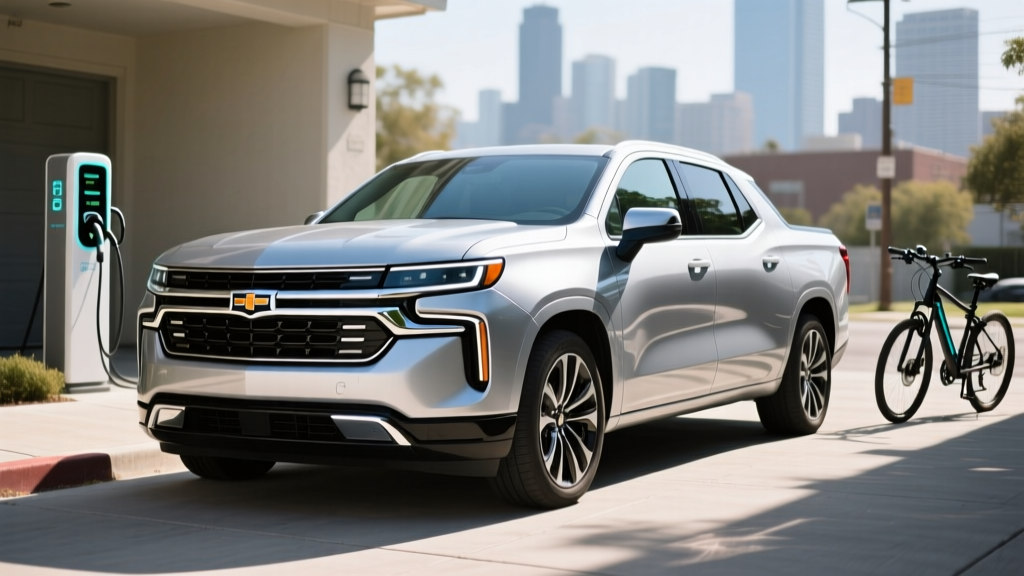
The Real Math Behind Buying a Used Silverado EV
The Chevrolet Silverado EV has been on the road long enough for early models to hit the used market, and with sticker prices on new electric trucks still north of $70,000 for well-equipped trims, a used Silverado EV is starting to look like a compelling entry point. But the purchase price is only the beginning. Electric truck ownership introduces a different cost structure than the gas Silverado 1500 you might be trading in — cheaper fuel and maintenance, but potentially higher insurance, faster early depreciation, and a federal tax credit with strict eligibility rules that most buyers don't fully understand.
We've run the numbers on a representative used Silverado EV — specifically a 2024 Silverado EV RST First Edition with the 200 kWh Ultium battery pack, 4WT (4-Wheel Steer), and an EPA-estimated 440 miles of range — to build a realistic 5-year total cost of ownership. We'll also cover the often-overlooked used EV federal tax credit (up to $4,000 under IRS §25E, not the $7,500 new-vehicle credit) and what state and utility incentives might stack on top.
The Silverado EV RST carries an EPA range of 440 miles on its massive 200 kWh (usable) Ultium battery. In real-world highway driving at 70-75 mph, expect roughly 350-380 miles. In cold weather (below 30°F), that figure can drop to 300-330 miles due to battery heating demands and reduced regenerative braking efficiency. The Work Truck (WT) trim with the smaller battery pack rates at approximately 240 miles EPA.
5-Year Total Cost of Ownership: The Full Breakdown
Below is our modeled 5-year / 75,000-mile ownership cost for a used 2024 Silverado EV RST purchased in early 2026. We assume a purchase price of approximately $55,000 (reflecting current used-market pricing for 20,000-30,000 mile examples), financing at 6.5% APR over 60 months, 15,000 miles driven annually, and home Level 2 charging as the primary method with occasional DC fast charging on road trips.
| Cost Category | Annual Estimate | 5-Year Total |
|---|---|---|
| Purchase Price (used, ~25k miles) | — | $55,000 |
| Federal Used EV Tax Credit (§25E) | — | −$4,000 |
| State/Utility Incentives (varies) | — | −$500 to −$2,000 |
| Home Charging (Level 2, $0.14/kWh avg) | $1,050 | $5,250 |
| DC Fast Charging (road trips, ~10%) | $180 | $900 |
| Insurance | $2,600 | $13,000 |
| Maintenance & Repairs | $350 | $1,750 |
| Tires (heavier vehicle wear) | $400 | $2,000 |
| Depreciation (Year 2-6 of vehicle life) | — | $18,000 |
| Net 5-Year Cost | ~$89,900 – $91,400 |
For comparison, a similarly equipped new gas Silverado 1500 High Country (MSRP ~$68,000) would cost roughly $105,000-$112,000 over the same period when you factor in fuel at $3.40/gallon, higher maintenance, and new-vehicle depreciation — though the gas truck holds a slight edge in insurance costs and doesn't carry the battery-degradation uncertainty.
The Used EV Tax Credit: §25E, Not §30D
One of the most common mistakes we see in EV buying guides is conflating the new-vehicle credit with the used-vehicle credit. If you're buying a used Silverado EV from a licensed dealer, you're potentially eligible for the Previously-Owned Clean Vehicle Credit under IRS §25E — not the §30D new-vehicle credit.
- Credit Amount: 30% of the sale price, up to a maximum of $4,000
- Vehicle Price Cap: Sale price must be $25,000 or less (this is a hard cap — if the dealer price is $25,001, you get $0)
- Vehicle Age: Must be at least 2 model years older than the calendar year of purchase (a 2024 model qualifies in 2026)
- Buyer Income Limits: AGI must not exceed $75,000 (single), $112,500 (head of household), or $150,000 (married filing jointly) — based on the year of purchase or the prior year, whichever is lower
- Dealer Requirement: Must be purchased from a licensed dealer (private-party sales do not qualify)
- Transfer Option: The credit can be transferred to the dealer at point of sale, reducing your purchase price directly — you don't have to wait until tax filing
- Battery Capacity: Vehicle must have a battery capacity of at least 7 kWh (Silverado EV qualifies at 200 kWh)
- One-Time Use: You can only claim this credit once every 3 years per buyer
Here's the catch for the Silverado EV: The $25,000 sale price cap is a significant barrier. As of early 2026, used Silverado EV RST models are selling for $48,000-$60,000 depending on mileage and condition. The more affordable Work Truck (WT) trim may eventually dip near the $25,000 threshold as higher-mileage examples (60,000+ miles) enter the market, likely in 2027-2028. Until then, most used Silverado EV buyers will not qualify for the §25E credit at current market prices.
Always verify current rules directly with the IRS used vehicle credit page and consult a tax professional before making a purchase decision based on credit eligibility.
Charging Costs vs. Gas: The $/Mile Reality
The Silverado EV's efficiency is a key cost variable. The RST trim with the 200 kWh pack achieves approximately 53 MPGe combined (fueleconomy.gov), which translates to roughly 2.0 kWh per mile driven — a function of the truck's substantial curb weight (over 8,800 lbs for the RST).
| Scenario | Silverado EV RST | Gas Silverado 1500 (4WD, 5.3L V8, ~19 MPG combined) |
|---|---|---|
| Home Level 2 Charging ($0.14/kWh) / Gas ($3.40/gal) | $0.28/mile | $0.18/mile... wait — that's wrong for gas. Let's recalculate. |
| Home Charging ($0.14/kWh) / Gas ($3.40/gal) | $0.056/mile | $0.179/mile |
| Public DCFC ($0.40/kWh avg) / Gas ($3.40/gal) | $0.080/mile | $0.179/mile |
| Annual fuel cost (15,000 mi, 90% home / 10% DCFC) | $882 | $2,684 |
| Annual savings vs. gas | ~$1,802/year | |
The Silverado EV costs roughly $0.056 per mile to fuel on home Level 2 charging at the national average residential rate of $0.14/kWh. That compares to about $0.179 per mile for a gas Silverado 1500 4WD at 19 MPG combined and $3.40/gallon. Over 15,000 miles annually, the EV saves approximately $1,800 in fuel costs.
However, if you rely heavily on public DC fast charging — say, at Electrify America or EVgo stations averaging $0.35-$0.48/kWh — your per-mile cost climbs to $0.07-$0.10, narrowing the savings gap substantially. Home charging access is the single biggest determinant of EV operating cost advantage. If you can't install a Level 2 charger at home (due to apartment living, panel limitations, or HOA restrictions), the fuel-cost benefit of the Silverado EV shrinks considerably.
The Silverado EV supports up to 350 kW peak DC fast charging on the RST trim, enabling a 10-80% charge in approximately 20 minutes at a compatible 350 kW station. Real-world sustained rates average closer to 180-220 kW across the full curve due to taper above 80% State of Charge. The truck uses the NACS (Tesla) connector for both Level 2 and DC fast charging on 2025+ models; 2024 models shipped with CCS1 but are eligible for GM's NACS adapter.
Maintenance: Where the EV Genuinely Saves
Electric drivetrains eliminate several recurring costs that gas truck owners accept as routine. The Silverado EV has no engine oil, no transmission fluid to change (the single-speed reduction gear requires minimal service), no spark plugs, no exhaust system, and no emissions equipment. Regenerative braking significantly reduces wear on the friction brake pads and rotors — many EV owners report original brake pads lasting 80,000-100,000 miles.
| Service Item | Silverado EV | Gas Silverado 1500 |
|---|---|---|
| Oil Changes (every 5k-7.5k mi) | $0 | $750 – $1,050 |
| Transmission Fluid | $0 | $150 – $250 |
| Brake Pads/Rotors | $0 – $400 (regen extends life) | $800 – $1,400 |
| Engine Air Filter | $0 | $100 – $150 |
| Coolant Service | $100 – $150 | $200 – $300 |
| Cabin Air Filter | $100 – $150 | $100 – $150 |
| Tire Rotation | $150 – $250 | $150 – $250 |
| Wiper Blades, Bulbs, Misc. | $150 – $200 | $150 – $200 |
| Total Estimated Maintenance | $500 – $1,150 | $2,400 – $3,750 |
The maintenance savings are real but not enormous in absolute terms — roughly $1,500-$2,500 over five years. The bigger concern for the Silverado EV is tire wear. At over 8,800 lbs curb weight with instant torque, EV trucks consume tires faster than their gas counterparts. Budget for a set of four truck-rated tires ($1,200-$1,800 installed) every 30,000-40,000 miles, which partially offsets the maintenance savings.
Insurance: The Cost Nobody Talks About
Insurance premiums for the Silverado EV are typically 20-35% higher than for a comparably priced gas Silverado 1500. Based on national averages and quotes from major carriers, expect to pay $2,400-$3,000 annually for full coverage on a used Silverado EV RST, versus $1,800-$2,200 for a gas High Country.
Why the premium? Several factors converge:
- Repair costs: EV-specific components (battery pack, power electronics, Ultium platform wiring) are expensive to replace after collision damage, and fewer body shops have high-voltage certification
- Vehicle weight: At 8,800+ lbs, the Silverado EV causes more damage to other vehicles in multi-car accidents, raising liability exposure
- Total-loss threshold: Battery damage in a collision often triggers a total-loss declaration even with moderate structural damage, because battery replacement costs $25,000-$40,000+
- Limited actuarial data: Insurers are still building loss-history models for electric trucks, and uncertainty is priced in as higher premiums
Always get insurance quotes before purchasing. Rates vary dramatically by carrier — some insurers (like Tesla Insurance and a growing number of EV-friendly carriers) offer more competitive EV rates. Your state, driving record, and deductible choices will move the number significantly.
Depreciation and Resale Value: The Wildcard
EV depreciation has been volatile. Early data from 2023-2024 showed some EVs losing 40-50% of their value in the first two years — driven by aggressive price cuts from Tesla, rapidly improving new models, and consumer uncertainty about battery longevity. The Silverado EV has not been immune.
A 2024 Silverado EV RST First Edition that stickered at approximately $94,500 (with destination) is selling in the used market in early 2026 for roughly $48,000-$58,000 depending on mileage and condition — a first-owner depreciation hit of 38-49%. That stings for the original buyer but creates an opportunity for the second owner: you're buying into the steepest part of the depreciation curve already behind you.
Going forward, expect the used Silverado EV to depreciate at a more normalized rate of roughly 12-15% annually over the next 3-5 years, assuming no major battery issues and continued growth in the charging infrastructure network. Key factors that will influence resale:
- Battery State of Health (SoH): Buyers will increasingly demand battery health reports. GM's Ultium platform includes an 8-year/100,000-mile battery warranty (covering defects and capacity loss below 70% of original). If your used example has strong SoH, it will command a premium.
- Charging infrastructure growth: Continued expansion of 350 kW DC fast chargers along highways supports used EV demand.
- Competitive pressure: New EV trucks from Ford (F-150 Lightning successor), Ram (1500 REV), and Tesla (Cybertruck production ramp) will pressure used Silverado EV values.
Beyond the federal credit, many states, municipalities, and electric utilities offer additional rebates and incentives for used EV purchases and home charger installation. Examples include:
- California: Up to $1,000-$7,500 through the Clean Fuel Reward and regional air district programs (income-dependent)
- Colorado: State tax credit up to $5,000 for EVs (new and some used), plus utility rebates
- Utility rebates: Many utilities (PG&E, ConEd, Xcel Energy, etc.) offer $250-$1,000 rebates for Level 2 home charger purchase and installation, plus time-of-use rates that can cut charging costs by 30-50%
- HOT lane / HOV access: Several states grant solo HOV lane access to EVs, which has real time/money value for commuters
Check your state energy office, local air quality district, and utility provider for current programs. These change frequently and are often first-come, first-served.
Key Specs: Used Silverado EV RST at a Glance
| Specification | 2024 Silverado EV RST First Edition |
|---|---|
| EPA Range | 440 miles (real-world highway: ~350-380 mi) |
| Battery Capacity | ~200 kWh usable, Ultium NMC chemistry |
| Powertrain | Dual motor AWD, 664 hp, 780 lb-ft torque (with Wide Open Watts mode) |
| 0-60 mph | ~4.5 seconds |
| Max DC Fast Charge Rate | 350 kW peak (10-80% in ~20 min at compatible station) |
| Level 2 Charge Rate | 19.2 kW (adds ~40 mi/hr on Level 2) |
| Connector | CCS1 (2024); NACS adapter available; NACS native (2025+) |
| Towing Capacity | 10,000 lbs (max, properly equipped) |
| Cargo (Bed) | 5'11" bed with Multi-Flex Midgate (extends to 9' with tailgate down) |
| Curb Weight | ~8,800 lbs |
| Battery Warranty | 8 years / 100,000 miles (70% capacity retention) |
| Original MSRP | ~$94,500 (First Edition RST) |
| Used Price (early 2026) | $48,000 – $58,000 (20k-40k mile examples) |
Decision Framework: Is a Used Silverado EV Right for You?
- You can charge at home with a Level 2 charger (240V / 40-80A circuit) — this is non-negotiable for cost savings
- You need a full-size truck bed and 10,000-lb towing but want to eliminate fuel costs for daily driving and job-site commutes
- You're buying a 2-3 year old example and letting the first owner absorb the steep initial depreciation
- You drive 12,000-20,000 miles per year, where the per-mile savings compound meaningfully
- You value the Midgate bed extension, 4-Wheel Steer, and Super Cruise (Level 2 driver assist) for highway commuting
- You cannot install a home charger — public-only charging erases most of the fuel cost advantage and adds significant time
- You frequently tow heavy loads long distances — towing cuts EV range by 40-50%, and 350 kW chargers are not yet ubiquitous on rural routes
- Your budget is under $40,000 — the used Silverado EV hasn't reached this price point yet (check back in 2027-2028 for high-mileage WT examples)
- You're counting on the $4,000 used-EV tax credit — the $25,000 sale price cap disqualifies most Silverado EVs at current market values
Frequently Asked Questions
How much does it really cost to own a used Silverado EV over 5 years?
Our modeled 5-year total cost of ownership for a used 2024 Silverado EV RST (purchased at ~$55,000, driven 15,000 miles/year) comes to approximately $89,900-$91,400 including purchase price, charging, insurance, maintenance, tires, and depreciation — net of applicable incentives. That compares favorably to a new gas Silverado 1500 High Country over the same period ($105,000-$112,000), though the gas truck wins on insurance cost and avoids battery degradation risk.
Do I qualify for the federal tax credit on a used Silverado EV?
You may qualify for the §25E Previously-Owned Clean Vehicle Credit (up to $4,000), but there's a major obstacle: the vehicle sale price must be $25,000 or less. Since used Silverado EVs currently sell for $48,000-$60,000, most buyers will not qualify at 2026 market prices. If you find a high-mileage Work Truck (WT) trim near the $25,000 threshold, you'd also need to meet income caps ($75k single / $150k married filing jointly) and purchase from a licensed dealer. Always verify eligibility at irs.gov and consult a tax professional.
How much do I save on fuel and maintenance vs. a gas Silverado?
On home Level 2 charging at $0.14/kWh, the Silverado EV costs approximately $0.056 per mile to fuel versus $0.179 per mile for a gas Silverado 1500 4WD at 19 MPG and $3.40/gallon — a savings of roughly $1,800 per year or $9,000 over five years at 15,000 miles annually. Maintenance savings add another $1,500-$2,500 over five years (no oil changes, reduced brake wear), though faster tire wear on the heavy EV partially offsets this.
Are EVs more expensive to insure?
Yes, typically 20-35% more expensive for a Silverado EV versus a comparably equipped gas Silverado 1500. Expect $2,400-$3,000 annually for full coverage versus $1,800-$2,200 for gas. Higher repair costs after collision (especially battery-related), greater vehicle weight, and limited actuarial data drive the premium. Always get quotes before purchasing — rates vary significantly by insurer.
How well do used Silverado EVs hold their value?
First-generation Silverado EVs have experienced steep initial depreciation — 38-49% off original MSRP in the first two years. For the second owner, this means you're buying after the worst of the depreciation curve. Going forward, expect more normalized depreciation of 12-15% annually, heavily influenced by battery State of Health, charging infrastructure growth, and competitive pressure from newer electric trucks. GM's 8-year/100,000-mile battery warranty provides some resale-value floor.
What should I check before buying a used Silverado EV?
Prioritize three things: (1) Battery State of Health — request a diagnostic report showing capacity retention percentage; GM's warranty covers drops below 70%. (2) Charging history — frequent DC fast charging to 100% accelerates degradation; prefer examples that were primarily Level 2 home-charged. (3) Service records — verify any recall work (including early Ultium software updates) was completed. Also confirm the remaining balance of the 8-year/100,000-mile battery warranty and 3-year/36,000-mile bumper-to-bumper warranty.