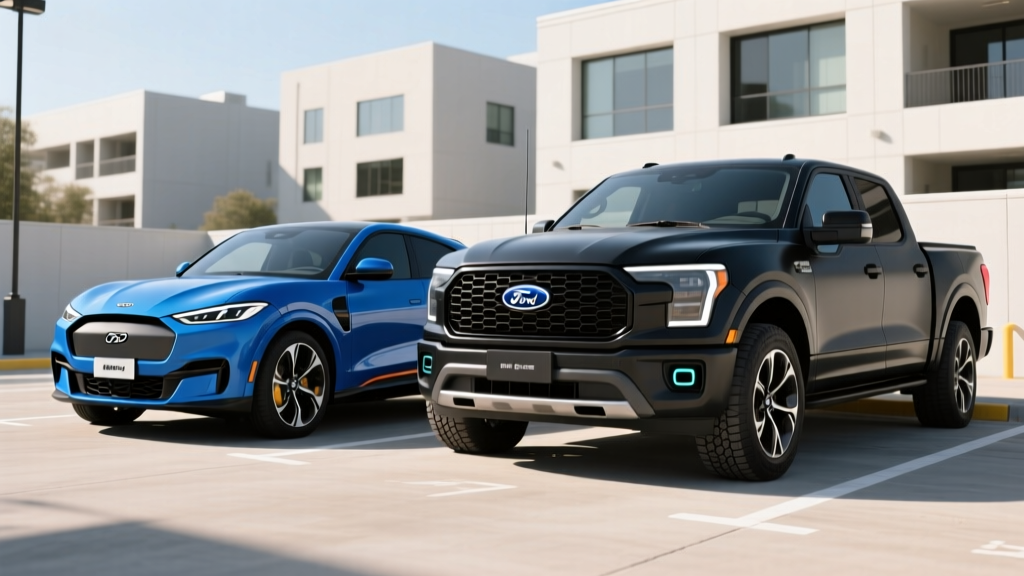
If you have been scrolling Autotrader or CarGurus lately, you have probably noticed an influx of used Ford EV deals — specifically pre-owned Mustang Mach-E crossovers and F-150 Lightning pickups. After aggressive new-vehicle leasing, fleet sell-offs, and steep depreciation curves in 2023–2025, the secondary market is now saturated with low-mileage Ford EVs at prices that undercut comparable gas models. But a cheap sticker price is only the start of the ownership equation.
Below, we run the full 5-year cost-of-ownership math on the two most common used Ford EVs, check whether you can still stack a federal tax credit on a pre-owned purchase, and compare real fuel and maintenance savings against the higher insurance premiums EVs typically carry.
Which Used Ford EVs Are Actually on the Market?
Ford has sold two mainstream battery-electric vehicles in volume: the Mustang Mach-E (a midsize crossover launched for the 2021 model year) and the F-150 Lightning (a full-size pickup launched for 2022). Both are well represented on dealer lots and private-party listings in early 2026.
| Spec | Mustang Mach-E (Extended Range, RWD) | F-150 Lightning (Extended Range, Lariat) |
|---|---|---|
| Usable Battery (kWh) | 91 kWh (NMC) | 131 kWh (NMC) |
| EPA Range | ~312 mi (2023 ER RWD) | ~320 mi (2023 Ext. Range) |
| Real-World Highway / Cold | ~250–270 mi hwy; ~220 mi cold | ~240–260 mi hwy; ~200 mi cold |
| Peak DC Fast Charge | 150 kW (10–80% ~45 min) | 150 kW (10–80% ~41 min) |
| Level 2 Home Charge (kW) | 10.5 kW (~30 mi/hr) | 19.2 kW w/ 80A charger (~52 mi/hr) |
| 0–60 mph | ~5.1 sec (RWD ER) | ~3.8 sec (Ext. Range) |
| Horsepower | 290 hp (RWD) / 346 hp (AWD) | 580 hp |
| Original MSRP (base trim) | ~$48,000–$65,000 | ~$60,000–$95,000 |
| Typical Used Price (2026) | $24,000–$38,000 | $35,000–$58,000 |
| Battery / Powertrain Warranty | 8 yr / 100,000 mi | 8 yr / 100,000 mi |
The 5-Year Total Cost of Ownership: Real Numbers
The most common mistake EV shoppers make is looking only at the purchase price. Here is a grounded 5-year / 60,000-mile ownership projection for a typical used Ford Mach-E (purchased at ~$30,000) compared to a similarly priced used gas crossover (e.g., a 2022 Ford Edge at ~$28,000, 24 MPG combined). Assumptions: 12,000 miles/year, home Level 2 charging at $0.16/kWh average, gas at $3.40/gallon.
| Category | Used Mach-E (ER RWD) | Used Gas Crossover (24 MPG) |
|---|---|---|
| Purchase Price | $30,000 | $28,000 |
| Federal Used-EV Tax Credit (§25E) | –$4,000 (if eligible) | $0 |
| Net Purchase After Credit | $26,000 | $28,000 |
| Fuel / Energy (60k mi) | $3,360 (3.5 mi/kWh × $0.16) | $8,500 (24 MPG × $3.40) |
| Maintenance (5 yr) | $1,400 | $3,800 |
| Insurance (5 yr) | $11,500 | $8,200 |
| Depreciation (5 yr) | $10,000 | $9,500 |
| Total 5-Year Cost | $52,260 | $58,000 |
| Cost Per Mile (all-in) | $0.87 | $0.97 |
The Mach-E wins on operating costs by roughly $5,740 over five years, but insurance and depreciation narrow the gap substantially. Your actual numbers depend heavily on local electricity rates, annual mileage, and whether you qualify for the used-EV credit.
Federal Tax Credits: §30D for New, §25E for Used
This is where confusion runs rampant. The $7,500 federal credit under IRS §30D applies only to new EVs. If you are buying a used Ford EV, the relevant incentive is the §25E Previously Owned Clean Vehicle Credit, worth up to $4,000 (or 30% of the sale price, whichever is lower).
- Credit amount: 30% of sale price, max $4,000
- Sale price cap: Vehicle must sell for $25,000 or less
- Vehicle age: Model year at least 2 years older than current calendar year (so 2024 or older in 2026)
- Buyer income caps (MAGI): $75,000 single / $112,500 head of household / $150,000 married filing jointly
- Dealer requirement: Must purchase from a licensed dealer (private-party sales do not qualify)
- First transfer: Must be the first qualified sale of that specific VIN since Aug 16, 2022
- Point-of-sale transfer: Available — you can apply the credit as a down-payment reduction at the dealer
What this means in practice: A 2022 Mach-E Select listed at $24,500 from a Ford dealer could net you the full $4,000 credit if your income is under the caps, dropping your effective price to $20,500. But a 2023 Mach-E Premium at $32,000 would not qualify because it exceeds the $25,000 sale-price cap. This is why the best used Ford EV deals cluster around the base Select and standard-range trims.
Rules change. Always verify current-year guidance at irs.gov and consult a tax professional for your specific situation.
Fuel Savings: $/Mile Math That Actually Holds Up
Let's run concrete numbers. The Mach-E Extended Range averages roughly 3.5 miles per kWh in mixed driving (per fueleconomy.gov). The F-150 Lightning Extended Range averages about 2.0 mi/kWh. Here is what that costs versus gasoline:
| Vehicle | Energy Source | Rate Assumption | $/Mile | Annual Cost |
|---|---|---|---|---|
| Mach-E ER (home L2) | Electricity | $0.16/kWh | $0.046 | $552 |
| Mach-E ER (DC fast only) | Electricity | $0.40/kWh | $0.114 | $1,371 |
| F-150 Lightning (home L2) | Electricity | $0.16/kWh | $0.080 | $960 |
| Gas Crossover (24 MPG) | Gasoline | $3.40/gal | $0.142 | $1,700 |
| Gas F-150 (19 MPG) | Gasoline | $3.40/gal | $0.179 | $2,147 |
Home charging is where the economics shine. At $0.16/kWh national average, the Mach-E costs roughly one-third as much per mile as a gas crossover. But if you rely exclusively on DC fast charging at $0.35–$0.48/kWh (common on Electrify America and EVgo), the savings nearly evaporate. Home Level 2 access is the single biggest determinant of EV operating-cost advantage.
Maintenance: Where EVs Quietly Save Thousands
Electric drivetrains have far fewer wear items than internal-combustion powertrains. No oil changes, no spark plugs, no timing belts, no exhaust system, and regenerative braking extends pad life dramatically.
| Service Item | Mach-E (EV) | Gas Crossover |
|---|---|---|
| Oil Changes | $0 | $600–$900 |
| Brake Pads (front + rear) | $0–$300 (regen extends life) | $600–$1,200 |
| Cabin Air Filter | $150 | $150 |
| Coolant / Fluid Service | $200 | $400 |
| Tires (EVs wear tires faster) | $1,050 (heavier vehicle) | $800 |
| Miscellaneous | $0 | $500 |
| Total (5 yr) | ~$1,400 | ~$3,050–$3,800 |
The one area where EVs cost more: tires. The Mach-E and Lightning are heavy (4,800 lb and 6,400 lb respectively), and instant torque accelerates tread wear. Budget for a tire rotation every 5,000 miles and expect replacement at 30,000–40,000 miles rather than 50,000+.
Insurance: The Cost EV Owners Often Overlook
EV insurance premiums are typically 15–30% higher than equivalent gas vehicles. According to industry data, the average annual premium for a Mach-E is $2,200–$2,500, compared to $1,500–$1,800 for a gas Ford Edge. The F-150 Lightning runs even higher at $2,400–$3,000/year.
Why the premium? Three factors:
- Higher repair costs: Battery pack damage can total a vehicle that would otherwise be repairable; high-voltage safety protocols require specialized technician training
- Parts cost: EV-specific components (power electronics, battery modules) carry higher replacement costs
- Vehicle value: Even used, the Lightning and Mach-E command higher insured values than comparable gas models
Shop quotes from EV-friendly insurers (Geico, Progressive, and State Farm all have EV-specific rating models). Some insurers offer discounts for garaged EVs with home charging. Always get a binding quote before purchase — insurance cost can swing your 5-year TCO by $2,000+.
Depreciation: Why Used Ford EV Deals Exist in the First Place
The reason you can find a 2022 Mach-E for under $28,000 is steep early depreciation. Ford EVs took a harder depreciation hit than Teslas in 2023–2025 for several reasons:
- Tesla price wars: When Tesla cut Model Y pricing by $10,000+ in 2023, it dragged down resale values across the entire EV segment
- Fleet and lease sell-offs: Large numbers of off-lease Mach-Es and Lightnings hit the market simultaneously in 2024–2025
- Charging-standard transition: Early Mach-Es and Lightnings have CCS1 ports; Ford switched to NACS for 2025+, creating buyer hesitation around older connector types (though CCS-to-NACS adapters from Ford mitigate this)
- Battery health uncertainty: Used buyers discount for unknown long-term degradation
The typical depreciation curve for a Mach-E: ~40–50% loss in the first 3 years, compared to ~30–35% for a gas crossover. However, the steepest depreciation has already occurred. From 2026 forward, expect used Ford EVs to depreciate at rates closer to the segment average — meaning buying now captures most of the depreciation benefit while still retaining reasonable resale value.
State, Local, and Utility Incentives
Common examples (verify current availability):
- Utility charger rebates: Many utilities offer $300–$1,000 toward Level 2 home charger purchase and installation
- State purchase rebates: Some states (e.g., California, Colorado, Massachusetts) offer $1,000–$4,000 in additional point-of-sale rebates for income-qualified EV buyers, including used vehicles
- HOV lane access: Several states grant carpool-lane stickers for EVs, including used purchases — a significant commuting benefit in congested metro areas
- Time-of-use rates: Utility EV-specific rate plans can drop charging costs to $0.06–$0.09/kWh during off-peak hours, dramatically improving the fuel-cost equation
Frequently Asked Questions
How much does it really cost to own a used Ford EV over 5 years?
Based on our analysis, a used Mach-E purchased at ~$30,000 (net ~$26,000 after the §25E credit) costs approximately $52,000–$55,000 all-in over 5 years and 60,000 miles, including purchase, energy, insurance, maintenance, and depreciation. That works out to roughly $0.85–$0.92/mile. A comparable gas crossover costs $55,000–$60,000 over the same period.
Do I qualify for a federal tax credit on a used Ford EV?
You may qualify for the §25E used-EV credit (up to $4,000) if: the vehicle sells for $25,000 or less, you buy from a licensed dealer, your MAGI is under $75K/$112.5K/$150K (single/HOH/MFJ), and it is the first qualifying transfer of that VIN since August 2022. The $7,500 §30D credit does not apply to used vehicles. Check IRS.gov for current rules.
How much do I save on fuel and maintenance versus a gas car?
With home Level 2 charging at $0.16/kWh, a Mach-E owner saves roughly $1,100–$1,200/year on fuel versus a 24-MPG gas crossover. Maintenance savings add another $300–$500/year (no oil changes, reduced brake wear). Combined, expect $7,000–$9,000 in operating-cost savings over 5 years. These savings shrink if you rely on expensive DC fast charging.
Are used Ford EVs more expensive to insure?
Yes, typically 15–30% more per year. A Mach-E averages $2,200–$2,500/year vs. ~$1,600 for a gas crossover. The F-150 Lightning runs $2,400–$3,000/year. Higher repair costs, specialized parts, and elevated vehicle values drive the premium. Always get a binding insurance quote before committing to a purchase.
How well do used Ford EVs hold their value?
Ford EVs experienced steep initial depreciation (40–50% in 3 years), driven by Tesla price cuts, lease sell-offs, and the CCS-to-NACS connector transition. However, the steepest drop has already occurred. From 2026 forward, expect more moderate depreciation closer to segment averages. The 8-year/100,000-mile battery warranty (which transfers to second owners) provides residual-value support.
Should I worry about the CCS charging port on older Ford EVs?
Ford provides a CCS-to-NACS adapter for 2021–2024 Mach-E and Lightning owners, enabling access to Tesla Supercharger V3 stalls (up to 150 kW for these vehicles). The adapter is typically free or low-cost through Ford dealers. While native NACS ports are more convenient, the adapter eliminates any practical charging-access limitation.