The used EV market surge of 2025-2026 has fundamentally reshaped the entry point for electric vehicle ownership. With off-lease Model 3s, Ioniq 5s, and Mach-Es flooding dealer lots at 30-50% below their original MSRP, buyers who were previously priced out of electrification now have a realistic on-ramp. But a lower sticker price is only the beginning of the ownership equation. Insurance premiums, charging infrastructure costs, battery health uncertainty, and a complex web of federal and state incentives all determine whether a used EV is genuinely cheaper to own than its gas-powered counterpart.
This guide walks through the complete 5-year cost of owning a used EV in 2026 — from the moment you sign the paperwork through five years of charging, insuring, maintaining, and eventually reselling the vehicle. Every figure is grounded in current data, and we flag exactly where costs surprise new EV owners.
The 5-Year Total Cost of Ownership: Used EV vs. Comparable Gas Car
To build a realistic comparison, we're using a representative 2023 Tesla Model 3 Long Range (purchased used in 2026 at approximately $24,000 with ~30,000 miles) against a 2023 Toyota Camry SE (purchased used at approximately $22,500 with similar mileage). Both are midsize sedans popular in the used market.
| Cost Category | Used Model 3 LR | Used Camry SE | Notes |
|---|---|---|---|
| Purchase Price | $24,000 | $22,500 | Avg. used market, Q1 2026 |
| Federal Tax Credit (§25E) | −$4,000 | $0 | Used EV credit, 30% up to $4,000 |
| Effective Purchase | $20,000 | $22,500 | After credit application |
| Fuel / Charging (5 yrs, 60k mi) | $3,900 | $7,200 | $0.13/kWh home vs. $3.40/gal gas |
| Insurance (5 yrs) | $12,500 | $8,750 | $2,500/yr EV vs. $1,750/yr gas avg. |
| Maintenance (5 yrs) | $1,800 | $4,200 | No oil changes, regen saves brakes |
| Depreciation (5 yrs) | $10,000 | $7,500 | EVs still depreciate faster on avg. |
| Total 5-Year Cost | $48,200 | $50,150 | |
| Net Savings (EV vs. Gas) | +$1,950 over 5 years | Highly dependent on insurance & electricity rates | |
The headline number: a used Model 3 saves roughly $1,950 over five years compared to a used Camry — but that margin is razor-thin and entirely dependent on your electricity rate, insurance market, and how the EV's resale value holds. Change any one of those variables and the math flips. Let's examine each line item.
Federal Tax Credits for Used EVs: §25E Rules in 2026
The IRS §25E Previously-Owned Clean Vehicle Credit is the incentive driving much of the used EV market surge. Unlike the new-vehicle §30D credit (up to $7,500), the used-EV credit provides 30% of the sale price, up to a maximum of $4,000. On a $24,000 used Model 3, that's the full $4,000 — effectively dropping the purchase to $20,000.
§25E Used EV Credit Eligibility Checklist (2026)
- Vehicle price cap: Sale price must be $25,000 or less
- Vehicle age: Must be at least 2 model years old (a 2024 or older model purchased in 2026)
- Buyer income limits: AGI must not exceed $75,000 (single), $112,500 (head of household), or $150,000 (married filing jointly)
- Dealer requirement: Vehicle must be purchased from a licensed dealer (private-party sales do not qualify)
- First transfer: The qualified sale must be the first transfer to a new owner since August 16, 2022, other than back to the original owner or a dealer
- Credit frequency: You can only claim the §25E credit once every 3 years
- Point-of-sale transfer: As of 2024, the credit can be transferred to the dealer at purchase, reducing your out-of-pocket cost immediately rather than waiting for tax filing
- Battery capacity: Vehicle must have a battery capacity of at least 7 kWh
Important caveats: The $25,000 price cap means higher-priced used EVs — like a used Model S or Rivian R1T — won't qualify. And the income limits are strict; a married couple earning $155,000 jointly gets nothing. Always verify your eligibility against the current IRS guidance before counting on this credit in your budget. Tax rules can change, and a qualified tax professional should confirm your specific situation.
For new EV purchases, the §30D credit remains available at up to $7,500, but it carries its own stringent requirements: MSRP caps ($55,000 for sedans, $80,000 for SUVs/trucks), the same income limits, and critical-mineral and battery-component sourcing rules that have disqualified several models. If you're cross-shopping new vs. used, the §25E credit on a cheaper used EV can sometimes deliver better effective savings than a partial §30D credit on a new one.
Charging vs. Gas: The Real Cost Per Mile
The fuel-cost advantage of an EV is real, but the exact savings depend heavily on how and where you charge. Here's the math using current national averages:
| Scenario | Rate | Vehicle Efficiency | Cost Per Mile |
|---|---|---|---|
| Home Level 2 (national avg.) | $0.16/kWh | 3.5 mi/kWh (Model 3 LR) | $0.046/mi |
| Home Level 2 (cheap utility, e.g., WA state) | $0.10/kWh | 3.5 mi/kWh | $0.029/mi |
| Home Level 2 (expensive utility, e.g., CA) | $0.30/kWh | 3.5 mi/kWh | $0.086/mi |
| Public DC fast charging (avg.) | $0.40/kWh | 3.5 mi/kWh | $0.114/mi |
| Gas car (28 MPG combined) | $3.40/gallon | 28 MPG (Camry SE) | $0.121/mi |
| Gas car (22 MPG combined) | $3.40/gallon | 22 MPG (truck/SUV) | $0.155/mi |
At the national average electricity rate of ~$0.16/kWh and home charging, the Model 3 costs roughly $0.046 per mile — about 62% less than the Camry at $0.121/mile. Over 12,000 miles per year, that's a savings of approximately $900 annually, or $4,500 over five years.
But notice the California row: at $0.30/kWh (common in PG&E and SCE territory during peak hours), the gap nearly closes. And if you rely exclusively on public DC fast chargers at $0.40/kWh or more, your per-mile cost is nearly identical to the gas car. Home charging access is the single biggest variable in EV fuel economics. If you can install a Level 2 home charger and charge on off-peak rates, the savings are substantial. If you're dependent on public charging, the advantage shrinks dramatically.
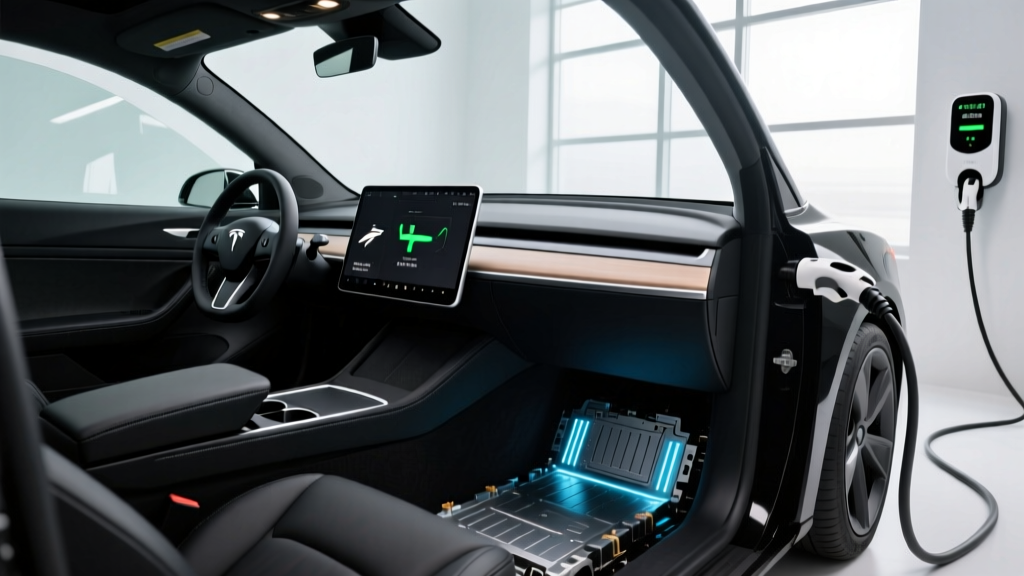
For reference, the 2023 Model 3 Long Range has a 75 kWh (usable) NMC battery with an EPA-rated 341-mile range and a combined efficiency of 132 MPGe (25 kWh/100mi). Real-world highway range at 75 mph is closer to 270-290 miles, and cold-weather range (below 30°F) can drop to 230-260 miles without preconditioning.
Maintenance Savings: Where EVs Genuinely Cost Less
This is the category where EVs consistently outperform gas cars, and the savings are not subtle.
| Service Item | EV (Model 3) | Gas Car (Camry) |
|---|---|---|
| Oil changes (every 5k-10k mi) | $0 (none needed) | $600-$900 |
| Brake pads | $0-$200 (regen extends life to 100k+ mi) | $600-$1,200 (1-2 replacements) |
| Transmission fluid | $0 (single-speed, sealed) | $150-$300 |
| Coolant flush | $0-$150 (longer intervals) | $200-$400 |
| Air filters (engine) | $0 (no engine) | $100-$200 |
| Cabin air filter | $100-$200 | $100-$200 |
| Tire rotation & replacement | $1,200-$1,800 (EVs are heavier, wear tires faster) | $900-$1,400 |
| Wiper blades, misc. | $200-$300 | $200-$300 |
| 5-Year Total | $1,500-$2,650 | $2,850-$4,900 |
The two biggest savings are oil changes (eliminated entirely) and brake wear. Regenerative braking handles the majority of deceleration in an EV, meaning the friction brakes are used far less. It's common for Tesla and Hyundai/Kia EV owners to report original brake pads at 80,000+ miles.
The one area where EVs cost more to maintain is tires. EVs are typically 500-1,000 lbs heavier than comparable gas cars due to the battery pack, and instant torque accelerates tread wear. Budget for tire replacement at 30,000-40,000 miles rather than the 50,000+ miles typical of gas sedans. A set of four Michelin all-season tires for a Model 3 runs $800-$1,100 installed.
The Insurance Reality: Why EVs Cost More to Insure
This is the line item that catches most new EV buyers off guard. EVs are typically 15-30% more expensive to insure than equivalent gas vehicles, and the reasons are structural, not temporary:
- Higher repair costs: EV battery packs are expensive to replace if damaged. Even minor collision damage near the battery enclosure can trigger a total battery replacement ($12,000-$20,000 for a Model 3), which insurers factor into premiums.
- Specialized labor: Fewer body shops have high-voltage-certified technicians, and those that do charge higher labor rates.
- Parts availability: EV-specific parts (battery modules, power electronics, drive units) have longer lead times and higher costs than mass-produced ICE components.
- Total-loss frequency: Insurers are more likely to declare a damaged EV a total loss because battery integrity is difficult to verify post-collision.
Based on 2026 rate data, expect to pay $2,200-$2,800 per year for full coverage on a used Model 3 (varies significantly by state, driving record, and age). The same driver in the same state might pay $1,500-$2,000 for a Camry. That's a $500-$1,000 annual premium gap, or $2,500-$5,000 over five years — which can erase much of the fuel savings.
Shop quotes aggressively. Tesla has its own insurance product in many states that uses real-time driving data (via the Tesla app) to set premiums, and it's often 10-20% cheaper than traditional carriers for clean-record drivers. Geico, Progressive, and State Farm have also improved their EV rate models as the fleet has grown.
Depreciation and Resale: Do Used EVs Hold Their Value?
Depreciation was the Achilles' heel of early EV ownership. Between rapid technology obsolescence, battery degradation fears, and Tesla's aggressive new-vehicle price cuts in 2023-2024, used EV values fell sharply. A 2022 Model 3 Long Range that stickered at $53,000 could be found for $22,000-$26,000 by early 2025 — a 50%+ depreciation in under three years.
However, the used EV market surge has stabilized prices in 2025-2026 as demand catches up with supply. Key factors:
- Battery health data is improving: Platforms like fueleconomy.gov and third-party services now provide battery State of Health (SoH) reports, reducing buyer uncertainty.
- Warranty coverage transfers: Federal law mandates that EV battery warranties (typically 8 years / 100,000 miles) transfer to subsequent owners. A 2023 Model 3 with 30,000 miles still has ~5 years and 70,000 miles of battery warranty remaining.
- NACS standardization: The industry-wide adoption of the North American Charging Standard (NACS) has reduced connector-related obsolescence risk for non-Tesla EVs from 2025 onward.
- Price floor established: The $25,000 price point (driven by the §25E credit cap) has created strong demand for used EVs priced at or below that threshold, establishing a price floor.
Expect a used EV purchased in 2026 for $24,000 to be worth approximately $12,000-$16,000 after five additional years of ownership (60,000 more miles). That's 33-50% retained value, which is still below the Toyota/Honda benchmark of 45-55% for gas vehicles but improving. Battery degradation is typically 10-15% over 100,000 miles for NMC chemistry and 5-10% for LFP chemistry, based on fleet data from Tesla, Hyundai, and BYD.
State, Local, and Utility Incentives
Note: State and local incentives vary enormously by jurisdiction and change frequently. The examples below are illustrative as of early 2026. Always check your state's energy office, your utility's website, and the Alternative Fuels Data Center for current programs in your area.
Beyond federal credits, many buyers can stack additional incentives:
- State rebates: California's CVRP has been replaced by newer programs targeting lower-income buyers; Colorado offers up to $5,000 in state tax credits for EVs (new and used); Massachusetts, New York, and Oregon have similar programs.
- Utility rebates: Many electric utilities offer $250-$1,000 rebates for purchasing an EV, plus additional rebates ($300-$700) for installing a Level 2 home charger. Check with your local utility — PG&E, ConEdison, Xcel Energy, and others have active programs.
- HOV lane access: Several states (CA, CO, FL, GA, MD, MN, NJ, NY, VA, WA) still offer HOV/carpool lane stickers or exemptions for EVs, though some programs are phasing out as EV adoption grows.
- Registration fee offsets: Some states charge higher annual registration fees for EVs (to compensate for lost gas tax revenue) — typically $50-$225/year. Factor this into your TCO.
- Home charging equipment: The §30C Alternative Fuel Vehicle Refueling Property Credit provides up to $1,000 (30% of cost) for home charger installation, though it has specific census-tract eligibility requirements.
When combined, these programs can knock an additional $1,000-$5,000 off the effective cost of used EV ownership, depending on where you live. A buyer in Colorado with a participating utility could see $4,000 (federal) + $3,500 (state) + $500 (utility charger rebate) = $8,000 in total incentives on a $24,000 used EV.
Decision Framework: Is a Used EV Right for You?
Choose a Used EV If:
- You have access to home or workplace Level 2 charging (this is non-negotiable for cost savings)
- Your household income is below the §25E caps ($75k single / $150k joint) and you can claim the $4,000 credit
- Your daily commute is under 80 miles round-trip (well within any used EV's real-world range)
- You drive 10,000-15,000 miles/year (higher mileage = more fuel savings to offset insurance)
- You live in a state with additional rebates or low electricity rates
- You can get competitive insurance quotes before purchasing
Stick with a Gas Car or Consider a Hybrid If:
- You rely exclusively on street parking with no charging access
- Your income exceeds the §25E credit limits (the price advantage narrows significantly)
- You regularly drive 300+ miles in a single trip in cold weather (real-world range drops 20-30%)
- Your insurance quotes come in more than 40% above your current gas-car policy
- You live in a region with high electricity rates and no off-peak charging options
Frequently Asked Questions
How much does it really cost to own an EV over 5 years?
For a used EV purchased around $24,000 in 2026, the total 5-year cost (after the $4,000 federal credit) is approximately $45,000-$52,000 depending on your electricity rates, insurance market, and annual mileage. This includes purchase price, charging, insurance, maintenance, and depreciation. In favorable conditions (cheap electricity, low insurance, state rebates), a used EV can save $2,000-$5,000 vs. a comparable gas car over 5 years. In unfavorable conditions (expensive electricity, high insurance, no charging access), it can cost $2,000-$4,000 more.
Do I qualify for the federal used-EV tax credit?
You qualify for the §25E credit (up to $4,000) if: the vehicle costs $25,000 or less, is at least 2 model years old, you buy from a licensed dealer, and your AGI is under $75,000 (single) or $150,000 (married filing jointly). You can only claim it once every 3 years. The credit can be transferred to the dealer at the point of sale for an immediate price reduction. Verify current rules at irs.gov as eligibility criteria can change.
How much do I save on fuel and maintenance?
Fuel savings are typically $600-$1,200 per year (at 12,000 miles/year and home charging on average electricity rates). Maintenance savings are typically $400-$700 per year, driven primarily by eliminated oil changes and extended brake life. Combined, expect $1,000-$1,900 in annual operating savings vs. a comparable gas sedan. However, tire costs are higher on EVs due to vehicle weight and instant torque.
Are EVs more expensive to insure?
Yes, typically 15-30% more than comparable gas vehicles. For a used Model 3, expect $2,200-$2,800/year in full-coverage premiums vs. $1,500-$2,000 for a Camry. The gap is driven by higher repair costs, specialized labor requirements, expensive battery replacements, and higher total-loss frequency. Tesla Insurance (available in many states) and competitive quoting can reduce the gap. Always get insurance quotes before committing to a purchase.
How well do EVs hold their value?
EVs have historically depreciated faster than gas cars, losing 50-60% of value in the first 3 years (vs. 35-45% for reliable gas sedans). However, the 2025-2026 used EV market surge has stabilized prices, particularly for vehicles priced under $25,000 where the §25E credit creates strong demand. Battery warranties (8 years/100,000 miles) transfer to second owners, and NACS standardization has reduced obsolescence risk. Expect a used EV purchased in 2026 to retain 33-50% of its purchase value after 5 additional years of ownership.
What should I check before buying a used EV?
Request a battery State of Health (SoH) report — many dealers and services can pull this from the vehicle's telematics. Confirm the remaining battery warranty (8 years/100,000 miles from original in-service date, federal minimum). Check for open recalls via NHTSA. Test the DC fast-charging capability at a public station. Verify which charging connector the vehicle uses (CCS, NACS, or CHAdeMO) and ensure compatibility with your local charging networks. And always get insurance quotes before finalizing the purchase.