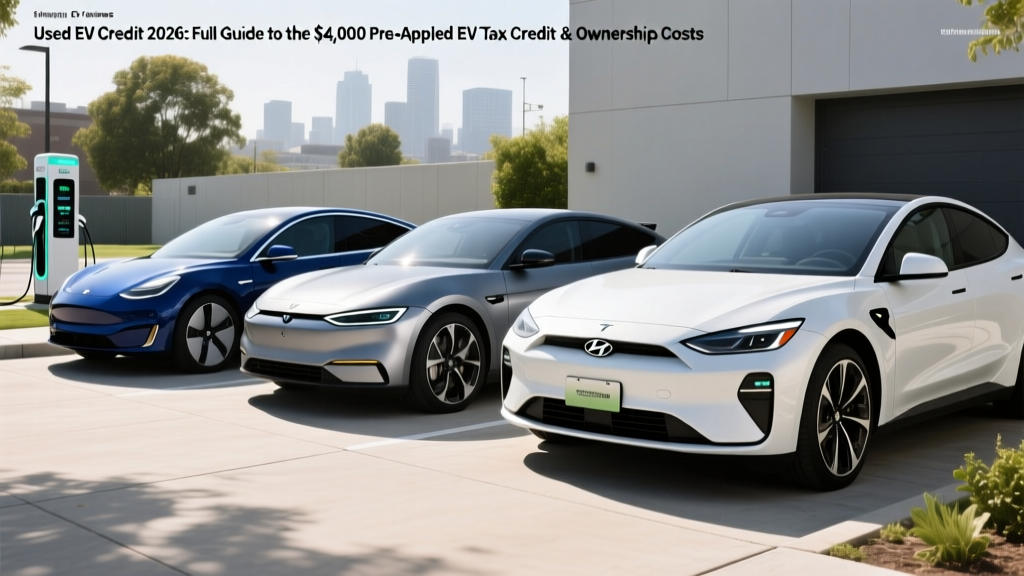
The federal ev credit for used car purchases — officially the Previously-Owned Clean Vehicle Credit under IRS §25E — has opened electrified ownership to a much wider audience since taking effect. With used EV prices settling from their 2022-2023 peaks, a qualifying pre-owned electric vehicle paired with a $4,000 tax credit can undercut comparable gas cars on total cost of ownership. But the credit comes with strict income caps, price ceilings, and dealer-reporting requirements that trip up many buyers.
This guide breaks down exactly how the used EV credit works in 2026, who qualifies, and what owning a used EV actually costs over five years — including the line items most calculators ignore.
How the Used EV Tax Credit Works Under §25E
Unlike the new-vehicle credit under §30D (which offers up to $7,500), the previously-owned clean vehicle credit provides 30% of the sale price, up to a maximum of $4,000. The vehicle must be purchased from a licensed dealer — private-party sales do not qualify.
§25E Used EV Credit Eligibility Checklist (2026)
- Maximum credit: $4,000 (or 30% of sale price, whichever is lower)
- Vehicle sale price cap: $25,000 or less (as reported by the dealer)
- Vehicle age: Model year must be at least two years before the purchase year (e.g., 2024 or older for a 2026 purchase)
- Battery capacity: Minimum 7 kWh
- Vehicle type: BEV or qualifying PHEV with GVWR under 14,000 lbs
- Income caps (MAGI): $75,000 single / $112,500 head of household / $150,000 married filing jointly
- Dealer requirement: Must be purchased from a registered dealer who files IRS Form 15400
- Transfer option: Credit can be transferred to the dealer as a point-of-sale discount (as of 2024+)
- Frequency limit: One used-EV credit per taxpayer every three years
- Clean title: Salvage or rebuilt-title vehicles do not qualify
The point-of-sale transfer is the most consequential change for used buyers. Instead of waiting until you file taxes to claim the credit, you can assign it to the dealer at purchase, reducing your drive-off price by up to $4,000 immediately. This effectively turns a $22,000 used Chevrolet Bolt EV into an $18,000 vehicle at the point of sale.
Qualifying Used EVs: What's Actually Available Under $25,000
The $25,000 sale-price cap is the tightest constraint. In 2026's used market, several models consistently land under that threshold, making them eligible for the full $4,000 credit:
| Model | Typical Used Price | Battery (kWh) | EPA Range | Credit After §25E |
|---|---|---|---|---|
| Chevrolet Bolt EV (2020-2023) | $14,000–$21,000 | 65 kWh (NMC) | 259 mi | As low as $10,000 |
| Nissan LEAF (2021-2023, 62 kWh) | $15,000–$22,000 | 62 kWh (NMC) | 212–226 mi | As low as $11,000 |
| Hyundai Kona Electric (2021-2023) | $17,000–$24,000 | 64 kWh (NMC) | 258 mi | As low as $13,000 |
| Tesla Model 3 (2018-2020, Std Range) | $19,000–$25,000 | 50–54 kWh (NCA) | 240–263 mi | As low as $15,000 |
| Volkswagen ID.4 (2021-2022) | $20,000–$25,000 | 77 kWh (NMC) | 249–260 mi | As low as $16,000 |
Real-world range note: EPA figures assume mixed driving at moderate temperatures. Expect 15–25% range reduction in sustained highway driving at 75+ mph, and 20–35% loss in sub-freezing conditions. A 259-mile Bolt EV may deliver ~195 miles on a cold Midwestern winter highway run.
5-Year Total Cost of Ownership: Used EV vs. Comparable Gas Car
To compare apples to apples, let's model a used 2022 Chevrolet Bolt EV (purchased at $20,000, net $16,000 after credit) against a 2022 Honda Civic 1.5T (purchased used at ~$20,000). Both are compact, commuter-oriented, and bought in 2026.
| Cost Category | Used Bolt EV (5 yr) | Used Civic Gas (5 yr) |
|---|---|---|
| Purchase price (after credit) | $16,000 | $20,000 |
| Fuel/charging (60,000 mi) | $3,600 | $6,750 |
| Insurance (5 yr avg) | $9,500 | $7,500 |
| Maintenance (5 yr) | $1,200 | $3,500 |
| Depreciation (est. resale) | -$6,000 | -$8,000 |
| Net 5-Year Cost | $24,300 | $29,750 |
The used Bolt EV saves roughly $5,450 over five years in this scenario. The bulk of savings come from the upfront tax credit, lower fuel costs, and reduced maintenance. Insurance partially offsets those gains.
Charging vs. Gas: The Per-Mile Math
Fuel Cost Per Mile (2026 Assumptions)
| Metric | Bolt EV | Honda Civic 1.5T |
|---|---|---|
| Efficiency | 28 kWh/100 mi (3.57 mi/kWh) | 35 MPG combined |
| Home charging cost | $0.14/kWh (national avg) | $3.50/gal (national avg) |
| Cost per mile (home) | $0.039 | $0.100 |
| Public DCFC cost | $0.38/kWh (avg) | $3.50/gal |
| Cost per mile (DCFC) | $0.106 | $0.100 |
| Annual fuel cost (12,000 mi, 80% home) | $630 | $1,200 |
The math is clear: if you charge at home most of the time, an EV costs roughly 60% less per mile to fuel. If you rely entirely on public DC fast charging at $0.35–$0.45/kWh, the advantage narrows to roughly break-even with a fuel-efficient gas car. This is why home charging access — even a standard 120V Level 1 outlet that adds ~4 miles per hour — is the single biggest predictor of EV satisfaction and cost savings.
For the Bolt EV's 65 kWh battery, a full Level 2 charge at home costs roughly $9.10 (at $0.14/kWh), yielding ~259 miles of EPA range. That same distance in the Civic at 35 MPG requires 7.4 gallons at $25.90.
Maintenance Savings: What You Actually Skip
| Maintenance Item | Bolt EV (5 yr) | Civic Gas (5 yr) |
|---|---|---|
| Oil changes | $0 | $600 (10 changes) |
| Transmission fluid | $0 (no multi-speed trans) | $200 |
| Brake pads | $0–$200 (regen extends life 2–3×) | $600 (2 sets) |
| Air filters (engine) | $0 | $150 |
| Cabin air filter | $150 | $150 |
| Coolant flush | $200 (battery thermal system) | $200 |
| Tire rotation/replacement | $800 (EVs wear tires ~15% faster) | $700 |
| Wipers, misc. | $250 | $250 |
| Total 5-Year Maintenance | ~$1,200 | ~$3,500 |
EVs eliminate oil, spark plugs, timing belts, multi-speed transmissions, and exhaust systems. Regenerative braking dramatically extends brake pad life — many EV owners report original pads at 80,000+ miles. The one area where EVs cost slightly more is tires: the instant torque and heavier curb weight (the Bolt EV weighs 3,563 lbs vs. the Civic at ~2,900 lbs) accelerate tire wear modestly.
Insurance: The Cost Category Where EVs Lose
EV insurance premiums run 15–30% higher than equivalent gas vehicles, according to industry data. The reasons are structural:
- Higher repair costs: Battery packs, power electronics, and specialized aluminum structures require certified technicians and OEM parts
- Total-loss thresholds: Minor battery enclosure damage can trigger a total-loss declaration, even when the cells are unharmed
- Parts scarcity: Older used EVs may have limited aftermarket parts availability, pushing repairs toward dealer-only channels
- Driver profile: Insurers still weight EV drivers as higher-mileage urban commuters in some actuarial models
For our Bolt EV vs. Civic comparison, expect annual premiums of ~$1,900 vs. ~$1,500 — a $2,000 gap over five years. Shop quotes from EV-friendly insurers (Geico, Progressive, and Tesla Insurance in eligible states) before purchase, as premiums vary wildly by carrier, ZIP code, and driving record.
Depreciation and Resale Value: The Trend Is Improving
Used EV depreciation was brutal in 2023–2024, when Tesla's aggressive new-car price cuts cascaded through the secondary market. A 2022 Bolt EV that sold new for ~$28,000 was fetching under $15,000 by mid-2024 — over 45% depreciation in two years.
By 2026, the depreciation curve has stabilized for several reasons:
- New EV prices have risen modestly, reducing the downward pull on used values
- Battery health data from fueleconomy.gov and third-party services shows most 4–6 year-old packs retain 88–94% of original capacity
- The §25E credit creates a price floor — dealers know a $20,000 used EV effectively costs the buyer $16,000
- NACS adoption has reduced connector-anxiety for non-Tesla used EVs (many now include adapter compatibility)
Expect a used Bolt EV purchased in 2026 for $20,000 to resell for approximately $12,000–$14,000 in 2031, representing $6,000–$8,000 in depreciation. That's competitive with gas compact cars of similar age, especially once you factor in the $4,000 credit reducing your effective purchase basis.
State, Local, and Utility Incentives Beyond the Federal Credit
Important: State and local incentives vary significantly by jurisdiction and change frequently. Always verify current programs through your state's energy office or AFDC incentive database before purchasing.
Several states and utilities stack additional incentives on top of the federal §25E credit:
- Colorado: State tax credit of up to $5,000 for used EVs under $50,000 (income-dependent) — stackable with the federal $4,000
- California (CVRP): Up to $7,000 for low-income buyers purchasing a used EV, plus utility rebates
- Utility rebates: Many utilities offer $250–$1,500 rebates for home Level 2 charger installation, and some provide off-peak charging credits worth $100–$300/year
- HOV lane access: States including California, Colorado, and Virginia grant single-occupant HOV access to qualifying EVs — a benefit worth thousands in commute-time savings
- Property/sales tax exemptions: States like Washington exempt EVs from sales tax up to a cap; others waive annual personal property tax surcharges on electrified vehicles
A Colorado buyer stacking the $4,000 federal credit with the $5,000 state credit and a $500 utility charger rebate could reduce a $20,000 Bolt EV to an effective cost of $10,500 — making it the cheapest 250+ mile vehicle on the market, new or used.
Frequently Asked Questions
Can I get the used EV credit if I buy from a private seller?
No. The §25E credit requires purchase from a licensed dealer who is registered with the IRS Energy Credits Online system and files the required seller report (Form 15400). Private-party sales, auction purchases, and dealer-to-dealer transfers do not qualify.
Does the used EV credit apply to plug-in hybrids (PHEVs)?
Yes, but only PHEVs with at least 7 kWh of battery capacity and a gross vehicle weight rating under 14,000 lbs. Many older PHEVs (like early Toyota Prius Prime or Ford Fusion Energi) have smaller batteries and may not qualify. Verify the exact battery capacity on the window sticker or manufacturer spec sheet before purchasing.
Can I claim the credit if I claimed it in a previous year?
You can only claim the §25E credit once every three years. If you claimed it on a 2024 purchase, you cannot claim it again until the 2027 tax year. Plan accordingly if you anticipate buying multiple used EVs.
How does the point-of-sale transfer actually work?
At purchase, you elect to transfer the credit to the dealer. The dealer reduces your purchase price by the credit amount (up to $4,000) and then claims the credit from the IRS. You'll need to provide your taxpayer identification number and attest that your income falls within the MAGI limits. If your income ends up exceeding the cap when you file, you must repay the credit amount to the IRS — so be honest about your projected income.
What about battery degradation on a used EV?
Most 3–5 year-old EVs with NMC chemistry show 6–12% degradation based on Recurrent Auto's fleet data. The Bolt EV's liquid-cooled 65 kWh pack typically retains 90–94% capacity at 60,000 miles. GM's battery warranty covers 8 years/100,000 miles against defects and excessive degradation (below 60% capacity), meaning a 2022 Bolt EV retains factory battery coverage through 2030. Always request a battery health report or OBD-II State of Health reading before purchasing.
Do I need a home charger to make the economics work?
Strongly recommended but not strictly required. Without home charging, you'll rely on public DC fast chargers at $0.35–$0.45/kWh, which eliminates the per-mile fuel savings over a gas car. Even a standard 120V outlet (Level 1) adds roughly 35–40 miles of range overnight — enough for most daily commutes — and costs only $0.14/kWh. A Level 2 home installation ($500–$2,000 depending on electrical panel capacity) pays for itself within 12–18 months of fuel savings.