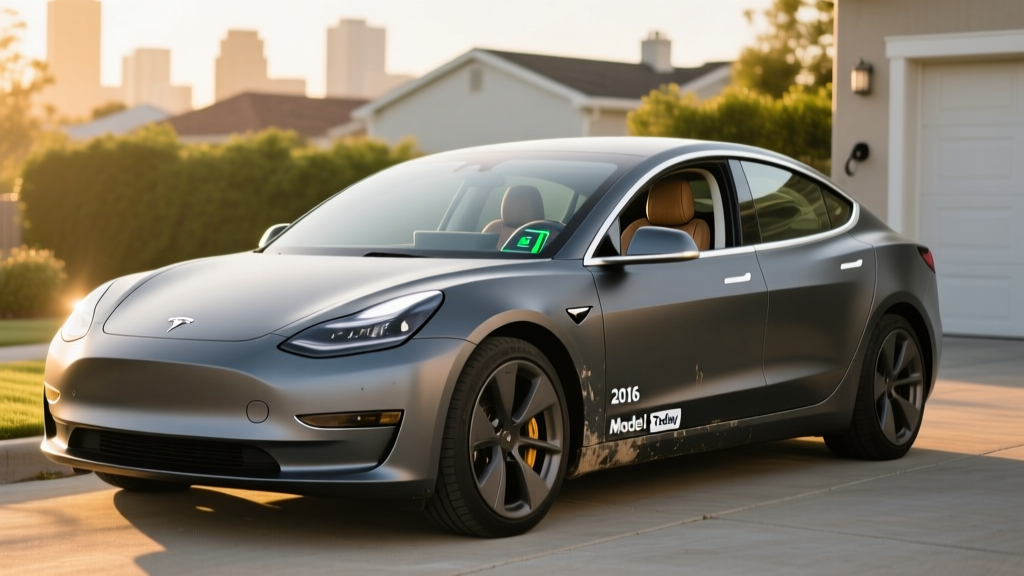
The 2016 Tesla Model 3 holds a unique place in electric vehicle history. Unveiled in March 2016 with over 400,000 reservations placed within weeks, it was the car that proved mainstream demand for EVs was real. But here's the catch: no customer actually received a 2016 Model 3. Production didn't begin until July 2017, and the first deliveries went to Tesla employees and reservation holders in the Fremont, California area. If you're searching for a "Tesla 3 2016," you're likely looking at either early 2017-2018 production models or the 2016 reveal itself. This guide covers what you need to know about buying one of these pioneering vehicles on the used market today.
The Reality of the "2016" Tesla Model 3
Tesla announced the Model 3 on March 31, 2016, at a packed event in Hawthorne, California. The $35,000 starting price and 215-mile range target generated unprecedented interest. However, Tesla's well-documented "production hell" meant the first customer vehicles rolled off the line in mid-2017 as 2018 model-year cars. When shopping the used market, you'll find:
- 2018 Model Year: The earliest customer cars, built from July 2017 onward. These are Long Range RWD variants with the 75 kWh battery.
- 2019 Model Year: Introduction of the Standard Range Plus (SR+) and Performance trims, plus the controversial panel-gap and build-quality era.
- No true 2016 model year exists in any registry or title document.
For this guide, we'll focus on the earliest production Model 3 vehicles (2018-2019 model years) — the cars born from that 2016 promise — and what buying one looks like nearly a decade later.
Battery, Range, and Real-World Efficiency
The early Long Range Model 3 uses a 75 kWh (usable) nickel-cobalt-aluminum (NCA) battery pack. Tesla never offered LFP chemistry in the US market until the 2021 Standard Range refresh, so any 2018-2019 car you find will have NCA cells — energy-dense but subject to typical lithium-ion degradation curves.
| Trim | Battery (usable) | Chemistry | EPA Range | EPA MPGe | kWh/100mi |
|---|---|---|---|---|---|
| Long Range RWD (2018) | 75 kWh | NCA | 310 mi | 130 MPGe | 26 |
| Long Range AWD (2018.5+) | 75 kWh | NCA | 310 mi | 126 MPGe | 27 |
| Performance (2018.5+) | 75 kWh | NCA | 310 mi | 120 MPGe | 28 |
| Standard Range Plus (2019) | 50 kWh | NCA (Panasonic 2170) | 240 mi | 123 MPGe | 27 |
Efficiency remains a Model 3 strong suit. At 26-28 kWh/100mi, it's one of the most efficient EVs ever sold — beating most competitors by 15-20%. This translates directly to lower charging costs and more miles per minute at a DC fast charger.
Charging Speed: DC Fast and Home Level 2
The 2018-2019 Model 3 supports CCS1 charging (via adapter for early cars, or native CCS on later 2019 builds) and Tesla's proprietary Supercharger network. Peak DC fast-charge capability is 250 kW on V3 Superchargers, though sustained rates depend heavily on battery temperature and state of charge.
| Charging Method | Power | Speed | Notes |
|---|---|---|---|
| Level 1 (120V outlet) | 1.4 kW | ~4 mi/hr | Emergency/trickle only |
| Level 2 (240V, 32A mobile connector) | 7.7 kW | ~30 mi/hr | Standard home charging |
| Level 2 (240V, 48A Wall Connector) | 11.5 kW | ~44 mi/hr | Requires hardwired 60A circuit |
| DC Fast (V3 Supercharger) | Peak 250 kW | 10-80% in ~25 min | Preconditioning required; tapers above 60% |
| DC Fast (50 kW CCS public) | 50 kW | ~180 mi/hr peak | Adapter required on 2018 models |
Charging curve reality: The Model 3's 250 kW peak is only sustained between roughly 10-30% SoC at optimal battery temperature. From 50-80%, speeds taper to 100-75 kW. A 10-80% session on a V3 Supercharger takes approximately 25-28 minutes. On older V2 (150 kW) Superchargers, expect 35-40 minutes for the same session. Always precondition the battery by navigating to a Supercharger in the car's navigation — this warms the pack for faster charging.
Performance and Driving Dynamics
Even the base 2018 Long Range RWD delivers brisk acceleration thanks to instant electric torque. The dual-motor AWD and Performance variants remain genuinely quick by any standard.
| Trim | Drivetrain | Horsepower | 0-60 mph | Top Speed |
|---|---|---|---|---|
| Long Range RWD | Rear-Wheel Drive | 283 hp | 5.1 sec | 140 mph |
| Long Range AWD | Dual-Motor AWD | 346 hp | 4.4 sec | 145 mph |
| Performance | Dual-Motor AWD | 450 hp | 3.3 sec | 162 mph |
| Standard Range Plus | Rear-Wheel Drive | 283 hp | 5.3 sec | 140 mph |
The Model 3's low center of gravity (battery pack under the floor) and near 50/50 weight distribution give it competent handling, though the ride is firm — especially on the Performance trim with its sport suspension and 20-inch wheels. Road noise is noticeable at highway speeds, a common complaint in early builds before Tesla added acoustic glass in later refreshes.
Autopilot, FSD, and Driver Assistance
Early 2018 Model 3s shipped with Tesla's Autopilot hardware suite (8 cameras, 12 ultrasonic sensors, radar on pre-2022 builds). Basic Autopilot includes Traffic-Aware Cruise Control and Autosteer (lane centering). FSD was sold as a $5,000-$12,000 add-on but remained in "beta" throughout this era. On the used market, FSD transfers with the vehicle if it was fully purchased (not subscribed) — verify this in the Tesla app before buying.
Compared to 2026 standards, early Autopilot feels dated. Lane changes require confirmation, phantom braking is documented, and the system struggles in construction zones and heavy rain. It's a competent highway cruise system, not a chauffeur.
Interior, Cargo, and Daily Practicality
The Model 3's minimalist interior was polarizing in 2018 and remains so. Everything routes through the 15-inch center touchscreen — including the speedometer, climate controls, glovebox release, and mirror adjustments. There is no instrument cluster, no heads-up display, and no physical buttons for critical functions.
| Measurement | Value |
|---|---|
| Front headroom | 40.3 in |
| Front legroom | 42.7 in |
| Rear headroom | 37.8 in |
| Rear legroom | 35.2 in |
| Trunk (rear) | 15 cu ft |
| Frunk (front trunk) | 3.1 cu ft |
| Total cargo | 18.1 cu ft (seats up) |
Rear-seat space is adequate for adults on short trips but tight for tall passengers on longer drives. The glass roof creates an airy cabin but offers no shade — solar heat gain is significant in summer. The 15 cu ft trunk is competitive with compact sedans, and the 60/40 split-folding rear seats expand utility for longer items.
Build quality note: 2018-2019 Model 3s are infamous for inconsistent panel gaps, interior rattles, paint imperfections, and water seal issues. Inspect any used example carefully, preferably with a pre-purchase inspection from a Tesla-qualified independent shop.
Pricing, Tax Credits, and Used Market Value
The original MSRP for a 2018 Long Range Model 3 was approximately $49,000 before incentives. On the 2026 used market, expect to pay:
| Trim / Year | Mileage Range | Typical Price |
|---|---|---|
| 2018 Long Range RWD | 60,000-90,000 mi | $22,000-$27,000 |
| 2018 Long Range AWD | 60,000-90,000 mi | $24,000-$29,000 |
| 2019 Performance | 50,000-80,000 mi | $26,000-$32,000 |
| 2019 Standard Range Plus | 50,000-80,000 mi | $18,000-$22,000 |
The original new-vehicle §30D credit no longer applies to used purchases. However, the §25E used-EV credit makes early Model 3s some of the best value propositions in the used EV market — provided battery health checks out.
Warranty and Long-Term Ownership Costs
The 2018 Model 3's original warranty included:
- Basic Vehicle: 4 years / 50,000 miles
- Battery & Drive Unit: 8 years / 120,000 miles (Long Range/Performance); 8 years / 100,000 miles (Standard Range)
- Battery capacity guarantee: Minimum 70% retention over the warranty period
By 2026, most 2018-2019 Model 3s are approaching or have exceeded the basic warranty. The 8-year battery warranty may still be active on lower-mileage examples — check the in-service date. If the battery drops below 70% capacity within the warranty window, Tesla will replace or refurbish it at no cost.
Out-of-warranty battery replacement for a 75 kWh Model 3 pack currently runs $12,000-$16,000 at Tesla Service Centers. Third-party EV battery shops are beginning to offer module-level repairs for $3,000-$6,000, addressing individual failed cell groups rather than full pack replacement.
Insurance costs for early Model 3s have moderated but remain above average for the compact sedan class — expect $1,800-$2,400/year depending on your profile and location. Tire wear is accelerated due to the car's weight (~4,000 lbs) and instant torque; budget for replacement every 25,000-35,000 miles.
Pros, Cons, and the Verdict
Pros
- Class-leading efficiency (26 kWh/100mi)
- Access to Tesla Supercharger network (most reliable DC network)
- Over-the-air updates still being delivered
- Strong used-EV tax credit eligibility
- Quick acceleration even in base trim
- Low running costs vs. gas equivalent
Cons
- Inconsistent build quality (panel gaps, rattles, paint)
- No physical buttons — everything on the touchscreen
- Rear seat space is tight for adults
- High insurance premiums
- Battery replacement cost if out of warranty
- Autopilot/FSD is Level 2 only, not autonomous
- No instrument cluster or HUD
Who Should Buy an Early Model 3?
Look Elsewhere If: You need spacious rear seating for car seats or tall passengers, you prefer traditional controls and instrument clusters, or you can't access home charging (public-only charging erodes the cost advantage significantly).
The early Model 3 remains one of the best value propositions in the used EV market. A 2018 Long Range at $24,000 — dropping to $20,000 after the §25E credit — delivers 250+ real-world miles, Supercharger access, and 4-second 0-60 times in AWD form. No other used EV at this price point matches the combination of range, efficiency, and charging infrastructure.
But go in with eyes open: inspect build quality thoroughly, verify battery health, budget for insurance, and understand that you're buying a 7-8 year old vehicle from Tesla's most turbulent production era. The car that launched the EV revolution is now a budget entry point — and for the right buyer, that's exactly the appeal.
Frequently Asked Questions
Does a "2016 Tesla Model 3" actually exist?
No. Tesla unveiled the Model 3 in March 2016, but production didn't begin until July 2017. The earliest customer cars are 2018 model year. Any listing claiming to be a 2016 is either mislabeled or referring to a pre-production prototype (not street-legal).
How much battery degradation should I expect on a 2018 Model 3?
Typical NCA degradation for a 2018 Model 3 at 80,000-100,000 miles is 10-15%. A car that originally had 310 EPA miles may now show 260-280 miles at 100% charge. Request a battery health report from Tesla Service or check the rated range display before buying.
Can I use non-Tesla DC fast chargers with an early Model 3?
Yes, with a CCS adapter. Tesla began including native CCS ports on Model 3 in late 2019. For 2018-early 2019 cars, you'll need a Tesla-to-CCS adapter ($150-$250 aftermarket, or Tesla's official adapter when available). The car charges at up to 150 kW on third-party CCS stations.
Is FSD worth paying extra for on a used Model 3?
Generally no — not at used-car prices. FSD was sold for up to $12,000 but delivers Level 2 functionality that competes with GM's Super Cruise and Ford's BlueCruise. Unless FSD is included in the sale price at no premium, don't pay extra for it. The subscription model ($99/month) is available if you want to try it.
What's the biggest risk in buying an early Model 3?
Out-of-warranty battery or drive unit failure. A full battery replacement runs $12,000-$16,000. Prioritize lower-mileage examples still within the 8-year/120,000-mile battery warranty, or factor replacement cost into your purchase budget.