Quick Answer: US EV Sales in August 2026
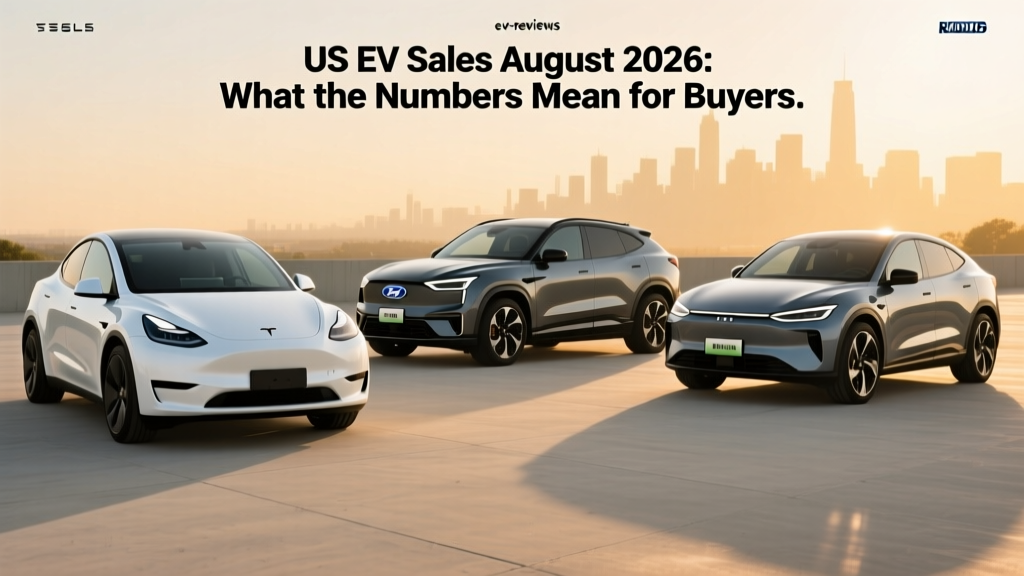
US new electric vehicle (BEV) sales in August 2026 reached an estimated 108,000–115,000 units, representing approximately 7.8–8.3% of total new light-duty vehicle sales — up from roughly 7.2% in August 2025 according to industry trackers. Plug-in hybrids (PHEVs) added another 42,000–48,000 units. The combined electrified share crossed 11% for the first time in a non-incentive-boost month. The average transaction price for a new BEV fell to approximately $48,200, narrowing the gap with the overall new-vehicle average of $46,800. For buyers, this means more competitive pricing, wider model availability, and stronger leverage at the dealership than at any point in 2025.
Why August 2026 Sales Data Matters for Your Purchase
Monthly sales figures aren't just industry scorekeeping — they directly affect what you pay, what's in stock, and how aggressively manufacturers compete on price. When US EV sales volume climbs, three things happen for buyers:
- Inventory builds: August 2026 saw days-supply for several popular BEVs (Hyundai Ioniq 5, Ford Mustang Mach-E, Tesla Model Y) stretch to 55–70 days, well above the 30-day industry target. That means dealers are motivated to negotiate.
- Incentives stack: Manufacturer discounts now layer on top of the federal §30D tax credit. Tesla, Hyundai, and Ford have all offered $1,000–$3,500 in additional manufacturer incentives on 2026 models during Q3.
- Model mix shifts: The sub-$40,000 BEV segment is growing. The Chevrolet Equinox EV (starting at $33,600 MSRP) and the base Hyundai Ioniq 5 ($42,600 before credit) are pulling volume from higher-priced competitors.
If you've been waiting for the market to tilt in the buyer's favor, August 2026 data confirms that inflection is underway.
Top-Selling EVs in August 2026: Specs and Pricing Breakdown
Here's what actually moved off lots last month, with the numbers that matter for a real purchase decision.
| Model | Est. Aug. Units | EPA Range | Battery (kWh) | Peak DC Charge | 10–80% Time | 0–60 mph | Base MSRP |
|---|---|---|---|---|---|---|---|
| Tesla Model Y (Long Range) | ~28,000 | 320 mi | 78.1 (NMC) | 250 kW | ~18 min | 4.8 sec | $46,630 |
| Tesla Model 3 (Long Range) | ~14,500 | 341 mi | 78.1 (NMC) | 250 kW | ~18 min | 4.2 sec | $42,630 |
| Hyundai Ioniq 5 (SEL) | ~7,800 | 303 mi | 77.4 (NMC) | 235 kW | ~18 min | 5.0 sec | $46,700 |
| Chevrolet Equinox EV (2LT) | ~6,500 | 319 mi | 85.0 (NMC) | 150 kW | ~30 min | 7.5 sec | $33,600 |
| Ford Mustang Mach-E (Select) | ~5,200 | 250 mi | 72.0 (LFP) | 150 kW | ~28 min | 5.8 sec | $39,995 |
| Honda Prologue (EX) | ~4,900 | 296 mi | 85.0 (NMC) | 150 kW | ~32 min | 6.5 sec | $47,400 |
| Rivian R1S (Dual Motor) | ~3,100 | 352 mi | 149.0 (NMC, Max Pack) | 220 kW | ~24 min | 4.5 sec | $79,900 |
EV vs. Gas vs. Hybrid: The August 2026 Cost Reality
Sales volume only tells half the story. The other half is whether an EV actually saves you money compared to the alternatives. Let's run the numbers on a realistic 5-year ownership scenario using a mainstream crossover comparison.
| Cost Factor (5 Years / 75,000 mi) | CHEVROLET EQUINOX EV 2LT | TOYOTA RAV4 GAS (LE AWD) | TOYOTA RAV4 PHEV (SE) |
|---|---|---|---|
| Purchase Price (MSRP) | $33,600 | $30,425 | $43,690 |
| Federal Tax Credit (§30D) | Up to $7,500* | $0 | Up to $7,500* |
| Net Effective Purchase | $26,100 | $30,425 | $36,190 |
| Fuel/Energy (75k mi) | $3,750 (home L2 avg.) | $7,875 (28 MPG avg, $2.95/gal) | $4,200 (mixed EV/gas) |
| Maintenance (5 yr) | $1,200 | $3,500 | $2,800 |
| Insurance (5 yr est.) | $9,500 | $7,200 | $8,400 |
| Depreciation (est. 5 yr) | $12,500 | $10,800 | $14,200 |
| Total 5-Year Cost | $53,050 | $59,800 | $69,290 |
*§30D eligibility requires meeting income caps ($150K single / $300K joint), MSRP caps ($55K SUVs, $55K sedans), and battery sourcing requirements. Credit can now be transferred at point of sale as a down-payment reduction. Verify current eligibility at IRS.gov. State incentives not included — check your local programs.
The Equinox EV wins on total cost primarily because the federal credit collapses the effective purchase price below the gas RAV4, and the fuel savings compound to over $4,100 across 75,000 miles. The PHEV RAV4 is the most expensive option here — its value proposition is for drivers who want electric-only commuting (42 miles EPA electric range) without range-anxiety on road trips, and who don't qualify for the full credit or want the flexibility.
Real-World Ownership: What Sales Numbers Don't Show You
August 2026 sales data reflects units delivered, not satisfaction or daily livability. Here's what you need to evaluate honestly before joining those sales figures:
Home Charging Access Is the Deciding Factor
Approximately 65% of US EV owners charge primarily at home. If you have a garage or driveway with access to a 240V outlet (or the ability to install one), an EV is seamless — you wake up every morning with a "full tank." A typical Level 2 home charger (48 amp / 11.5 kW) adds roughly 30–40 miles of range per hour, meaning any daily driving under 80 miles is trivially covered overnight.
If you live in an apartment without charging access, or street-park in a city, the calculus changes dramatically. Public DC fast charging costs 2–4× more per kWh than home electricity (typically $0.35–$0.55/kWh at Electrify America or EVgo vs. $0.12–$0.18/kWh at home). Weekly reliance on public fast charging erodes the fuel-cost advantage and adds 20–40 minutes of downtime per session.
Installation reality check: A Level 2 home charger installation runs $800–$2,500 total (equipment: $400–$700; electrician labor + permit: $400–$1,800). If your electrical panel needs an upgrade from 100A to 200A, add $1,500–$3,500. Always get a licensed electrician's assessment before committing to a vehicle.
Climate Matters More Than Marketing Suggests
Battery chemistry and thermal management determine how much range you actually lose in extreme temperatures. Lithium iron phosphate (LFP) batteries — used in the 2026 Mustang Mach-E Select and Tesla Model 3 RWD — are more resistant to degradation over time but suffer slightly worse cold-weather range loss (25–40%) compared to nickel-manganese-cobalt (NMC) packs (20–30% loss). Heat pumps, now standard on most 2026 BEVs including the Ioniq 5 and Model Y, recover 5–10% of winter range by efficiently heating the cabin without draining the traction battery as aggressively.
Common EV Buying Myths vs. the Data
| Myth | Fact (with data) |
|---|---|
| "EV batteries need replacing every few years and cost $20K." | Federal law mandates a minimum 8-year / 100,000-mile battery warranty (10 years in CARB states). Real-world degradation data shows most NMC packs retain 85–92% capacity at 100K miles. Replacement is rare under 150K miles, and costs have fallen to $8,000–$14,000 for most mainstream packs. |
| "There aren't enough chargers for road trips." | As of mid-2026, the US has over 45,000 DC fast-charging ports across networks like Tesla Supercharger (now open to NACS-equipped non-Teslas), Electrify America, and EVgo. Gaps remain in rural Montana, the Dakotas, and parts of West Virginia — but I-80, I-70, I-40, and I-10 corridors are well-covered. |
| "EVs are worse for the environment because of electricity generation." | Even on the dirtiest US grids (e.g., Wyoming, West Virginia), a BEV produces 30–45% fewer lifetime emissions than a comparable gas car per EPA analysis. On cleaner grids (Pacific Northwest, New York), the reduction exceeds 70%. |
| "I'll never save money because EVs are too expensive." | The 2026 Chevrolet Equinox EV starts at $33,600 and, with the full $7,500 §30D credit, nets $26,100 — cheaper than a base gas Honda CR-V ($31,450). The sub-$30K effective price point is now real for qualifying buyers. |
| "Charging takes too long on road trips." | Modern BEVs with 800V architecture (Ioniq 5, Kia EV6, Genesis GV60) peak at 235–350 kW and charge 10–80% in 18 minutes. Plan stops around restroom/food breaks and the downtime nearly disappears. The key limitation: sustained charge rate matters more than peak — most vehicles taper sharply above 80% SoC. |
Your Decision Framework: Should You Buy an EV in Late 2026?
Choose a BEV (full electric) if:
- You have reliable home or workplace Level 2 charging access
- Your daily driving is under 80 miles round-trip (covers ~90% of US commutes)
- You take fewer than 6 road trips over 300 miles per year
- You qualify for the §30D credit (income under $150K single / $300K joint) — the point-of-sale transfer makes the down payment significantly lower
- You want the lowest 5-year total cost of ownership and minimal maintenance
Choose a PHEV (plug-in hybrid) if:
- You lack consistent home charging but can plug in occasionally
- You regularly drive 300+ miles in a single day (rural routes, frequent long road trips)
- You live in an area with sparse DC fast-charging infrastructure
- You want electric-only commuting (typically 30–45 miles) with gas flexibility — models like the Toyota RAV4 Prime (42 mi electric) or Jeep Wrangler 4xe (22 mi electric)
Stick with a gas vehicle or HEV hybrid if:
- You have zero access to any charging (apartment, street parking, no workplace charging)
- You regularly tow over 5,000 lbs (EV towing range drops 40–55%)
- You live in an extreme cold climate (–20°F regularly) and drive long distances daily
- Your budget is under $25,000 and you need a new vehicle — the used EV market is an option, but the $4,000 used-EV credit has its own eligibility rules
What First-Time EV Buyers Should Know Before Signing
If you're about to join the growing US EV sales tally, here's the practical checklist that separates informed buyers from disappointed ones:
- Test the actual charging, not just the drive. Visit a DC fast charger during your test-own experience. Download the vehicle's app and the major network apps (Tesla, Electrify America, EVgo, ChargePoint). See how plug-and-charge works — or doesn't.
- Verify §30D eligibility before you negotiate. The credit's battery-sourcing and critical-mineral requirements eliminate some trims and model years. Check the vehicle's VIN against the fueleconomy.gov credit lookup before committing.
- Get an insurance quote before purchase. EV insurance premiums run 15–30% higher than comparable gas vehicles due to repair complexity and parts cost. For a $45,000 BEV, budget $1,800–$2,200/year depending on your state and driving record.
- Understand the charge curve. Peak charge rate (e.g., 250 kW) only applies at low state-of-charge and optimal battery temperature. Sustained rate matters more. A vehicle that peaks at 250 kW but sustains 180 kW from 10–60% will outcharge a vehicle that peaks at 250 kW but drops to 80 kW by 40% SoC.
- Budget for home charging setup. Even if installation is $1,500, it pays for itself within 12–18 months vs. public charging costs. Factor this into your total purchase budget.
Frequently Asked Questions
Are US EV sales still growing in 2026?
Yes, but the growth rate has moderated from the 50%+ year-over-year surges of 2022–2023. August 2026's BEV market share of approximately 8% represents steady, sustainable growth rather than the explosive early-adopter phase. PHEV sales are growing faster percentage-wise as mainstream buyers opt for the flexibility of plug-in hybrids.
Which EV brand sells the most units in the US?
Tesla remains the volume leader, accounting for roughly 40–45% of US BEV sales in August 2026. However, its market share has declined from 65%+ in 2022 as Hyundai/Kia, GM, Ford, and BMW have launched competitive models. The Tesla Model Y alone still outsells any single competitor, but the gap is narrowing.
Do the August sales numbers include used EVs?
No — the figures cited here cover new-vehicle deliveries only. The used EV market is substantial and growing, with models like the 2022–2023 Nissan Leaf, Chevrolet Bolt EV, and Tesla Model 3 now available between $15,000–$25,000. Used EVs may qualify for a separate $4,000 federal credit (30% of sale price, capped at $4,000) for vehicles priced under $25,000 through qualified dealers.
Is now a good time to buy, or should I wait for 2027 models?
For most buyers, late 2026 is a strong purchase window. Days-supply is elevated (buyer leverage), the §30D credit remains available through at least 2032, and the current model lineup offers more sub-$40K options than ever. Waiting for 2027 models means another 6–9 months of gas expenses and uncertain pricing. The exception: if you specifically want a next-generation model with solid-state or semi-solid-state battery technology (announced by Toyota, Nissan, and Samsung SDI for 2027–2028), holding off may be worthwhile — but these are still preliminary announcements with limited confirmed availability.
How do I check if a specific EV qualifies for the federal tax credit?
Use the official fueleconomy.gov Clean Vehicle Tax Credit lookup tool. Enter the vehicle's make, model, and VIN to confirm eligibility. Key requirements for 2026: buyer AGI under $150K (single) or $300K (joint), vehicle MSRP under $55,000 for sedans or $80,000 for SUVs/pickups, and the vehicle must meet battery-component and critical-minerals sourcing thresholds that tighten annually. The credit can be applied at point of sale as a direct reduction in your purchase price through a registered dealer.