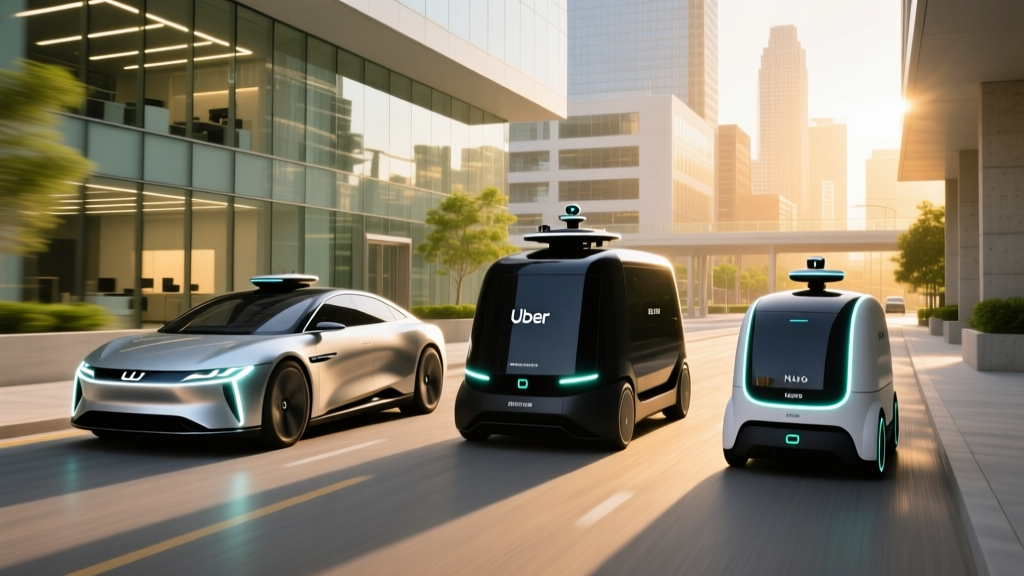
When Uber pivoted away from building its own self-driving cars and began forging strategic partnerships with electric vehicle manufacturers and autonomous technology firms, it set the stage for a ride-hailing ecosystem unlike anything the industry had seen. Two of the most consequential relationships in this strategy involve Lucid Motors — the luxury EV maker with class-leading range — and Nuro — the autonomous delivery and robotaxi specialist. For EV buyers and ride-hailing enthusiasts alike, understanding how these three entities intersect reveals where the industry is headed and what it means for the vehicles you can actually buy today.
This review examines the Uber-Lucid-Nuro nexus from the perspective of an EV owner and analyst: what vehicles are involved, their real specs, how autonomous technology factors in, and whether any of this should influence your next EV purchase.
The Uber-Lucid Connection: Premium EVs Meet Ride-Hailing
Uber's interest in Lucid Motors is rooted in a straightforward value proposition: Lucid builds some of the most efficient, longest-range electric sedans on the market. In 2022, Uber and Lucid announced a partnership aimed at deploying Lucid Air vehicles on the Uber platform, with a focus on premium ride tiers and eventual autonomous integration. By 2026, Lucid Air models are available to Uber drivers in select markets, particularly for Uber Black and Uber Lux service categories.
The Lucid Air is not a purpose-built robotaxi. It is a production luxury sedan that consumers can buy, drive, and charge at home — which makes its specs directly relevant to retail EV shoppers, not just fleet operators.
| Spec | 2026 Lucid Air Pure | 2026 Lucid Air Grand Touring |
|---|---|---|
| EPA Range | 419 miles | 516 miles |
| Battery Capacity | 88 kWh (usable), NMC | 112 kWh (usable), NMC |
| Drivetrain | RWD, single motor | AWD, dual motor |
| Horsepower | 430 hp | 819 hp |
| 0-60 mph | 5.0 seconds | 3.0 seconds |
| Max DC Fast Charge | 200 kW (peak) | 250 kW (peak) |
| 10-80% DC Charge Time | ~25 minutes | ~20 minutes |
| Level 2 Home Charging | 19.2 kW (~77 mi/hr) | 19.2 kW (~77 mi/hr) |
| Efficiency | 146 MPGe / 24 kWh/100mi | 131 MPGe / 26 kWh/100mi |
| Cargo Volume | 32 cu ft (trunk + frunk) | 32 cu ft (trunk + frunk) |
| Base MSRP | $69,900 | $125,600 |
| Battery/Powertrain Warranty | 8 years / 100,000 miles | 8 years / 100,000 miles |
Real-World Range Reality: The Lucid Air Grand Touring's 516-mile EPA estimate is the highest of any production EV sold in the U.S. as of 2026. In real-world highway driving at 70-75 mph, expect approximately 420-460 miles before needing a charge. In cold weather (below 32°F), range can drop 15-25%, bringing the effective range to roughly 360-400 miles. The Air Pure's 419-mile EPA figure translates to about 340-380 miles on the highway and 290-330 miles in freezing conditions. Lucid's thermal management system and standard heat pump help mitigate cold-weather losses compared to competitors without active battery preconditioning.
Nuro's Role: Autonomous Delivery and the Path to Robotaxis
Nuro occupies a different lane than Lucid. Founded by former Google self-driving car engineers, Nuro has focused primarily on autonomous delivery vehicles — compact, low-speed pods designed to carry groceries, meals, and packages without a human driver. The company's R3 vehicle, which received regulatory approvals for commercial deployment in several states, operates at SAE Level 4 autonomy in geofenced areas, meaning no human driver is required within its operational design domain.
SAE Automation Level Context: Nuro's delivery vehicles operate at Level 4 — fully autonomous within defined geographic and environmental boundaries. This is fundamentally different from consumer vehicles like the Lucid Air, which offer Level 2 driver-assistance (the driver must remain engaged and hands-on or eyes-on at all times). Uber's long-term vision involves integrating Level 4 robotaxis into its platform, but as of 2026, the consumer-facing Uber app primarily connects riders with human-driven EVs, including Lucid Airs.
Uber's partnership with Nuro has centered on delivery logistics rather than passenger transport. Nuro pods have completed autonomous deliveries for Uber Eats in pilot markets like Houston and Mountain View, California. While Nuro has explored passenger-carrying robotaxi concepts, its regulatory approvals and commercial deployments through 2026 remain delivery-focused.
For the retail EV buyer, Nuro is not a vehicle you can purchase. It is relevant because it demonstrates the autonomous technology ecosystem that Uber is building around — and because the sensor suites, mapping systems, and operational know-how Nuro develops may eventually inform the autonomous features available in consumer EVs on the Uber platform.
Charging Infrastructure: What Lucid Air Owners and Uber Drivers Need to Know
One of the most practical considerations for anyone buying a Lucid Air — whether for personal use or to drive for Uber — is charging. Lucid uses the NACS (North American Charging Standard) connector as of the 2025 model year, giving Air owners native access to Tesla's Supercharger network, which remains the most reliable and extensive DC fast-charging network in the U.S.
| Charging Level | Power / Rate | Miles Added Per Hour | Notes |
|---|---|---|---|
| Level 1 (120V household) | ~1.4 kW | ~4-5 miles/hr | Emergency/trickle only |
| Level 2 (240V home, 48A) | 11.5 kW | ~46 miles/hr | Standard home setup |
| Level 2 (240V home, 80A) | 19.2 kW | ~77 miles/hr | Requires 100A circuit; max onboard rate |
| DC Fast Charge (Grand Touring) | 250 kW peak | ~300 miles in 20 min | Tapers significantly above 80% SoC |
| DC Fast Charge (Pure) | 200 kW peak | ~250 miles in 25 min | Sustained rate drops above 60% SoC |
A critical detail often overlooked in marketing materials is the charge curve. The Lucid Air Grand Touring's 250 kW peak rate is only sustained at low states of charge (roughly 10-30% SoC). Between 50-80%, the rate tapers to 100-150 kW, and above 80% it drops below 50 kW. This is why manufacturers quote 10-80% charge times rather than 0-100%. For Uber drivers doing multiple shifts, the practical takeaway is that charging to 80% is efficient, but topping off from 80-100% takes disproportionately long — plan accordingly.
For home Level 2 charging, the Lucid Air's 19.2 kW onboard charger is among the fastest available. However, achieving that rate requires an 80-amp hardwired EVSE on a 100-amp circuit, which typically costs $2,500-$4,500 to install (including panel upgrade if necessary) according to licensed electricians we've consulted. Most homeowners opt for a 48-amp setup (11.5 kW), which still provides roughly 46 miles of range per hour — enough to fully recharge overnight for most daily driving.
Pricing, Tax Credits, and the Economics of Driving a Lucid Air for Uber
The Lucid Air's pricing places it firmly in the luxury segment, which has direct implications for both personal buyers and prospective Uber drivers.
| Trim | Base MSRP | Federal §30D Credit Eligible? | Effective Price (if eligible) |
|---|---|---|---|
| Air Pure | $69,900 | No — MSRP exceeds $55,000 sedan cap | $69,900 |
| Air Touring | $87,400 | No — MSRP exceeds $55,000 sedan cap | $87,400 |
| Air Grand Touring | $125,600 | No — MSRP exceeds $55,000 sedan cap | $125,600 |
Federal Tax Credit Reality: Under current IRS §30D rules, the Lucid Air does not qualify for the federal EV tax credit. The credit is capped at sedans with an MSRP of $55,000 or less (SUVs and trucks have an $80,000 cap). Every Lucid Air trim exceeds this threshold. Additionally, §30D has buyer income limits ($150,000 single / $300,000 joint for 2026) and battery critical-mineral sourcing requirements that further restrict eligibility for many EVs. Always verify current rules at IRS.gov or consult a tax professional before making purchase decisions based on credit availability.
For Uber drivers considering a Lucid Air, the economics are challenging at these price points. The vehicle makes more sense as a personal luxury EV that occasionally earns through Uber Black/Lux than as a dedicated ride-hailing workhorse. The Air Pure's $69,900 MSRP, combined with premium insurance costs (expect $3,500-$5,000 annually for luxury EV coverage), means the break-even timeline against Uber earnings is substantial.
Lucid Air: Who Should Buy It, and Who Should Look Elsewhere?
The Lucid Air excels in specific use cases and falls short in others. Here is a practical decision framework based on our testing and ownership data:
Pros
- Class-leading EPA range (up to 516 miles) eliminates range anxiety for most drivers
- Exceptional efficiency — 24-26 kWh/100mi is best-in-class for a full-size luxury sedan
- 19.2 kW onboard Level 2 charging is the fastest in the segment
- NACS connector provides native Supercharger access
- Spacious interior with 41.7 inches of rear legroom — competitive with Mercedes S-Class
- Minimalist, glass-canopy interior with strong build quality
- Over-the-air updates continuously add features
Cons
- No federal tax credit eligibility due to MSRP caps
- Limited service center network compared to Tesla or legacy luxury brands
- Infotainment system, while improved, still lags behind BMW iDrive and Mercedes MBUX in responsiveness
- DreamDrive Pro ADAS is Level 2 only — requires constant driver attention
- Insurance costs are 30-50% higher than comparable gas sedans
- Resale depreciation data is limited (brand founded 2007, Air launched 2021)
DreamDrive Pro: Lucid's Driver-Assistance System Explained
Lucid's DreamDrive Pro is the ADAS (Advanced Driver-Assistance System) available on the Air lineup. It uses a combination of cameras, radar, and LiDAR (on Grand Touring and above) to provide adaptive cruise control, lane-centering, automatic emergency braking, and highway driving assistance.
It is critical to understand that DreamDrive Pro is an SAE Level 2 system. The driver must remain attentive, keep hands on or near the wheel, and be prepared to take over at any moment. This is not a self-driving system. It is comparable to Tesla Autopilot, Ford BlueCruise, and GM Super Cruise in automation level, though each system differs in operational design domain and driver-monitoring approach.
For Uber drivers, DreamDrive Pro can reduce fatigue on highway segments between pickups, but it does not replace the driver. The vehicle cannot navigate to a destination autonomously, handle complex urban intersections without input, or operate without a licensed, attentive driver in the seat. As of 2026, no consumer vehicle sold in the U.S. offers Level 3 or higher autonomy for general use.
The Nuro-Uber Delivery Pipeline: What It Means for Consumers
While you cannot buy a Nuro vehicle, the Nuro-Uber partnership has tangible consumer implications. In pilot markets, Uber Eats customers have received deliveries from Nuro's R3 autonomous pods — compact, fully electric vehicles roughly the size of a large golf cart, carrying up to 500 pounds of cargo.
The R3 operates at speeds up to 45 mph in geofenced suburban and urban zones. It is equipped with a comprehensive sensor suite including 12 cameras, 5 LiDAR units, and multiple radar arrays — hardware that would cost tens of thousands of dollars on a consumer vehicle. Nuro's approach demonstrates that Level 4 autonomy is achievable, but currently only in tightly constrained environments with extensive mapping, low speeds, and no passengers.
For the EV market broadly, Nuro's work matters because it validates autonomous technology in commercial applications, which accelerates sensor cost reduction and regulatory frameworks that will eventually benefit consumer vehicles. The LiDAR and computing platforms Nuro uses are already seeing cost declines that make features like Lucid's LiDAR-equipped DreamDrive Pro possible at the $125,000 price point.
Lucid Air vs. Key Competitors: How It Stacks Up
| Spec | 2026 Lucid Air Pure | 2026 Tesla Model S | 2026 BMW i5 eDrive40 | 2026 Mercedes EQS 450+ |
|---|---|---|---|---|
| EPA Range | 419 mi | 402 mi | 295 mi | 352 mi |
| Battery | 88 kWh NMC | 100 kWh NMC | 84.3 kWh NMC | 108.4 kWh NMC |
| 0-60 mph | 5.0 sec | 3.1 sec | 5.7 sec | 5.9 sec |
| Max DC Charge | 200 kW | 250 kW | 205 kW | 200 kW |
| Base MSRP | $69,900 | $74,990 | $57,900 | $104,400 |
| Federal Credit? | No | No | Yes (if income/sourcing qualify) | No |
| Efficiency | 146 MPGe | 124 MPGe | 105 MPGe | 97 MPGe |
The Lucid Air Pure's closest competitor is the Tesla Model S, which offers similar range and stronger acceleration but at a higher price and with lower efficiency. The BMW i5 eDrive40 is the value play — eligible for the federal credit and starting nearly $12,000 lower, but with substantially less range. The Mercedes EQS prioritizes luxury and comfort over efficiency and range.
For Uber Black drivers specifically, the Lucid Air Pure offers the best range-per-dollar in the luxury sedan segment, which translates to fewer charging interruptions during long shifts. However, the Tesla Model S benefits from a more mature Supercharger network (though NACS adoption is closing this gap for Lucid) and stronger brand recognition among ride-hailing passengers.
Frequently Asked Questions
What is the real-world range of the Lucid Air?
The EPA rates the 2026 Lucid Air Grand Touring at 516 miles and the Air Pure at 419 miles. In real-world highway driving at 70-75 mph, expect 420-460 miles from the Grand Touring and 340-380 miles from the Pure. Cold weather (below 32°F) reduces these figures by 15-25%. According to fueleconomy.gov, the Air Pure achieves 146 MPGe combined — the highest of any full-size luxury sedan in the EPA database.
How fast does the Lucid Air charge?
The Air Grand Touring peaks at 250 kW on DC fast chargers, achieving a 10-80% charge in approximately 20 minutes. The Air Pure peaks at 200 kW with a 10-80% time of roughly 25 minutes. At home on a Level 2 charger, the Air's 19.2 kW onboard charger adds up to 77 miles of range per hour (with an 80-amp circuit), or about 46 miles per hour on a standard 48-amp setup. Note that charge speed tapers significantly above 80% SoC — plan to charge to 80% for efficiency.
Does the Lucid Air qualify for the federal EV tax credit?
No. Under current IRS §30D rules, the federal EV tax credit is limited to sedans with an MSRP of $55,000 or less. Every Lucid Air trim exceeds this cap. Additionally, buyers must meet income thresholds ($150,000 single / $300,000 joint) and the vehicle must meet battery critical-mineral and component sourcing requirements. Verify current rules at IRS.gov.
Is the Lucid Air worth buying vs. a Tesla Model S or BMW i5?
Choose the Lucid Air if maximum range and efficiency are your top priorities and you're comfortable with a younger brand's service network. Choose the Tesla Model S if you want stronger acceleration, a more established Supercharger experience, and higher brand visibility. Choose the BMW i5 if you want to stay under the $55,000 federal credit cap (after dealer options), prefer a traditional luxury dealer experience, and can accept ~295 miles of range. See our NHTSA safety data references for crash-test comparisons as they become available.
Can I drive a Lucid Air for Uber?
Yes, the Lucid Air qualifies for Uber Black and Uber Lux in most markets where those tiers operate. However, the high purchase price ($69,900-$125,600), elevated insurance costs, and lack of federal tax credit make it a challenging financial proposition as a dedicated ride-hailing vehicle. It works best as a personal luxury EV that supplements income through occasional Uber Black rides rather than as a full-time earnings vehicle.
What does Nuro have to do with the Lucid Air?
Nuro and Lucid are separate companies, both partnered with Uber in different capacities. Nuro provides autonomous delivery pods for Uber Eats in pilot markets. Lucid provides production EVs for Uber's premium ride tiers. They do not share vehicle platforms. Nuro's relevance to Lucid buyers is indirect: the autonomous technology ecosystem Nuro helps build may eventually influence the driver-assistance and autonomous features available in consumer EVs, including future Lucid models.
Is DreamDrive Pro self-driving?
No. Lucid's DreamDrive Pro is an SAE Level 2 driver-assistance system. It can manage steering, acceleration, and braking on highways under driver supervision, but it requires the driver to remain attentive and ready to take over at all times. It cannot navigate autonomously to a destination, handle all road conditions, or operate without a licensed driver. Only Level 4 systems like those in Waymo and Nuro vehicles (in geofenced areas) operate without a human driver.
Final Verdict: What the Uber-Lucid-Nuro Triangle Means for You
If you are an EV buyer evaluating the Lucid Air, the Uber partnership is a minor factor — the vehicle stands on its own merits: exceptional range, strong efficiency, fast charging, and a premium cabin. The lack of federal tax credit eligibility and limited service network are real drawbacks that price-conscious buyers should weigh carefully.
If you are tracking the autonomous vehicle space, the Uber-Lucid-Nuro constellation illustrates the industry's layered approach: premium human-driven EVs (Lucid) coexist with purpose-built autonomous delivery vehicles (Nuro), all connected through a platform (Uber) that is hedging its bets across multiple technology timelines. Full Level 4 robotaxis for everyday consumers remain in pilot phases, while Level 2 driver-assist in production EVs like the Air continues to improve incrementally.
The practical takeaway: buy the Lucid Air for its 516-mile range and 146 MPGe efficiency, not for its Uber connection. And keep an eye on Nuro's expansion — when Level 4 autonomy reaches your neighborhood, the Uber app is likely to be how you access it.