What Is the Uber Go Electric Grant — and Is It Still Available?
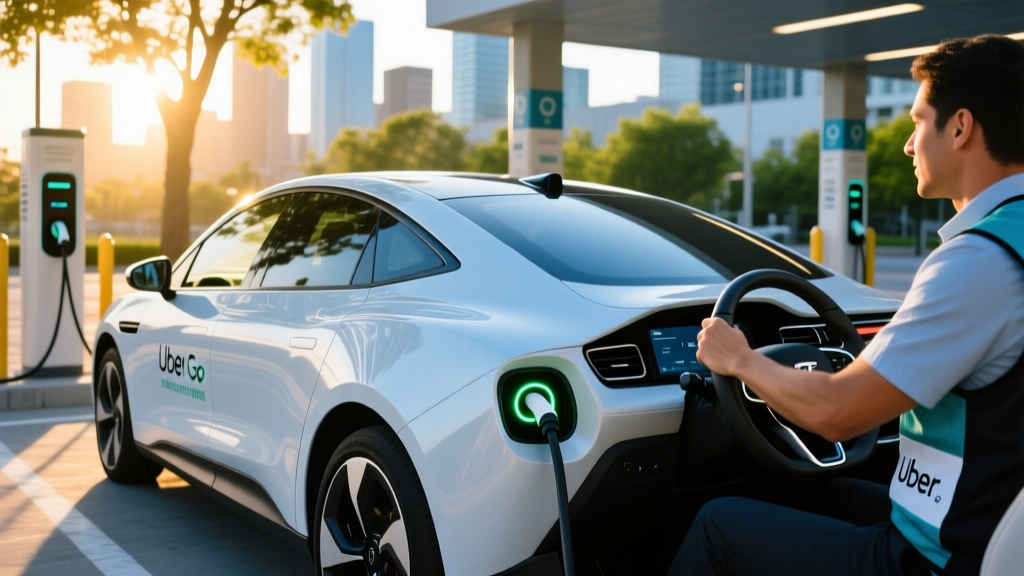
Short answer: The Uber Go Electric grant was a limited-time incentive program that offered qualifying Uber drivers cash rebates (typically up to $1,000–$1,500 depending on market) to switch to a battery-electric vehicle. Uber has run various iterations of this program in partnership with local utilities, city governments, and environmental organizations in select US metro areas. As of 2026, Uber's EV incentive programs have evolved — drivers should check the Uber Sustainability page and their driver app for current offers in their city. However, the broader financial case for going electric as a rideshare driver is stronger than ever when you combine federal §30D tax credits, state rebates, and fuel savings.
If you drove for Uber between 2021 and 2024, you may have seen promotions for the Go Electric grant in markets like Los Angeles, San Francisco, Seattle, or New York. These grants were designed to lower the upfront barrier to EV adoption for drivers who put in 30,000–50,000 miles per year — the exact mileage profile where EVs deliver the biggest cost-per-mile advantage over gasoline.
Here's what mattered about those programs and what you need to know now to make the EV math work as a rideshare driver in 2026.
EV vs. Gas: The Real Cost-Per-Mile for Rideshare Drivers
Rideshare economics come down to one number: cost per mile driven. Whether you're behind the wheel of a Toyota Camry or a Tesla Model 3, every mile you put on the car either earns you profit or eats into it. Let's compare a typical gas midsize sedan against a popular EV used for rideshare duty.
| Metric | 2026 Hyundai Ioniq 6 SE (EV) | 2026 Toyota Camry LE (Gas) |
|---|---|---|
| Base MSRP | $38,650 | $29,495 |
| EPA Efficiency | 140 MPGe combined (25 kWh/100mi) | 32 MPG combined |
| Fuel/Energy Cost per Mile | $0.04–$0.06 (home L2) / $0.10–$0.14 (public DCFC) | $0.11 (at $3.50/gal) |
| Annual Fuel Cost (40k mi) | $1,600–$2,400 (home) / $4,000–$5,600 (public) | $4,375 |
| Estimated Maintenance/Year | $400–$600 | $900–$1,200 |
| EPA Range | 361 miles | ~480 miles (14.5-gal tank) |
| IRS §30D Tax Credit | Up to $7,500 (eligibility varies) | $0 |
Sources: fueleconomy.gov, manufacturer spec sheets. Energy costs based on $0.14/kWh national average residential rate and $0.40/kWh average public DCFC rate. Gas at $3.50/gallon.
The numbers tell a clear story if you can charge at home. At 40,000 miles per year — typical for a full-time rideshare driver — an EV charged on a Level 2 home charger saves roughly $2,000–$2,800 annually on energy alone compared to a 32-MPG gas sedan. Add in lower maintenance (no oil changes, fewer brake replacements thanks to regenerative braking, no transmission fluid), and total annual savings can reach $3,000–$3,500.
But if you're entirely dependent on public DC fast charging at $0.35–$0.50/kWh, that energy advantage shrinks dramatically — and in some markets, disappears entirely. This is the single most important variable in your EV decision as a rideshare driver.
Total Ownership Cost: 3-Year Rideshare Breakdown
Let's model three years and 120,000 miles of rideshare driving — a realistic lifecycle for a driver considering whether to go electric.
| Cost Category (3 Years / 120k mi) | EV (Home Charging) | EV (Public DCFC Only) | Gas Sedan (32 MPG) |
|---|---|---|---|
| Vehicle Purchase (after incentives) | $31,150 (with $7,500 §30D) | $31,150 (with $7,500 §30D) | $29,495 |
| Fuel / Energy | $5,400 | $14,400 | $13,125 |
| Maintenance | $1,500 | $1,500 | $3,300 |
| Insurance (avg) | $7,200 | $7,200 | $5,400 |
| Tires (high mileage) | $2,400 | $2,400 | $1,800 |
| Home Charger Install | $1,200–$2,000 | $0 | $0 |
| Total 3-Year Cost | $48,850–$49,650 | $56,650 | $53,120 |
| Cost per Mile | $0.41 | $0.47 | $0.44 |
Key takeaways from this breakdown:
- Home charging is non-negotiable for savings. The EV with home charging beats gas by about $0.03/mile — roughly $3,600 over 120,000 miles. Without home charging, the EV actually costs more per mile than the gas car.
- Insurance is the hidden EV tax. EV insurance premiums run 15–30% higher than comparable gas vehicles, according to industry data. Factor this into your budget.
- Tire wear is real. EVs are heavier (the Ioniq 6 weighs ~4,500 lbs vs. the Camry at ~3,300 lbs) and deliver instant torque. Expect to replace tires every 25,000–35,000 miles instead of 40,000–50,000.
- The §30D tax credit is the great equalizer on purchase price. If you qualify for the full $7,500, the EV's higher MSRP essentially disappears at the point of sale.
Federal Tax Credits and Incentives: What Rideshare Drivers Qualify For
The Uber Go Electric grant was a supplemental, market-specific program. The backbone of EV affordability for any rideshare driver in 2026 is the federal IRS §30D Clean Vehicle Credit. Here's what you need to know:
- Maximum credit: $7,500 for new qualifying EVs; up to $4,000 for qualifying used EVs (the §25E credit).
- Income caps: Modified adjusted gross income (MAGI) must not exceed $150,000 (single), $225,000 (head of household), or $300,000 (joint) for new EVs. Used-EV credit caps are half those amounts.
- MSRP caps: Vans, SUVs, and pickups up to $80,000; sedans and other vehicles up to $55,000.
- Battery sourcing: The vehicle must meet critical-mineral and battery-component requirements that tighten each year. Check the latest list at fueleconomy.gov.
- Point-of-sale transfer: As of 2024, you can transfer the credit to the dealer at purchase, reducing your out-of-pocket cost immediately — you don't have to wait until tax filing.
- Business use consideration: If you drive for Uber as an independent contractor, the vehicle may qualify as a business asset. Consult a tax professional about whether §30D or commercial EV credits (§45W) apply to your situation, as you generally cannot claim both.
Some states layer on additional incentives — California's CEC and CARB programs, Colorado's state tax credit, and various utility rebates can add $1,000–$5,000 on top of federal credits. Check your state's energy office and local utility for current programs.
Best EVs for Rideshare Duty in 2026
Not every EV is suited for the rigors of rideshare driving. You need range to minimize charging downtime, rear-seat comfort for rider ratings, fast DC charging to get back on the road, and a price that works with rideshare margins. Here are the top contenders:
| Model | EPA Range | Battery | DC Fast Charge (10–80%) | Base MSRP | §30D Eligible |
|---|---|---|---|---|---|
| 2026 Tesla Model 3 Long Range | 363 mi | 79 kWh (NMC) | ~250 kW peak, ~25 min | $42,490 | Yes (verify sourcing) |
| 2026 Hyundai Ioniq 6 SE | 361 mi | 77.4 kWh (NMC) | ~240 kW peak, ~18 min | $38,650 | Yes (verify sourcing) |
| 2026 Chevrolet Equinox EV 3RS | 319 mi | 85 kWh (NMC) | ~150 kW peak, ~30 min | $36,900 | Yes (verify sourcing) |
| 2026 Tesla Model Y Long Range | 320 mi | 79 kWh (NMC) | ~250 kW peak, ~25 min | $44,990 | Yes (SUV MSRP cap) |
Real-world range caveat: Expect 10–20% less than EPA on highway-heavy driving at 70+ mph. In freezing temperatures, reduce by an additional 15–30% depending on whether the vehicle has a heat pump (Tesla and Hyundai do; this helps significantly). For a 40,000-mile/year driver, plan your charging around ~270–300 miles of usable range in mixed conditions.
Charging Strategy: The Make-or-Break Factor
Your charging access determines whether an EV saves you money or costs you more than a gas car. Here's the hierarchy for rideshare drivers:
Best case — Level 2 home charging (240V, 32–48A): A 7.7–11.5 kW home charger adds roughly 25–44 miles of range per hour. Overnight (8 hours), you can fully replenish 200–300+ miles — enough for a full day of driving. Installation costs $500–$2,000 depending on your electrical panel. At $0.14/kWh average residential rates, this is the cheapest fuel you'll ever buy.
Workable — Depot or fleet charging: Some Uber markets partner with charging networks like EVgo or ChargePoint to offer discounted rates for drivers. If your city has a depot-charging option at $0.20–$0.25/kWh, the math still works.
Expensive — Public DC fast charging only: At $0.35–$0.55/kWh ( Electrify America, EVgo, Tesla Supercharger rates vary), your per-mile energy cost can match or exceed gasoline. Use DCFC for mid-day top-ups, not as your primary strategy.
Charging curve reality check: When you see "250 kW peak charging," understand that this is the maximum rate at a low state of charge (typically 10–30% SoC). Charging slows progressively above 50% and drops sharply above 80%. A 10–80% session on a 250 kW-capable vehicle takes 18–30 minutes depending on battery temperature and preconditioning. Plan your charging stops around 10–80% to minimize time off the road.
Common Misconceptions About EVs for Rideshare
| Myth | Fact |
|---|---|
| "The battery will die before 100,000 miles." | Modern NMC and LFP batteries are warrantied for 8 years/100,000 miles with a minimum 70% capacity retention (most manufacturers). Real-world data shows typical degradation of 8–12% at 100,000 miles. High-mileage Teslas have exceeded 200,000 miles with 85%+ SoH. |
| "EVs are more expensive to insure and repair after accidents." | Insurance premiums are higher (15–30%), but this is factored into the TCO above. Collision repair costs can be higher due to battery proximity, but EVs have fewer mechanical failure points. |
| "I'll spend too much time charging during shifts." | With home overnight charging, most drivers start each shift at 90–100% SoC. A 15–20 minute DCFC top-up during a meal break adds 120–180 miles — enough for the rest of a shift. |
| "Riders don't care what car I drive." | Uber's EV badge and Green Future program give EV drivers preferential matching in some markets and a $1/mile bonus in select cities. Riders in premium tiers (Comfort, Black) also rate EVs higher for quietness and smoothness. |
| "I can't drive an EV in winter." | Cold weather reduces range by 15–30% (worst case: short trips with frequent cabin heating). A heat-pump-equipped EV like the Tesla Model 3 or Hyundai Ioniq 6 reduces this penalty. Preconditioning while plugged in preserves range. |
Decision Framework: Should You Go Electric for Rideshare?
Choose an EV if:
- You have access to Level 2 home charging (garage, driveway, or apartment building with EV infrastructure)
- You drive 30,000+ miles per year — the fuel savings compound with mileage
- You qualify for the §30D tax credit (check income caps and vehicle eligibility at irs.gov)
- Your market offers utility rebates or Uber EV bonus programs
- You plan to keep the vehicle 3+ years (to recoup the higher upfront cost through savings)
Stick with gas or a hybrid if:
- You cannot install or access reliable Level 2 charging at home or a depot
- You drive fewer than 20,000 miles per year (savings don't offset higher purchase price and insurance)
- You live in an area with limited public charging infrastructure and extreme winter temperatures
- You need maximum flexibility for long road trips outside your metro area without planning charging stops
- You don't qualify for federal or state incentives due to income or vehicle sourcing requirements
Consider a PHEV as a middle ground if:
- You want some electric-only driving for short trips but gas flexibility for longer hauls
- A PHEV like the Toyota Prius Prime (44 miles electric-only, 52 MPG combined on gas) gives you partial savings without range or charging anxiety
Frequently Asked Questions
Does Uber still offer the Go Electric grant in 2026?
Uber's EV incentive programs evolve by market and year. The original Go Electric grant was a limited rollout. Check the Uber driver app under "Earnings > Promotions" and Uber's sustainability page for current offers in your city. Many markets now offer EV per-trip bonuses ($0.50–$1.00 extra per ride) rather than upfront grants.
Can I use the §30D tax credit if I drive for Uber as a 1099 contractor?
Generally, §30D is a personal-use credit. If the vehicle is used primarily for business (more than 50% business miles), you may need to explore the commercial clean vehicle credit (§45W) instead, which has different rules. You typically cannot claim both. Consult a tax professional who understands rideshare taxation — this is not a DIY determination.
How much does home Level 2 charger installation cost?
A 48-amp Level 2 charger (like the ChargePoint Home Flex or Tesla Wall Connector) costs $500–$700 for the unit. Professional installation by a licensed electrician ranges from $500–$1,500 if your panel has capacity. If you need a panel upgrade (from 100A to 200A service), add $1,500–$3,000. Total: $1,000–$2,200 for most homes, or up to $5,000 if a panel upgrade is needed.
Will my EV battery last through 150,000+ miles of rideshare driving?
Likely yes, with some capacity loss. Federal law mandates that EV battery warranties cover at least 8 years/100,000 miles with a minimum 70% capacity retention threshold. Real-world fleet data from high-mileage drivers shows most modern NMC batteries retain 80–88% capacity at 100,000 miles. LFP batteries (found in some Tesla Model 3 Standard Range vehicles) show even less degradation but offer shorter total range. At 150,000 miles, expect 75–85% remaining capacity — still very usable for daily rideshare shifts.
What's the cheapest EV that qualifies for the full $7,500 tax credit?
As of early 2026, the Chevrolet Equinox EV (starting ~$36,900 before credit) and certain configurations of the Tesla Model 3 are among the most affordable new EVs that may qualify for the full $7,500 §30D credit, bringing effective prices into the high $20,000s. Eligibility depends on battery sourcing requirements that change annually — always verify on fueleconomy.gov before purchasing.