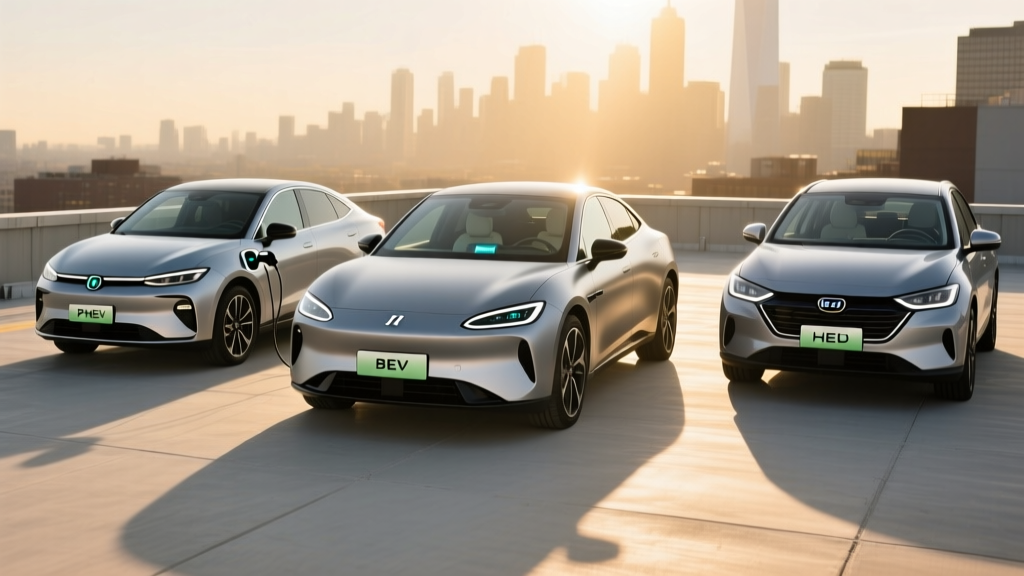
If you're shopping for an electrified vehicle in 2026, you'll encounter three main types of electric cars: Battery Electric Vehicles (BEVs), Plug-in Hybrid Electric Vehicles (PHEVs), and conventional Hybrid Electric Vehicles (HEVs). Here's the fast answer: a BEV runs solely on battery power (200–400+ miles EPA range, cheapest to fuel, requires charging access); a PHEV pairs a smaller battery (25–50 miles electric-only) with a gas engine for longer trips; and an HEV uses a tiny battery to assist a gas engine (no plug, 45–60 MPG combined). The right choice depends entirely on your daily mileage, home charging access, and budget.
Quick Answer: Which Type of Electric Car Fits You?
- BEV: You can charge at home, drive under 250 miles daily, and want the lowest operating cost.
- PHEV: You want electric commuting (30–45 mi) but need gas flexibility for road trips or lack reliable charging.
- HEV: You can't plug in at home but still want better fuel economy than a gas-only car.
Battery Electric Vehicles (BEVs): Full Electric, Zero Tailpipe Emissions
A BEV has no gas engine. It stores energy in a large lithium-ion or lithium iron phosphate (LFP) battery pack and drives one or more electric motors. In 2026, mainstream BEVs range from the EPA-rated 240-mile Chevrolet Equinox EV to the 402-mile Lucid Air Grand Touring, with most new models landing between 270 and 340 miles EPA.
Real-World Range vs. EPA Sticker
The EPA range figure is a combined-cycle estimate. In practice, expect:
- Highway driving (70–80 mph): 15–25% less than EPA combined range due to aerodynamic drag.
- Cold weather (below 32°F): 20–35% range reduction from cabin heating and battery chemistry limitations, though heat-pump-equipped models (Hyundai Ioniq 5, Tesla Model Y, BMW iX) mitigate this to roughly 15–20% loss.
- City / moderate climate: Often meets or slightly exceeds EPA estimates thanks to regenerative braking.
A 310-mile EPA-rated BEV like the Tesla Model Y Long Range may deliver 250–270 miles on a 75°F highway trip and 200–230 miles in 20°F winter conditions. Plan charging stops around 80% of the EPA number for comfortable road-trip margins.
BEV Charging Speeds and Infrastructure
Charging speed is measured in kilowatts (kW) — the rate of energy delivery — while battery capacity is measured in kilowatt-hours (kWh) — the total energy stored. These are not interchangeable.
| Charging Level | Power (kW) | Miles Added per Hour | Typical Use Case |
|---|---|---|---|
| Level 1 (120V) | 1.0–1.4 kW | 3–5 mi/hr | Overnight trickle; PHEV-friendly |
| Level 2 (240V) | 7.2–19.2 kW | 25–65 mi/hr | Home daily charging; workplace |
| DC Fast Charge | 50–350 kW peak | 150–800+ mi/hr (peak) | Road trips; 10–80% in 18–45 min |
Modern BEVs on 800V architectures (Hyundai Ioniq 5, Kia EV6, Porsche Taycan) peak at 230–350 kW and charge 10–80% in roughly 18–22 minutes at compatible stations. However, charging curves taper significantly above 80% SoC — a 250 kW peak may sustain only 40–60 kW past 85%, making 10–80% the practical fast-charging window.
Plug-in Hybrid Electric Vehicles (PHEVs): The Bridge Between Gas and Electric
PHEVs carry a medium battery (typically 12–25 kWh usable) that provides 25–50 miles of electric-only driving, plus a gas engine for extended range. Once the battery depletes, the vehicle operates as a conventional hybrid, achieving 35–50 MPG combined.
Examples in 2026 include the Toyota RAV4 Prime (42 miles electric, 94 MPGe combined, ~$44,500 MSRP), the Jeep Wrangler 4xe (22 miles electric, 49 MPGe), and the Chrysler Pacifica Hybrid (32 miles electric, 82 MPGe). According to fueleconomy.gov, a PHEV's MPGe rating reflects blended electric-and-gas operation during the first 100 miles from a full charge.
When a PHEV Makes Financial Sense
If your commute is 30 miles round-trip and you charge at home nightly, a PHEV can run almost entirely on electricity Monday through Friday, burning gas only on weekend road trips. The tradeoff: PHEV batteries are smaller and cheaper to replace ($4,000–$8,000 vs. $10,000–$20,000+ for BEV packs), but you still maintain a gas engine — oil changes, spark plugs, and exhaust systems remain part of ownership.
Hybrid Electric Vehicles (HEVs): No Plug Required
HEVs use a small battery (1–2 kWh) and electric motor to assist a gas engine, recovering energy through regenerative braking. You never plug in. Fuel economy typically lands between 45 and 60 MPG combined — the Toyota Prius achieves up to 57 MPG combined EPA, while the Honda Accord Hybrid delivers 48 MPG combined.
HEVs suit buyers who lack any charging access (apartment dwellers, street parkers) but still want meaningful fuel savings. The upfront premium over a gas-only equivalent is usually $1,500–$3,000, with payback in 3–5 years at average mileage.
Cost Comparison: BEV vs. PHEV vs. HEV vs. Gas
Below is a five-year total cost of ownership (TCO) estimate for a midsize crossover, assuming 12,000 miles/year, $3.50/gallon gas, and $0.16/kWh home electricity. Figures are illustrative averages; actual costs vary by model, region, and driving pattern.
| Cost Category | Gas Vehicle | HEV | PHEV | BEV |
|---|---|---|---|---|
| Purchase Price (avg MSRP) | $35,000 | $38,000 | $44,000 | $45,000 |
| Federal Tax Credit (§30D) | $0 | $0 | $3,750–$7,500* | $3,750–$7,500* |
| Fuel/Energy (5 yr) | $10,500 | $6,300 | $4,200 | $4,800 |
| Maintenance (5 yr) | $4,500 | $4,000 | $4,200 | $2,000 |
| Insurance (5 yr avg) | $7,500 | $7,800 | $8,200 | $9,000 |
| Home Charger Install | $0 | $0 | $0–$500 | $500–$2,000 |
| Estimated 5-Yr TCO | $57,500 | $56,100 | $52,900–$56,650 | $50,300–$58,300 |
* Federal §30D credit eligibility depends on MSRP caps ($55,000 cars / $80,000 SUVs/trucks), buyer income limits ($150K single / $300K joint AGI), battery critical-mineral and component sourcing requirements, and manufacturer sales caps. Check current rules at IRS.gov. Credit can now be transferred at point of sale as an instant rebate.
Maintenance Reality
BEVs eliminate oil changes, transmission fluid, spark plugs, timing belts, and exhaust repairs. Brake pad life extends dramatically (80,000–150,000 miles) thanks to regenerative braking. PHEVs and HEVs still require gas-engine maintenance, though less frequently than pure ICE vehicles due to engine-off electric driving phases.
Common Misconceptions About Electric Car Types
| Myth | Fact |
|---|---|
| "BEV batteries need replacing every 5 years" | Federal law mandates 8-year/100,000-mile battery warranties. Data shows most packs retain 85–92% capacity at 150,000 miles. LFP chemistry packs (Tesla Model 3 RWD, Ford Mustang Mach-E Select) degrade even slower. |
| "You can't road-trip in a BEV" | The U.S. now has 6,000+ DC fast-charging stations. Tesla Supercharger access opened to NACS-equipped Fords, Rivians, and GM EVs in 2024–2025. Planning apps (A Better Routeplanner, PlugShare) make 300-mile stops trivial. |
| "PHEVs are always the best compromise" | PHEVs only save fuel if you charge regularly. A never-plugged-in PHEV gets worse MPG than a dedicated HEV due to extra battery weight. They also cost $3,000–$8,000 more upfront. |
| "All electric cars qualify for the $7,500 tax credit" | Many popular models receive $0–$3,750 due to battery sourcing rules. Always verify per-model eligibility on IRS.gov before purchasing. |
| "Cold weather destroys all EVs equally" | Heat-pump-equipped BEVs lose ~15–20% range in freezing temps; resistive-heater models lose 25–35%. PHEVs use gas-engine waste heat for cabin warming, reducing winter efficiency penalties. |
Real-World Ownership Considerations
Home Charging Access
Home charging is the single biggest ownership advantage. A Level 2 home charger (7.2–11.5 kW, 240V) adds 25–45 miles of range per hour, fully replenishing most BEVs overnight. Installation costs $500–$2,000 for a straightforward setup near your electrical panel, but can climb to $2,500–$5,000 if a panel upgrade (from 100A to 200A service) is needed. Renters and condo dwellers should verify outlet access or negotiate charger installation before committing to a BEV.
Driving Patterns and Climate
If you drive 40+ miles daily in stop-and-go traffic, a BEV or PHEV maximizes regenerative braking savings. Highway-heavy commuters (60+ miles at 75 mph) see less BEV efficiency advantage. In northern-tier states with sustained sub-freezing winters, a PHEV or an LFP-equipped BEV with a heat pump offers the most predictable year-round experience.
Insurance and Depreciation
BEV insurance premiums run 10–20% higher than equivalent gas vehicles, driven by higher repair costs and specialized parts. Depreciation has been volatile — early-2024 price wars (led by Tesla) depressed used EV values, but 2025–2026 models show more stable residuals as the market normalizes.
Decision Framework: Which Type of Electric Car Should You Buy?
If-Then Buying Guide
- If you have home Level 2 charging (or can install it) and your daily driving is under 80 miles round-trip → Buy a BEV. Lowest fuel cost (~$0.04/mi vs. $0.14/mi gas), minimal maintenance, and access to HOV lanes in many states.
- If you want electric commuting but take 4+ road trips per year exceeding 300 miles → Buy a PHEV. Daily electric driving + unlimited gas range. Best of both worlds, with a higher purchase price.
- If you rent, lack charging access, or live in a rural area with sparse public chargers → Buy an HEV. No plug needed, 50+ MPG, no range anxiety, and a modest price premium over gas models.
- If your budget is under $30,000 and you need maximum fuel savings → Consider a used BEV (Chevrolet Bolt EUV, Nissan Leaf) eligible for the up-to-$4,000 used EV credit, or a new HEV like the Toyota Corolla Hybrid (~$24,000).
- If you tow frequently (5,000+ lbs) → PHEV or HEV currently offer more predictable range under heavy load. BEV towing (Ford F-150 Lightning, Rivian R1T) cuts range by 30–50%.
Frequently Asked Questions
What's the cheapest type of electric car to own long-term?
A BEV charged primarily at home on residential electricity rates (~$0.12–$0.18/kWh) delivers the lowest per-mile energy cost and fewest maintenance expenses over 5–10 years. However, the higher upfront price and insurance premiums mean the break-even point versus a gas car is typically 4–7 years depending on mileage and local incentives.
Do PHEVs make sense if I can't charge at home?
Rarely. Without regular plug-in charging, a PHEV operates as a heavier, less efficient HEV. You'll pay a purchase premium for battery capacity you never use. If home charging isn't possible, an HEV is the smarter financial choice.
How long do EV batteries last before needing replacement?
Modern NMC and LFP battery packs are engineered for 1,500–3,000+ full charge cycles before reaching 70–80% State of Health (SoH). In real-world terms, that's 200,000–400,000 miles for most BEVs. The 8-year/100,000-mile federal warranty covers packs that drop below 60–70% capacity. Full pack replacement costs $10,000–$22,000 depending on the model, but is rarely needed within the vehicle's practical lifespan.
Which type of electric car is best for cold climates?
BEVs with heat pumps (Hyundai/Kia E-GMP platform, Tesla Model Y, BMW iX) handle cold best among pure electrics, losing 15–20% range at 20°F. PHEVs have an inherent cold-weather advantage: the gas engine produces waste heat for cabin warming, reducing the efficiency penalty. If you live where temperatures regularly drop below 10°F and lack a garage, a PHEV offers more predictable winter range.
Are all types of electric cars eligible for federal tax credits?
No. Only BEVs and PHEVs (not HEVs) may qualify for the §30D federal clean vehicle credit. Even among plug-in vehicles, eligibility depends on MSRP caps, buyer income thresholds, battery sourcing requirements, and final assembly location. As of 2026, many popular models qualify for partial credits ($3,750) or none at all. Always verify the specific model-year and trim on IRS.gov before purchasing.