If you have seen the search query "is Trump banning Tesla" trending in EV forums and Google suggestions, you are not alone. The short answer is no: there is no executive order, proposed legislation, or regulatory action from the Trump administration that bans Tesla vehicles from U.S. roads or prohibits their sale. What has changed for 2026 are the federal EV tax credit rules under IRS §30D, along with shifting political rhetoric around electrification mandates. Tesla remains fully legal to buy, sell, register, and drive in all 50 states.
But policy noise shouldn't distract from the metal. The 2026 Tesla Model Y Long Range AWD remains one of the highest-volume EVs in America, and whether you can stomach the brand's political associations is a personal call. What we can measure objectively are its range, charging speed, interior utility, and total cost after incentives. Here is the data-driven breakdown.
Is There Actually a Tesla Ban? Separating Policy Fact from Fiction
Let's address the keyword head-on. No branch of the U.S. government has moved to ban Tesla as a manufacturer or prohibit consumers from purchasing its vehicles. What the second Trump administration has pursued includes:
- Rollback of EPA tailpipe emissions standards that indirectly favored EV adoption targets — this affects automaker fleet planning, not consumer purchasing.
- Proposed modifications to the §30D federal EV tax credit, including stricter battery-sourcing requirements and potential phase-out timelines. As of 2026, the credit still exists but with tighter critical-mineral and component-sourcing rules that shift eligibility quarter by quarter.
- Elimination of certain federal fleet EV mandates for government vehicles — again, not a consumer-facing ban.
Tesla actually benefits from some administration dynamics: Elon Musk's alignment with the Trump administration has, if anything, shielded Tesla from the most aggressive anti-EV policy moves. The real risk to Tesla buyers isn't a ban — it's tax credit eligibility changes and brand perception affecting resale values. We cover the credit math in detail below.
2026 Tesla Model Y Long Range: The Spec Sheet That Matters
| Spec | Value |
|---|---|
| EPA Estimated Range | 320 miles |
| Battery Capacity (usable) | ~75 kWh, NMC (nickel manganese cobalt) |
| Drivetrain | Dual-motor AWD |
| Horsepower | 384 hp (combined) |
| 0–60 mph | 4.8 seconds |
| Peak DC Fast Charge Rate | 250 kW (CCS via NACS adapter or native NACS) |
| 10–80% DC Fast Charge Time | ~25 minutes (preconditioned) |
| Level 2 Home Charge Rate | 11.5 kW (~44 miles/hr) |
| EPA Efficiency | 122 MPGe combined / 28 kWh/100 mi |
| Cargo Volume (rear seats up) | 30.2 cu ft |
| Cargo Volume (rear seats folded) | 72.1 cu ft |
| Rear Legroom | 38.4 inches |
| Battery Warranty | 8 years / 120,000 miles (≥70% capacity retention) |
| Base MSRP | $48,990 (before destination) |
| As-Tested Price (Long Range AWD) | $52,490 w/ FSD capability |
Real-World Range: What 320 EPA Miles Actually Means on the Road
The Model Y's 75 kWh usable battery paired with Tesla's heat pump (standard since the 2022 refresh) gives it an efficiency advantage over many competitors. At 28 kWh per 100 miles combined, it sips electrons compared to the Ford Mustang Mach-E Extended Range AWD (32 kWh/100 mi) or the Hyundai Ioniq 5 AWD (30 kWh/100 mi), per EPA fueleconomy.gov data.
For a daily commuter doing 40 miles round-trip, a single charge lasts well over a week. For road-trippers crossing the Southwest or Mountain states, you'll want to plan Supercharger stops every 220–250 miles to keep state of charge (SoC) above 15% as a buffer — especially in cold or hilly terrain.
Charging Speed: Supercharger Network vs. CCS Public Charging
Tesla's charging ecosystem remains its strongest competitive moat in 2026. Here is what charging actually looks like across all three levels:
| Charging Level | Power (kW) | Miles Added per Hour | Typical Use Case |
|---|---|---|---|
| Level 1 (120V household) | ~1.4 kW | ~5 mi/hr | Emergency / overnight trickle |
| Level 2 (240V home Wall Connector) | 11.5 kW | ~44 mi/hr | Daily home charging (7–8 hr full charge) |
| DC Fast (Tesla Supercharger V3/V4) | Peak 250 kW | ~200 mi in 15 min | Road trips, 10–80% in ~25 min |
| DC Fast (CCS public stations via adapter) | Up to 250 kW | Varies by station | Electrify America, EVgo networks |
The charging curve reality: The Model Y peaks at 250 kW only at low states of charge (roughly 10–30% SoC) with a preconditioned battery. By 50% SoC, the rate drops to approximately 150 kW, and above 80% it tapers sharply to under 50 kW. This is standard lithium-ion behavior, not a Tesla-specific limitation, but it means your average charge rate across a 10–80% session is closer to 140–160 kW, not the headline 250 kW number.
Home charging with a Tesla Wall Connector on a 60-amp circuit delivers 11.5 kW (48 amps continuous), adding roughly 44 miles of range per hour. A full 10–100% charge takes about 7.5 hours — easily accomplished overnight. Installation costs for a 240V/60A circuit typically run $800–$2,000 depending on panel proximity and local permit fees; a 200-amp panel upgrade adds $1,500–$3,000 if your home's electrical service is older.
Tax Credit Eligibility: The Real 2026 §30D Math for Tesla Buyers
This is where the "is Trump banning Tesla" question gets practical. The federal EV tax credit under IRS §30D is still alive in 2026, but eligibility for the Model Y depends on three moving targets:
- MSRP cap: SUVs (including the Model Y) must have an MSRP at or below $80,000. The Model Y Long Range at ~$49K clears this easily.
- Buyer income cap: Modified adjusted gross income (MAGI) must not exceed $150,000 (single), $225,000 (head of household), or $300,000 (married filing jointly).
- Battery sourcing requirements: Both critical-minerals and battery-component thresholds have tightened annually. As of 2026, vehicles must meet escalating percentages of U.S.-sourced or FTA-partner-sourced critical minerals and battery components to qualify for the full $7,500 ($3,750 for minerals + $3,750 for components). Tesla has made significant supply-chain adjustments, but eligibility can shift quarterly based on fueleconomy.gov listings.
| Scenario | MSRP | Federal Credit | Effective Price |
|---|---|---|---|
| Long Range AWD (full credit eligible) | $48,990 | −$7,500 | ~$41,490 |
| Long Range AWD (partial credit — minerals only) | $48,990 | −$3,750 | ~$45,240 |
| Long Range AWD (no credit — income over cap) | $48,990 | $0 | $48,990 |
Critical note: The §30D credit can now be transferred to the dealer at point of sale as an instant discount, rather than claimed on your tax return. This effectively reduces your out-of-pocket cost at purchase. However, if your tax liability is lower than the credit amount, the point-of-sale transfer still works — it's treated as a nontaxable advance payment to the dealer. Always verify current-quarter eligibility on fueleconomy.gov before signing, as battery-sourcing compliance can change mid-year.
Interior, Tech, and Driver Assistance: Tesla's Minimalist Bet
The 2026 Model Y interior remains polarizing. There is no instrument cluster — all information lives on the 15.4-inch center touchscreen. Build quality has improved incrementally since the Fremont early-production days, with tighter panel gaps and upgraded materials in the Juniper refresh. The cabin is quiet at highway speeds, aided by acoustic glass.
Standout tech features:
- Over-the-air (OTA) software updates that add functionality quarterly
- Tesla Supercharger network: 6,000+ U.S. stalls with native plug-and-charge reliability
- Sentry Mode dashcam system with 360-degree recording
- HEPA air filtration with bioweapon-defense mode
- Frunk (front trunk) adding ~4.1 cu ft of secure storage
Notable drawbacks:
- No Apple CarPlay or Android Auto — Tesla's proprietary infotainment only
- Turn-signal stalks removed in latest refresh; signals are on the steering wheel (divisive ergonomics)
- Minimalist interior lacks physical buttons for climate, mirrors, and glovebox — all touchscreen-controlled
- Rear visibility is compromised by the sloping roofline; the digital rearview mirror option is recommended
How the Model Y Stacks Up Against Key Competitors
At roughly $49K before credits, the Model Y Long Range AWD competes directly with the Hyundai Ioniq 5 Limited AWD (~$52K), Ford Mustang Mach-E Premium AWD (~$48K), and the Kia EV6 GT-Line AWD (~$53K). Here is how it compares on the metrics buyers care about most:
- Range advantage: 320 EPA miles beats the Ioniq 5 AWD (290 mi) and Mach-E Extended Range AWD (290 mi). Only the EV6 GT-Line (310 mi) comes close.
- Charging speed: The Ioniq 5 and EV6 (E-GMP platform, 800V architecture) charge faster — 10–80% in ~18 minutes vs. the Model Y's ~25 minutes. On long road trips, this matters.
- Supercharger access: As of 2026, Ford, Hyundai/Kia, and others have gained Tesla Supercharger access via NACS adapters, eroding Tesla's exclusive network advantage. But native NACS plug-and-charge remains smoother than adapter-based CCS-to-NACS connections.
- Cargo utility: The Model Y's 72.1 cu ft with seats folded leads the compact electric SUV segment. The Ioniq 5 offers 59.3 cu ft; the Mach-E, 59.7 cu ft.
- Resale value: Tesla's depreciation has worsened since 2023 price cuts. Expect roughly 45–50% value retention at 3 years/36,000 miles, below the segment average. Brand perception is a wildcard here.
Pros
- Class-leading EPA range (320 mi) and cargo space (72.1 cu ft)
- Best-in-class efficiency at 28 kWh/100 mi
- Supercharger network reliability remains top-tier
- OTA updates continuously add features
- Strong §30D credit eligibility (verify quarterly)
Cons
- DC fast charging slower than 800V rivals (25 min vs 18 min, 10–80%)
- No Apple CarPlay / Android Auto
- Depreciation steeper than Hyundai/Kia competitors
- Brand perception risk may affect resale further
- Touchscreen-only controls divide owners
Who Should Buy the 2026 Tesla Model Y — And Who Should Look Elsewhere
Choose the Model Y if: You prioritize maximum range and cargo space in a compact electric SUV, you want the most mature Supercharger network for road trips, you value OTA software updates, and you qualify for the full $7,500 §30D credit (bringing effective price to ~$41,500).
Look at competitors if: You want the fastest DC charging available (Hyundai Ioniq 5 / Kia EV6 with 800V), you refuse to live without Apple CarPlay, you want a more traditional interior with physical controls, or brand association with Tesla's leadership is a dealbreaker for you personally.
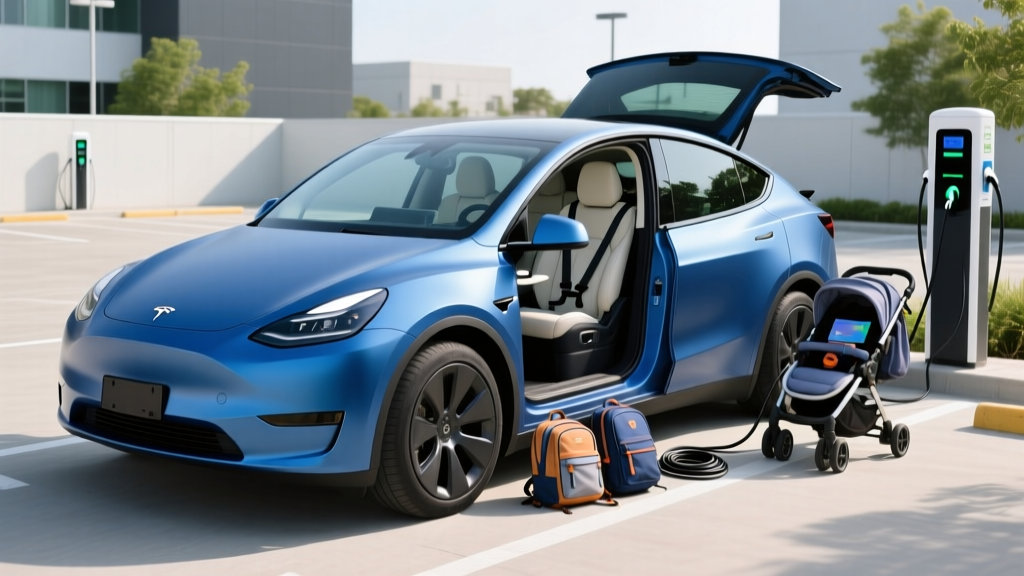
For daily commuters driving under 60 miles round-trip, the Model Y's efficiency and home-charging convenience make it nearly effortless to own. For families needing car-seat space and cargo volume, the 72.1 cu ft with seats folded is segment-best. For road-trippers covering 300+ miles regularly, the Supercharger network still offers the lowest-friction long-distance EV experience in 2026 — even as competitors gain access.
For towing, the Model Y is rated at 3,500 lbs — adequate for a small utility trailer or a pair of dirt bikes, but not for a boat or camper. If towing is a priority, look at the Ford F-150 Lightning or Rivian R1S instead.
Frequently Asked Questions
Is Trump banning Tesla vehicles in the United States?
No. There is no federal ban on Tesla sales, ownership, or operation. Tesla vehicles remain fully legal in all 50 states. Policy changes under the Trump administration have focused on emissions-standard rollbacks and EV tax credit modifications — not prohibitions on specific manufacturers.
What is the real-world range of the 2026 Tesla Model Y Long Range?
The EPA rates it at 320 miles. Real-world highway driving at 70–75 mph yields approximately 270–290 miles. In cold weather (below 30°F), expect 230–250 miles due to battery chemistry limitations and cabin heating demands, even with the standard heat pump.
How fast does the Model Y charge at home and on the road?
At home on a Level 2 Tesla Wall Connector (11.5 kW / 240V), it adds roughly 44 miles of range per hour, fully charging overnight in about 7.5 hours. On DC fast chargers (Tesla Supercharger V3/V4), it peaks at 250 kW and charges from 10–80% in approximately 25 minutes with a preconditioned battery.
Does the 2026 Tesla Model Y qualify for the $7,500 federal EV tax credit?
It can, but eligibility depends on your income (MAGI caps of $150K/$225K/$300K), the vehicle's MSRP (under $80K — the Model Y qualifies), and current-quarter battery-sourcing compliance per IRS §30D rules. Check fueleconomy.gov for the latest quarterly eligibility before purchasing. The credit can be transferred at point of sale for an instant price reduction.
Is the Tesla Model Y worth buying over the Hyundai Ioniq 5 or Ford Mach-E?
The Model Y wins on range (320 vs 290 mi), cargo space (72.1 vs ~59 cu ft), and efficiency (28 vs 30–32 kWh/100 mi). The Ioniq 5 and EV6 win on DC fast-charge speed (18 vs 25 min, 10–80%) and offer Apple CarPlay. The Mach-E offers a more conventional interior. Your decision likely hinges on whether Supercharger access and range outweigh faster charging and infotainment flexibility.
What is Tesla's battery warranty on the Model Y?
Tesla covers the battery and drive unit for 8 years or 120,000 miles (whichever comes first), with a guaranteed minimum 70% capacity retention. If the battery degrades below 70% state of health within that period, Tesla will repair or replace it at no cost. Real-world data from high-mileage Model Y owners suggests typical degradation of 8–12% over the first 100,000 miles with NMC chemistry.