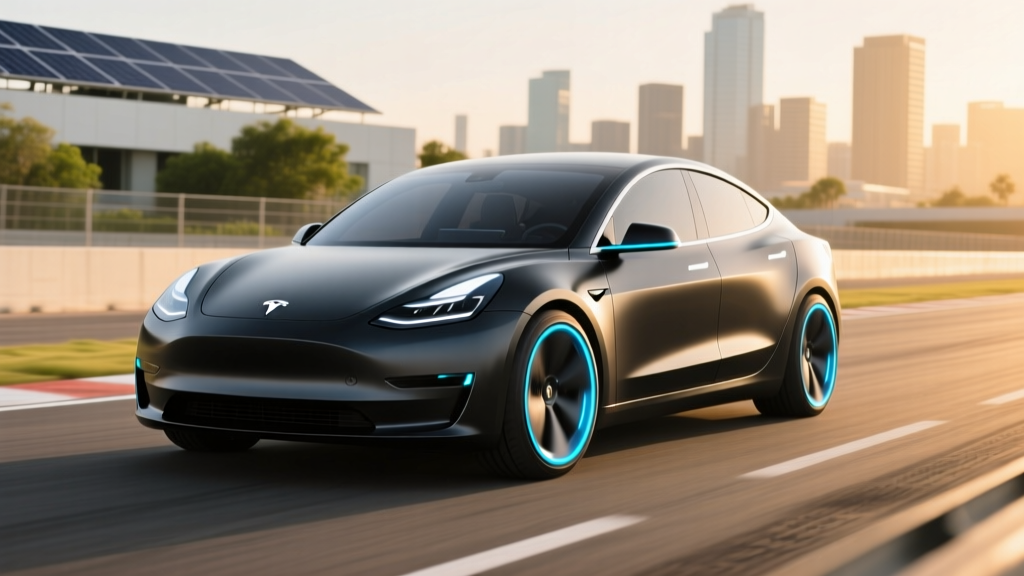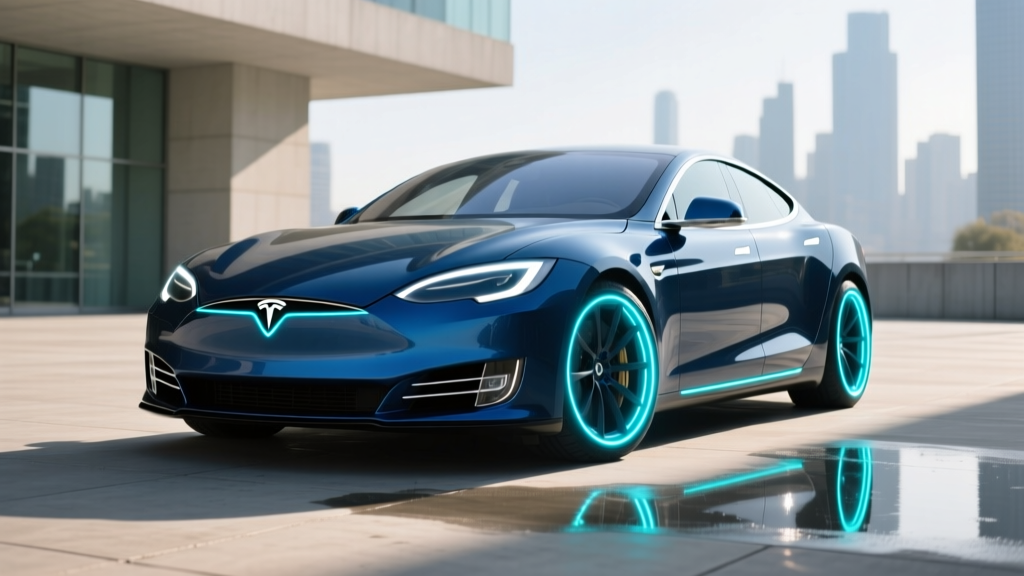
If you have seen a Tesla Model 3 or Model Y pulsing with neon-blue light strips along its door handles, grille, and wheel arches in a dark parking lot, you have likely witnessed what owners call Tron Mode. The name is unofficial — Tesla itself markets the feature as Light Show — but the community nickname stuck because the synchronized, glowing aesthetic closely resembles the light-cycle sequences from the film Tron: Legacy.
Tron Mode is not a performance upgrade, a range extender, or a driver-assist feature. It is a choreographed exterior and interior lighting sequence that syncs to music, turning the car into a mobile light installation. For some buyers it is a frivolous gimmick; for others it is a genuine differentiator that makes a Tesla feel more personal in a world where EV silhouettes are converging. Below we break down exactly what Tron Mode is, which 2026 Tesla models support it, what it costs, and whether it should influence your purchase decision.
What Tron Mode Actually Does on a Tesla
Tron Mode (Light Show) is accessed from the vehicle's touchscreen under Controls → Light Show. When activated, the car synchronizes its exterior lighting elements — headlights, taillights, turn signals, fog lamps, door-handle illumination, and on newer models, the front light bar and ambient exterior accent lighting — with an internal music library. The choreography includes pulsing, sweeping, and color-cycling patterns that respond to beat, tempo, and frequency.
On 2025-refresh and 2026 Model 3 Highland and Model Y Juniper vehicles, Tesla added a configurable ambient exterior lighting strip along the lower door sills and front fascia. This hardware is what makes the "Tron" aesthetic possible — older pre-2024 Model 3 and Model Y vehicles have Light Show, but the effect is noticeably more subdued without the dedicated accent LEDs.
Which 2026 Tesla Models Support Tron Mode
Light Show is available across the entire 2026 Tesla lineup via over-the-air (OTA) software updates, but the visual impact varies significantly by model and hardware generation:
| Model | Hardware Generation | Exterior Accent LEDs | Tron Effect Quality |
|---|---|---|---|
| Model 3 (Highland / 2026 refresh) | HW4+ | Yes — door sill, front fascia | ★★★★★ (Best) |
| Model Y (Juniper / 2026) | HW4+ | Yes — door sill, front fascia | ★★★★★ (Best) |
| Model S (2026) | HW4 | Partial — door handles only | ★★★☆☆ |
| Model X (2026) | HW4 | Partial — door handles, falcon-wing accents | ★★★★☆ |
| Cybertruck (2026) | HW4+ | Yes — full perimeter light bar | ★★★★★ (Unique) |
The Cybertruck's full-perimeter LED light bar produces arguably the most dramatic Tron Mode effect in the lineup, with the stainless-steel exoskeleton reflecting and amplifying the light patterns. The Model 3 Highland and Model Y Juniper are the most popular platforms for the feature due to their volume sales and integrated accent lighting.
How to Activate and Customize Tron Mode
Activating Light Show is straightforward:
- Park the vehicle in a safe, legal location (the feature is disabled while the car is in Drive or moving above 5 mph).
- Navigate to Controls → Light Show on the central touchscreen.
- Select a music track from the built-in library or pair via Bluetooth to use your own playlist.
- Choose a lighting pattern: Pulse, Wave, Strobe, Random, or Custom (on 2026 models).
- Press Start Show. The vehicle will dim interior lights, lock doors, and begin the sequence.
On 2026 Model 3 and Model Y, Tesla introduced a Custom Choreography Editor in the 2025.44 software update, allowing owners to map specific light elements to beat patterns manually. The community has built a robust library of shared choreographies optimized for electronic, hip-hop, and orchestral tracks.
Does Tron Mode Affect Range, Battery, or Warranty?
This is the most common question from prospective buyers. The short answer: no meaningful impact.
- Energy draw: A full 15-minute Light Show consumes approximately 0.05–0.10 kWh from the traction battery. For context, a Model 3 Long Range AWD has a ~79 kWh usable battery — the show uses roughly 0.1% of total capacity.
- Battery degradation: The discharge rate is far too low to contribute to measurable lithium-ion degradation. Battery wear is driven by charge cycles, depth of discharge, and thermal management — not brief accessory loads.
- Warranty: Using Light Show does not void any portion of Tesla's New Vehicle Limited Warranty or the 8-year/120,000-mile battery and drive unit warranty. It is a factory-supported feature.
- LED lifespan: Tesla's exterior LEDs are rated for the vehicle's lifetime. Running Light Show for even 30 minutes daily will not meaningfully reduce LED longevity.
Tron Mode vs. Competitor Ambient Lighting Features
Tesla's Light Show is not the only exterior lighting feature in the EV market, but it is the most choreographed. Here is how it compares to rival offerings for 2026:
| Feature | Tesla Light Show (Tron Mode) | Hyundai Ioniq 5 Digital Pixel Lights | BMW iX Interactive Light Bar | Rivian Camp Mode Lighting |
|---|---|---|---|---|
| Music sync | Yes — full beat-matched | No — static patterns only | Partial — ambient mode | No — static scene modes |
| Custom choreography | Yes (2026 editor) | No | No | No |
| Exterior accent LEDs | Yes (newer models) | Pixel headlamps only | Grille/door handles | Camp lighting (functional) |
| OTA updates | Yes — new shows added | Limited | Limited | Yes |
| Community ecosystem | Large — shared choreographies | Small | Minimal | Growing |
Hyundai's pixel-style lighting on the Ioniq 5 and Ioniq 6 is distinctive but static — it does not sync to music. BMW's light bar on the iX and i4 is interior-focused with exterior welcome/exit sequences. Rivian's camp lighting is utilitarian, designed for campsite illumination rather than entertainment. Tesla remains the only automaker offering a fully choreographed, music-synced, community-customizable exterior light show as a standard (no-cost) feature.
Cost, Availability, and Tax Credit Context
Tron Mode / Light Show is standard equipment on every 2026 Tesla. There is no additional package, subscription, or trim-level requirement. If you buy any new Tesla in 2026, you get the feature via OTA software.
However, the quality of the experience depends on the hardware generation. Buyers specifically seeking the best Tron Mode effect should prioritize:
- 2026 Model 3 Long Range AWD — $47,740 MSRP (before incentives)
- 2026 Model Y Long Range AWD — $48,630 MSRP (before incentives)
- 2026 Cybertruck AWD — $79,990 MSRP (before incentives)
Regarding the federal §30D clean vehicle tax credit: eligibility depends on MSRP caps ($55,000 for sedans, $80,000 for SUVs/trucks), buyer income limits ($150K single / $300K joint MAGI), and battery critical-mineral and component sourcing requirements that have tightened annually through 2026. The Model 3 Long Range and Model Y Long Range have historically qualified for the full $7,500 credit (or a portion thereof, depending on sourcing compliance for the specific build month). The Cybertruck at $79,990 falls under the $80,000 SUV/truck cap and may qualify. Always verify current eligibility at fueleconomy.gov and consult a tax professional before relying on the credit in your purchase decision.
Who Should Care About Tron Mode (and Who Should Not)
Tron Mode matters if you...
- Attend EV meets, Cars & Coffee, or Tesla owner gatherings
- Want a personalized, shareable vehicle feature for social content
- Have kids or teens who enjoy interactive tech features
- Value community-driven customization (shared choreographies)
- Are choosing between a 2026 Tesla and a competitor and want tiebreaker differentiators
Tron Mode does NOT matter if you...
- Prioritize range, charging speed, and efficiency above all else
- View the vehicle purely as transportation
- Are buying a pre-2024 used Tesla (the effect is underwhelming without accent LEDs)
- Live in an HOA or area with strict vehicle-lighting ordinances (check local rules)
- Expect it to add resale value — it is a standard feature, not a premium option
Frequently Asked Questions
Is Tron Mode a real Tesla feature or just a fan name?
"Tron Mode" is a community nickname. The official Tesla feature is called Light Show, accessible from the touchscreen. The name stuck because the blue neon aesthetic on newer models closely resembles the Tron film franchise.
Does Tron Mode work while driving?
No. Light Show is disabled when the vehicle is in Drive or moving above 5 mph. It is a parked-vehicle feature only, for safety and legal compliance.
Can I add Tron Mode to an older Tesla (pre-2024 Model 3/Y)?
Light Show software is available on older vehicles, but the full "Tron" aesthetic requires the exterior accent LED hardware introduced with the Model 3 Highland (2024+) and Model Y Juniper (2025+) refreshes. Aftermarket LED kits exist, but they are not Tesla-approved and may affect warranty coverage for electrical components.
Does running Light Show drain the battery significantly?
No. A 15-minute show uses approximately 0.05–0.10 kWh — less than 0.15% of a Model 3 Long Range's ~79 kWh battery. You could run a show every night for a year and use less than 25 kWh total.
Is Tron Mode available on the Tesla Model S and Model X?
Yes, Light Show software is available on the Model S and Model X, but the effect is less dramatic because these models lack the full exterior accent LED strips found on the refreshed Model 3, Model Y, and Cybertruck. Door-handle and headlight/taillight choreography is still supported.
Does Tron Mode require a subscription?
No. Light Show is standard on all Tesla vehicles and does not require Tesla's Premium Connectivity subscription or Full Self-Driving (Supervised) package. It is included with the base vehicle software.