Travis Scott's Cybertruck: Why It's the Most Talked-About EV in Hip-Hop
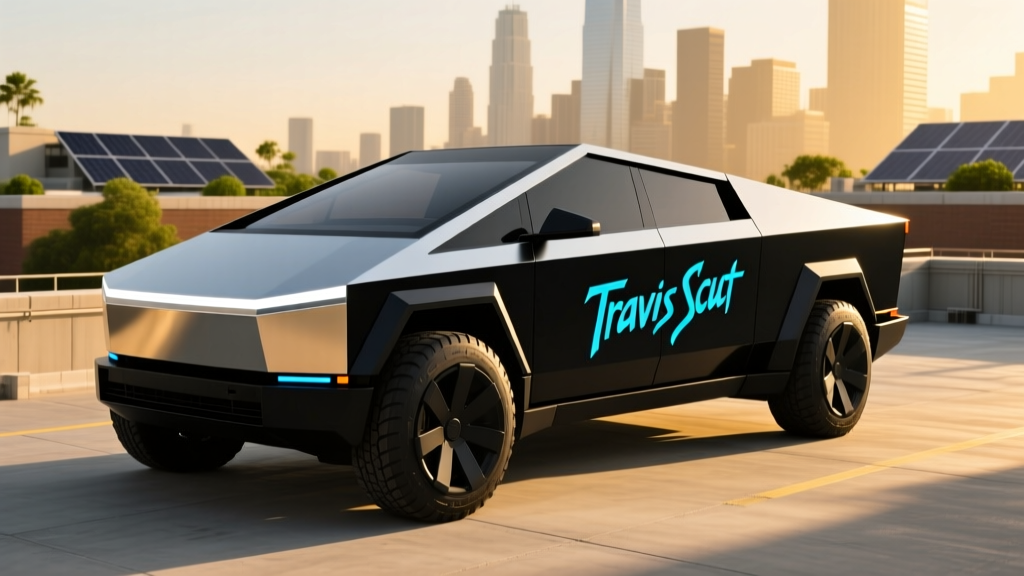
When Travis Scott rolled a Tesla Cybertruck onto his Cactus Jack campus and began appearing in paparazzi shots with the angular stainless-steel pickup, searches for "travis scott cybertruck" spiked — and stayed there. The Cybertruck is already one of the most polarizing vehicles on American roads; in the hands of a cultural icon who treats vehicles as stage props, it becomes something else entirely: a rolling billboard for Tesla's most speculative product.
This review treats the Cybertruck the way we treat every EV that crosses our desk: with a spec sheet, a charger, a stopwatch, and a calculator. We'll walk through the 2026 model-year AWD and Cyberbeast trims (the ones Travis has been photographed in), with real-world range, charging curves, tax-credit reality, and ownership math. Whether you're here because of the celebrity association or because you're genuinely shopping a six-figure electric pickup, the numbers below are what actually matter.
Spec Sheet: 2026 Tesla Cybertruck AWD & Cyberbeast
| Specification | Cybertruck AWD | Cyberbeast (Tri-Motor) |
|---|---|---|
| Drivetrain | Dual-motor AWD | Tri-motor AWD (torque vectoring) |
| Horsepower | 600 hp | 845 hp |
| 0-60 mph | 4.1 seconds | 2.6 seconds |
| EPA Range | 340 miles | 320 miles |
| Battery (usable) | ~123 kWh, NMC | ~123 kWh, NMC |
| Max DC Fast Charge | 250 kW (V3 Supercharger) | 250 kW (V3 Supercharger) |
| 10-80% DC Time | ~28 minutes | ~28 minutes |
| Level 2 Home Charge | 11.5 kW (~37 mi/hr) | 11.5 kW (~37 mi/hr) |
| MPGe (combined) | ~70 MPGe | ~68 MPGe |
| Efficiency | ~48 kWh/100 mi | ~50 kWh/100 mi |
| Tow Rating | 11,000 lbs | 11,000 lbs |
| Payload | 2,500 lbs | 2,500 lbs |
| Bed Length | 6 ft (lockable vault) | 6 ft (lockable vault) |
| Cargo (bed + frunk) | ~67 cu ft bed, 7 cu ft frunk | ~67 cu ft bed, 7 cu ft frunk |
| Base MSRP (2026) | $79,990 | $99,990 |
| Federal §30D Credit | Not eligible | Not eligible |
| Battery/Drive Warranty | 8 yr / 120,000 mi | 8 yr / 120,000 mi |
Real-World Range: What the EPA Sticker Doesn't Tell You
The EPA posts 340 miles for the AWD and 320 miles for the Cyberbeast. Those are the headline numbers, and they're what you'll see on the window sticker. They are not what you'll see on a road trip.
- City / suburban (AWD): ~320-335 miles achievable in mild weather.
- Highway (70-75 mph, AWD): expect ~255-280 miles — the Cybertruck's slab-sided, 7,000-lb aerodynamics punish efficiency at speed.
- Cold weather (30°F, highway): 200-230 miles is realistic; NMC chemistry and the heat pump help, but cold still cuts 25-35%.
- Towing (~7,000 lb trailer): plan for 140-170 miles between stops.
Source: fueleconomy.gov EV range methodology.
Travis Scott's typical use case — short urban loops around Los Angeles, occasional runs to Houston or Atlanta — sits squarely in the favorable city-driving envelope. For anyone planning Interstate 10 road trips in January, the math is less forgiving.
Charging: DC Fast, Home Level 2, and the Curve That Matters
The Cybertruck charges on the Tesla Supercharger network using the NACS connector, which is now the North American standard adopted by Ford, GM, Rivian, and most major OEMs. It does not natively support CCS1 without an adapter, and CHAdeMO is a non-starter.
| Charging Level | Power | Miles Added per Hour | Typical Use |
|---|---|---|---|
| Level 1 (120V) | ~1.4 kW | ~3 mi/hr | Emergency only |
| Level 2 (240V, 48A) | 11.5 kW | ~37 mi/hr | Home overnight (full charge in ~11 hr) |
| DC Fast (V3 Supercharger) | Peak 250 kW | Up to ~1,000 mi/hr at peak | Road trips; 10-80% in ~28 min |
| DC Fast (V4 Supercharger) | Up to 350 kW capable | Future OTA unlocks | Cybertruck currently capped at 250 kW |
Charging curve reality: The 250 kW figure is a peak, not a plateau. The Cybertruck pulls peak power between roughly 10-45% SoC, then tapers to ~180 kW through 60%, ~120 kW at 75%, and drops below 50 kW above 90%. That's why the honest metric is 10-80% time (~28 min), not peak kW. Preconditioning the battery via the Tesla nav-routed precondition is essential — arriving cold can double your stop.
At home on a Wall Connector with a 60A circuit, expect a full charge in 10-11 hours. Homes with 200A panels usually accommodate this without an upgrade; 100A panels may require a $1,500-$3,000 service upgrade.
Performance, Tech, and the Cyberbeast Question
The Cyberbeast's 2.6-second 0-60 time makes it one of the quickest production pickups ever built, trailing only the Rivian R1T Quad-Motor and GMC Hummer EV in the electric-truck drag strip. It's also largely irrelevant to daily driving — what matters more is the steer-by-wire system and 4-wheel steering, which give the Cybertruck a turning circle tighter than a Model 3 despite its 20-foot length.
Standout tech:
- Steer-by-wire with variable ratio (no mechanical column)
- 48-volt electrical architecture (first in a mass-production vehicle)
- 18.5" front touchscreen + 9.4" rear screen
- Adaptive air suspension with 12" ground clearance in Extract Mode
- Exoskeleton stainless-steel body — no paint, no traditional panels
- Bioweapon Defense Mode (HEPA filtration)
- Powershare V2L: up to 11.5 kW output from bed and cabin outlets
Notable drawbacks:
- Steer-by-wire has a learning curve; some testers report fatigue on long highway drives
- Rear visibility is poor; the digital rear-view mirror is mandatory
- Stainless exterior shows fingerprints and scratches; no paint protection film adheres well
- Cabin materials at $100k feel closer to a $60k vehicle
- Insurance premiums run 20-40% above comparable F-150 Lightning trims
Pricing, Tax Credits, and the Travis Scott Trim Myth
There is no official "Travis Scott" Cybertruck trim. What exists: the AWD at $79,990, the Cyberbeast at $99,990, and Tesla's occasional "Luxe" or "Foundation Series" packages that push as-tested prices above $120,000. Custom wraps, Cactus Jack graphics, and aftermarket lighting are owner-applied — Tesla does not offer a branded collaboration edition as of the 2026 model year.
| Trim | Base MSRP | Federal §30D Credit | Effective Price |
|---|---|---|---|
| AWD | $79,990 | $0 (MSRP cap exceeded) | $79,990 |
| Cyberbeast | $99,990 | $0 (MSRP cap exceeded) | $99,990 |
| AWD w/ Luxe Package | ~$94,990 | $0 | ~$94,990 |
Tax credit reality (IRS §30D): The federal EV credit has an MSRP cap of $80,000 for trucks, vans, and SUVs. The base AWD Cybertruck at $79,990 technically slips under — but only if destination fees and any add-ons don't push the sticker over the line, and only if the buyer meets income caps ($300k joint / $150k single), critical-mineral sourcing, and North American battery assembly rules. As of 2026, Tesla's battery sourcing has not consistently met §30D requirements, so even the base AWD is generally ineligible. Always confirm on IRS.gov's qualified vehicle list before signing.
Cargo, Cabin, and Daily Practicality
The Cybertruck's 6-foot bed is a lockable vault with a powered tonneau rated for 300 lbs of weight on top. Combined with the front trunk (frunk), total enclosed cargo volume is roughly 74 cu ft. The bed is shorter than a Ford F-150's 6.5-foot option, but it's sealed and secure — a genuine advantage for urban owners.
Inside, front legroom is generous at ~41.5 inches; rear legroom is ~38 inches, adequate for adults on longer trips but tighter than a Rivian R1T or F-150 Lightning. The rear bench seats three, though the middle position is compromised by the floor hump created by the structural battery pack.
Is It Worth It vs. Rivian R1T, F-150 Lightning, and Hummer EV?
- Supercharger network access (still the gold standard)
- Stainless-steel durability / no paint maintenance
- Steer-by-wire maneuverability
- 11.5 kW V2L for job sites or tailgates
- Cultural cachet — the Travis Scott factor is real
- Rivian R1T: better interior, more refined ride, longer real-world range
- F-150 Lightning: lower price, Pro Power Onboard, familiar truck ergonomics
- Hummer EV: more off-road capability, more interior room
- All three qualify for partial credits in certain trims
Who the Cybertruck Actually Suits
Buy it if: You want a statement vehicle with Supercharger access, you live in a warm climate, your daily commute is under 100 miles round-trip, and you value the 11.5 kW V2L for job sites or events. The celebrity association is real currency in certain industries — entertainment, nightlife, content creation — and the Cybertruck delivers it without the depreciation hit of a wrapped G-Wagon.
Skip it if: You live in the upper Midwest (cold-weather range loss is severe), you regularly tow more than 5,000 lbs, you need a true work truck with commercial fleet support, or you expect $100k interior materials. The F-150 Lightning Lariat or Rivian R1T Max are more rational choices in those cases.
Cybertruck FAQ
Does Travis Scott actually own a Cybertruck?
Yes — multiple paparazzi and social-media posts from 2024-2026 confirm Travis Scott has owned at least one Cybertruck, often seen around Los Angeles and Houston. It is a stock or lightly customized Tesla model, not a branded collaboration.
What is the real-world range of the Cybertruck?
Expect 255-280 miles on the highway in mild weather, 320-335 around town, and 200-230 in freezing temperatures. Towing cuts range roughly in half.
How fast does the Cybertruck charge?
On a V3 Supercharger, 10-80% takes about 28 minutes at a peak of 250 kW. At home on a 48A Level 2 circuit, a full charge takes 10-11 hours.
Does the Cybertruck qualify for the federal EV tax credit?
Generally no. The base AWD MSRP sits at $79,990 — technically under the $80,000 truck cap — but battery-sourcing rules under §30D have excluded most Tesla builds as of 2026. Confirm on IRS.gov before purchase.
Is the Cybertruck a good daily driver?
For urban and suburban owners with home charging, yes. The 4-wheel steering makes parking easy, and the V2L is genuinely useful. For cold-climate owners or heavy towers, the F-150 Lightning or Rivian R1T are more practical.
What's the Cybertruck's battery warranty?
Tesla covers the battery and drive unit for 8 years or 120,000 miles, whichever comes first, with a minimum 70% capacity retention threshold.