The Short Answer: Does an EV Have a Transmission?
Yes — but not the kind you're used to. Nearly every battery-electric vehicle (BEV) sold in 2026 uses a single-speed reduction gearbox rather than a multi-gear automatic, CVT, or manual transmission. Electric motors produce maximum torque from 0 RPM and operate efficiently across a wide speed range (typically 0–15,000+ RPM), eliminating the need for gear shifts. The result is seamless, instant acceleration with far fewer moving parts than a conventional drivetrain.
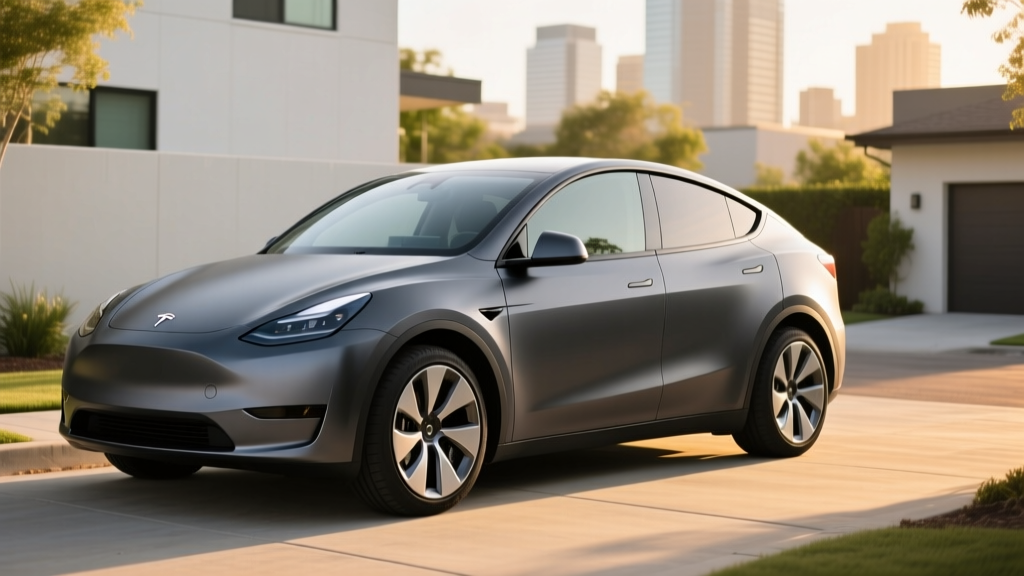
A handful of EVs, like the original Porsche Taycan, use a two-speed transmission on the rear axle to optimize both launch acceleration and high-speed efficiency. But for over 95% of EVs on the road — from the Tesla Model Y to the Hyundai Ioniq 5 — the "transmission" is a fixed-ratio gear reduction unit with just one forward gear.
How an EV Drivetrain Actually Works
In a gasoline car, the internal combustion engine produces useful power only within a narrow RPM band (roughly 1,500–5,500 RPM). A multi-speed transmission — typically 8, 9, or even 10 gears in modern automatics — exists to keep the engine in that sweet spot as vehicle speed changes. Each shift introduces a momentary interruption in power delivery, adds mechanical complexity, and creates maintenance requirements (fluid changes, clutch wear, solenoid failures).
Electric motors operate on fundamentally different physics:
- Torque from zero: A permanent-magnet synchronous motor (the type used in most 2026 EVs) delivers peak torque the instant current flows. There is no idle speed, no stall, and no need to "build revs."
- Wide RPM range: EV motors spin efficiently from 0 to well over 10,000 RPM. A Tesla Model 3 motor, for instance, can reach approximately 18,000 RPM — enough to push the car to its electronically limited top speed in a single gear ratio.
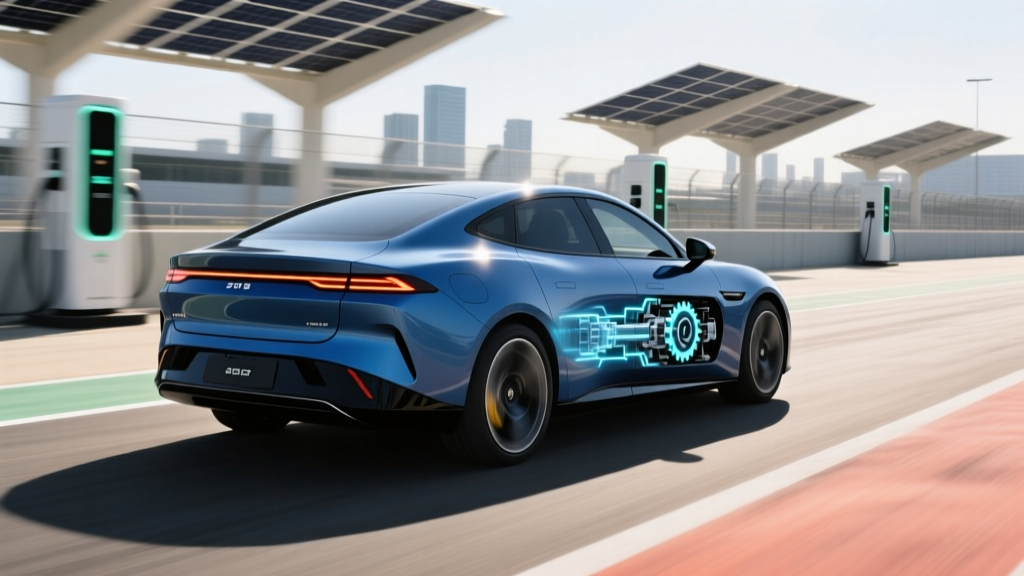
- Reduction gearbox: The motor's high RPM is reduced through a single set of helical gears (typical ratios between 8:1 and 10:1) to match wheel speed. This gearbox contains a differential and is lubricated for life in most designs.
The entire unit — motor, inverter, and reduction gearbox — is often packaged as an integrated "e-axle" or "drive unit" weighing 60–120 lbs depending on power output. Compare that to a gas car's engine + torque converter + multi-speed transmission, which can exceed 400 lbs.
EV vs Gas: Drivetrain Efficiency & Complexity Compared
| Attribute | Battery-Electric (BEV) | Gas Car (ICE) |
|---|---|---|
| Transmission type | Single-speed reduction gear | 6–10 speed automatic / CVT / DCT |
| Forward gears | 1 | 6–10 |
| Moving parts in drivetrain | ~20–30 | ~200+ |
| Drivetrain efficiency | ~89–95% | ~14–30% (tank-to-wheel) |
| Transmission fluid change interval | None (sealed, lifetime fill) | 30,000–60,000 miles |
| Transmission replacement cost | $1,500–$4,000 (gearbox) | $3,500–$7,000+ |
| Clutch / torque converter | None | Yes — wear item |
| Energy wasted as heat (drivetrain) | ~5–11% | ~70–86% |
Data sources: U.S. Department of Energy / fueleconomy.gov, manufacturer service documentation.
The efficiency gap is striking. A gas engine converts only about 20–30% of gasoline's chemical energy into motion at the wheels; the rest is lost as heat, friction, and pumping losses — much of it through the transmission itself (torque converter slippage, gear mesh losses). An EV motor + single-speed gearbox converts roughly 89–95% of battery energy into forward motion. This is a primary reason why EVs achieve such high MPGe ratings despite heavier curb weights.
Why Don't Most EVs Need Multiple Gears?
The engineering rationale comes down to the motor's torque curve:
- Constant torque region (0 to ~5,000 RPM): The motor delivers maximum torque regardless of speed. This is where you feel that instant, neck-snapping acceleration from a stoplight.
- Constant power region (~5,000 to ~15,000+ RPM): Torque tapers off, but power remains flat. The car continues accelerating, just at a decreasing rate — sufficient to reach highway speeds and beyond.
A single gear ratio is chosen to balance two goals: strong low-speed acceleration and adequate top speed. For a car like the 2026 Hyundai Ioniq 5 (168 kW / 225 hp in the standard-range RWD model), a ~9:1 reduction ratio delivers 0–60 mph in approximately 7.4 seconds and a top speed of 115 mph — all in one gear.
The Two-Speed Exception: Porsche Taycan
The Porsche Taycan uses a ZF-designed two-speed automatic on the rear axle. First gear has a very short ratio (~16:1) for explosive launches (0–60 in 2.6 seconds in Turbo S trim), while second gear (~8:1) optimizes high-speed cruising efficiency and extends top speed to 162 mph. Porsche engineers determined that the added weight (~40 lbs) and complexity were justified for a performance flagship. No other mainstream 2026 EV has adopted this approach at scale.
Real-World Ownership: Maintenance Cost Savings
The single-speed transmission is one of the biggest — and least discussed — ownership advantages of going electric. Here's how the numbers stack up over a typical 5-year / 75,000-mile ownership period:
| Maintenance Item | Gas Car (5 yr / 75k mi) | BEV (5 yr / 75k mi) |
|---|---|---|
| Transmission fluid changes | $150–$400 (2–3 services) | $0 |
| Engine oil changes | $250–$600 (8–15 services) | $0 |
| Spark plugs / ignition | $200–$500 | $0 |
| Brake pads (front) | $300–$600 (1–2 replacements) | $0–$200 (regen braking reduces wear) |
| Timing belt / chain | $500–$1,200 (if applicable) | $0 |
| Air / fuel / cabin filters | $150–$350 | $50–$150 (cabin filter only) |
| Exhaust / emissions | $100–$800 (O2 sensors, catalytic converter risk) | $0 |
| Total estimated maintenance | $1,650–$4,450 | $50–$350 |
Source: AAA "Your Driving Costs" 2025 report, fueleconomy.gov maintenance comparisons.
Over five years, an EV owner can expect to save $1,300–$4,100 in routine maintenance alone. The sealed reduction gearbox plays a starring role: no fluid to change, no clutches to wear, no solenoids to fail.
Common Misconceptions About EV Transmissions
| Myth | Fact |
|---|---|
| "EVs have no transmission at all." | They have a single-speed reduction gearbox — it's a transmission, just with one gear. |
| "The gearbox will fail and cost $10,000 to replace." | EV reduction gearboxes are simple, robust units. Failures are rare, and replacement typically costs $1,500–$4,000 — far less than a modern 8- or 10-speed automatic rebuild. |
| "EVs can't tow because they only have one gear." | Towing capacity is limited by motor thermal management and battery capacity, not gearing. The 2026 Ford F-150 Lightning tows up to 10,000 lbs; the Rivian R1T tows 11,000 lbs — both with single-speed gearboxes. |
| "You need to change the gearbox fluid regularly." | Most 2026 EVs use sealed, lifetime-fill gear oil. Tesla, Hyundai, GM, and BMW do not list transmission fluid changes in their standard maintenance schedules. Some owners proactively change fluid at 100,000+ miles as a precaution (~$100–$200 at a shop), but it is not required. |
| "EVs lose performance at highway speeds because of the single gear." | Acceleration tapers above ~80 mph compared to low-speed punch, but modern EV motors produce ample power for highway passing. A 2026 Tesla Model 3 Long Range (346 hp) still delivers strong 60–90 mph passing acceleration in well under 4 seconds. |
What This Means for First-Time EV Buyers
If you're shopping for your first EV, the single-speed drivetrain has practical implications that go beyond the spec sheet:
Driving Feel
Expect perfectly smooth, uninterrupted acceleration. There are no shift shocks, no hesitation while the transmission "thinks," and no hunting for the right gear on hilly roads. Regenerative braking — which recaptures kinetic energy and sends it back to the battery — further simplifies the driving experience, enabling one-pedal driving in most models.
Reliability
Fewer moving parts means fewer things that can break. According to Consumer Reports reliability data, EVs consistently show lower powertrain failure rates than comparable gas vehicles. The reduction gearbox is among the most trouble-free components in the entire car.
Long-Term Cost
Beyond maintenance savings, the simpler drivetrain contributes to lower total cost of ownership. When combined with lower fueling costs (electricity at $0.14/kWh national average vs. gasoline at $3.40/gallon), a typical mid-size EV sedan saves an estimated $6,000–$10,000 over 5 years and 75,000 miles in combined fuel and maintenance — before factoring in any federal §30D tax credits (up to $7,500 for eligible new EVs, subject to MSRP caps, buyer income limits, and battery-sourcing requirements).
Decision Framework: Should the Transmission Factor Into Your EV Choice?
Choose a single-speed BEV if:
- You prioritize low maintenance costs and long-term reliability
- You commute in stop-and-go traffic (no shift fatigue, strong regen braking)
- You want the smoothest possible acceleration experience
- You plan to own the car 7+ years and want to minimize drivetrain repair risk
Consider a two-speed EV (e.g., Porsche Taycan) if:
- Track-capable launch performance is a priority
- You regularly drive at sustained speeds above 100 mph (autobahn-style use)
- You're willing to accept marginally higher complexity for performance gains
Consider a PHEV instead if:
- You lack reliable home or workplace charging
- You frequently tow heavy loads on long trips where charging infrastructure is sparse
- You want electric commuting (25–50 miles) with gas-engine flexibility for road trips — note that PHEVs retain a conventional multi-speed transmission for the gas engine
Frequently Asked Questions
Do Teslas have a transmission?
Yes. Every Tesla model (Model 3, Model Y, Model S, Model X) uses a single-speed reduction gearbox. Tesla has used single-speed units since the original Roadster abandoned its troubled two-speed prototype transmission in 2008. The Model S Plaid's tri-motor setup uses three individual single-speed gearboxes — one per motor.
Can an EV transmission be repaired, or must it be replaced?
Most EV reduction gearboxes are serviceable: bearings, seals, and gear sets can be replaced individually by a qualified EV technician. However, because failures are uncommon and the units are relatively inexpensive compared to ICE transmissions, some shops opt for a complete swap. Expect $1,500–$4,000 depending on the model and whether the unit is refurbished or new.
Does the single-speed gearbox affect highway range?
Minimally. The motor's wide RPM range and high efficiency across that range mean that a well-chosen gear ratio provides strong efficiency at both city and highway speeds. The primary range killers at highway speeds are aerodynamic drag (which scales with the square of velocity) and cold-weather battery resistance — not gearing. Expect roughly 10–20% less range at a sustained 75 mph compared to the EPA combined estimate, and 20–35% less in sub-freezing temperatures without preconditioning.
Do hybrids have the same transmission as a full EV?
No. Conventional hybrids (HEVs) and plug-in hybrids (PHEVs) typically use a planetary gearset (Toyota's e-CVT) or a dedicated hybrid transmission (Hyundai/Kia's 6-speed DCT in PHEV models) that blends power from both the electric motor and gas engine. These are more complex than a BEV's single-speed unit but generally simpler than a conventional automatic.
Will future EVs use multi-speed transmissions?
Widespread adoption is unlikely. As motor technology improves — particularly with higher-RPM designs and silicon-carbide inverters — the case for additional gears weakens further. Multi-speed EV transmissions add weight, cost, complexity, and potential failure points for marginal efficiency gains. The industry consensus in 2026 strongly favors single-speed simplicity.