The Short Answer: No Traditional Transmission
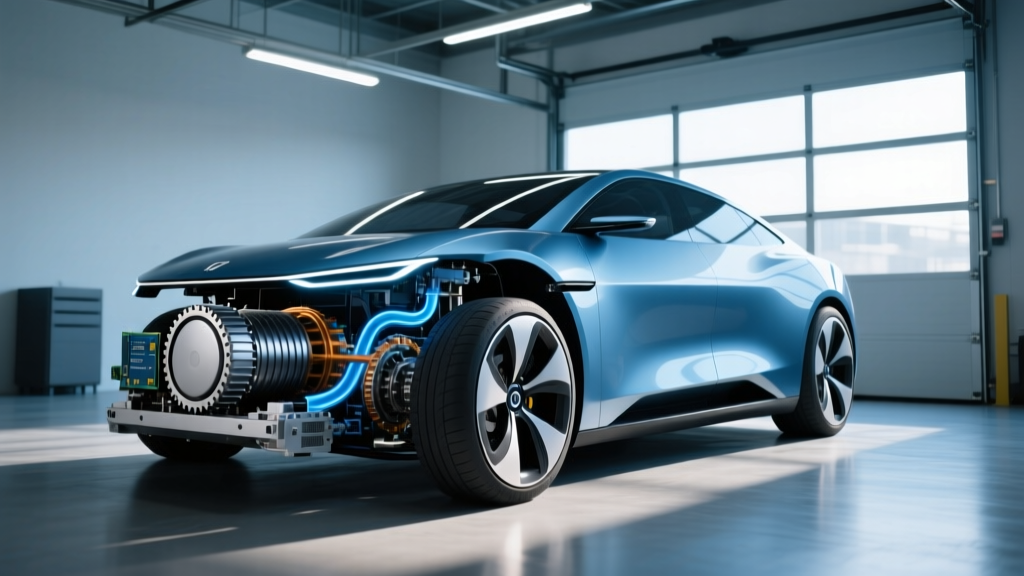
Most electric vehicles do not have a multi-speed transmission like a gas car. Instead, they use a single-speed reduction gear (typically with a ratio between 8:1 and 10:1) that transfers torque from the electric motor to the wheels. Because electric motors produce maximum torque from 0 RPM and can safely rev to 15,000–20,000+ RPM, there's no need for gear shifts. A few exceptions exist — the Porsche Taycan and Audi e-tron GT use a two-speed rear axle — but for over 95% of EVs on the road in 2026, "transmission" as you know it simply doesn't apply.
Why Electric Motors Don't Need Multiple Gears
Internal combustion engines have a narrow power band. A typical gas engine produces peak torque between 1,500–4,500 RPM and redlines around 6,000–7,000 RPM. To keep the engine in its useful range across speeds from 0 to 80+ mph, a 6-, 8-, or even 10-speed automatic transmission is necessary. Each gear ratio multiplies torque differently for acceleration, cruising, or climbing.
Electric motors behave fundamentally differently:
- Instant peak torque at 0 RPM. An EV motor delivers its maximum twisting force the moment current flows — no revving required.
- Extremely wide operating range. Most EV traction motors spin safely from 0 to 15,000–20,000 RPM, covering the full speed range of the vehicle in a single ratio.
- Linear power delivery. Power ramps predictably with RPM, so there's no "sweet spot" that demands shifting to stay in.
The single-speed reduction gear (sometimes called a "gearbox" or "drive unit") reduces the motor's high rotational speed to a usable wheel speed while multiplying torque. For example, a motor spinning at 16,000 RPM through a 9:1 reduction gear turns the wheels at roughly 1,778 RPM — about right for highway speeds on typical tire diameters.
The Exceptions: Two-Speed EV Transmissions
A handful of performance EVs use a two-speed transmission on the rear axle. The Porsche Taycan (including the 2026 model year) employs a ZF-developed two-speed unit: first gear provides aggressive launch acceleration (0–60 mph in as little as 2.4 seconds for the Turbo S), while second gear optimizes high-speed efficiency and top speed (up to 162 mph). The Audi e-tron GT, which shares the J1 platform with the Taycan, uses the same setup.
Why bother with two speeds in these cars? At extreme power outputs (750+ hp in the Taycan Turbo S with Launch Control), a single gear forces a compromise between 0–60 performance and top-end efficiency. The second gear lets Porsche optimize both. For everyday EVs making 200–400 hp, this compromise is negligible — the single-speed unit handles it all with less weight, fewer parts, and zero shift interruption.
Rumors of multi-speed EV transmissions for mainstream vehicles surface periodically, but as of 2026, no high-volume automaker has adopted them. The cost, weight, and complexity penalties outweigh the marginal efficiency gains for non-performance applications.
EV Drivetrain vs. Gas Car Drivetrain: What's Different
| Component | Typical Gas Car | Typical EV (2026) |
|---|---|---|
| Power source | Internal combustion engine (ICE) | Electric motor(s) |
| Transmission | 6–10 speed automatic, CVT, or manual | Single-speed reduction gear (most); 2-speed (rare) |
| Moving parts in drivetrain | Hundreds (gears, clutch packs, torque converter, valve train) | ~20–30 (motor rotor, reduction gear set, differential) |
| Transmission fluid changes | Every 30,000–60,000 miles ($150–$350 per service) | Mostly sealed; some models recommend inspection at 60,000–100,000 mi |
| Exhaust system | Catalytic converter, muffler, O2 sensors | None |
| Brake wear | Standard friction braking; pads every 30,000–50,000 mi | Regenerative braking extends pad life to 80,000–150,000+ mi |
| Typical drivetrain warranty | 5 yr / 60,000 mi powertrain | 8 yr / 100,000 mi battery & drive unit (federal minimum) |
The reduction in moving parts is the single biggest maintenance advantage of an EV drivetrain. There are no spark plugs, no timing belts, no clutch plates, no torque converter, and no transmission fluid to flush on the schedule gas-car owners know. The reduction gear itself is typically bathed in a small quantity of gear oil that many manufacturers consider "lifetime" fill, though some (like Hyundai/Kia) recommend inspection or replacement around 120,000 miles.
Real Costs: Drivetrain Maintenance Savings in Context
The absence of a multi-speed transmission contributes meaningfully to lower EV maintenance costs, but it's one piece of a larger picture. Here's a realistic 5-year cost breakdown comparing a 2026 EV (using the Hyundai Ioniq 6 SE, 361-mile EPA range, $39,500 MSRP) against a comparable gas sedan (Toyota Camry LE, 32 MPG combined, ~$29,000 MSRP):
| Category | Hyundai Ioniq 6 SE (EV) | Toyota Camry LE (Gas) |
|---|---|---|
| Purchase price (MSRP) | $39,500 | $29,000 |
| Federal §30D tax credit (if eligible) | −$3,750 to $7,500 (varies by sourcing & income) | $0 |
| Fuel / electricity (75,000 mi) | ~$2,800 (home L2 at $0.14/kWh avg) | ~$8,200 (gas at $3.40/gal, 32 MPG) |
| Transmission maintenance | $0–$150 (inspection) | $400–$700 (fluid changes) |
| Engine maintenance (oil, filters, plugs) | $0 | $1,200–$1,800 |
| Brake pads | $0–$250 (regen extends life) | $400–$800 |
| Tires (heavier EV wears faster) | $1,600–$2,400 | $1,200–$1,800 |
| Insurance (avg) | ~$8,500 (EV premium ~15–20% higher) | ~$7,200 |
| Estimated 5-yr total (before credit) | ~$52,550–$54,900 | ~$47,800–$49,500 |
| Estimated 5-yr total (with max credit) | ~$45,050–$47,400 | ~$47,800–$49,500 |
Key takeaway: The EV's drivetrain and powertrain maintenance savings are real — roughly $1,600–$2,500 over 5 years when you combine zero oil changes, zero transmission fluid services, and reduced brake wear. But higher insurance premiums and tire costs eat into that advantage. The federal §30D tax credit (up to $7,500, subject to MSRP caps, buyer income limits, and battery sourcing requirements per the IRS) is often the deciding factor in total cost parity. Always confirm your eligibility with a tax professional before counting on the credit.
Common Misconceptions About EV Transmissions
| Myth | Fact |
|---|---|
| "EVs have no gears at all." | EVs use a single-speed reduction gear (typically 8:1 to 10:1 ratio). It's a gear set — just not a multi-speed transmission. |
| "EV transmissions will break and cost $5,000+ to replace." | Single-speed reduction gears have very few wear components. Failure is rare, and the drive unit is covered under the 8-year/100,000-mile federal warranty minimum. Out-of-warranty replacement runs $2,000–$4,500 depending on the model — less than many ICE transmission rebuilds. |
| "Without a transmission, EVs can't go fast." | The Tesla Model S Plaid hits 0–60 in 1.99 seconds and a top speed of 200 mph with a single-speed gear. Motor RPM range makes multi-speed unnecessary for most performance targets. |
| "EVs need transmission fluid changes like gas cars." | Most EV reduction gears use a small sealed oil bath. Some manufacturers recommend inspection at high mileage, but routine flushes are generally not required. Check your owner's manual for model-specific intervals. |
| "All EVs are direct-drive with no gears." | Direct-drive (no reduction gear) exists in some hub-motor concepts, but production EVs use a reduction gear between the motor and differential to multiply torque and keep motor RPM in an efficient range. |
How the Single-Speed Gear Affects Your Real-World Driving
The single-speed design shapes the EV driving experience in ways that matter daily:
Acceleration Feel
Without shift interruptions, EV acceleration is seamless. A 2026 Tesla Model 3 Long Range (82 kWh usable battery, NMC chemistry, ~330 hp) delivers its 0–60 mph run in approximately 4.4 seconds with a single, unbroken surge of torque. Gas cars in the same price bracket pause momentarily during each upshift. This is why even modest-power EVs feel quicker than their 0–60 times suggest in city driving.
Regenerative Braking Integration
The same motor that propels the car reverses its role during deceleration, converting kinetic energy back into electricity stored in the battery. The single-speed gear allows instant transition between drive and regen modes with no mechanical disconnection. This is why one-pedal driving works: lift off the accelerator and the motor immediately begins braking at up to 0.3g of deceleration in many models, sending 20–60 kW back into the pack depending on speed and state of charge.
Highway Efficiency Trade-Off
The single gear ratio is optimized for a broad range, but it isn't perfectly efficient at every speed. At sustained 80 mph highway driving, EV energy consumption rises noticeably compared to city driving — the opposite of gas cars, which often achieve better MPG on the highway. For example, the EPA rates the 2026 Ioniq 6 SE at 140 MPGe combined, but real-world highway testing at 75 mph typically yields efficiency closer to 3.0–3.3 miles per kWh (roughly 100–113 MPGe equivalent). Expect real-world highway range of approximately 270–300 miles versus the 361-mile EPA combined sticker.
Real-World Range Reality Check: EPA range is measured on a mixed driving cycle. On a 75 mph highway trip in 40°F weather, expect 25–35% less range than the EPA sticker. Cold temperatures increase battery internal resistance and cabin heating draws 2–5 kW continuously. Plan charging stops accordingly.
Decision Framework: Does the Drivetrain Simplicity Matter for Your Purchase?
Choose an EV if:
- You want minimal drivetrain maintenance. No transmission fluid, no clutch, no timing belt, no exhaust — the single-speed gear and electric motor require very little scheduled service over 150,000+ miles.
- You have access to home Level 2 charging. A 240V home charger (7.2–11.5 kW) adds 25–45 miles of range per hour of charging and makes the EV experience effortless. Without home charging, public DC fast charging costs more ($0.30–$0.55/kWh) and requires time planning.
- Your daily driving is under 250 miles round-trip. This covers the real-world range of most 2026 EVs even with highway and cold-weather losses, meaning you'll rarely need mid-day charging.
- You qualify for the §30D tax credit. The up-to-$7,500 credit (point-of-sale transfer available) can close the upfront price gap with gas cars. Check IRS rules on income caps ($150K single / $300K joint), MSRP limits ($55K sedans / $80K SUVs & trucks), and battery sourcing requirements.
Consider a hybrid (HEV/PHEV) instead if:
- You can't charge at home or work. A conventional hybrid like the Toyota Prius (57 MPG combined) eliminates range anxiety and charging dependency entirely.
- You regularly drive 400+ miles in a single day in cold climates. While DC fast charging infrastructure has expanded significantly by 2026, highway charging deserts still exist in parts of the Mountain West and rural Midwest. A PHEV like the Toyota RAV4 Prime (42-mile electric range, 38 MPG gas) offers electric commuting with gas flexibility.
- Upfront budget is tight and you don't qualify for credits. Gas and hybrid vehicles still carry a lower sticker price in most segments, and the maintenance savings of an EV take 4–6 years to offset the premium without incentive help.
Frequently Asked Questions
Do electric vehicles have a clutch?
No. Since there's only one gear ratio and the electric motor can start from a standstill without stalling (unlike a gas engine), there is no clutch mechanism. The motor controller manages torque delivery electronically from 0 RPM.
Can an EV's reduction gear fail?
It's uncommon but possible. The reduction gear contains bearings, a gear set, and seals. Bearing wear or seal leaks at very high mileage (150,000+ miles) can require service. However, failure rates are significantly lower than multi-speed automatic transmissions in gas vehicles, which have complex clutch packs and valve bodies that wear with use.
Does the single-speed gear limit towing capacity?
Not inherently. Towing capacity is limited more by motor thermal management, battery discharge rate, and cooling capacity than by the gear ratio. The 2026 Ford F-150 Lightning (dual motor, 131 kWh extended-range pack) tows up to 10,000 lbs with its single-speed drive units. However, towing at highway speeds dramatically reduces range — expect a 40–55% range reduction when pulling a heavy trailer at 70 mph.
Will EVs ever have multi-speed transmissions?
For mainstream vehicles, it's unlikely as of current industry direction. Motor technology continues to improve — higher RPM limits and wider efficiency maps reduce the case for additional gears. Porsche and Audi's two-speed units serve niche performance targets. Bosch and ZF have prototyped multi-speed EV transmissions, but no mass-market automaker has committed to one for 2026 or announced models.
How does the EV drivetrain warranty compare to gas cars?
Federal law mandates that EV battery and drive unit components carry at least an 8-year / 100,000-mile warranty (10 years / 150,000 miles in California and states that follow CARB standards). This covers the electric motor, reduction gear, inverter, and battery pack against defects and excessive capacity loss (typically below 70% state of health). Most gas car powertrain warranties cover 5 years / 60,000 miles. Per fueleconomy.gov, this warranty advantage is one of the strongest ownership-cost arguments for EVs.
Do EVs use a differential?
Yes. Most EVs have a conventional open or limited-slip differential integrated into the drive unit, just like a gas car. Some dual-motor EVs (one motor per axle) effectively function as all-wheel drive without a mechanical connection between the front and rear axles — the motor controllers manage torque distribution electronically, which is faster and more precise than a mechanical center differential.
Sources: EPA Fuel Economy (range and MPGe data), IRS §30D Clean Vehicle Credit rules, manufacturer specification pages for Hyundai, Tesla, Porsche, and Ford.