The Short Answer on the Toyota Tacoma Electric
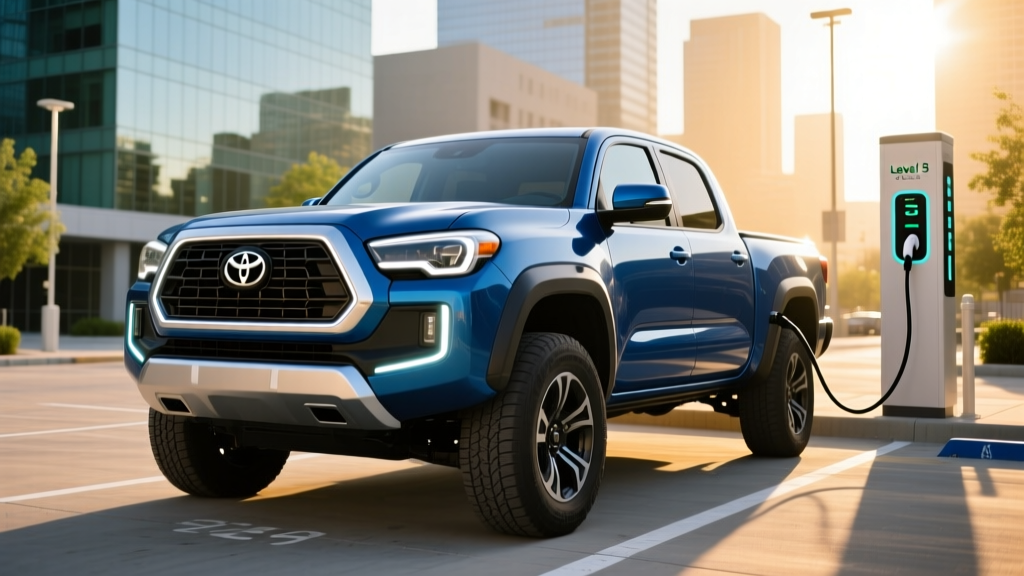
As of early 2026, Toyota does not sell a fully electric Tacoma. The current fourth-generation Tacoma (introduced for the 2024 model year) is offered exclusively with a 2.4-liter turbocharged four-cylinder gas engine or the i-FORCE MAX hybrid powertrain, which pairs that turbo engine with a 48-hp electric motor integrated into the eight-speed automatic transmission. Toyota has signaled that a battery-electric Tacoma is in development — CEO Koji Sato has committed to expanding the BEV lineup — but no production date, battery specs, or pricing have been officially announced. If you need an electric midsize truck today, the closest alternatives are the Ford Maverick hybrid (for efficiency) or stepping up to the full-size Ford F-150 Lightning or Rivian R1T. If you want a Tacoma specifically and want electrification, the i-FORCE MAX hybrid is your current option.
Where the Toyota Tacoma Electric Stands in 2026
Toyota's approach to truck electrification has been cautious and incremental. While the company has unveiled concepts like the EPU (Electric Pickup Unit) at the 2023 Tokyo auto show — a compact electric truck concept with a unibody architecture and approximately 20 inches of bed length — it has not confirmed a production timeline for a battery-electric Tacoma. The EPU concept, measuring roughly 197 inches long, hinted at a possible compact electric truck slotting below or alongside the Tacoma, but concept-to-production timelines in the auto industry typically run 2–4 years, with no guarantee of faithful translation.
What Toyota has committed to is a broader BEV expansion: the company targets 30 battery-electric models globally by 2030 and has invested tens of billions in battery development, including a partnership with Panasonic on next-generation cells. But for the Tacoma nameplate specifically, the current generation remains anchored to internal combustion and mild hybridization.
This matters for buyers because it means your decision today is between a gas Tacoma, a hybrid Tacoma, or a competitor's electric truck — not a fully electric Tacoma.
The i-FORCE MAX Hybrid: Tacoma's Current Electrified Option
The i-FORCE MAX is the closest thing to an "electrified Tacoma" you can buy right now. Here's what the powertrain delivers:
| Spec | i-FORCE MAX Hybrid | Standard 2.4L Turbo Gas |
|---|---|---|
| Horsepower | 326 hp combined | 278 hp |
| Torque | 465 lb-ft combined | 317 lb-ft |
| Electric Motor | 48 hp / 184 lb-ft (integrated) | None |
| Battery | 1.87 kWh NiMH (hybrid system) | N/A |
| Transmission | 8-speed automatic | 8-speed automatic (or 6-speed manual on select trims) |
| EPA Fuel Economy (4x4) | ~23 mpg combined (est.) | ~20–22 mpg combined |
| Max Towing Capacity | 6,000 lbs | 6,500 lbs |
| 0–60 mph (est.) | ~6.5 sec | ~7.5 sec |
| Starting MSRP (2025 TRD Off-Road) | ~$46,300 | ~$38,600 (SR5 base) |
The hybrid system's 1.87 kWh battery is small — it's a mild/full hybrid, not a plug-in. You cannot charge it from a wall outlet, and it offers no meaningful electric-only driving range. The electric motor assists the gas engine during acceleration and low-speed maneuvers, improving torque delivery and shaving a few mpg off fuel consumption. Think of it as a performance-and-efficiency assist, not an EV experience.
Tacoma Hybrid vs. Electric Trucks: Head-to-Head
If you're weighing a Tacoma i-FORCE MAX against actual electric trucks, here's how the numbers compare across key ownership metrics:
| Metric | Tacoma i-FORCE MAX (Hybrid) | Ford F-150 Lightning (Extended Range) | Rivian R1T (Dual-Motor Max Pack) |
|---|---|---|---|
| Powertrain | 2.4L Turbo + Electric Motor (HEV) | Dual-Motor BEV | Dual-Motor BEV |
| Horsepower | 326 hp | 580 hp | 665 hp |
| EPA Range / Fuel Economy | ~23 mpg combined (~460 mi on 20-gal tank) | 320 mi (EPA) | 410 mi (EPA) |
| Energy Cost per Mile | ~$0.15/mi (gas at $3.50/gal) | ~$0.04–$0.06/mi (home charging) | ~$0.04–$0.06/mi (home charging) |
| Max Towing | 6,000 lbs | 7,700 lbs (w/ Max Tow) | 11,000 lbs |
| Starting MSRP | ~$46,300 | ~$69,995 | ~$89,900 |
| Federal Tax Credit (§30D) | Not eligible (not a BEV/PHEV) | Up to $7,500 (verify sourcing) | Up to $7,500 (verify sourcing) |
| Charging/Fueling Time | ~5 min at gas station | 10–80% in ~41 min (150 kW DC) | 10–80% in ~30 min (200+ kW DC) |
The price gap is substantial. The Tacoma hybrid starts roughly $24,000–$44,000 below electric alternatives, and it avoids the charging infrastructure dependency entirely. But EVs dominate on per-mile energy cost, instant torque (critical for towing and trail crawling), and available federal incentives.
Real Costs: Tacoma Hybrid vs. Electric Truck Ownership
Let's project a realistic 5-year ownership scenario assuming 15,000 miles per year, 75,000 miles total.
| Cost Category (5 Yr / 75K mi) | Tacoma i-FORCE MAX | F-150 Lightning (Ext. Range) |
|---|---|---|
| Purchase Price (base) | $46,300 | $69,995 |
| Federal Tax Credit | $0 | Up to $7,500* |
| Effective Purchase | $46,300 | ~$62,495 |
| Fuel / Energy (75K mi) | ~$11,250 (gas @ $3.50/gal, 23 mpg) | ~$3,375 (home L2 @ $0.14/kWh, 2.0 kWh/mi) |
| Maintenance (est.) | ~$2,800 (oil changes, filters, brakes) | ~$1,200 (no oil changes, regen saves brakes) |
| Insurance (avg.) | ~$8,500 | ~$10,500 |
| Est. Depreciation | ~$18,000 | ~$25,000 |
| Total 5-Year Cost | ~$86,850 | ~$95,070 |
*Federal §30D tax credit eligibility depends on MSRP caps ($80,000 for trucks/vans/SUVs), buyer income limits ($300K joint / $150K single modified AGI), and battery-component and critical-mineral sourcing requirements. Verify current-year rules at irs.gov and consult a tax professional. Credits can now be transferred to the dealer at point of sale.
The Tacoma hybrid wins on total cost primarily because of the lower purchase price and lower insurance premiums. The Lightning recovers ground on fuel savings (~$7,875 less over 5 years) and reduced maintenance, but doesn't fully close the gap. However, if you drive more miles annually (say 20,000+), the per-mile energy advantage of an EV grows significantly.
What a Fully Electric Tacoma Would Need to Deliver
Based on the Tacoma's core buyer profile — off-road enthusiasts, light-duty haulers, daily commuters who value reliability — a battery-electric Tacoma would need to hit specific benchmarks to succeed:
- Range: At least 300 miles EPA to be competitive with the F-150 Lightning and Rivian R1T. Real-world highway range at 70 mph typically drops 15–20% below EPA, so a 300-mile sticker translates to roughly 240–255 miles on the interstate.
- Battery: Likely 100–130 kWh usable capacity (NMC chemistry for energy density). Toyota's bZ4X uses a 71.4 kWh NMC pack; a truck would need substantially more. LFP (lithium iron phosphate) could be an option for lower trims, trading range for longevity and lower cost.
- Charging: Peak DC fast-charge rate of at least 200 kW, with a 10–80% time under 30 minutes. Toyota's bZ4X has been criticized for charging speeds peaking around 150 kW and tapering aggressively — a truck must do better.
- Towing: Minimum 5,000–6,000 lbs to match the current Tacoma. Towing with an EV typically cuts range by 40–50%, a reality every EV truck buyer must accept.
- Off-Road Capability: Low-center-of-gravity battery placement actually benefits off-road dynamics (reduced rollover risk), but underbody battery protection is critical. Rivian's R1T uses a full skid plate system; Toyota would need equivalent armor for TRD Pro credibility.
- Price: The Tacoma's sweet spot is $38,000–$55,000. A BEV version would likely start above $50,000 given battery costs, putting it in direct competition with the Ford F-150 Lightning on price while offering a smaller bed and cabin.
Cold Weather, Towing, and the Real-World EV Truck Equation
Electric trucks face physics that gas trucks don't. Understanding these is essential before committing to any EV truck purchase:
Cold-weather range loss: Lithium-ion batteries lose 20–40% of their rated range in sub-freezing temperatures, depending on severity and whether the cabin heater is running. A 300-mile EPA truck could deliver 180–210 miles on a 15°F day. Heat pumps (standard on some EVs, optional on others) mitigate this by 10–15 percentage points, but the loss is real and recurring for buyers in northern climates.
Towing range reduction: Pulling a 4,000-lb trailer at highway speeds can cut EV range by 40–50%. A 320-mile truck becomes a 160–190-mile truck under load. This isn't a defect — it's aerodynamic drag and rolling resistance multiplied by weight. Gas trucks also lose efficiency while towing, but the refueling network makes it a non-issue; for EVs, it requires careful route planning around DC fast chargers.
Charging-curve reality: Peak charge rates (e.g., 250 kW) are sustained only between roughly 10–40% state of charge. Above 60%, charging slows dramatically to protect the battery. A "30-minute 10–80% charge" often means the last 20% takes as long as the first 50%. Plan road trips around 10–80% stops, not full charges.
Decision Framework: Should You Wait for the Electric Tacoma?
Choose the Tacoma i-FORCE MAX Hybrid now if:
- You need a midsize truck in 2026 and can't wait 2–4 years for an unannounced EV variant
- Your typical driving includes remote off-road trails, rural areas, or regions with sparse DC fast-charging infrastructure
- You tow regularly and can't accept the 40–50% range hit that EV towing imposes
- Your budget is $40,000–$55,000 and you want to avoid the $65,000+ entry point of electric trucks
- You don't have reliable home Level 2 charging access (a 240V/40A+ circuit is essential for practical EV ownership)
Consider an electric truck (Lightning, R1T, Silverado EV) now if:
- You have home Level 2 charging and drive under 300 miles daily without a trailer
- You want instant electric torque for trail crawling or boat launches
- You want to eliminate oil changes, transmission fluid, and exhaust-system maintenance
- Per-mile energy cost matters to you — $0.04–$0.06/mi on home electricity vs. $0.15/mi on gas
- You qualify for the §30D federal tax credit and can bring the effective price below $62,000
Wait for the electric Tacoma if:
- You're specifically loyal to the Tacoma platform and want a midsize BEV truck (not full-size like the Lightning)
- Your current truck still serves you and you can comfortably delay a purchase 2–4 years
- You want Toyota's reliability track record applied to a battery-electric powertrain before committing
Common Misconceptions About the Tacoma and Electrification
| Myth | Fact |
|---|---|
| "The Tacoma hybrid is a plug-in you can charge at home." | The i-FORCE MAX is a conventional hybrid (HEV). It charges its 1.87 kWh battery through regenerative braking and the gas engine. There is no plug, no EV-only mode, and no external charging capability. |
| "Toyota's EV truck is already available in Japan." | Toyota has not launched a production electric pickup in any market as of early 2026. The EPU concept was shown in 2023 but has not entered production. |
| "An electric Tacoma would qualify for the full $7,500 tax credit." | Eligibility depends on battery-component manufacturing origin, critical-mineral sourcing, MSRP caps ($80K for trucks), and buyer income limits. Many EVs qualify for only a partial credit or none at all depending on the model year and sourcing. Always verify at irs.gov. |
| "EV trucks can't tow as much as gas trucks." | Towing capacity is comparable or superior (F-150 Lightning: 7,700 lbs; R1T: 11,000 lbs). The limitation is range while towing, not the mechanical ability to pull weight. |
| "The Tacoma will get a solid-state battery EV version soon." | Toyota is developing solid-state batteries but has stated initial production will target passenger cars, not trucks, likely in the 2027–2028 timeframe. A Tacoma with solid-state cells is speculative at this point. |
Frequently Asked Questions
Will Toyota make an electric Tacoma?
Toyota has signaled intent to electrify its truck lineup and has shown the EPU electric pickup concept, but no production electric Tacoma has been officially announced with a release date, specs, or pricing as of early 2026. Industry timelines suggest a possible 2027–2029 window if development proceeds.
Is the Tacoma i-FORCE MAX a plug-in hybrid?
No. The i-FORCE MAX is a conventional (non-plug-in) hybrid. Its 1.87 kWh battery is charged exclusively by the gas engine and regenerative braking. You cannot plug it in, and it does not offer meaningful electric-only driving. For a plug-in Toyota truck, you'd need to look at the Tundra — which also does not currently offer a PHEV variant.
What electric midsize trucks are available now?
The midsize electric truck segment is extremely limited as of 2026. The Ford Maverick is available as a hybrid (not fully electric). The Chevrolet Silverado EV and GMC Sierra EV are full-size. The Rivian R1T is midsize-adjacent but priced significantly higher than a Tacoma. If you need a midsize BEV truck at a Tacoma price point, you may need to wait for Toyota, Ford, or Stellantis to fill that gap.
How much would an electric Tacoma likely cost?
Based on current EV truck pricing and battery costs, a production electric Tacoma would likely start in the $50,000–$60,000 range for a base model, with well-equipped TRD Pro or off-road variants reaching $65,000–$75,000. This would place it above the current gas/hybrid Tacoma but potentially below the F-150 Lightning and Rivian R1T.
Does the Tacoma hybrid save enough fuel to justify the price premium?
The i-FORCE MAX adds roughly $5,000–$8,000 over equivalent gas trims (depending on configuration) and gains approximately 2–4 mpg combined. At 15,000 miles/year and $3.50/gallon gas, that's roughly $200–$400/year in fuel savings. The payback period on fuel alone is long — but the hybrid also delivers substantially more torque (465 lb-ft vs. 317 lb-ft), which improves acceleration, towing feel, and off-road low-speed control. Most buyers choose the i-FORCE MAX for performance, with efficiency as a secondary benefit.
Can I charge an EV truck at home on a standard outlet?
Technically yes, on a 120V Level 1 outlet, but you'll add only 2–4 miles of range per hour — roughly 20–40 miles overnight. For practical daily use of a large-battery truck (100+ kWh), a Level 2 home charger (240V, 40–48A) delivering 7–11 kW is essential, adding 25–40 miles per hour. Installation typically costs $800–$2,500 depending on panel capacity and wiring distance. Consult a licensed electrician to assess your home's 200A panel headroom.
Sources: Toyota Tacoma Official Specs, EPA Fuel Economy, IRS Clean Vehicle Credits