The Short Answer on the Toyota Sienna EV
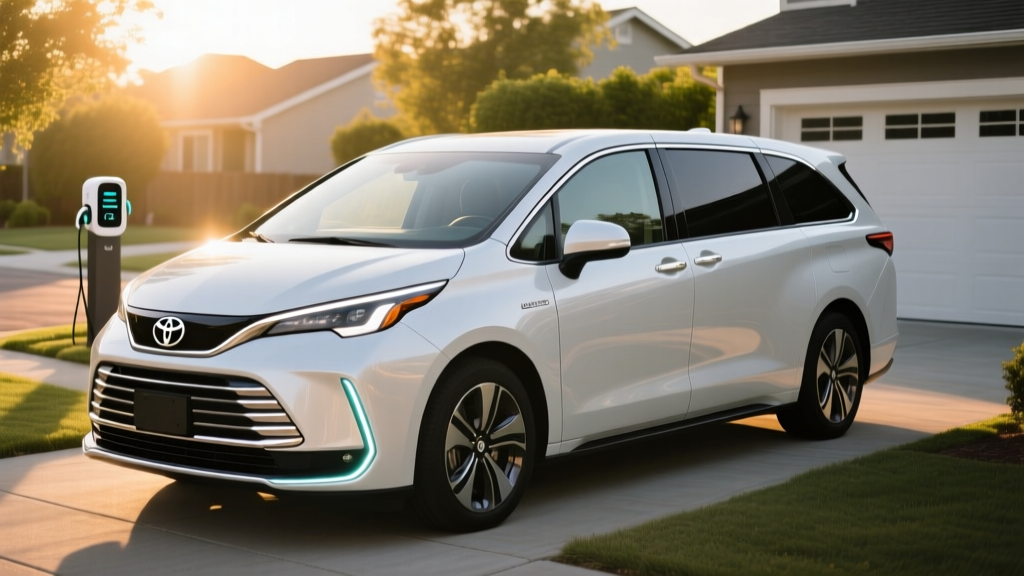
As of early 2026, Toyota has not released a fully electric Sienna. The current Toyota Sienna is a hybrid-only minivan (HEV) with an EPA-estimated 36 MPG combined. Toyota has announced a broad EV expansion through 2028 that includes a three-row electric SUV, and industry reporting points to an electrified minivan in the pipeline — but no official Sienna EV exists on dealer lots today. Families shopping now must choose between the proven Sienna Hybrid, a competing electric SUV like the Kia EV9, or wait for Toyota's next move.
Why Families Are Searching for a Sienna EV
The Toyota Sienna has dominated the minivan segment for years, and for good reason. With seating for up to eight, sliding rear doors, and hybrid efficiency that embarrasses most compact sedans, it's the default pick for cost-conscious families. But as more households explore electric vehicles, a question keeps surfacing in forums, dealership inquiries, and Google searches: When is Toyota making the Sienna electric?
The motivation is straightforward. A fully electric minivan could slash fuel costs further, eliminate oil changes, and offer a smoother, quieter ride for passengers — all while maintaining the cargo space and seating flexibility that defines the segment. The problem is that Toyota's EV roadmap has moved slower than competitors, and the minivan segment specifically has seen almost zero electrification beyond plug-in hybrid concepts.
Current Toyota Sienna: Hybrid Specs and Pricing
Before speculating about an electric successor, it's worth anchoring expectations to what Toyota currently offers. The 2026 Toyota Sienna is built on the TNGA-K platform and pairs a 2.5-liter four-cylinder engine with Toyota's fourth-generation hybrid system.
| Spec | Value |
|---|---|
| Powertrain | 2.5L I4 + hybrid system (HEV) |
| Horsepower | 245 hp (combined system) |
| EPA Fuel Economy (FWD) | 36 MPG city / 36 highway / 36 combined |
| EPA Fuel Economy (AWD) | 35 MPG city / 35 highway / 35 combined |
| Drivetrain | FWD standard; electronic AWD available |
| Seating | 7 or 8 passengers |
| Cargo (behind 3rd row) | 33.5 cu ft |
| Max Cargo (all seats folded) | 101.0 cu ft |
| Towing Capacity | 3,500 lbs |
| Base MSRP (LE trim) | ~$39,000 |
| Top Trim MSRP (Platinum) | ~$55,000 |
| Powertrain Warranty | 5 years / 60,000 miles |
| Hybrid Battery Warranty | 10 years / 150,000 miles |
Source: fueleconomy.gov and Toyota Motor Corporation spec sheets.
The Sienna's 36 MPG combined is exceptional for a vehicle of its size. For a family driving 15,000 miles per year at $3.50/gallon, annual fuel cost sits around $1,458. That's already a strong economic position — which raises the bar for any EV replacement to justify a higher purchase price.
Toyota's EV Roadmap: Where a Sienna EV Fits
Toyota has committed to launching approximately 30 battery electric models globally by 2030, with a specific target of 1.5 million annual EV sales. The company's U.S. strategy has prioritized SUVs and trucks first — the bZ4X crossover is already on sale, and a three-row electric SUV (widely expected to wear a "bZ" nameplate) has been confirmed for the U.S. market.
A Sienna EV — or more likely, an electric minivan on a new dedicated EV platform — would logically follow the three-row SUV. Minivans require specific platform attributes: low floor height for easy step-in, flat load floors, and packaging that accommodates sliding door mechanisms. These engineering demands mean Toyota is unlikely to simply drop a battery into the current Sienna's architecture. A dedicated e-TNGA or next-generation platform would be required.
Realistic timeline estimate: If Toyota follows its announced cadence, a production electric minivan for the U.S. market could arrive for the 2027 or 2028 model year. This is speculative and based on industry reporting, not an official Toyota announcement.
EV vs. Hybrid Minivan: Cost and Ownership Comparison
Since a Sienna EV doesn't yet exist, the most useful comparison is the current Sienna Hybrid against the closest electric alternative families actually buy: the Kia EV9, a three-row electric SUV that competes for the same buyer.
| Category | Toyota Sienna Hybrid (XLE) | Kia EV9 (Land AWD) |
|---|---|---|
| Base MSRP | $45,000 | $60,500 |
| Federal Tax Credit (§30D) | $0 (HEV not eligible) | Up to $7,500 (eligibility varies) |
| Effective Purchase Price | $45,000 | ~$53,000 |
| Fuel / Energy (5 yr) | $7,290 (gas at $3.50/gal) | $4,050 (electric at $0.15/kWh) |
| Maintenance (5 yr) | $3,200 | $1,800 |
| Insurance (5 yr est.) | $8,500 | $10,200 |
| Estimated Depreciation | $16,000 | $22,000 |
| Total 5-Year Cost | $80,000 | $91,050 |
This comparison reveals a critical point: the Sienna Hybrid's low fuel costs and strong resale value make it extremely difficult for an EV to beat on total cost of ownership, at least until EV purchase prices drop further or battery costs decline. The EV9 offers zero tailpipe emissions and a quieter ride, but the ~$11,000 five-year gap is substantial.
A future Sienna EV would need to launch in the $48,000–$55,000 range (before incentives) to be competitive with its own hybrid sibling. That's a tall order given current battery costs for a 90+ kWh pack needed to deliver 300+ miles of range in a heavy minivan.
What a Sienna EV Would Need to Deliver
Based on the segment's demands and what competing electric vehicles offer, any future Toyota electric minivan would need to hit these benchmarks to succeed:
- Range: Minimum 300 miles EPA (real-world highway: ~250–270 miles). Families take road trips; anything less creates practical limitations.
- Charging Speed: Peak DC fast charging of at least 200 kW, with a 10–80% time under 25 minutes. Minivan buyers won't tolerate 45-minute charging stops with restless children.
- Seating and Cargo: True 7–8 passenger capacity with at least 30 cu ft behind the third row. Sliding doors are non-negotiable for the segment.
- Price: Under $55,000 before incentives to stay within the §30D MSRP cap for SUVs/vans ($80,000 cap applies, but competitive pricing matters more).
- Towing: At least 3,500 lbs to match the current Sienna.
- All-Wheel Drive: Available dual-motor AWD for snow-belt families.
Common Misconceptions About a Sienna EV
| Myth | Fact |
|---|---|
| "The Sienna EV is available now" | No fully electric Sienna exists as of 2026. The Sienna is hybrid-only. |
| "An EV minivan will be cheaper to own than the Sienna Hybrid" | Not necessarily. The Sienna's 36 MPG already delivers low fuel costs. A higher EV purchase price and steeper depreciation can erase energy savings. |
| "I'll get the $7,500 federal tax credit on any future Sienna EV" | The §30D credit has income caps ($150K single / $300K joint), MSRP caps, and battery-sourcing requirements that change annually. Check IRS guidelines at time of purchase. |
| "Toyota is behind, so the Sienna EV will be bad" | Toyota's slower EV pace means more time for battery cost reduction and charging infrastructure maturation. A 2028 Sienna EV could benefit from lower-cost LFP or next-gen NMC cells. |
| "I should wait for the Sienna EV before buying a minivan" | If you need a minivan now, the current Sienna Hybrid is one of the most efficient and reliable options available. Waiting 2+ years for an unconfirmed model carries opportunity cost. |
Should You Wait, Buy Hybrid, or Look Elsewhere?
Decision Framework: What Should You Do?
Buy the Toyota Sienna Hybrid NOW if:
- You need a minivan within the next 6 months
- Your annual mileage is under 15,000 miles (the hybrid's fuel cost advantage is hard to beat)
- You lack reliable home Level 2 charging access
- You value proven reliability and strong resale value
- Your budget is under $50,000
Consider the Kia EV9 or another electric SUV NOW if:
- You have home Level 2 charging and mostly drive under 250 miles/day
- You want zero tailpipe emissions and qualify for the §30D federal tax credit
- You don't strictly need sliding doors or a traditional minivan layout
- You're comfortable with a higher purchase price and potentially steeper depreciation
Wait for a potential Sienna EV if:
- Your current vehicle has 2+ years of useful life remaining
- You are committed to both the minivan form factor AND electric propulsion
- You expect battery costs and charging infrastructure to improve significantly by 2028
- You can absorb the uncertainty of an unannounced product timeline
Real-World Ownership Considerations for Electric Minivans
Even when a Sienna EV arrives, families should weigh several practical factors that spec sheets don't capture:
Home charging is essential. A minivan-sized battery (likely 90–110 kWh usable) would take 50+ hours on a standard 120V Level 1 outlet to charge from empty. A Level 2 home charger (9.6–11.5 kW, requiring a 240V/50–60A circuit) is mandatory, adding $800–$2,500 in installation costs depending on your electrical panel's capacity. Families renting or living in condos without dedicated parking face a real barrier.
Cold-weather range loss is significant. Expect 20–35% range reduction in sustained sub-freezing temperatures. A Sienna EV rated at 310 miles EPA could deliver just 200–220 miles in a Minnesota January — tight for a family road trip without careful planning.
Charging on road trips adds time. Even with peak 200+ kW DC fast charging, the charging curve tapers significantly above 80% state of charge. A realistic 10–80% stop in a large-battery minivan will take 25–35 minutes, plus time to find, navigate to, and connect at the station. With children, this can stretch to 45+ minutes per stop.
Insurance costs run higher for EVs. Industry data consistently shows EV insurance premiums running 15–25% above comparable gas or hybrid vehicles, driven by higher repair costs and battery replacement risk. Factor this into your budget.
What First-Time EV Buyers Should Know
If you're considering any electric vehicle — whether it's the Kia EV9 today or a future Sienna EV — these fundamentals apply:
- kW vs. kWh: Kilowatts (kW) measure power — how fast you charge or accelerate. Kilowatt-hours (kWh) measure energy — your battery's capacity and what determines range. A 100 kWh battery charged at 150 kW will not fill in 40 minutes because the charge rate tapers as the battery fills.
- EPA range vs. real-world: EPA estimates assume a mix of city and highway driving at moderate temperatures. Sustained highway speeds (70–80 mph) typically reduce range by 10–20%. Cold weather compounds this. Always budget 15–25% below the EPA sticker for trip planning.
- Preconditioning matters: Most EVs can warm the battery before you arrive at a DC fast charger, enabling peak charge rates. Skipping preconditioning in cold weather can cut your charge speed in half.
- The §30D tax credit is not guaranteed: Battery sourcing requirements, critical mineral thresholds, and MSRP/income caps all affect eligibility. Rules can change with legislation. Always verify against the IRS clean vehicle credit page before counting on $7,500 at purchase.
- Level 2 driver-assist is not self-driving: Features like Toyota Safety Sense, Tesla Autopilot, and GM Super Cruise are SAE Level 2 systems. You must remain engaged, hands available, and eyes on the road at all times. No consumer vehicle sold today is "self-driving."
Frequently Asked Questions
Is there a fully electric Toyota Sienna available in 2026?
No. The 2026 Toyota Sienna is a hybrid-electric vehicle (HEV) only. Toyota has not announced a production Sienna EV, though the company's broader EV expansion roadmap suggests an electric minivan could arrive around the 2027–2028 model year.
What is the most fuel-efficient minivan you can buy today?
The Toyota Sienna Hybrid leads the segment at 36 MPG combined (FWD). The Chrysler Pacifica Hybrid (PHEV) offers 30 MPG combined once its 32-mile electric range is depleted, but can drive emission-free on shorter trips. No fully electric minivan is currently sold in the U.S. market.
How much would a Sienna EV likely cost?
Based on current EV pricing trends and battery costs, a Sienna EV would likely start between $50,000 and $58,000 before incentives — a significant premium over the current Sienna Hybrid's ~$39,000 base price. Whether federal §30D tax credits apply would depend on battery sourcing, MSRP caps, and buyer income at time of purchase.
Should I buy a Kia EV9 instead of waiting for a Sienna EV?
If you need three-row, family-friendly electric transportation now and can accommodate the EV9's SUV layout (no sliding doors, slightly less cargo flexibility than a minivan), the EV9 is the closest electric alternative. It offers up to 304 miles of EPA range, available AWD, and DC fast charging up to 210 kW. However, it starts around $55,000 and does not match a minivan's ease of child-seat installation or third-row access.
Will a Sienna EV qualify for the $7,500 federal tax credit?
It depends on several factors at time of sale: the vehicle's MSRP (must be under $80,000 for vans/SUVs), your adjusted gross income (under $150K single / $300K joint filer), and whether the battery meets critical mineral and component sourcing thresholds per IRS §30D rules. These requirements tighten over time, so eligibility is not guaranteed even if the vehicle itself qualifies.
How does the Sienna Hybrid compare to an EV on maintenance costs?
The Sienna Hybrid still requires oil changes, transmission fluid service, and engine air filter replacements — typically $600–$800 per year. A battery-electric minivan would eliminate these, reducing annual maintenance to roughly $300–$400 (cabin filters, wipers, brake fluid, tire rotation). Over 5 years, that's a $1,500–$2,000 savings for the EV, though not enough alone to offset a large purchase-price gap.
Bottom Line
The Toyota Sienna EV remains one of the most anticipated vehicles in the family-hauler segment, but it does not yet exist. Toyota's current Sienna Hybrid delivers best-in-class efficiency at 36 MPG combined with proven reliability and strong resale value. Families who need a minivan today should buy or lease the hybrid without hesitation. Those who can wait and are committed to going fully electric should monitor Toyota's EV announcements through 2027 — but have a backup plan, because timelines in the auto industry frequently slip.