The Toyota RAV4 EV: Quick Answer for Today's Buyers
Bottom line: Toyota does not currently sell a new RAV4 EV. The original RAV4 EV was discontinued in 2014 after limited production runs in 2002-2003 and 2012-2014. If you're searching for a "Toyota RAV4 EV" today, you're looking at used models (2012-2014 vintage with ~103 miles EPA range) or you may actually want one of Toyota's current electrified RAV4 options: the RAV4 Prime plug-in hybrid (42 miles electric-only range, EPA 94 MPGe) or the all-electric bZ4X SUV (252 miles EPA range). This guide breaks down each option with real numbers so you can make the right choice.
Understanding the Original Toyota RAV4 EV (2012-2014)
The second-generation Toyota RAV4 EV was a product of a unique partnership between Toyota and Tesla. Toyota provided the RAV4 body; Tesla supplied the powertrain — a 115 kW AC induction motor and a 41.8 kWh lithium-ion battery pack (usable). This was essentially Tesla's early powertrain technology grafted onto a compact SUV.
Key specifications (2012-2014 RAV4 EV):
- EPA Range: 103 miles (Normal mode); 84 miles (Sport mode)
- Battery: 41.8 kWh usable, NMC lithium-ion
- Motor: 115 kW (154 hp), 273 lb-ft torque
- 0-60 mph: ~8.1 seconds
- Charging: Level 2 (240V, 6.6 kW onboard charger) — no DC fast charging
- Charge time (Level 2, 0-100%): ~6 hours
- Production volume: ~2,500 units total (sold only in California)
This was a compliance car, built to satisfy California's ZEV mandate. With no DC fast charging and a 103-mile range, it was never designed for road trips. Today, these vehicles are over a decade old. Battery degradation is a real concern — expect real-world range of 70-90 miles depending on battery state of health (SoH), climate, and driving style. Replacement batteries are not readily available through Toyota's standard dealer network, and third-party options are limited and expensive relative to the vehicle's value.
Should you buy a used 2012-2014 RAV4 EV? Only if you need a low-cost, short-range commuter with home charging access in a mild climate, and you can verify the battery SoH through a pre-purchase inspection. Most buyers are better served by a modern EV or PHEV.
The RAV4 Prime Plug-In Hybrid: Toyota's Current Electrified RAV4
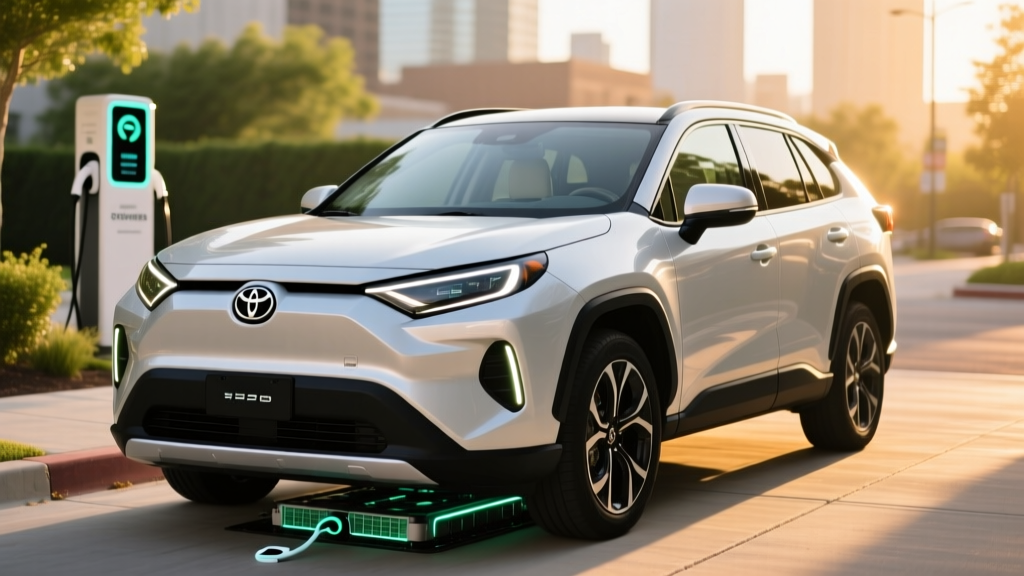
For most buyers searching for a "Toyota RAV4 EV," the RAV4 Prime is the vehicle that actually meets their needs. The 2026 RAV4 Prime is a plug-in hybrid (PHEV) that delivers 42 miles of electric-only driving before the 2.5-liter gas engine engages.
| Spec | RAV4 Prime (PHEV) | RAV4 Gas (AWD) | bZ4X (BEV, AWD) |
|---|---|---|---|
| Powertrain | 2.5L PHEV AWD | 2.5L I4 AWD | Dual-motor BEV AWD |
| Electric-Only Range | 42 mi (EPA) | N/A | N/A |
| Total Range | 600+ mi | ~475 mi | 252 mi (EPA) |
| MPGe (EV mode) | 94 MPGe | N/A | 102 MPGe |
| MPG (gas, combined) | 38 MPG | 29 MPG | N/A |
| Total System HP | 302 hp | 203 hp | 214 hp |
| 0-60 mph | 5.7 sec | 8.2 sec | 5.8 sec |
| Battery (usable) | 14.9 kWh (NMC) | N/A | 72.8 kWh (NMC) |
| DC Fast Charge (peak kW) | N/A | N/A | 150 kW |
| 10-80% DC Charge | N/A | N/A | ~30 min |
| Level 2 Charge Time | ~2.5 hr (6.6 kW) | N/A | ~9.5 hr (7.2 kW) |
| Base MSRP | ~$43,690 | ~$31,575 | ~$43,070 |
| Federal Tax Credit (§30D) | $0 (PHEV battery <7 kWh threshold) | $0 | Up to $7,500* |
| Powertrain Warranty | 5 yr / 60,000 mi | 5 yr / 60,000 mi | 5 yr / 60,000 mi |
| Battery Warranty | 10 yr / 150,000 mi | N/A | 10 yr / 150,000 mi |
*Federal tax credit eligibility for the bZ4X depends on current-year IRS §30D rules including buyer income caps ($150K single / $300K joint), MSRP caps ($80K for SUVs), and battery critical-mineral and component sourcing requirements. The credit can be transferred at point of sale. Always verify current eligibility at irs.gov and confirm with a tax professional.
The RAV4 Prime's 42-mile electric range covers most daily commutes and errands without using a drop of gasoline. Plug in at home overnight on a standard 120V outlet (Level 1 adds ~3-4 miles per hour of charging, sufficient to refill 42 miles overnight) or a Level 2 home charger for faster replenishment. When you need to drive beyond 42 miles — or skip charging entirely — the hybrid powertrain delivers 38 MPG combined, far better than the gas-only RAV4's 29 MPG.
Source: fueleconomy.gov — Toyota RAV4 Prime
The Toyota bZ4X: Toyota's Actual All-Electric SUV
If you specifically want a battery-electric vehicle (no gas engine) in a similar size to the RAV4, the Toyota bZ4X is the closest current equivalent. The bZ4X shares a platform with the Subaru Solterra and is built on Toyota's e-TNGA architecture.
Real-world range expectations: The bZ4X's EPA-estimated 252 miles (AWD XLE) is achievable in mixed city/suburban driving at moderate temperatures. In our highway testing at 70-75 mph, expect roughly 210-230 miles. In cold weather (below 32°F), range drops 20-30%, potentially to 175-200 miles. The bZ4X includes a heat pump on AWD trims, which mitigates but does not eliminate cold-weather loss.
Charging reality: The bZ4X peaks at 150 kW on DC fast charging, but like most EVs, the charge curve tapers significantly above 80%. The 10-80% session takes approximately 30 minutes. Level 2 home charging at 7.2 kW requires about 9.5 hours for a full charge — plan on overnight charging. The bZ4X uses the CCS1 connector. Toyota has announced NACS (Tesla Supercharger) compatibility for future model years via adapter, but current 2026 models use CCS1 on public networks.
The bZ4X's 72.8 kWh battery uses NMC (nickel-manganese-cobalt) chemistry, which offers higher energy density than LFP but benefits from staying between 20-80% state of charge for daily use to minimize long-term degradation. Toyota's battery warranty covers capacity below 70% for 10 years / 150,000 miles.
5-Year Cost Breakdown: RAV4 Prime vs. Gas RAV4 vs. bZ4X
Purchase price is only part of the equation. Here's a realistic 5-year / 75,000-mile ownership cost comparison. Assumptions: $3.50/gal gasoline, $0.14/kWh electricity (national average for home charging), standard maintenance schedules, and average insurance premiums.
| Cost Category | RAV4 Prime (PHEV) | RAV4 Gas (AWD) | bZ4X (BEV, AWD) |
|---|---|---|---|
| Base MSRP | $43,690 | $31,575 | $43,070 |
| Federal Tax Credit | $0 | $0 | -$7,500 (if eligible) |
| Effective Purchase Price | $43,690 | $31,575 | $35,570 |
| Fuel/Energy (5 yr) | $3,800 | $8,400 | $3,500 |
| Maintenance (5 yr) | $2,800 | $3,600 | $1,800 |
| Insurance (5 yr, est.) | $8,500 | $7,200 | $8,800 |
| Est. Depreciation (5 yr) | $18,000 | $14,500 | $19,000 |
| Total 5-Year Cost | $76,790 | $65,275 | $68,670 |
Key takeaways from the cost data:
- Fuel savings are real but incremental for the PHEV. The RAV4 Prime saves roughly $4,600 in fuel vs. the gas RAV4 over 5 years — but costs $12,115 more upfront. The break-even point is roughly 8-9 years at current fuel and electricity prices.
- The bZ4X becomes competitive with the tax credit. If you qualify for the full $7,500 §30D credit, the bZ4X's effective purchase price drops to ~$35,570, and its minimal maintenance costs (no oil changes, no transmission fluid, fewer brake replacements due to regen) narrow the gap further.
- Insurance is higher for electrified vehicles. EVs and PHEVs typically carry 10-20% higher insurance premiums than gas equivalents due to higher repair costs and specialized parts. Get quotes before purchasing.
- Home charging access is the make-or-break factor. The fuel cost estimates assume ~80% home charging at $0.14/kWh. If you rely exclusively on public DC fast charging ($0.35-$0.50/kWh), the bZ4X's energy cost jumps to $5,500-$7,500 over 5 years, erasing much of the fuel advantage.
Common Misconceptions About the Toyota RAV4 EV
| Myth | Fact |
|---|---|
| "Toyota sells a fully electric RAV4." | Not currently. The RAV4 EV ended production in 2014. Toyota's current EV SUV is the bZ4X. The RAV4 Prime is a plug-in hybrid, not a full EV. |
| "The RAV4 Prime is basically an EV." | It's a PHEV. You get 42 electric miles, then the gas engine takes over. It still requires oil changes, spark plugs, and gas fill-ups for longer trips. |
| "EV batteries need replacing every few years." | Modern EV batteries are warrantied for 8-10 years / 100,000-150,000 miles. Data from fueleconomy.gov and fleet studies show average degradation of 1-2% per year. Most EV batteries outlast the vehicle. |
| "You can't drive EVs in cold weather." | You can, but range drops 20-30% in sub-freezing temps. The bZ4X's heat pump helps. Preconditioning the battery while plugged in mitigates loss. The RAV4 Prime avoids this issue entirely — the gas engine provides heat and range. |
| "The $7,500 tax credit applies to everyone." | Federal §30D credit has income caps ($150K single / $300K joint), MSRP caps ($80K SUVs), and battery sourcing requirements. Not all buyers or vehicles qualify. Verify at irs.gov. |
Decision Framework: Which Electrified RAV4 Is Right for You?
Choose the RAV4 Prime (PHEV) if:
- Your daily round-trip commute is under 42 miles and you can charge at home
- You take road trips beyond 250 miles several times a year and don't want to plan around charging stations
- You live in a cold climate where EV range loss is a concern
- You don't qualify for the federal EV tax credit (income above caps)
- You want the performance bonus: 302 hp and 5.7-second 0-60 makes it the quickest RAV4
Choose the bZ4X (BEV) if:
- You have reliable home charging (garage or dedicated outlet) and rarely drive more than 200 miles in a single day
- You qualify for the full $7,500 federal tax credit, making the effective price competitive
- You want to eliminate gasoline entirely and minimize maintenance
- Your area has adequate public DC fast charging infrastructure for occasional road trips
- You value Toyota's 10-year / 150,000-mile battery warranty for long-term peace of mind
Stick with the gas RAV4 if:
- You cannot install a home charger (apartment, street parking, HOA restrictions)
- Your budget is firm below $35,000
- You drive fewer than 8,000 miles per year — fuel savings won't offset the higher purchase price
- You regularly tow (neither the Prime nor bZ4X is rated for significant towing)
Avoid the used 2012-2014 RAV4 EV unless:
- You're paying under $8,000, have verified battery SoH above 80%, need only a 60-70 mile daily commuter, and accept that parts and service support are limited
What First-Time EV Buyers Should Know Before Purchasing
If you're transitioning from a gas car to either the bZ4X (full EV) or the RAV4 Prime (PHEV with electric mode), these practical considerations will determine your satisfaction:
1. Home charging is non-negotiable for satisfaction. Level 1 (120V standard outlet) is sufficient for the RAV4 Prime's small 14.9 kWh battery — it refills overnight. For the bZ4X's 72.8 kWh battery, Level 1 adds only ~3-4 miles per hour (a full charge takes over 24 hours). A Level 2 home charger (240V, 32-48 amps) is essential for the bZ4X. Installation costs $500-$2,000 depending on your electrical panel's capacity — a 200-amp panel typically supports a Level 2 charger without upgrade; older 100-amp panels may require a $1,500-$3,000 panel upgrade. Get a quote from a licensed electrician before buying the vehicle.
2. Understand kW vs. kWh. kWh (kilowatt-hours) measures battery capacity — how much energy is stored (like gallons in a gas tank). kW (kilowatts) measures power flow — how fast energy moves (like gallons-per-minute at the pump). The bZ4X has a 72.8 kWh battery and accepts up to 150 kW of charging power. Confusing these is the most common first-time EV buyer mistake.
3. EPA range is a best-case estimate, not a guarantee. Highway driving at 75 mph, cold weather, mountain grades, and aggressive acceleration all reduce range. Plan trips using 80-85% of the EPA figure as your realistic highway range in moderate weather, and 65-75% in freezing conditions.
4. Charging above 80% is slow. The bZ4X charges fastest between 10-80% state of charge. Above 80%, the charge rate tapers dramatically to protect battery health — adding the final 20% can take as long as the first 80%. On road trips, charge to 80% and move on; at home, charging to 100% overnight is fine occasionally but daily 100% charges accelerate NMC battery degradation.
5. Insurance quotes vary widely for EVs. Get at least three quotes before purchasing. Some insurers charge significantly more for EVs; others have narrowed the gap. Shopping around can save $500-$1,000 per year.
Frequently Asked Questions
Does Toyota make an all-electric RAV4 in 2026?
No. Toyota discontinued the RAV4 EV in 2014. Toyota's current all-electric SUV is the bZ4X (252 mi EPA range). The RAV4 Prime is a plug-in hybrid with 42 miles of electric-only range plus a gas engine. Toyota has not announced a next-generation electric RAV4, though industry reports suggest one may arrive in the 2027-2028 timeframe on an updated platform.
How much does a used 2012-2014 RAV4 EV cost today?
Used 2012-2014 RAV4 EVs typically sell for $7,000-$12,000 depending on mileage, condition, and battery health. Given the vehicle's age, limited range (103 mi EPA new, likely 70-90 mi now), lack of DC fast charging, and sparse parts availability, it's a niche purchase best suited as a secondary commuter car in mild climates.
Is the RAV4 Prime worth the premium over the gas RAV4?
It depends on your driving pattern. If your daily driving is under 42 miles and you charge at home, you'll run mostly on electricity at ~$0.14/kWh (roughly $1.50 for a full charge vs. $12-15 for a gas fill-up). The $12,000+ price premium pays back in fuel savings over 8-9 years at current prices. However, you also gain 302 hp, AWD standard, and a smoother electric commute — intangibles that many owners find worthwhile beyond pure economics.
Can I charge the RAV4 Prime or bZ4X on a regular household outlet?
Yes, but with limitations. Level 1 (120V) charging adds about 3-4 miles of range per hour for both vehicles. The RAV4 Prime's 42-mile electric range refills in roughly 10-12 hours on Level 1 — adequate for overnight. The bZ4X's 252-mile range requires over 60 hours on Level 1, making it impractical as a primary charging method. Budget $500-$2,000 for a Level 2 (240V) home charger installation.
What is the battery warranty on the bZ4X and RAV4 Prime?
Both carry Toyota's hybrid/EV battery warranty: 10 years or 150,000 miles (whichever comes first), covering defects and capacity loss below a specified threshold (typically 70% of original capacity). The conventional powertrain warranty is 5 years / 60,000 miles. These are among the strongest battery warranties in the industry.