The Short Answer on Toyota and EVs
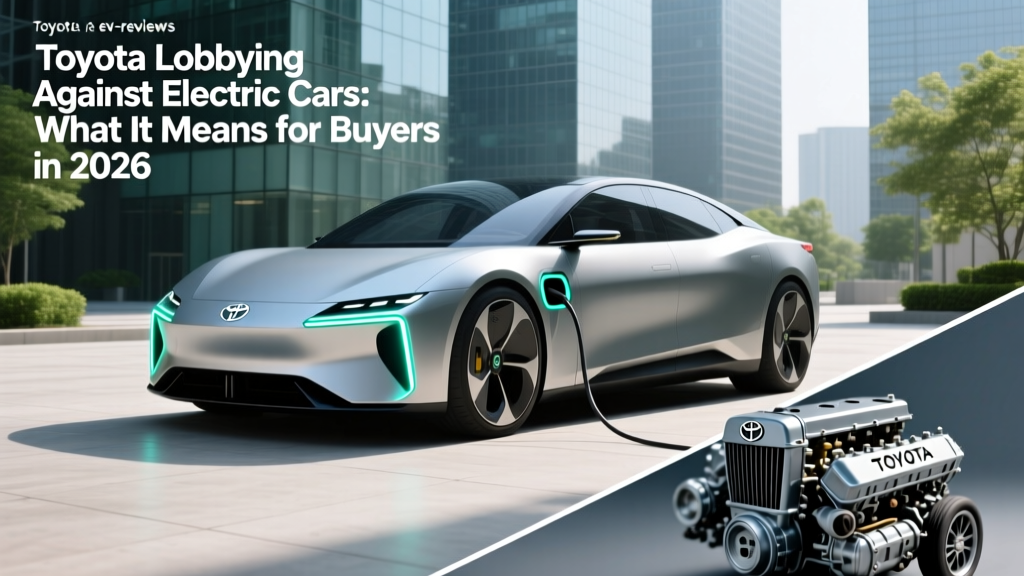
Toyota lobbying against electric cars has been well-documented — the automaker spent years pushing hydrogen fuel cells and hybrids while urging regulators to slow BEV mandates. But as of 2026, Toyota sells the bZ4X (EPA 252 mi, starting ~$38,450) and the upcoming bZ Compact SUV, alongside one of the deepest hybrid lineups in the industry. The lobbying story matters less for your purchase decision than hard numbers: real-world range, charging speed, total cost of ownership, and whether your driving pattern fits a BEV, PHEV, or hybrid. Toyota's political stance hasn't prevented buyers from accessing competitive EVs — it's just meant Toyota's own EV portfolio arrived later and smaller than rivals like Hyundai, Tesla, and Ford.
What Toyota Actually Lobbied Against — and Why It Matters to You
Between 2021 and 2024, Toyota was consistently ranked among the automakers most resistant to battery-electric mandates, according to analyses by InfluenceMap and other climate-policy watchdogs. The company's lobbying focused on several themes:
- Arguing for a "multi-pathway" approach — pushing regulators to treat hybrids, plug-in hybrids, hydrogen fuel cells, and BEVs as equally valid, rather than setting BEV-specific sales targets.
- Opposing EPA tailpipe rules that effectively mandated rapid EV adoption, including the 2023-2027 light-duty emissions standards.
- Investing in hydrogen (Mirai fuel cell vehicle, hydrogen combustion prototypes) while allocating relatively modest BEV R&D until its 2021 strategy pivot.
For buyers in 2026, the practical result is straightforward: Toyota's EV lineup is narrower than competitors, but its hybrid and PHEV offerings are extensive. If you were counting on Toyota for a long-range, fast-charging BEV, you're shopping a smaller menu than you'd find at Hyundai/Kia or Tesla. If you want a proven hybrid or a bridge PHEV, Toyota is arguably the strongest player in the market.
The 2026 Toyota Electrified Lineup: By the Numbers
Here's what Toyota actually sells or has announced for the U.S. market as of mid-2026:
| Model | Type | EPA Range / MPGe | Battery (kWh) | Max DC Charge (kW) | 0-60 mph | Base MSRP |
|---|---|---|---|---|---|---|
| bZ4X (FWD) | BEV | 252 mi / 114 MPGe | 71.4 (NMC) | 150 kW | 7.1 sec | $38,450 |
| bZ4X (AWD) | BEV | 228 mi / 102 MPGe | 71.4 (NMC) | 150 kW | 5.8 sec | $40,800 |
| Rav4 Prime (PHEV) | PHEV | 42 mi electric / 94 MPGe | 18.1 (NMC) | N/A (L2 only) | 5.7 sec | $44,985 |
| Prius Prime (PHEV) | PHEV | 44 mi electric / 114 MPGe | 13.6 (NMC) | N/A (L2 only) | 6.6 sec | $33,445 |
| Grand Highlander Hybrid | HEV | 36 MPG combined | 1.6 (NiMH) | N/A | 7.8 sec | $45,020 |
Sources: fueleconomy.gov, Toyota USA press site. EPA estimates — real-world results vary with temperature, terrain, and driving style.
Cost Comparison: Toyota bZ4X vs. RAV4 Hybrid vs. RAV4 Gas
The strongest argument Toyota makes for its multi-pathway strategy is that hybrids deliver most of the emissions benefit at lower upfront cost. Let's test that with actual ownership numbers over 5 years and 75,000 miles.
| Cost Category | bZ4X FWD (BEV) | RAV4 Hybrid (HEV) | RAV4 Gas (AWD) |
|---|---|---|---|
| Base MSRP | $38,450 | $33,425 | $30,425 |
| Federal Tax Credit (§30D) | Up to $7,500* | $0 | $0 |
| Effective Purchase Price | ~$30,950 | $33,425 | $30,425 |
| Fuel/Energy (75k mi) | $2,850 (home L2) | $5,625 (gas) | $7,500 (gas) |
| Maintenance (5 yr) | ~$1,200 | ~$2,800 | ~$3,200 |
| Insurance (5 yr est.) | ~$8,500 | ~$7,200 | ~$7,000 |
| 5-Year Total | ~$43,500 | ~$49,050 | ~$48,125 |
*§30D credit eligibility depends on buyer income (AGI ≤$150k single / ≤$300k joint), vehicle MSRP caps ($55k SUVs), battery sourcing rules, and point-of-sale transfer. Verify at irs.gov. Electricity cost assumes $0.14/kWh national average at 3.5 mi/kWh. Gas at $3.50/gal.
The bZ4X wins on 5-year cost if you qualify for the full tax credit and charge primarily at home. Without the credit, the RAV4 Hybrid becomes the cost leader. This is precisely the buyer calculus Toyota's lobbying sought to protect — ensuring consumers could choose hybrids without regulatory penalty.
Common Misconceptions About Toyota's EV Stance
| Myth | Fact |
|---|---|
| "Toyota doesn't make any electric cars." | Toyota sells the bZ4X in the U.S. and has announced several next-gen BEVs with improved battery chemistry for 2026-2028. |
| "Toyota's lobbying killed EV adoption." | U.S. EV sales grew from ~3% (2021) to ~12% (2025). Toyota's lobbying slowed some regulations but didn't stop market momentum led by Tesla, Hyundai/Kia, Ford, and GM. |
| "Hybrids are just as good as EVs for the environment." | A BEV charged on the average U.S. grid produces roughly 50-60% less lifetime CO₂ than a comparable hybrid, per Argonne National Lab lifecycle analyses. Hybrids are a bridge, not a destination. |
| "Toyota's bZ4X charges as fast as competitors." | At 150 kW peak, the bZ4X takes ~30 min for a 10-80% charge. The Hyundai Ioniq 5 (peak 240 kW) does 10-80% in ~18 minutes. Charging speed matters for road trips. |
| "The federal tax credit applies to all Toyota electrified vehicles." | Only the bZ4X qualifies for §30D. Hybrids and PHEVs with small batteries generally don't meet the credit's battery-capacity or sourcing thresholds. |
Decision Framework: Which Toyota Electrified Vehicle Fits You?
Choose the bZ4X (BEV) if:
- You have reliable Level 2 home charging (240V, 32A+ circuit)
- Your daily driving is under 150 miles round-trip
- You qualify for the §30D tax credit (check income and sourcing rules)
- You rarely take 400+ mile road trips, or you're comfortable planning DC fast-charge stops
Choose the RAV4 Prime (PHEV) if:
- You want 42 miles of electric-only commuting but need gas flexibility for longer trips
- You can install a Level 2 charger at home (the Prime charges in ~2.5 hours at 6.6 kW)
- You value the 302-hp combined powertrain and 5.7-second 0-60 time
- You want to hedge against charging-infrastructure gaps in your region
Choose the RAV4 Hybrid (HEV) if:
- You live in an apartment or lack home-charging access
- You want maximum simplicity — no plugs, no charging apps, no range planning
- Your budget prioritizes lowest upfront cost over 5-year total savings
- You drive in extreme cold regularly (hybrid efficiency degrades less than BEV range in sub-zero temps)
What Toyota's Lobbying Means for Charging Infrastructure
One indirect effect of Toyota's multi-pathway lobbying — and similar efforts by other automakers — is that federal infrastructure spending has remained somewhat technology-agnostic. The NEVI (National Electric Vehicle Infrastructure) program's $5 billion in highway charging funds primarily supports BEV fast chargers, but political pressure to include hydrogen refueling has slowed deployment timelines.
As of early 2026, the U.S. has roughly 200,000 public charging ports (Level 2 and DC combined), with DC fast chargers numbering around 50,000. That's up significantly from 2023, but coverage remains uneven — rural corridors in the Mountain West and Great Plains still have significant gaps. If you're buying a bZ4X or any BEV, your road-trip planning should start with apps like PlugShare or A Better Routeplanner, not EPA range estimates alone.
Frequently Asked Questions
Does Toyota's lobbying mean I shouldn't buy a Toyota EV?
Not necessarily. The bZ4X is a competent, if unremarkable, mid-size electric SUV. Its main weaknesses are real-world range (~200-220 mi highway vs. EPA 252) and charging speed (150 kW peak vs. 240 kW on the Ioniq 5). Toyota's political positions don't change the physics of the car you drive. Judge the vehicle on its specs, not the company's lobbying record.
Will Toyota's next-gen batteries make their current EVs obsolete?
Toyota has announced solid-state and "performance" lithium-ion batteries targeting 2027-2028, promising 450+ mile range and 10-minute fast charging. These are preliminary claims with no U.S.-spec vehicles confirmed. If you need an EV now, don't wait for announced technology — but if you can hold off 18-24 months, Toyota's BEV lineup should be meaningfully more competitive.
Is a RAV4 Prime PHEV a better buy than the bZ4X?
For many buyers, yes — especially if you lack guaranteed home charging or take frequent road trips. The Prime's 42-mile electric range covers most commutes, and the gas engine eliminates range anxiety. The trade-off: higher fuel costs on long trips (38 MPG gas-only vs. the bZ4X's $0.04/mile electricity cost) and no §30D tax credit eligibility.
How does the bZ4X compare to Tesla Model Y or Hyundai Ioniq 5?
The bZ4X trails both on key metrics. Model Y Long Range: EPA 320 mi, 250 kW peak charging, ~$44,990. Ioniq 5: EPA 303 mi, 240 kW peak, ~$42,900. The bZ4X's 252-mile EPA rating and 150 kW charging put it a generation behind. Its advantages are Toyota's dealer network, familiar interior ergonomics, and standard Toyota Safety Sense 3.0 (Level 2 ADAS with lane-centering and adaptive cruise).
What's the real cost to charge a bZ4X at home?
The bZ4X's 71.4 kWh battery, charged from 10-80% (~50 kWh), costs roughly $7.00 at $0.14/kWh (U.S. residential average). That delivers about 175 miles of real-world range, or ~$0.04/mile. Compare to the RAV4 gas at $3.50/gal and 30 MPG combined: ~$0.12/mile. Home charging is roughly one-third the per-mile fuel cost of gasoline.
The Bottom Line for 2026 Buyers
Toyota lobbying against electric cars is a real political story with real regulatory consequences — but it shouldn't drive your purchase decision. The practical question is whether Toyota's current electrified offerings match your driving pattern, budget, and charging access. The bZ4X is adequate but outclassed on range and charging speed. The RAV4 Prime and Prius Prime are among the best PHEVs available. And Toyota's conventional hybrids remain the gold standard for drivers who aren't ready to plug in. Match the vehicle to your miles, not the headline to your values.