Quick Answer: Toyota Hilux EV Europe Availability
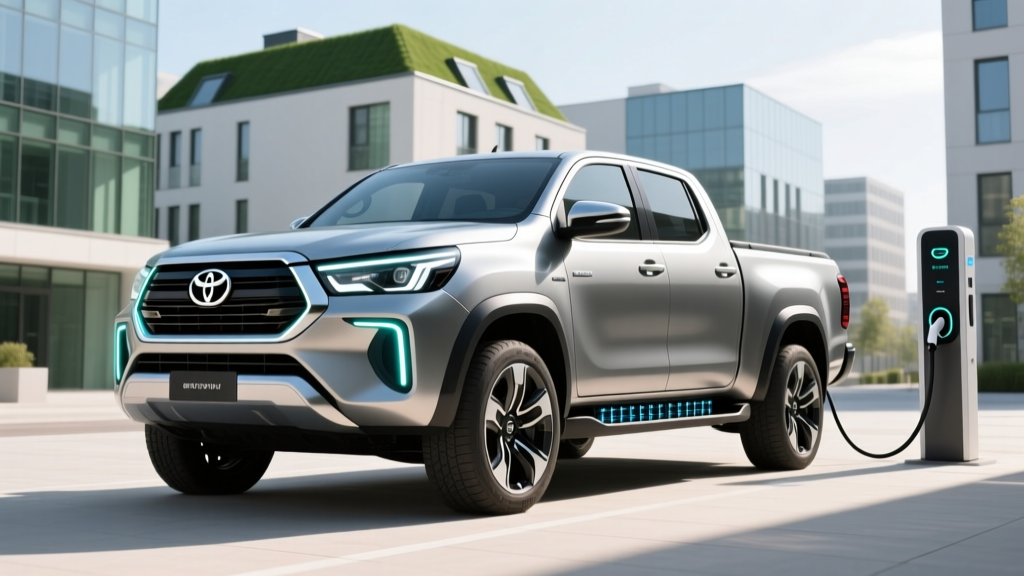
As of early 2026, Toyota has not officially confirmed a battery-electric Hilux pickup for the European market. The current-generation Hilux sold in Europe remains exclusively powered by a 2.8-liter turbodiesel (and a 48V mild-hybrid variant introduced in late 2023). Toyota's global EV strategy centers on the bZ-series SUVs, and while the automaker has teased electric pickup concepts—including the IMV 0 platform shown in Thailand—the Hilux EV remains an announced/aspirational product without a firm European launch date, homologated specs, or pricing.
If you're shopping for a zero-emission pickup in Europe right now, alternatives like the Ford E-Transit Custom, Maxus T90 EV, and upcoming Scout Motors offerings may be more immediately actionable. We'll track any official Toyota announcement and update this page accordingly.
What We Know About the Electric Hilux Platform
Toyota's IMV 0 (Innovative International Multi-purpose Vehicle) platform was unveiled in December 2023 in Thailand as a flexible architecture supporting internal combustion, hybrid, and battery-electric powertrains. The concept lineup included a compact pickup that strongly hinted at a next-generation Hilux EV, alongside an SUV and commercial MPV—all sharing modular underpinnings designed for emerging and developed markets alike.
However, Toyota has been characteristically cautious about timelines. The company's multi-pathway strategy—which invests simultaneously in hybrids, plug-in hybrids, hydrogen fuel cells, and BEVs—means battery-electric pickups sit lower in priority than hybrid electrification of existing high-volume models like the Hilux, Land Cruiser, and RAV4.
Here's what's been signaled versus what's confirmed:
| Detail | Status | Notes |
|---|---|---|
| IMV 0 platform | Confirmed (global concept) | Supports BEV; shown Dec 2023 in Thailand |
| European launch date | Not announced | No timeline from Toyota Motor Europe |
| Battery capacity (kWh) | Preliminary / estimated | Likely 60–80 kWh based on platform class |
| EPA/WLTP range | Not published | Expected ~300–400 km WLTP if 75 kWh pack |
| DC fast-charge rate | Not published | Estimated 100–150 kW peak |
| Payload / towing | Not published | Battery weight will reduce payload vs. diesel |
| European pricing | Not announced | Current Hilux diesel starts ~€35,000 (ex-VAT) |
| Tax / incentive eligibility | TBD | Varies by EU member state; no §30D relevance |
The key unknown for European buyers is whether Toyota will homologate a Hilux EV to EU safety and emissions standards or restrict electric IMV 0 derivatives to ASEAN, Latin American, and Australian markets where pickup demand is strong but regulatory pressure is different from Europe's CO₂ fleet-average mandates.
Current Toyota Hilux (Diesel) vs. an Electric Pickup: By the Numbers
While we wait for official Hilux EV specs, it's useful to understand the gap between today's diesel Hilux and what a battery-electric equivalent would need to deliver. The comparison below uses the current 2025/2026 Hilux 2.8 D-4D Invincible (the volume trim in Europe) against a projected Hilux EV based on class-appropriate estimates.
| Specification | Hilux 2.8 D-4D Diesel | Hilux EV (Estimated) |
|---|---|---|
| Powertrain | 2.8L turbodiesel I4, 204 PS (150 kW) | Dual-motor AWD BEV, ~220–280 PS est. |
| Torque | 500 Nm @ 1,600–2,800 rpm | ~400–500 Nm (instant, from 0 rpm) |
| Energy capacity | 80L diesel tank | ~70–80 kWh battery (NMC est.) |
| WLTP range | ~850–950 km (combined cycle) | ~300–400 km (est., WLTP) |
| Refuel/recharge time | ~5 min (diesel fill) | ~30–45 min (10–80% DC, est.) |
| Towing capacity | 3,500 kg (braked) | ~2,000–2,500 kg (est., battery weight penalty) |
| Payload | ~1,000 kg | ~600–800 kg (est.) |
| 0–100 km/h | ~10.0 sec | ~7–9 sec (est.) |
| CO₂ tailpipe | ~222–245 g/km (WLTP) | 0 g/km (upstream grid-dependent) |
| Starting price (Europe, ex-VAT) | ~€38,000–42,000 | ~€50,000–60,000 (est.) |
| Battery/powertrain warranty | 5 yr / 160,000 km (powertrain) | 8 yr / 160,000 km (typical Toyota BEV) |
The range disparity is the most significant gap. A diesel Hilux can cover 850+ km on a single tank—essential for rural, agricultural, and commercial users across Scandinavia, Iberia, and Eastern Europe. An electric Hilux with a ~75 kWh pack would deliver roughly 300–400 km under WLTP testing, and real-world highway and cold-weather driving could reduce that to 220–300 km. This is a fundamental limitation of current battery energy density (~250 Wh/kg at the cell level for NMC chemistry) that no manufacturer has solved for body-on-frame pickups.
Real-World Ownership Considerations for European Pickup Buyers
Even if Toyota announces a Hilux EV for Europe, practical ownership depends heavily on your use case. Here's how the key variables break down:
Home Charging Access
European pickup buyers skew toward rural and semi-rural areas—farmers, tradespeople, forestry workers—where home charging is often feasible (garage, driveway, or farmyard with 3-phase power). A 7–11 kW wallbox on a single-phase or 3-phase supply can fully recharge a ~75 kWh battery overnight (8–12 hours). However, apartment dwellers and urban fleet operators may lack dedicated charging, making a diesel or hybrid Hilux far more practical.
Cold-Weather Range Loss
In Nordic and Alpine markets—Norway, Sweden, Finland, Austria—winter temperatures routinely drop below –10°C. Lithium-ion batteries lose 15–30% of usable range in sustained cold, and cabin heating (even with a heat pump) draws significant energy. A Hilux EV rated at 380 km WLTP could deliver as little as 260–290 km in January conditions. For commercial users who need reliable range year-round, this is a deal-breaker until solid-state batteries or significantly larger packs become viable.
Charging Infrastructure
Europe's DC fast-charging network is expanding rapidly—Ionity, Fastned, EnBW, and Tesla Superchargers (now open to non-Tesla vehicles in many markets) cover major motorways. However, rural charging remains sparse in parts of Portugal, Greece, Romania, and the Balkans. A Hilux EV owner in rural Scotland or southern Spain may face 80–120 km gaps between public chargers, which is manageable for local work but problematic for longer hauls.
Towing and Payload Penalties
Battery packs are heavy. A ~75 kWh NMC pack adds roughly 400–500 kg to a vehicle's curb weight. For a body-on-frame pickup, this directly reduces payload (the weight you can legally carry in the bed) and towing capacity. Commercial buyers who regularly tow trailers, horse boxes, or equipment will find the current diesel Hilux's 3,500 kg braked towing rating difficult to match electrically without a much larger (and heavier) battery.
Running Costs: Diesel Hilux vs. Electric Pickup in Europe
Where an electric Hilux could shine is in operating cost, particularly for fleet buyers and urban last-mile commercial use. Here's a 5-year/100,000 km cost projection based on current European averages:
| Cost Category | Hilux 2.8 Diesel | Hilux EV (Estimated) |
|---|---|---|
| Fuel / electricity | €12,000–14,000 (€1.65/L diesel, ~8.5 L/100 km) | €3,500–5,500 (€0.25/kWh home, €0.55/kWh public) |
| Maintenance | €3,000–4,500 (oil, filters, DPF, AdBlue) | €1,000–1,800 (no oil changes, fewer moving parts) |
| Brake wear | €800–1,200 (pad + rotor replacement) | €200–400 (regen braking extends pad life 2–3×) |
| Insurance | €4,000–6,000 (5-yr total, varies by market) | €5,000–7,500 (EV premiums typically 10–25% higher) |
| Vehicle tax / road tax | €1,500–3,000 (CO₂-based, varies by country) | €0–500 (most EU states exempt or discount BEVs) |
| Low-emission zone fees | €500–2,000 (London ULEZ, Paris Crit'Air, etc.) | €0 (exempt in virtually all LEZs) |
| Total (5-yr operating) | €21,800–30,700 | €10,700–15,700 |
The electric Hilux saves roughly €10,000–15,000 over five years in operating costs—but this must be weighed against a higher purchase price (estimated €12,000–20,000 premium over diesel) and potential resale-value uncertainty. For fleet buyers with predictable routes, home-base charging, and urban delivery patterns, the math favors electric. For rural commercial users with long daily distances, towing needs, and limited charging access, diesel remains the pragmatic choice in 2026.
European EV Pickup Alternatives Available Now
If you need an electric pickup in Europe today, the Hilux EV isn't an option. Here's what is:
- Maxus T90 EV — One of the few electric pickups currently sold in Europe. ~88.5 kWh battery, ~330 km WLTP range, ~€55,000+ (ex-VAT). Chinese-built (SAIC Motor). Adequate for urban commercial use but limited towing (1,500 kg) and sparse dealer network.
- Ford E-Transit Custom — Not a pickup, but the electric van variant serves many of the same commercial roles. 68 kWh battery, ~337 km WLTP, from ~€48,000. Strong dealer and service network across Europe.
- Toyota Hilux Mild Hybrid (48V) — Toyota's current electrification answer for the Hilux. A 48-volt belt-driven system improves fuel economy by ~5–8% and enables brief engine-off coasting. Not a plug-in, not zero-emission, but available now with full Hilux capability.
- Scout Motors (VW Group) — The revived Scout brand (backed by Volkswagen) has announced electric trucks for North America; European availability remains unconfirmed but possible given VW's commercial vehicle ambitions.
Decision Framework: Should You Wait for the Hilux EV?
Buy Diesel Hilux Now If:
- You regularly tow more than 2,000 kg or carry near-max payload
- Your daily driving exceeds 300 km or includes remote/rural routes
- You operate in cold climates (Nordic, Alpine) where range loss is critical
- You lack reliable home or depot charging infrastructure
- You need a vehicle immediately for commercial use
Wait for the Hilux EV (or Buy Another BEV) If:
- Your daily routes are under 200 km with predictable stops
- You have home or depot charging (7–22 kW wallbox)
- You operate primarily in urban areas subject to low-emission zones
- Fleet tax incentives for BEVs significantly reduce your acquisition cost
- You can absorb a 12–24 month wait for potential Toyota announcements
Buy the Hilux 48V Mild Hybrid If:
- You want incremental fuel savings without range or capability compromise
- You need full Hilux towing (3,500 kg) and payload today
- You want Toyota's proven reliability and pan-European service network
Common Misconceptions About an Electric Hilux
| Myth | Fact |
|---|---|
| "The Hilux EV is available to order in Europe." | False. Toyota has not opened orders or confirmed a European launch. The IMV 0 platform exists as a concept architecture. |
| "An electric Hilux will match the diesel's 850 km range." | Extremely unlikely with current battery technology. Expect 300–400 km WLTP at best; real-world highway range will be lower. |
| "Electric pickups can't tow." | They can, but battery weight reduces available payload and towing capacity. The Ford F-150 Lightning (US-market) tows 4,500 kg but uses a 131 kWh pack weighing ~650 kg. |
| "Toyota is behind on EVs." | Toyota has deliberately prioritized hybrids (where they lead globally) and a multi-pathway approach. Their BEV rollout is slower but deliberate; the bZ4X and bZ3 (China) are in market, with more planned through 2028. |
| "Charging a pickup takes all day." | A 150 kW DC fast charger can take a ~75 kWh pack from 10–80% in roughly 25–35 minutes. Home Level 2 (11 kW) fully charges overnight in 7–8 hours. |
Frequently Asked Questions
Will Toyota sell an electric Hilux in Europe?
Not confirmed as of 2026. Toyota has shown the IMV 0 platform capable of supporting a BEV pickup, but no European launch date, pricing, or homologation has been announced. Toyota Motor Europe's current focus is on expanding the bZ-series BEV lineup and hybrid electrification of core models.
What battery chemistry would a Hilux EV use?
Likely NMC (nickel manganese cobalt) for energy density reasons—critical in a body-on-frame pickup where battery weight directly reduces payload. Toyota has also used LFP (lithium iron phosphate) in some bZ models for cost-sensitive markets, but LFP's lower energy density (~160 Wh/kg vs. ~250 Wh/kg for NMC) makes it less suitable for a truck needing 350+ km of range.
How much would a Toyota Hilux EV cost in Europe?
No official pricing exists. Based on the current diesel Hilux starting at ~€35,000–42,000 (ex-VAT depending on market and trim) and the typical BEV premium of 40–60% for comparable vehicles, an electric Hilux would likely start around €50,000–60,000 (ex-VAT). Final pricing depends on battery size, motor configuration, and Toyota's competitive positioning against the Maxus T90 EV and any future entrants.
Does the Hilux EV qualify for European EV incentives?
European EV incentives are set by individual member states, not the EU centrally. Countries like Norway, Germany (until the subsidy ended in late 2023), France (bonus écologique), and the Netherlands (SEPP/MIA/Vamil schemes) have varying purchase subsidies, tax exemptions, and fleet benefits. A Hilux EV would likely qualify where BEV pickup incentives exist, but specific amounts depend on the country, vehicle price caps, and fleet-vs-private classification. Check your national transport ministry or tax authority for current rules.
What's the best electric pickup I can buy in Europe right now?
The Maxus T90 EV is the most widely available electric pickup in Europe as of 2026, though its ~330 km WLTP range and 1,500 kg towing limit restrict it to light commercial and urban roles. For heavier-duty needs, no fully electric pickup currently matches the diesel Hilux's capability. The mild-hybrid Hilux 48V remains Toyota's electrified offering for buyers who need full pickup utility today.
How does cold weather affect an electric pickup's range?
Lithium-ion batteries lose 15–30% of rated range in sustained sub-zero temperatures due to increased internal resistance and cabin heating demand. A heat pump (standard on most modern BEVs) mitigates heating energy draw by ~30–40% compared to resistive heaters, but the net effect is still significant. For a Hilux EV with an estimated 380 km WLTP range, expect roughly 260–310 km in Nordic winter conditions—adequate for urban delivery but challenging for rural commercial routes without mid-day charging.
Sources referenced: Toyota Motor Europe — Hilux for current diesel/mild-hybrid specifications; Toyota's IMV 0 platform announcement via Toyota Global Newsroom (December 2023); European alternative-fuels infrastructure data via EAFO / European Commission. All projected Hilux EV figures are estimates based on class benchmarks and platform analysis, not manufacturer-confirmed specifications.