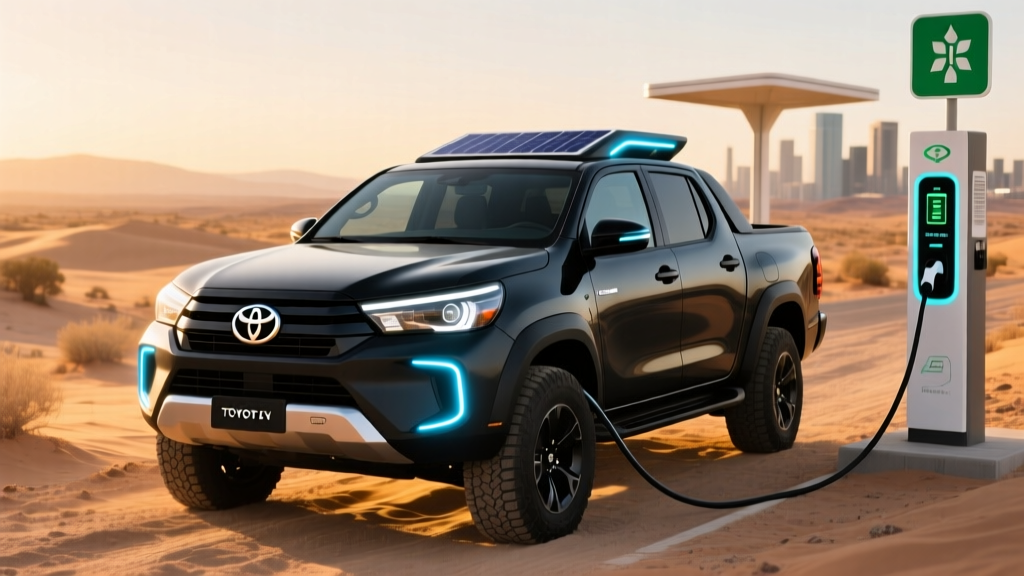
Short answer: As of early 2026, the Toyota Hilux EV is not available for sale in the United States. Toyota has unveiled an all-electric Hilux prototype (first shown in December 2023, with ongoing testing through 2024–2025), but the production model has not been confirmed for the US market. The Hilux itself has never been sold new in the US — the Tacoma fills that midsize truck slot here. If and when a production Hilux EV launches, it will likely debut in markets like Thailand, Australia, and Europe first. US buyers looking for an electric midsize pickup should evaluate the Ford Maverick (hybrid), Rivian R1T, or the Chevrolet Silverado EV as current alternatives.
What Is the Toyota Hilux EV and Where Does It Stand in 2026?
The Toyota Hilux is one of the most iconic midsize pickups globally — sold in over 180 countries, renowned for extreme durability, and a staple of commercial fleets from Southeast Asia to sub-Saharan Africa. In December 2023, Toyota unveiled an all-electric Hilux prototype built at its Thailand plant, signaling the company's intent to electrify its most rugged workhorse. Throughout 2024 and 2025, Toyota conducted real-world durability testing, including cold-climate and heavy-load trials.
However, Toyota has been characteristically cautious about committing to a production timeline or full specifications. The prototype uses a battery-electric powertrain mounted on a modified IMV (Innovative International Multi-purpose Vehicle) ladder-frame platform — the same architecture underpinning the current-generation Hilux and Fortuner. Toyota has not published final EPA-equivalent range figures, battery capacity, or pricing for a production version.
Here's what we know from Toyota's announcements and prototype data, alongside what remains unconfirmed:
| Specification | Status | Details |
|---|---|---|
| Platform | Confirmed | Modified IMV ladder-frame (body-on-frame) |
| Powertrain | Confirmed | Battery-electric (BEV), single or dual motor TBD |
| Battery chemistry | Likely | LFP (lithium iron phosphate) expected for durability/cost |
| Battery capacity (kWh) | Unconfirmed | Estimated 70–90 kWh usable based on segment competitors |
| Range (WLTP) | Unconfirmed | Estimated 250–300 mi (WLTP); US EPA would be ~10–15% lower |
| DC fast-charge rate (kW) | Unconfirmed | Estimated 100–150 kW peak based on Toyota bZ4X architecture |
| Towing capacity | Unconfirmed | Target likely ~2,500–3,500 kg (5,500–7,700 lbs) to match diesel Hilux |
| Payload | Unconfirmed | Target ~1,000 kg (2,200 lbs) |
| Production start | Unconfirmed | Likely 2026–2027 for initial markets |
| US availability | Not announced | No US launch confirmed; Tacoma remains US midsize truck |
| MSRP | Unconfirmed | No pricing announced |
Sources: Toyota Global Newsroom, Toyota Thailand announcements.
Why the Hilux EV Matters — Even If You Can't Buy One in the US
The electric Hilux represents a critical test case: can a body-on-frame, work-oriented pickup transition to battery power without sacrificing the payload, towing, and off-road durability that define the segment? Unlike unibody electric crossovers, a ladder-frame truck must carry heavy loads over rough terrain, which demands more energy and places greater stress on battery thermal management.
For US readers, the Hilux EV's development directly informs what to expect from a potential electric Tacoma. Toyota's Tacoma is the Hilux's North American sibling, and any powertrain technology validated on the Hilux EV will likely appear in a future Tacoma EV or PHEV. Toyota has confirmed an electrified Tacoma is in development, though whether it arrives as a plug-in hybrid first (following the Tacoma Hybrid launched for 2024) or a full BEV remains unclear.
Hilux EV vs. Gas/Diesel Hilux: What Changes for Owners?
For buyers in markets where the Hilux is sold, the EV version presents a fundamentally different ownership equation compared to the 2.4L and 2.8L turbodiesel variants that dominate sales today. Here's how the two compare based on prototype data and segment estimates:
| Factor | Hilux EV (Est.) | Hilux 2.8L Diesel |
|---|---|---|
| Fuel/Energy cost per mile | ~$0.04–0.07 (home charging) | ~$0.12–0.18 (diesel at $4.50/gal, 25 MPG) |
| Maintenance (annual) | ~$300–500 (no oil, filters, DEF) | ~$800–1,200 (oil, fuel filters, DEF, DPF) |
| Range (real-world) | ~200–260 mi (loaded/highway) | ~500–600 mi (21-gal tank, mixed driving) |
| Refueling/Recharge time | 30–45 min (10–80% DC fast) | 5 min (diesel fill-up) |
| Towing range impact | ~40–50% range reduction under max tow | ~25–35% range reduction under max tow |
| Cold-weather range loss | ~20–30% at 20°F | Minimal (diesel gelling managed with additives) |
| Drivetrain complexity | Single/dual motor, 1-speed reduction gear | Turbo diesel, 6-speed auto, DPF, SCR, DEF system |
| Upfront cost premium | Estimated 15–25% over diesel equivalent | Baseline |
The EV's advantage is clear for fleet operators with predictable routes and depot charging: dramatically lower per-mile energy costs and far less scheduled maintenance. The diesel's advantage is equally clear for remote or long-haul use: vastly greater range and faster refueling, critical in regions with sparse charging infrastructure.
Real-World Ownership Considerations for a Work Truck EV
If you're evaluating an electric pickup — whether the eventual Hilux EV, a Rivian R1T, or another model — these practical factors determine whether it works for your use case:
Home and Depot Charging Access
An electric work truck lives or dies by its charging setup. Level 2 home charging (240V, typically 7.2–11.5 kW) adds roughly 20–35 miles of range per hour — sufficient for overnight replenishment if your daily driving stays under 150 miles. For fleet operators, depot-installed Level 2 chargers (often 19.2 kW commercial units) can fully recharge a truck overnight in 6–8 hours.
If you lack access to reliable home or depot charging, an EV pickup becomes impractical for daily work use. Public DC fast charging works for occasional top-ups but is too slow and expensive for daily fleet operations.
Towing and Payload Range Penalty
This is the single biggest real-world limitation of electric pickups. Towing a 5,000-lb trailer can cut range by 40–50%, meaning a truck rated for 280 miles of range may deliver only 140–170 miles under load. The Hilux EV's body-on-frame design and expected LFP battery may mitigate this somewhat through robust thermal management, but physics is unforgiving: moving heavy mass requires energy, and batteries are heavy themselves.
Climate and Terrain
LFP battery chemistry — expected for the Hilux EV — performs better in extreme heat than NMC but still suffers range loss in cold weather. Expect 20–30% range reduction at 20°F (–7°C) and up to 40% at 0°F (–18°C). For buyers in tropical or temperate climates (the Hilux's core markets in Southeast Asia, Africa, and Australia), cold-weather loss is less of a concern than heat-soak management during heavy-load operation.
Off-Road and Remote Use
The Hilux's reputation rests on its ability to operate far from infrastructure. An EV version faces a genuine limitation here: if you're working a remote mine site, farm, or construction zone without grid power, recharging becomes a challenge. Toyota has hinted at solar-assisted charging and portable generator compatibility for off-grid scenarios, but these remain unconfirmed for production.
Cost Breakdown: What Would Hilux EV Ownership Actually Cost?
While US pricing is irrelevant (the truck isn't sold here), we can estimate total cost of ownership for buyers in markets where the Hilux competes, using data from Australia and Thailand as reference points:
| Cost Category | Hilux EV (Est.) | Hilux Diesel SR5 |
|---|---|---|
| Purchase price | AUD $75,000–85,000 | AUD $63,000–68,000 |
| Fuel/Energy (5 yr, 100,000 km) | AUD $3,500–5,500 | AUD $12,000–16,000 |
| Maintenance (5 yr) | AUD $1,500–2,500 | AUD $4,000–6,000 |
| Insurance (5 yr) | AUD $7,500–9,000 | AUD $6,000–7,500 |
| Registration/Taxes (5 yr) | AUD $3,000–4,000 | AUD $3,500–4,500 |
| Depreciation (est. resale at 5 yr) | ~45–55% retained | ~55–65% retained |
| Total 5-yr cost (est.) | AUD $90,500–106,000 | AUD $88,500–102,000 |
The EV's higher purchase price is partially offset by dramatically lower fuel and maintenance costs. Over 5 years, the total cost gap narrows to roughly AUD $2,000–4,000 — and if electricity prices are low (e.g., home solar charging), the EV can break even or come out ahead. However, EV depreciation remains a wildcard: early electric trucks have seen steeper depreciation than their diesel counterparts, though this may stabilize as the market matures.
Note: US buyers evaluating electric trucks should consult the IRS §30D clean vehicle credit rules for current federal incentives. The Hilux EV is not eligible since it's not sold in the US, but comparable trucks like the Rivian R1T may qualify for up to $7,500 depending on MSRP caps, buyer income limits, and battery-sourcing requirements.
Common Misconceptions About Electric Pickup Trucks
| Myth | Fact |
|---|---|
| "Electric trucks can't tow." | They can tow at rated capacity, but range drops 40–50% under max load. Plan routes around charging for long tows. |
| "Batteries won't survive work-truck abuse." | LFP batteries (expected in Hilux EV) have 3,000+ cycle life and tolerate heat/vibration well. Toyota's testing includes extreme durability validation. |
| "EV trucks are slower and less capable off-road." | Electric motors deliver instant torque (often 400+ lb-ft) with precise low-speed control — advantageous for rock crawling and technical terrain. |
| "You'll be stranded without charging stations." | True in remote areas — this is a real limitation. For depot-based or suburban work use, overnight Level 2 charging eliminates the problem entirely. |
| "EV batteries need replacing every few years." | Modern EV batteries retain 85–90% capacity at 100,000 miles. Toyota typically offers 8-year/100,000-mile hybrid battery warranties, and EV warranties are expected to match or exceed this. |
US Alternatives: What to Buy Instead in 2026
Since the Hilux EV isn't available stateside, here's how the current US electric and electrified midsize/full-size truck landscape compares:
| Model | Type | EPA Range | Starting MSRP | Best For |
|---|---|---|---|---|
| Rivian R1T (Dual Motor) | BEV | ~330 mi (Max Pack) | ~$73,000 | Adventure, off-road, tech-forward buyers |
| Ford F-150 Lightning | BEV | ~240–320 mi | ~$55,000 | Fleet/commercial, home backup power (V2H) |
| Chevrolet Silverado EV | BEV | ~360–400 mi (est.) | ~$55,000 | Max range, long-haul light duty |
| Ford Maverick Hybrid | HEV | ~500+ mi (37 MPG combined) | ~$28,000 | Budget urban/suburban light truck use |
| Toyota Tacoma Hybrid | HEV (i-FORCE MAX) | ~450+ mi (est. 25–27 MPG) | ~$40,000 | Off-road capability, Toyota reliability |
Range and pricing based on EPA data from fueleconomy.gov and manufacturer MSRP. Actual range varies with driving conditions, temperature, and payload.
Decision Framework: Should You Wait for the Hilux EV or Buy Now?
Choose to wait for the Hilux EV (or an electric Tacoma) if:
- You live in a market where the Hilux is sold (Australia, Thailand, South Africa, etc.) and a production launch is confirmed for your region.
- Your daily driving is under 150 miles and you have reliable home or depot Level 2 charging.
- You prioritize low operating costs and minimal maintenance over maximum range.
- You rarely tow heavy loads over long distances without planned charging stops.
- You're a fleet operator with predictable routes and overnight charging capability.
Choose a current alternative now if:
- You're in the US — the Hilux EV isn't coming here anytime soon, and the Tacoma EV timeline is unconfirmed.
- You regularly tow 5,000+ lbs over distances exceeding 100 miles.
- You work in remote areas without grid power or charging infrastructure.
- You need a truck today and can't wait 1–3 years for production and delivery.
- You operate in extreme cold (below 0°F regularly) where range loss makes EV impractical for your routes.
Frequently Asked Questions
Will the Toyota Hilux EV be sold in the United States?
No. Toyota has not announced any plans to sell the Hilux in the US market. The Tacoma serves as Toyota's midsize truck for North America. If Toyota produces an electric Tacoma, it would be the US equivalent — but that model has not been confirmed with a timeline as of 2026.
What battery chemistry will the Hilux EV use?
Toyota has not officially confirmed the battery chemistry, but industry analysis and Toyota's own strategy point strongly toward LFP (lithium iron phosphate). LFP offers superior cycle life (3,000+ cycles), better thermal stability, and lower cost — all priorities for a work truck. The trade-off is lower energy density compared to NMC, meaning a heavier or physically larger battery pack for equivalent range.
How long will it take to charge the Hilux EV?
Final charging specs are unconfirmed. Based on Toyota's current EV architecture (the bZ4X peaks at ~150 kW DC), we estimate the Hilux EV will support 100–150 kW DC fast charging, achieving a 10–80% charge in approximately 30–45 minutes. Level 2 home charging (7.2–11.5 kW) would require 8–12 hours for a full charge depending on battery size. Note that peak kW is not sustained — charge speed tapers significantly above 80% State of Charge to protect battery health.
Can an electric pickup handle off-road and heavy-duty work?
Yes, with caveats. Electric motors provide instant, linear torque with no turbo lag — an advantage in technical off-road situations. The Hilux EV's body-on-frame construction should maintain the ground clearance and articulation of the diesel model. However, sustained heavy-load operation generates significant battery heat, and remote off-road use without charging access remains a genuine limitation. Toyota's durability testing is specifically targeting these scenarios.
What will the Hilux EV cost?
No official pricing has been announced. Based on the price premium of EVs over diesel equivalents in the Hilux's core markets, expect a 15–25% premium over a comparably equipped diesel Hilux SR5. In Australia, that would place the EV roughly in the AUD $75,000–85,000 range at launch. Pricing will vary significantly by market depending on local incentives, import duties, and battery sourcing.
How does the Hilux EV compare to the Ford F-150 Lightning or Rivian R1T?
These are different vehicle classes. The F-150 Lightning and Rivian R1T are full-size or midsize-plus trucks with larger batteries (100–149 kWh), longer range (240–400 mi EPA), and higher towing capacities (7,700–11,000 lbs). The Hilux EV is a compact-to-midsize global truck designed for narrower roads, lighter payloads (~2,200 lbs), and markets where full-size American trucks don't fit. Direct comparison is limited, but the Hilux EV will likely prioritize ruggedness and cost-efficiency over maximum range or towing.
Editorial note: This article will be updated as Toyota releases confirmed production specifications and market availability for the Hilux EV. All estimated figures are based on prototype data, segment analysis, and Toyota's current EV technology. Always verify specifications with your local Toyota dealer before making purchasing decisions.