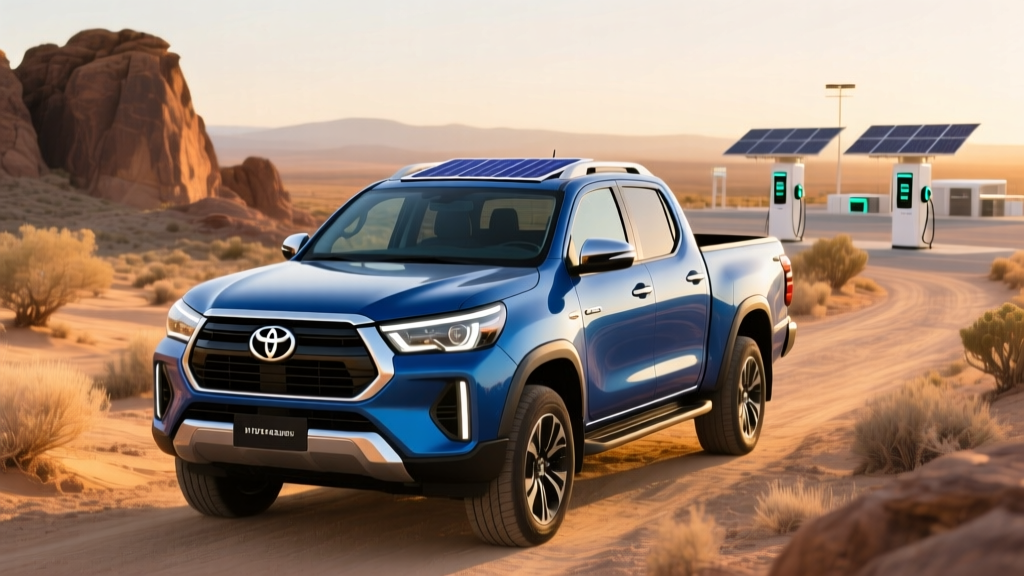
Is the Toyota Hilux Electric Available in the US?
No. As of early 2026, the Toyota Hilux Electric is an announced global-market pickup primarily targeting Australia, Southeast Asia, and select European markets. Toyota has confirmed a battery-electric Hilux is in development under its "multi-pathway" electrification strategy, but US availability remains unconfirmed. American buyers seeking a midsize electric pickup should look at the Ford Ranger (PHEV variant expected) or the Chevrolet Colorado EV (if released), as Toyota's US electric truck lineup currently centers on the larger Tacoma segment and the full-size Tundra i-FORCE MAX hybrid.
That said, the Hilux Electric is generating significant global interest — particularly among fleet operators and off-road enthusiasts — so here's a data-driven breakdown of what we know, what it costs to own, and how it compares to its diesel and hybrid siblings.
What We Know About the Hilux Electric So Far
Toyota first showcased the Hilux Revo BEV Concept at the 2022 Chang Motor Show in Thailand, and subsequent filings and executive statements have confirmed a production version is targeted for 2026–2027 in select markets. Based on Toyota's e-TNGA platform adaptations and the company's published battery roadmap, here are the preliminary specifications circulating from Toyota's regional disclosures:
| Specification | Hilux Electric (Estimated) | Hilux Diesel (2026, Global) |
|---|---|---|
| Battery Capacity | ~70–80 kWh (NMC chemistry) | N/A — 2.8L turbo-diesel |
| WLTP Range | ~300–350 km (186–217 mi) | ~900+ km (560+ mi) |
| Peak DC Fast Charge | ~120–150 kW | N/A |
| 10–80% Charge Time | ~35–45 minutes | N/A |
| Level 2 AC Charging | ~7–11 kW | N/A |
| Power Output | ~150–180 kW (201–241 hp) | ~150 kW (201 hp) |
| 0–100 km/h (0–62 mph) | ~8.5–10 seconds (est.) | ~10.5 seconds |
| Payload Capacity | ~800–1,000 kg (est.) | ~1,000–1,100 kg |
| Towing Capacity | ~2,500–3,000 kg (est.) | ~3,500 kg |
| Starting Price (AUD, est.) | ~$65,000–$80,000 AUD | ~$45,000–$60,000 AUD |
Critical note on range: The WLTP cycle tends to overestimate range by roughly 10–15% compared to US EPA testing. A Hilux Electric with a WLTP-rated 350 km would likely achieve an EPA-equivalent ~180–200 miles in US testing. Real-world highway driving at sustained speeds, especially while towing or carrying payload, could reduce that to 130–160 miles. Cold-weather operation (below freezing) can further reduce usable range by 20–30%, putting worst-case winter range at approximately 100–130 miles.
Real-World Range Expectations
WLTP Sticker: ~350 km (217 mi)
EPA-Equivalent Estimate: ~180–200 mi
Highway/Towing Real-World: ~130–160 mi
Cold-Weather Worst Case: ~100–130 mi
Pickups face unique range penalties: boxy aerodynamics, heavy payloads, and towing can cut range by 40–50%. The Hilux Electric's range will be its biggest practical limitation for commercial users.
Hilux Electric vs. Diesel Hilux: Total Cost of Ownership
For fleet buyers and owner-operators, the purchase price is only part of the equation. The Hilux Electric carries a significant upfront premium, but operating costs tell a different story over time. Here's a 5-year / 100,000 km ownership comparison based on Australian market conditions (AUD):
| Cost Category (5 yr / 100k km) | Hilux Electric (Est.) | Hilux Diesel 2.8L |
|---|---|---|
| Purchase Price | $72,000 AUD | $52,000 AUD |
| Fuel / Electricity | $3,200 (home charging @ $0.28/kWh) | $14,500 (diesel @ $2.10/L, 8.5 L/100km) |
| Maintenance | $1,800 (tires, cabin filter, brake fluid) | $5,500 (oil, filters, belts, DPF service) |
| Registration / Taxes | $3,800 (varies by state) | $4,200 |
| Insurance | $7,500 | $5,800 |
| Depreciation (est.) | $28,000 | $22,000 |
| Total 5-Year Cost | ~$116,300 AUD | ~$104,000 AUD |
| Cost Per Kilometer | $1.16 AUD/km | $1.04 AUD/km |
Over five years, the diesel Hilux still holds a cost advantage in most scenarios — primarily due to the EV's higher purchase price and steeper depreciation. However, the breakeven point shifts dramatically for high-mileage urban fleet use (delivery, last-mile logistics) where diesel costs compound and regenerative braking extends brake life. At 150,000+ km over 5 years, the Hilux Electric's fuel savings (~$16,800) begin to close the purchase-price gap.
Charging the Hilux Electric: What Owners Need to Know
Charging infrastructure is the single biggest ownership variable for any EV pickup. The Hilux Electric is expected to support both AC and DC charging, but the practical experience depends heavily on your setup:
| Charging Level | Power (kW) | Approx. km Added Per Hour | Best For |
|---|---|---|---|
| Level 1 (standard outlet) | ~1.8–2.3 kW | ~10–14 km/hr | Overnight top-up only |
| Level 2 (wallbox, single-phase) | ~7 kW | ~40–45 km/hr | Home/workplace daily charging |
| Level 2 (wallbox, 3-phase) | ~11 kW | ~60–70 km/hr | Faster home charging (if supported) |
| DC Fast Charge | ~120–150 kW (peak) | ~500–700 km/hr | Road trips, quick top-ups |
Home charging cost (Australia): At an average residential electricity rate of $0.28 AUD/kWh, fully charging a 75 kWh battery costs roughly $21 AUD, yielding approximately 300 km of WLTP range — about $0.07 AUD per kilometer. Compare that to diesel at roughly $0.18 AUD per kilometer.
Charging curve reality: Like all EVs, the Hilux Electric will not sustain its peak DC charge rate for the full session. Expect peak rates (120–150 kW) only between 10–40% State of Charge (SoC), tapering to 80–100 kW through 60%, and dropping sharply above 80%. A 10–80% session will take roughly 35–45 minutes; an 80–100% session could add another 25–30 minutes.
US buyers take note: If the Hilux Electric ever reaches North America, it would likely adopt the NACS (Tesla) connector standard, which has become the dominant plug format in the US as of 2025. In global markets, expect CCS2 (Europe/Australia) or GB/T (China).
Battery Longevity, Warranty, and Replacement
Toyota has historically offered robust battery warranties on its electrified vehicles — typically 8 years / 160,000 km with a capacity retention threshold of 70%. The Hilux Electric is expected to follow this pattern, which is competitive with global benchmarks set by Hyundai (8yr/160k km) and slightly below Tesla's 8yr/192,000 km standard.
Degradation expectations: Modern NMC lithium-ion batteries in well-managed thermal systems typically lose 1–2% capacity per year under normal use. After 5 years, expect roughly 90–95% State of Health (SoH). Heavy DC fast-charging use, frequent 100% SoC storage, and extreme heat exposure can accelerate this to 2–3% annually.
Battery replacement cost: If out of warranty, a full battery pack replacement for a 70–80 kWh system currently runs $15,000–$25,000 USD equivalent, though prices are declining roughly 8–12% per year as cell manufacturing scales. Module-level replacement (swapping individual degraded modules rather than the full pack) may be available for significantly less.
Common Misconceptions About the Hilux Electric
| Myth | Fact |
|---|---|
| "The Hilux Electric is available in the US" | It is not. Toyota has not confirmed US sales. The Hilux is not sold in the US market — Toyota offers the Tacoma instead. |
| "Electric pickups can't tow" | Electric motors produce instant torque, making them capable towers. However, towing severely reduces range — expect a 40–50% range cut at max tow weight. |
| "EV batteries need replacing every 5 years" | Modern EV batteries are designed for 15–20 years of service. Toyota warranties typically guarantee 70%+ capacity at 8 years. Real-world data shows most packs retain 85–92% at 5 years. |
| "Charging takes too long for commercial use" | For depot-based fleets that charge overnight on Level 2, the Hilux Electric can start every day with a full battery. DC fast-charging at 120–150 kW adds ~200 km in 20 minutes — sufficient for lunch-break top-ups. |
| "It qualifies for the $7,500 US tax credit" | The Hilux is not sold in the US and would need to meet IRS §30D requirements including North American final assembly, MSRP caps, battery sourcing, and buyer income limits to qualify. |
Who Should Consider the Hilux Electric — and Who Shouldn't
Actionable Decision Framework
Consider the Hilux Electric if:
- You operate a fleet in urban or suburban areas with daily routes under 200 km
- You have depot or home charging access (Level 2 minimum)
- Fuel cost savings are a priority at high annual mileage (25,000+ km/year)
- You operate in a jurisdiction with EV purchase incentives or zero-emission zone mandates
- Noise and local air quality matter (residential delivery, mining sites, indoor facilities)
Stick with the diesel Hilux (or a hybrid alternative) if:
- Your routes regularly exceed 300 km per day without mid-day charging access
- You tow heavy loads (boats, trailers, equipment) over long distances
- You operate in remote areas without DC fast-charging infrastructure
- Upfront budget is constrained and total-cost-of-ownership breakeven is beyond your ownership horizon
- You need maximum payload — battery weight reduces cargo capacity by ~100–200 kg
What US Buyers Can Do Instead
American truck buyers watching the Hilux Electric with envy have limited but growing alternatives in the electric midsize pickup segment:
- Ford Maverick (Hybrid/PHEV): The Maverick Hybrid achieves an EPA-estimated ~42 MPG combined, making it the most fuel-efficient truck on the US market. A PHEV variant is anticipated.
- Rivian R1T: A full-size electric pickup with EPA ranges up to 410 miles (Max Pack), starting around $75,000. Offers genuine off-road capability and 11,000 lb towing.
- Chevrolet Silverado EV: Larger than the Hilux, but offers up to 440 miles EPA range and commercial-fleet variants that compete on operating cost.
- Toyota Tacoma i-FORCE MAX (Hybrid): Not a BEV, but Toyota's hybrid turbocharged powertrain delivers 326 hp and improved efficiency over the outgoing V6, bridging the gap until a full-electric Tacoma arrives.
Toyota has signaled that a US-market electric truck is part of its long-term roadmap, but the company's electrified vehicle strategy continues to prioritize a multi-pathway approach spanning hybrids, PHEVs, hydrogen fuel cells, and BEVs rather than committing to any single technology.
Frequently Asked Questions
When will the Toyota Hilux Electric be available?
Toyota has targeted 2026–2027 for initial market launches, beginning in Thailand and Australia. A global rollout timeline has not been published, and US availability is not confirmed.
How much will the Hilux Electric cost?
Estimated starting prices are in the range of $65,000–$80,000 AUD (roughly $42,000–$52,000 USD), representing a 30–40% premium over the diesel Hilux in most markets.
Can the Hilux Electric tow a trailer?
Yes, with an estimated towing capacity of 2,500–3,000 kg — less than the diesel's 3,500 kg. Expect range to drop by 40–50% when towing near maximum capacity.
What charging connector will it use?
Market-dependent: CCS2 in Australia and Europe, GB/T in China. If it ever reaches North America, NACS is the expected standard as of 2025.
Is the Hilux Electric a good fleet vehicle?
For urban and suburban fleets with predictable daily routes under 200 km and access to depot charging, the operating cost savings are substantial — roughly $0.07/km for electricity vs. $0.18/km for diesel. For long-haul or remote operations, the diesel remains the practical choice.
Does Toyota offer any electric trucks in the US?
As of 2026, Toyota does not sell a fully electric truck in the United States. The Tacoma and Tundra are available with hybrid (i-FORCE MAX) powertrains. Toyota's US BEV lineup includes the bZ4X crossover.