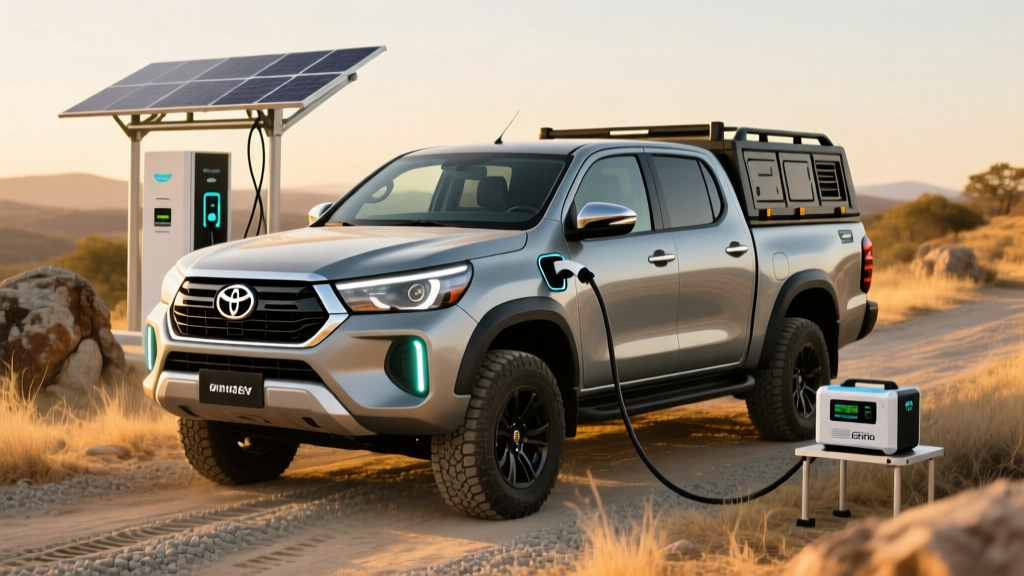
The Toyota Hilux has been a global workhorse for over five decades, dominating pickup markets from Southeast Asia to Africa and Australia. Now, Toyota is electrifying the legend. The Toyota Hilux BEV, officially unveiled as a prototype in late 2023 and entering limited production for select global markets in 2025–2026, represents Toyota's cautious but deliberate move into the electric pickup segment.
As of early 2026, the Hilux BEV is not confirmed for the U.S. market. Toyota sells the Tacoma domestically, and the Hilux BEV is targeted at regions where the Hilux nameplate dominates — Australia, Southeast Asia, South Africa, and parts of Europe. This review covers announced and preliminary production specs for global-market models, with analysis relevant to U.S. buyers who may see a similar platform arrive stateside or who are tracking Toyota's EV truck strategy.
What We Know: 2026 Hilux BEV Specifications
Toyota has released preliminary specifications through regional press events and its global newsroom. Because the Hilux BEV is still ramping production and has not been submitted to the U.S. EPA for certification, the range and efficiency figures below are based on WLTP and Toyota's internal testing. We'll translate these to EPA-equivalent estimates where possible.
| Specification | Value |
|---|---|
| Battery Capacity | ~80 kWh usable (LFP chemistry) |
| WLTP Range | ~310 km (~193 miles) |
| EPA-Equivalent Range (est.) | ~170–185 miles |
| Drivetrain | Dual-motor AWD (part-time 4WD modes) |
| Power Output | ~270 hp (200 kW) combined |
| Torque | ~350 lb-ft (475 Nm) |
| 0–100 km/h (0–62 mph) | ~8.5 seconds (est.) |
| Max DC Fast Charge | 150 kW (CCS2 / NACS TBD by market) |
| 10–80% DC Charge Time | ~35 minutes (est.) |
| Level 2 AC Charge Rate | 11 kW (3-phase where available) |
| Towing Capacity | ~2,500 kg (~5,500 lbs) braked |
| Payload | ~800 kg (~1,760 lbs) |
| Cargo Bed Length | ~1,555 mm (~61.2 in) — standard bed |
| Warranty (Battery) | 8 years / 160,000 km (~100,000 mi) — regional |
| Base MSRP (Australia est.) | AUD $70,000–$80,000 (~USD $45,000–$52,000) |
Range and Efficiency: Real-World Expectations
WLTP Estimate: ~193 miles (310 km)
EPA-Equivalent Estimate: ~170–185 miles
Real-World Highway (70 mph): ~140–155 miles
Cold Weather (below 32°F / 0°C): ~120–140 miles
Heavy Towing (near max capacity): ~90–110 miles
The Hilux BEV's ~80 kWh LFP battery is modest by full-size U.S. truck standards (the Ford F-150 Lightning Extended Range uses a 131 kWh pack). Toyota has prioritized durability and cost over maximum range — LFP chemistry offers excellent cycle life (typically 3,000+ cycles before significant degradation) and thermal stability, making it well-suited for a work truck that may see daily charging and harsh conditions.
However, the efficiency penalty of a body-on-frame pickup with all-terrain tires is real. Expect roughly 2.0–2.3 kWh per mile in mixed driving, translating to an estimated 95–105 MPGe combined. Highway driving at sustained speeds pushes consumption closer to 2.5 kWh/mile, which is why real-world highway range drops to approximately 140–155 miles.
For context, this range is adequate for urban and suburban work duty — daily job-site commutes of 40–80 miles round-trip with overnight home charging. It falls short of the 250+ mile expectations U.S. truck buyers have from the Rivian R1T or F-150 Lightning, which is one reason Toyota may be hesitant to bring this specific platform stateside without a larger battery option.
Charging Speed: DC Fast and Home Level 2
The Hilux BEV supports up to 150 kW DC fast charging, which is competitive for its battery size but not class-leading. The 150 kW peak allows a 10–80% charge in roughly 35 minutes under optimal conditions (battery preconditioned, ambient temperature 60–80°F).
| Charge Level | Power | Time / Rate | Notes |
|---|---|---|---|
| Level 1 (120V) | ~1.4 kW | ~2–3 mi/hr | Emergency/trickle only |
| Level 2 (240V, single-phase) | 7.2 kW | ~18–22 mi/hr; full charge ~11 hrs | Standard U.S. home setup |
| Level 2 (3-phase AC) | 11 kW | ~28–32 mi/hr; full charge ~7.5 hrs | Common in AU/EU; rare in U.S. homes |
| DC Fast Charge | 150 kW peak | 10–80% in ~35 min | Tapers above 80%; ~40–50 kW sustained avg |
A key detail: LFP batteries can typically be charged to 100% regularly without the degradation concerns associated with NMC chemistries. Toyota recommends periodic 100% charges for LFP packs to allow the battery management system (BMS) to recalibrate cell balance. This is a practical advantage for work-truck owners who want maximum range available every morning.
The 150 kW peak charge rate is adequate but reflects the 80 kWh pack's C-rate limitations. Expect the charge curve to taper noticeably above 60% state of charge, with sustained rates averaging 40–50 kW across the full 10–80% session. On a road trip, plan for 35-minute stops every ~140 miles — workable but not seamless for long hauls.
Performance and Drivetrain
The dual-motor AWD setup delivers approximately 270 hp and 350 lb-ft of torque to all four wheels. Toyota has tuned the Hilux BEV for low-end torque delivery suited to off-road crawling and load-lugging rather than straight-line speed. The estimated 0–62 mph time of ~8.5 seconds is respectable for a work truck but won't challenge the Rivian R1T's sub-3-second dual-motor performance variants.
Where the Hilux BEV aims to shine is off-road capability. Toyota's prototype demonstrations highlighted:
- Part-time 4WD modes with electronic locking rear differential
- Hill descent control and crawl modes leveraging instant electric torque
- Wading depth estimated at 700 mm (~27.5 in) — competitive with ICE Hilux
- Underbody battery protection with reinforced skid plates
The low center of gravity from the floor-mounted battery pack improves stability on uneven terrain, though the added weight (estimated curb weight ~2,400 kg / ~5,300 lbs) is something Toyota's suspension engineers have had to account for with revised spring rates and damping.
Pricing, Tax Credits, and U.S. Availability
U.S. Availability: Not confirmed for 2026. The Hilux BEV is currently targeted at global markets (Australia, ASEAN, South Africa, Europe).
Estimated Global MSRP: AUD $70,000–$80,000 (~USD $45,000–$52,000) depending on trim and market.
Federal Tax Credit (§30D): Not applicable — the Hilux BEV is not sold in the U.S. and therefore does not appear on the IRS's list of eligible vehicles. If Toyota introduces a U.S.-spec variant (potentially as an electric Tacoma variant), it would need to meet all §30D requirements including:
- MSRP cap: ≤$80,000 for trucks/vans
- Buyer income cap: ≤$150,000 single / $300,000 joint AGI
- Battery critical minerals and component sourcing thresholds (phasing in through 2026)
- Final assembly in North America
Source: IRS Clean Vehicle Credits
For U.S. buyers interested in an electric pickup today, the relevant competitors with confirmed §30D eligibility include the Ford F-150 Lightning (qualifying trims), Chevrolet Silverado EV (4WT and select trims), and Rivian R1T (Dual-Motor Standard battery configuration). The Toyota Tacoma, currently ICE and hybrid only in the U.S., has not received an official BEV confirmation for North America as of early 2026.
Cargo, Utility, and Interior
The Hilux BEV retains the body-on-frame architecture of the current-generation Hilux, which means bed dimensions and cab space are largely carried over from the ICE model:
- Cargo bed: ~61.2 inches long × 58.3 inches wide (between wheel wells) — fits standard pallets in global markets
- Payload capacity: ~1,760 lbs (800 kg)
- Towing: ~5,500 lbs braked — adequate for light trailers, boats, and campers
- Frunk (front trunk): Small auxiliary compartment (~2 cu ft) for charging cables and tools — the electric powertrain doesn't free up massive front storage due to the inverter and HVAC components
- Rear seat: Double cab configuration seats 5; rear legroom is ~34 inches — tight for tall adults on long trips but typical for mid-size global pickups
Inside, Toyota has equipped the Hilux BEV prototype with a 12.3-inch touchscreen running Toyota's latest infotainment system, wireless Apple CarPlay/Android Auto, and a digital instrument cluster with EV-specific readouts (battery temperature, charge rate, energy flow). Driver assistance features include Toyota Safety Sense 3.0 with adaptive cruise control, lane tracing assist, and pre-collision braking — all SAE Level 2 systems requiring continuous driver engagement.
Who Is the Hilux BEV For?
- LFP battery offers excellent longevity (3,000+ cycles) and 100% daily charging tolerance
- Proven Hilux off-road platform with EV torque advantages for crawling
- 2,500 kg towing and 800 kg payload — genuine work-truck utility
- Lower running costs vs. diesel Hilux in markets with high fuel prices
- Toyota's global service network and parts availability
- ~170–185 mi EPA-equiv. range is limiting for highway and long-distance use
- 150 kW DC charging is slower than U.S. rivals (F-150 Lightning: 150–170 kW; Silverado EV: up to 350 kW)
- Not available in the U.S. market — no tax credit path
- Heavy curb weight (~5,300 lbs) impacts efficiency and tire wear
- Rear seat space is tight for a double cab
Best suited for: Fleet operators, tradespeople, and rural buyers in global markets who drive 60–100 miles daily, have reliable overnight charging, and need a rugged, low-maintenance work truck. The Hilux BEV makes strong economic sense in Australia and Southeast Asia where diesel prices are high and daily routes are predictable.
Not ideal for: U.S. buyers (not available), long-distance road trippers, or anyone regularly towing near max capacity over highway distances. The ~170-mile range and 35-minute charge stops make cross-country travel impractical compared to diesel or larger-battery EV trucks.
How It Compares: Hilux BEV vs. Global Electric Truck Rivals
| Model | Battery | Range (est.) | DC Charge | Towing | Price (USD est.) |
|---|---|---|---|---|---|
| Toyota Hilux BEV | 80 kWh LFP | ~170–185 mi | 150 kW | 5,500 lbs | $45,000–$52,000 |
| Ford F-150 Lightning (Std Range) | 98 kWh NMC | ~230 mi (EPA) | 150 kW | 7,700 lbs | $52,000–$58,000 |
| Rivian R1T (Dual-Motor Std) | 95 kWh NMC | ~270 mi (EPA) | 200 kW | 11,000 lbs | $69,900 |
| Chevrolet Silverado EV 4WT | 100 kWh NMC | ~270 mi (EPA) | 200 kW | 8,000 lbs | $55,000–$62,000 |
The Hilux BEV is priced aggressively for global markets and offers the durability reputation of the Hilux nameplate. However, U.S.-market competitors offer substantially more range, faster charging (in the Silverado EV's case), and higher towing capacity. The Hilux BEV's niche is affordable, rugged, short-range work duty in markets where Toyota's dealer network and parts availability are unmatched.
Frequently Asked Questions
What is the real-world range of the Toyota Hilux BEV?
The Hilux BEV's WLTP-rated range is approximately 193 miles (310 km). In real-world driving, expect roughly 170–185 miles under EPA-equivalent mixed conditions, 140–155 miles at sustained highway speeds, and as low as 120 miles in freezing temperatures or when towing near max capacity. The 80 kWh LFP battery prioritizes cycle life over energy density.
How fast does the Hilux BEV charge at home and on DC fast chargers?
On a DC fast charger, the Hilux BEV peaks at 150 kW and charges from 10–80% in approximately 35 minutes, though sustained rates average 40–50 kW across the session. At home on a 240V Level 2 charger (7.2 kW), expect roughly 18–22 miles of range per hour of charging, with a full charge taking about 11 hours. Markets with 3-phase AC (Australia, Europe) can charge at 11 kW, reducing full-charge time to ~7.5 hours.
Does the Hilux BEV qualify for the U.S. federal EV tax credit?
No. The Toyota Hilux BEV is not sold in the United States as of 2026 and therefore is not eligible for the IRS §30D Clean Vehicle Credit. Even if imported, it would need to meet North American final assembly, battery sourcing, MSRP cap ($80,000 for trucks), and buyer income requirements to qualify. U.S. buyers should look at the F-150 Lightning, Silverado EV, or Rivian R1T for tax-credit-eligible electric trucks.
Is the Hilux BEV worth buying over a diesel Hilux?
It depends on your use case. For daily work routes under 100 miles with home charging access, the Hilux BEV offers significantly lower per-mile energy costs (especially in high-diesel-price markets like Australia), reduced maintenance (no oil changes, fewer moving parts), and instant torque for off-road and load-lugging scenarios. For long-distance driving, remote-area work without charging infrastructure, or heavy towing over highway distances, the diesel Hilux remains more practical in 2026.
Will Toyota sell the Hilux BEV in the United States?
Toyota has not confirmed U.S. availability for the Hilux BEV as of early 2026. The U.S. mid-size truck market is served by the Tacoma (available in ICE and hybrid). If Toyota introduces an electric mid-size pickup for North America, it would likely be a Tacoma BEV variant built on a localized platform to meet §30D tax credit assembly requirements. Watch for announcements at major U.S. auto shows.
What is the battery warranty on the Hilux BEV?
Toyota offers an 8-year / 160,000 km (~100,000 mile) battery warranty in most global markets, covering defects and capacity loss below a specified threshold (typically 70% state of health). LFP chemistry is expected to retain 80%+ capacity well beyond 200,000 miles under normal use, based on industry degradation data for lithium iron phosphate cells.
Sources: Toyota Global Newsroom, IRS Clean Vehicle Credits, fueleconomy.gov (for U.S. competitor EPA data).
Note: The Toyota Hilux BEV specifications in this review are based on preliminary and regional production data as of early 2026. Final specs, pricing, and availability vary by market. This vehicle is not available for purchase in the United States.