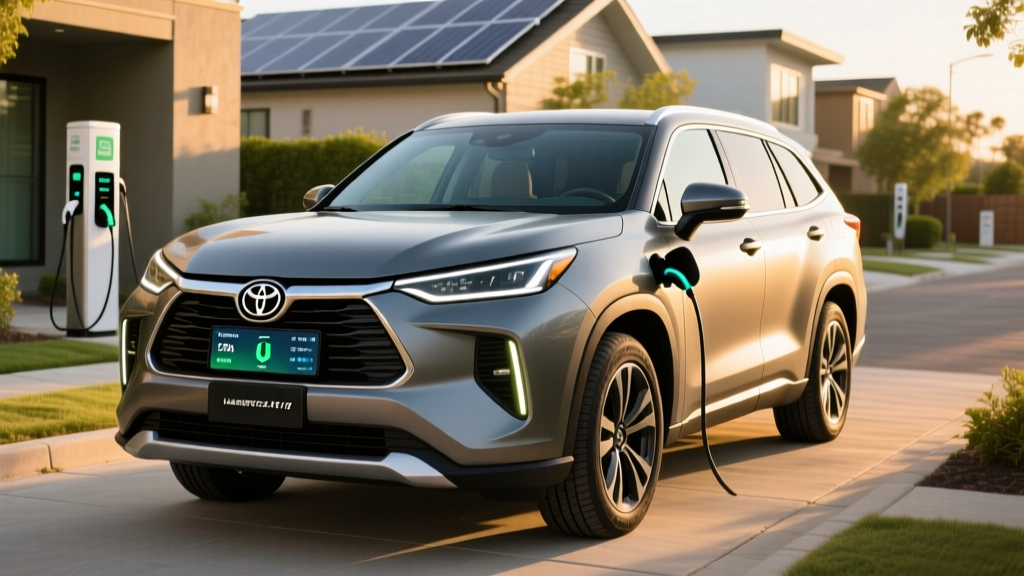
Quick Answer: The Toyota Highlander EV (officially the Toyota bZ5x in the U.S. market, announced for the 2026 model year) is expected to be a three-row electric SUV targeting an EPA range of approximately 280–320 miles depending on trim, with a starting MSRP around $48,000–$52,000. It competes directly with the Kia EV9, Hyundai Ioniq 9, and Rivian R1S. However, as of mid-2026, Toyota has not released final EPA-certified specs or opened orders. Buyers currently shopping for a three-row Toyota electrified SUV should also consider the Toyota Grand Highlander Hybrid, which is available now with up to 36 MPG combined and no range-anxiety trade-offs.
What Is the Highlander EV and When Can You Buy It?
Toyota has been cautious with full battery-electric vehicles, and the three-row SUV segment is no exception. The vehicle many search for as the "Highlander EV" is the production version of Toyota's large electric SUV concept, positioned on the e-TNGA platform (shared in concept with Subaru). Industry reports and Toyota's own product roadmap indicate a U.S. launch for the 2026–2027 model year, likely badged under Toyota's bZ ("beyond Zero") electric sub-brand.
Until Toyota publishes final EPA range estimates, battery capacity figures, and trim-level pricing, all specifications remain preliminary and estimated. What we do know from Toyota's global announcements and platform architecture:
- Platform: e-TNGA (evolved), likely shared components with the bZ4X architecture but stretched for three-row packaging
- Estimated battery: 90–110 kWh usable capacity (NMC chemistry, based on Toyota's current supply chain)
- Estimated range: 280–320 miles EPA (AWD trims will sit at the lower end)
- Charging: DC fast charging expected at 150–180 kW peak (CCS1 or NACS, depending on final U.S. connector decision — Toyota has committed to NACS adoption for future models)
- Drivetrain: Single-motor FWD and dual-motor AWD configurations
If you need a three-row electrified Toyota today, the Grand Highlander Hybrid (34–36 MPG combined, ~$43,000 starting) remains the pragmatic choice. Let's break down how a future Highlander EV would compare.
Highlander EV vs. Grand Highlander Hybrid: The Numbers
The most common cross-shopping dilemma for Toyota loyalists is whether to wait for the EV or buy the hybrid now. Here's a data-driven comparison using confirmed hybrid specs and estimated EV figures:
| Specification | Highlander EV (Estimated) | Grand Highlander Hybrid (2025/2026) |
|---|---|---|
| Powertrain | BEV (battery electric) | HEV (gas-electric hybrid) |
| EPA Range / Fuel Economy | ~280–320 mi range | 36 MPG combined (source: fueleconomy.gov) |
| Energy Capacity | ~90–110 kWh battery | 14.9-gallon fuel tank |
| Total Driving Range | ~280–320 mi | ~536 mi |
| Refuel / Recharge Time | ~25–35 min (10–80% DCFC) | ~5 min (gas station) |
| Starting MSRP | ~$48,000–$52,000 (est.) | ~$43,000–$45,000 |
| Federal Tax Credit (§30D) | Potentially up to $7,500 (see eligibility below) | Not eligible (HEV) |
| Annual Fuel/Energy Cost | ~$600–$900 (electricity, varies by rate) | ~$1,800–$2,200 (gas at $3.40/gal, 15K mi/yr) |
| Maintenance (5-yr est.) | ~$1,200–$1,800 | ~$2,800–$3,500 |
| Seating | 3 rows / 7–8 passengers | 3 rows / 7–8 passengers |
Key takeaway: The hybrid wins on total range and refueling convenience today. The EV wins on per-mile energy cost and maintenance savings — but only if you have reliable home charging access and your daily driving stays under ~250 miles between charges.
Real Costs: Purchase, Charging, and 5-Year Ownership
Let's model a realistic 5-year total cost of ownership (TCO) for the Highlander EV versus the Grand Highlander Hybrid, assuming 15,000 miles/year, national average electricity at $0.16/kWh, and gas at $3.40/gallon:
| Cost Category (5 Years) | Highlander EV (Est.) | Grand Highlander Hybrid |
|---|---|---|
| Purchase Price (base MSRP) | $50,000 | $44,000 |
| Federal Tax Credit (§30D) | –$3,750 to –$7,500* | $0 |
| Home Charger Install (Level 2) | $1,200–$2,500 | $0 |
| Energy/Fuel (75,000 mi total) | $3,500–$4,500 | $9,000–$11,000 |
| Maintenance | $1,500 | $3,200 |
| Insurance (avg.) | $9,500–$11,000 | $7,500–$9,000 |
| Estimated Depreciation | $18,000–$22,000 | $14,000–$17,000 |
| Approx. 5-Year TCO | $60,000–$72,000 | $63,000–$74,000 |
*§30D tax credit eligibility depends on MSRP caps ($80,000 for SUVs), buyer income limits ($300K MFJ / $150K single), battery critical-mineral sourcing, and final assembly in North America. Verify current rules at IRS.gov before purchasing. Credit may be transferred to the dealer as a point-of-sale discount.
What the numbers reveal: The EV's higher purchase price and insurance premiums are largely offset by fuel and maintenance savings over five years. The tax credit — if the vehicle qualifies — can tip the scales decisively. But depreciation remains the wildcard: EV resale values have been volatile, and Toyota's strong brand retention may help the hybrid hold value better in the short term.
Charging Reality: Home Setup and Public Network Access
The single biggest ownership variable for any EV is charging access. If you're considering the Highlander EV, you need a realistic charging plan before you buy.
Home Charging (Where 80%+ of Charging Happens)
A Level 2 home charger (240V, 32–48 amps) is essentially mandatory for convenient EV ownership. For a ~100 kWh battery, expect:
- Level 1 (120V, 12A): ~1.4 kW — adds roughly 4–5 miles of range per hour. A full charge takes 3+ days. Impractical as a primary strategy.
- Level 2 (240V, 48A): ~11.5 kW — adds roughly 35–40 miles per hour. Full charge in ~9–10 hours (overnight).
- DC Fast Charging (150–180 kW peak): 10–80% in approximately 25–35 minutes. Note: charge rate tapers significantly above 80% SoC to protect battery health. A 10–90% session may take 45–55 minutes.
Home installation costs typically range from $1,200 to $2,500 for a straightforward setup (240V outlet or hardwired charger near the panel). If your home needs a panel upgrade (200A service), add $1,500–$3,500. Always get a quote from a licensed electrician before committing to an EV purchase.
Public Charging and Road Trips
Toyota's adoption of NACS means future Toyota EVs should gain access to Tesla Supercharger stations (via adapter or native port), significantly expanding the fast-charging network. Combined with Electrify America, EVgo, and other networks, a 300-mile-range Highlander EV should handle road trips with one 25–30 minute charge stop every 2.5–3 hours of driving.
However, charging deserts remain real in rural areas, particularly across parts of the Mountain West, rural South, and northern Plains. If your regular routes include these areas, the hybrid's 536-mile gas range is a significant advantage.
Common Misconceptions About the Highlander EV
| Myth | Fact |
|---|---|
| "The Highlander EV is available to order now." | As of 2026, Toyota has not opened U.S. orders. Specs are preliminary. The Grand Highlander Hybrid is the current three-row Toyota option. |
| "EV batteries need replacing every 5 years." | Modern NMC and LFP batteries are warrantied for 8 years/100,000 miles (minimum) with a capacity retention threshold of 70%. Real-world degradation data shows most EV batteries retain 85–90% capacity after 5 years and 75,000 miles. |
| "I'll save $7,500 on taxes automatically." | The §30D credit has strict requirements: buyer income caps, MSRP caps, North American final assembly, and battery mineral sourcing rules. Many EVs qualify for only $3,750 or $0 depending on the model year and sourcing compliance. Always verify at IRS.gov. |
| "EVs don't work in cold weather." | Cold weather reduces range by 15–30% (due to battery chemistry and cabin heating demands). A 300-mile EPA range may drop to 210–255 miles at 20°F. Preconditioning the battery and using a heat pump (expected on the Highlander EV) mitigate this, but the loss is real and should factor into your range planning. |
| "Public charging is unreliable everywhere." | Reliability varies significantly by network. Tesla Superchargers consistently report 99%+ uptime. Electrify America and EVgo have improved but still experience occasional outages. Plan routes using apps like PlugShare and A Better Routeplanner. |
Decision Framework: Should You Wait for the EV or Buy Now?
Wait for the Highlander EV if:
- You have (or can install) Level 2 home charging
- Your daily driving is under 200 miles round-trip
- You live in an area with robust public DC fast charging
- You want the lowest per-mile energy cost and are willing to pay more upfront
- You can wait 6–18 months for confirmed specs, pricing, and availability
- The vehicle qualifies for a meaningful §30D tax credit in your purchase year
Buy the Grand Highlander Hybrid now if:
- You need a three-row Toyota SUV immediately
- You live in an apartment or lack home charging access
- You regularly drive in rural areas with limited charging infrastructure
- You frequently take long road trips (500+ miles) and don't want to plan charge stops
- You live in a cold climate where EV range loss is a significant concern
- You want proven, long-term reliability data (Toyota hybrids have 25+ years of track record)
Consider a competitor's three-row EV now if:
- You want an electric three-row SUV today — the Kia EV9 (EPA range up to 304 mi, starting ~$55,000) and Hyundai Ioniq 9 are available and shipping
- You want NACS native charging and Supercharger access without an adapter
What First-Time EV Buyers Must Know
If the Highlander EV (or any EV) would be your first electric vehicle, these practical realities matter more than spec sheets:
- Home charging is non-negotiable for most owners. Public charging is a supplement, not a substitute. Budget $1,200–$2,500 for a quality Level 2 charger installation before you buy.
- EPA range is optimistic for highway and cold-weather driving. Plan for 75–85% of the sticker range in real-world highway use, and 65–75% in sub-freezing temperatures.
- kW ≠ kWh. kW (kilowatts) measures charge speed — how fast energy flows into the battery. kWh (kilowatt-hours) measures battery capacity — how much energy the battery stores. A 100 kWh battery charged at 150 kW doesn't fill in 40 minutes because the charge rate tapers as the battery fills.
- Insurance costs 15–25% more for EVs on average, due to higher repair costs and specialized parts. Get quotes before purchasing.
- Maintenance is genuinely lower — no oil changes, no spark plugs, fewer brake replacements (thanks to regenerative braking). But tire wear can be 10–20% faster due to EV weight and instant torque.
- The §30D tax credit is not guaranteed. Verify the specific vehicle's eligibility in your purchase year, including battery sourcing and MSRP/income requirements, at IRS.gov.
Frequently Asked Questions
Is there a Toyota Highlander EV available in 2026?
Not yet for U.S. consumers. Toyota has announced plans for a large three-row electric SUV, but final EPA specs, pricing, and order availability have not been confirmed as of mid-2026. The closest current Toyota option is the Grand Highlander Hybrid.
What will the Highlander EV cost?
Industry estimates place the starting MSRP between $48,000 and $52,000, with higher trims (AWD, larger battery) potentially reaching $58,000–$62,000. Final pricing will be confirmed closer to the on-sale date.
Will the Highlander EV qualify for the $7,500 federal tax credit?
This depends on battery sourcing compliance, final assembly location, MSRP caps ($80,000 for SUVs under §30D), and buyer income limits. Toyota's battery supply chain decisions will determine eligibility. Check the IRS clean vehicle credit page at purchase time for the definitive answer.
How does the Highlander EV compare to the Kia EV9?
The Kia EV9 is available now with EPA range up to 304 miles, 210 kW DC fast charging (10–80% in ~24 minutes), and a starting MSRP around $55,000. If Toyota's EV matches or undercuts the EV9 on price while offering comparable range and charging speed, it will be competitive. But the EV9 has a head start in availability and real-world reviews.
Can I charge a Toyota EV at Tesla Superchargers?
Toyota has committed to adopting the NACS (North American Charging Standard) connector for future EVs, which should enable native Supercharger access. Early models may ship with CCS1 and a NACS adapter. Confirm the connector type for your specific model year before purchase.
What is the real-world range in cold weather?
Expect a 15–30% range reduction in sustained sub-freezing temperatures. A 300-mile EPA-rated Highlander EV could deliver 210–255 miles in winter conditions. Preconditioning the battery while plugged in and using seat/steering wheel heaters (instead of cabin air heating) can recover some of that loss.