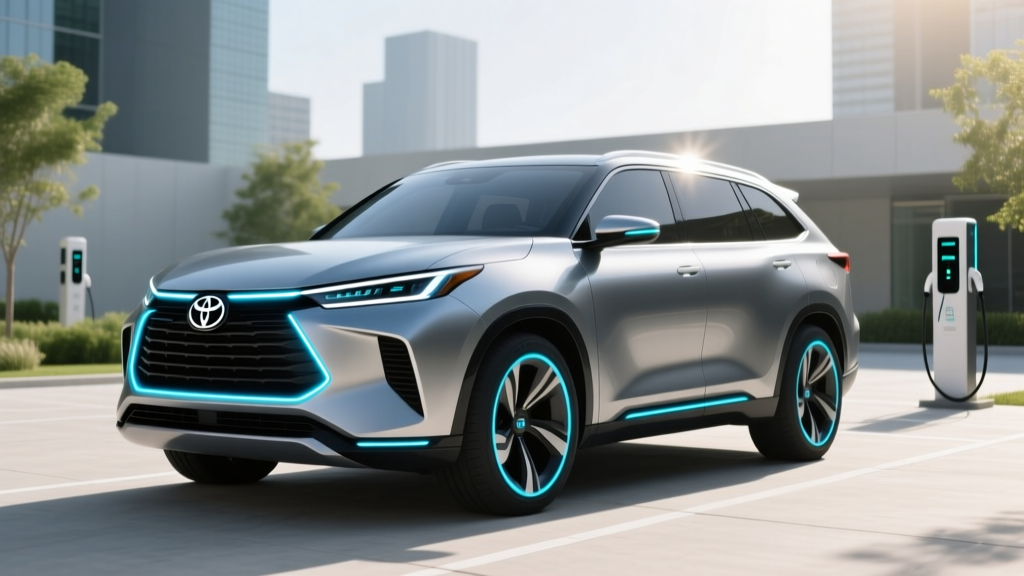
The short answer: As of early 2026, Toyota does not sell an electric Highlander. There is no officially announced "Toyota Highlander Electric" model with confirmed specs, pricing, or a release date. However, Toyota has confirmed it is developing a three-row electric SUV for the North American market, expected to ride on an evolved version of its bZ dedicated EV platform. If you need a three-row electrified Toyota today, your options are the Highlander Hybrid (HEV, ~36 MPG combined) or the Grand Highlander Hybrid (up to ~36 MPG combined, more third-row and cargo space). Buyers specifically waiting for a battery-electric Toyota three-row SUV should monitor Toyota's 2026–2027 product announcements closely, but should not delay a purchase indefinitely expecting an imminent launch.
Why Everyone Is Searching for a Toyota Highlander Electric
The Toyota Highlander has been one of America's best-selling three-row SUVs for over two decades, and the hybrid variant accounts for a significant share of those sales. As families consider going fully electric, the natural question is: when will Toyota offer a battery-electric Highlander? Search interest in "Toyota Highlander electric" reflects genuine buyer demand — not vaporware speculation.
Toyota's EV strategy has been methodical (critics say slow) compared to Hyundai-Kia or Tesla. The bZ4X, Toyota's first dedicated EV, launched for the 2023 model year with an EPA-estimated range of up to 252 miles and a 71.4 kWh battery. It's a two-row compact crossover — not a family hauler. Toyota has since signaled a broader EV lineup, including larger vehicles built on its newly developed EV platforms, but a production-ready electric three-row SUV wearing the Highlander nameplate has not been confirmed as of this writing.
What we do know from Toyota's public roadmap and supply-chain reporting:
- Toyota plans to launch 30 battery-electric models globally by 2030, with a target of 3.5 million annual EV sales.
- A next-generation EV platform (sometimes referred to as the "bZ large" or next-gen modular architecture) is in development, designed to underpin sedans, crossovers, and SUVs including three-row configurations.
- Toyota has invested heavily in U.S. battery production, including a multi-billion-dollar battery plant in North Carolina intended to supply both hybrid and EV battery packs.
- The Highlander nameplate carries immense brand equity in the U.S. — if Toyota builds a three-row electric SUV, branding it as an electric Highlander (or a Highlander-badged EV variant) would be the most market-savvy move.
What a Toyota 3-Row Electric SUV Could Look Like: Educated Projections
While no official specs exist, we can build a reasonable projection based on Toyota's bZ platform trajectory, competitive benchmarks (Kia EV9, Hyundai Ioniq 9, Volkswagen ID. Buzz, and the upcoming three-row electric SUVs from legacy OEMs), and Toyota's own battery technology announcements.
| Spec | Projected Toyota 3-Row EV | Kia EV9 (2025 Benchmark) |
|---|---|---|
| Battery capacity (usable) | ~95–110 kWh (estimated, NMC or LFP) | 99.8 kWh (NMC) |
| EPA range | ~270–310 mi (estimated) | 270–304 mi |
| Peak DC fast charge rate | ~200–250 kW (estimated) | 236 kW (peak) |
| 10–80% DC charge time | ~22–28 min (estimated) | ~24 min |
| Horsepower | ~300–400 hp (dual-motor AWD est.) | 379 hp (GT-Line AWD) |
| 0–60 mph | ~5.5–7.0 sec (estimated) | 4.9 sec (GT-Line AWD) |
| Starting MSRP | ~$55,000–$62,000 (estimated) | $54,900 |
| Charging port | NACS (Toyota has committed to NACS) | CCS1 (adapter for NACS) |
Key caveats: These projections are estimates based on competitive positioning and Toyota's announced technology direction. Toyota has committed to adopting the NACS (North American Charging Standard) connector for future EVs, which would grant access to Tesla's Supercharger network — a significant advantage for road-tripping families. Toyota has also announced next-generation battery technologies including bipolar LFP packs (lower cost, slightly less energy density) and higher-performance NMC cells. A three-row SUV would likely use the higher-capacity NMC chemistry to achieve 280+ miles of EPA range while managing the weight of a large vehicle.
Highlander Hybrid vs. a Future Electric Highlander: Cost and Efficiency Compared
If you're deciding whether to buy a Highlander Hybrid now or wait for an electric version, here's how the numbers stack up using the current 2025/2026 Highlander Hybrid as a baseline and our projected electric variant.
| Metric | 2025 Highlander Hybrid LE AWD | Projected Toyota 3-Row EV |
|---|---|---|
| Base MSRP | ~$42,000 | ~$55,000–$62,000 |
| EPA fuel economy / efficiency | 35 city / 35 hwy / 35 combined MPG | ~90–100 MPGe (est.) |
| Annual fuel/energy cost (15,000 mi/yr) | ~$1,800 (gas at $3.50/gal) | ~$650–$900 (home charging at $0.14/kWh) |
| Annual maintenance (est.) | ~$600–$800 | ~$200–$400 |
| Federal tax credit (§30D) | Not eligible (HEV) | Up to $7,500 if eligible (see rules below) |
| 5-year fuel/energy cost | ~$9,000 | ~$3,250–$4,500 |
| 5-year maintenance cost | ~$3,000–$4,000 | ~$1,000–$2,000 |
The math: A future electric three-row Toyota would likely carry a $13,000–$20,000 price premium over the Highlander Hybrid at the base trim. However, the annual savings on fuel and maintenance — roughly $1,200–$1,800 per year for a typical driver — would close that gap over 7–10 years of ownership, depending on your local electricity rates and driving patterns. The §30D federal tax credit could knock up to $7,500 off the effective purchase price, but eligibility depends on MSRP caps (SUVs: $80,000), buyer income limits ($300,000 joint / $150,000 single AGI), and stringent battery-critical-mineral and component sourcing requirements that change annually. Always verify current-year eligibility on IRS.gov or with a tax professional before counting on the credit.
Real-World Ownership Considerations for a 3-Row Electric SUV
A three-row EV is a different ownership proposition than a compact crossover. Here's what families need to think through before committing — whether to a future Toyota electric SUV or a current competitor like the Kia EV9.
Home Charging Is Nearly Mandatory
Public DC fast charging works for road trips, but daily charging needs to happen at home for convenience and cost savings. A Level 2 home charger (240V, 40–48 amps, delivering 9.6–11.5 kW) will add roughly 25–35 miles of range per hour of charging. For a 100 kWh battery, a full 10–100% charge takes about 9–11 hours on Level 2 — fine for overnight, but you need a dedicated 50- or 60-amp circuit installed by a licensed electrician. Installation costs typically range from $800 to $2,500 depending on your electrical panel capacity and the run distance from panel to garage or driveway. If your home has a 100-amp electrical panel, you may need a panel upgrade ($1,500–$3,000+) to support a Level 2 charger alongside other household loads.
Cold-Weather Range Loss Is Real
Large SUV batteries are not immune to cold-weather degradation. Expect a 15–30% range reduction in sustained sub-freezing temperatures, depending on whether the vehicle uses a heat pump for cabin heating (which significantly reduces the penalty). A projected 290-mile EPA range could drop to 200–245 miles in January in Minnesota or New England. If you live in a cold climate and regularly drive 200+ miles in winter, a larger battery pack or a plug-in hybrid may be more practical.
Road-Trip Charging Logistics
A 100+ kWh battery charging at 200–250 kW peak will deliver a 10–80% charge in roughly 22–28 minutes under optimal conditions (preconditioned battery, warm ambient temperature, a functioning high-power charger). But real-world DC fast charging involves taper: after 80% SoC, charge speed drops dramatically to protect battery health. Plan for 30–40 minute stops on long family road trips. Toyota's commitment to NACS means future models should have native access to the Tesla Supercharger network, which remains the most reliable and widespread DC fast-charging network in the U.S.
Third Row and Cargo Trade-Offs
Battery packs sit under the floor in dedicated EV platforms, which can raise the floor height and compromise third-row headroom and cargo volume compared to ICE counterparts. The Kia EV9, for example, offers usable third-row space but less cargo volume behind the third row than a gas-powered Telluride. Toyota's packaging decisions for a three-row EV will be critical — the Highlander Hybrid already has a somewhat tight third row, and buyers will expect an EV variant to match or improve on that utility.
Common Misconceptions About a Toyota Highlander Electric
| Myth | Fact |
|---|---|
| "The Toyota Highlander Electric is available now." | No. As of 2026, Toyota sells no electric Highlander. The bZ4X is a two-row compact EV. The Highlander lineup remains gas and hybrid only. |
| "Toyota has abandoned EVs." | False. Toyota has committed $70+ billion to electrification (including BEVs, HEVs, PHEVs, and hydrogen) and plans 30 BEV models by 2030. They are investing heavily but moving more cautiously than some competitors. |
| "An electric Highlander would get 400+ miles of range." | Unlikely in a first-generation model. A heavy three-row SUV with a 100–110 kWh battery is more likely to achieve 270–310 miles EPA. 400+ miles would require a significantly larger, heavier, and more expensive battery pack. |
| "I'll definitely get the $7,500 tax credit." | Not guaranteed. §30D credit eligibility depends on MSRP caps, buyer income, and battery sourcing requirements that shift yearly. Toyota's supply chain may or may not meet critical-mineral thresholds in the launch year. |
| "I can just use public chargers instead of installing a home charger." | Technically possible but impractical for daily use. Public DC fast charging costs 2–4× more per kWh than home charging and adds significant time. Most EV owners report that home charging is essential to satisfaction. |
Should You Wait or Buy Now? A Decision Framework
Buy a Highlander Hybrid NOW if:
- You need a three-row SUV within the next 6 months.
- You don't have reliable access to home charging (apartment, street parking, no garage).
- Your budget is under $50,000 and you need maximum value today.
- You regularly tow (the Highlander Hybrid is rated for up to 3,500 lbs; early EVs in this class may have limited or unproven towing capacity).
- You live in a region with sparse public charging infrastructure and frequently take long road trips.
Consider a Kia EV9 or Hyundai Ioniq 9 NOW if:
- You want a three-row electric SUV today and can't wait for Toyota.
- You have home Level 2 charging set up or can install it.
- You're comfortable with a non-Toyota brand for a large EV purchase.
- Your budget is $55,000–$70,000+ and you want EV driving dynamics, low running costs, and NACS/CCS charging access.
WAIT for a Toyota electric 3-row SUV if:
- You're a loyal Toyota buyer and trust their long-term reliability and resale value.
- Your current vehicle has 12–24+ months of useful life left.
- You want native NACS/Supercharger access and Toyota's specific approach to battery longevity and warranty.
- You're willing to pay a potential first-year premium and accept limited initial availability.
What First-Time EV Buyers Should Know Before Committing to a 3-Row Electric SUV
If a future Toyota electric Highlander (or any three-row EV) will be your first battery-electric vehicle, here are the fundamentals that don't appear on the window sticker:
- kW vs. kWh — know the difference. kWh (kilowatt-hours) measures battery capacity — how much energy the pack stores (like gallons in a gas tank). kW (kilowatts) measures power — how fast energy flows during charging (like gallons-per-minute at a pump). A 100 kWh battery charged at 200 kW peak doesn't charge in 30 minutes because the rate tapers as the battery fills.
- EPA range is a best-case laboratory number. Real-world highway driving at 70–80 mph typically yields 85–90% of EPA range. Cold weather, roof cargo boxes, and aggressive acceleration push that down further. Plan your road-trip legs around 70–75% of the EPA sticker to avoid stress.
- Insurance costs more for EVs. Industry data shows EV insurance premiums run 15–25% higher than comparable gas vehicles, driven by higher repair costs and battery replacement risk. Get quotes before you buy.
- Battery degradation is slow but real. Modern NMC and LFP packs typically lose 5–10% of capacity over 8–10 years / 100,000–150,000 miles. Toyota's battery warranty is expected to follow the industry standard of 8 years / 100,000 miles with a minimum 70% capacity retention guarantee.
- The charge curve matters more than peak kW. A vehicle that peaks at 250 kW but drops to 50 kW by 60% SoC may charge slower overall than one that sustains 200 kW to 80%. Look for sustained charge rate data from independent testing, not just the headline peak number.
Frequently Asked Questions
Does Toyota currently sell an electric Highlander?
No. As of 2026, the Toyota Highlander is available only as a gas-powered or hybrid (HEV) model. Toyota's only dedicated battery-electric vehicle currently on sale in the U.S. is the bZ4X, a two-row compact crossover SUV.
When will a Toyota electric three-row SUV be available?
Toyota has not announced an official release date. Industry analysts and supply-chain reporting suggest a 2027–2028 model-year launch is plausible, but Toyota has not confirmed this timeline. Monitor Toyota's official press channels for announcements.
Will a Toyota electric 3-row SUV be called "Highlander"?
It's likely but not confirmed. Toyota could use the Highlander name to leverage existing brand recognition, or it could create a new nameplate under the bZ naming convention (as it did with bZ4X). Toyota has been gradually moving away from the bZ naming scheme, so a familiar name like Highlander is plausible.
How much will a Toyota electric Highlander cost?
No official pricing exists. Based on competitive positioning against the Kia EV9 ($54,900–$73,900) and the current Highlander Hybrid ($42,000–$54,000), a reasonable estimate is a starting MSRP in the $55,000–$62,000 range, with higher trims reaching $65,000–$75,000+.
Will it qualify for the $7,500 federal EV tax credit?
Possibly, but it depends on several factors at the time of purchase: the vehicle's MSRP must be at or below $80,000 (SUV cap), your adjusted gross income must fall below IRS thresholds ($300,000 joint / $150,000 single), and the battery must meet critical-mineral and component sourcing requirements per IRS §30D rules. These sourcing rules tighten each year, so eligibility in a 2027–2028 launch year is uncertain. Consult a tax professional and check IRS.gov before making purchase decisions based on the credit.
Should I buy a Highlander Hybrid now or wait for an electric version?
If you need a three-row vehicle now, the Highlander Hybrid is an excellent choice with 35 MPG combined, proven Toyota reliability, and no charging infrastructure dependency. If your current vehicle can last another 2–3 years and you have home charging access, waiting for Toyota's electric three-row SUV (or a competitor's offering) could yield long-term fuel savings and a more modern driving experience. There is no universally right answer — it depends on your timeline, budget, and charging situation.