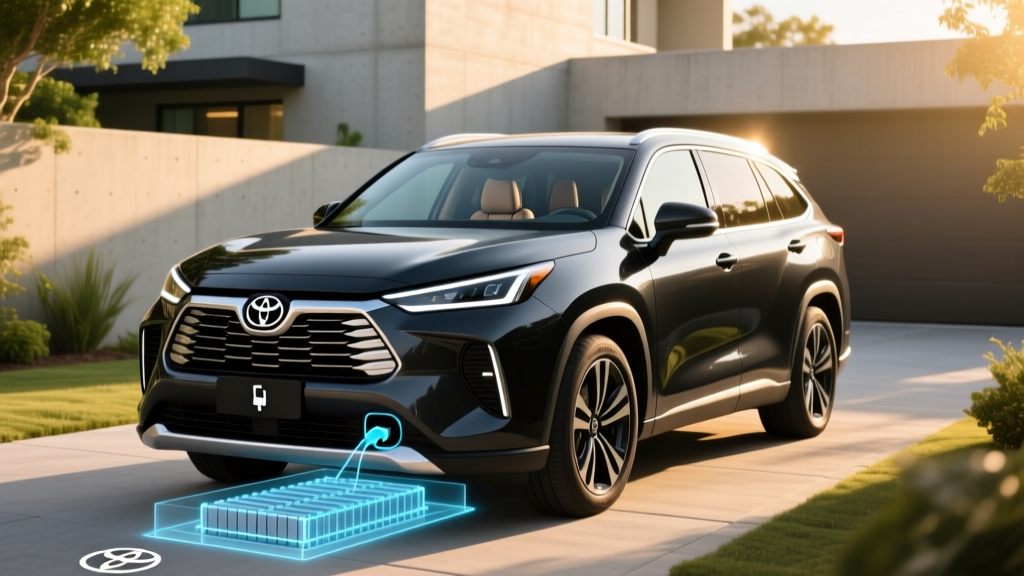
Status update (Q1 2026): The Toyota Highlander BEV was officially unveiled in late 2025 as a 2026 model-year vehicle. Toyota has confirmed production will begin in the second half of 2026, with deliveries expected by late 2026 or early 2027. The specifications below are based on Toyota's official preliminary data and may be subject to minor revision before customer deliveries begin. We will update this review with final EPA-certified figures once available.
Quick Verdict: Toyota's Three-Row Electric Play
The Highlander BEV marks Toyota's entry into the highly competitive three-row electric SUV segment, a space currently dominated by the Kia EV9, Rivian R1S, and the upcoming electric Honda SUV. Built on Toyota's modular e-TNGA platform and leveraging lessons learned from the bZ4X, the Highlander BEV aims to deliver what Toyota loyalists have been asking for: a practical, family-oriented electric SUV with the brand's trademark reliability and a usable range figure.
With an estimated 320 miles of EPA range, a 100 kWh battery pack, and seating for up to seven, the Highlander BEV is positioned as a mainstream family hauler rather than a luxury statement. Its starting price of approximately $52,000 places it squarely against the Kia EV9 and below the Rivian R1S, though federal tax credit eligibility will depend heavily on battery sourcing and buyer income.
| Spec | Highlander BEV (XLE AWD) |
|---|---|
| EPA Range (est.) | ~320 miles |
| Battery Capacity | 100 kWh (usable ~95 kWh), NMC chemistry |
| Peak DC Fast Charge | ~200 kW |
| 10-80% DC Charge Time | ~28 minutes (est.) |
| Level 2 Home Charge Rate | 11.5 kW (~33 mi/hr) |
| 0-60 mph | ~6.0 seconds (AWD) |
| Horsepower | ~340 hp (dual-motor AWD) |
| Drivetrain | Dual-motor AWD standard |
| MPGe (combined, est.) | ~89 MPGe |
| Efficiency | ~36 kWh/100 mi |
| Cargo (behind 3rd row) | ~16 cu ft |
| Cargo (max, seats folded) | ~82 cu ft |
| Starting MSRP | ~$52,000 (LE AWD) |
| Battery Warranty | 8 years / 100,000 miles |
Range and Efficiency: What the EPA Number Means in Practice
Toyota's preliminary EPA estimate for the Highlander BEV AWD is approximately 320 miles on a full charge. For a three-row SUV pushing over 5,000 pounds, that's a competitive figure — it matches the Kia EV9 Long Range AWD (304 miles EPA) and trails only the longest-range configurations in the segment.
The 320-mile EPA figure assumes a mix of city and highway driving at moderate temperatures. Here's what to expect in practice:
- Highway cruising (70-75 mph): Expect ~265-280 miles. Large SUVs suffer disproportionate aero drag at speed, and the Highlander BEV's boxy profile is no exception.
- City/suburban driving: You'll approach or slightly exceed the EPA number, thanks to regenerative braking recapturing energy in stop-and-go traffic.
- Cold weather (below 32°F): Plan for a 20-30% reduction, bringing usable range to ~225-255 miles. Toyota has confirmed a standard heat pump, which mitigates cabin-heating energy draw but cannot fully offset battery chemistry slowdown in deep cold.
- Towing: Toyota rates the Highlander BEV at 3,500 lbs towing capacity. Expect range to drop by 35-50% when towing near max capacity — plan for 160-200 miles between charges with a trailer.
The 100 kWh battery pack uses NMC (nickel manganese cobalt) chemistry, which offers higher energy density than LFP — necessary to hit 320 miles in a heavy vehicle — but requires more careful state-of-charge management for long-term longevity. Toyota recommends daily charging to 80% for routine use and 100% only before long trips.
Charging Speed: DC Fast and Home Level 2
Charging speed is where the Highlander BEV shows both progress from the bZ4X and room for improvement versus segment leaders.
| Charging Level | Power / Rate | Speed | Notes |
|---|---|---|---|
| Level 1 (120V) | 1.4 kW | ~4 mi/hr | Emergency/trickle only; ~24 hrs for full charge |
| Level 2 (240V, 48A) | 11.5 kW | ~33 mi/hr | Full charge in ~9 hrs; ideal overnight home charging |
| DC Fast Charge (peak) | ~200 kW | 10-80% in ~28 min | Peak rate not sustained; tapers significantly above 60% SoC |
| DC Fast Charge (avg 10-80%) | ~140 kW avg | ~190 miles added in 28 min | Real-world average accounts for charge-curve taper |
The ~200 kW peak DC fast-charging rate is respectable but falls short of the Kia EV9's 236 kW peak and the Hyundai Ioniq 5's 240 kW capability on 800V architecture. Toyota uses a 400V electrical architecture in the Highlander BEV, which limits peak charge rate but keeps costs lower.
Charge-curve reality check: Like all EVs, the Highlander BEV will not sustain 200 kW for the full session. Based on Toyota's preliminary charge-curve data, expect peak rates between 10-40% SoC, with a taper beginning around 50% and a significant slowdown above 80%. If you're road-tripping, plan your stops around the 10-80% window for the fastest sessions — charging from 80-100% can add 20+ minutes for only ~60 miles of range.
The Highlander BEV comes with a NACS (North American Charging Standard) port, giving it native access to Tesla's Supercharger network — currently the largest and most reliable DC fast-charging network in the U.S. with over 25,000 stalls. This is a significant practical advantage for road trips, as noted in Toyota's official electrification materials.
Performance and Drivetrain
Toyota is offering the Highlander BEV exclusively with a dual-motor all-wheel-drive powertrain at launch, producing an estimated 340 horsepower and 325 lb-ft of torque. The 0-60 mph time of approximately 6.0 seconds is adequate for a family SUV — it won't embarrass you at a merge ramp, but it's not trying to be a performance vehicle either.
For context, the Kia EV9 GT-Line AWD hits 60 mph in 5.0 seconds (379 hp), while the base EV9 Light RWD does it in 8.2 seconds with 215 hp. The Highlander BEV splits the difference, offering confident acceleration without the efficiency penalty of the highest-output configurations.
Driving dynamics are tuned for comfort over sportiness. The suspension absorbs road imperfections well, and the low center of gravity (battery pack under the floor) keeps body roll reasonable for a vehicle of this size. Toyota's latest regenerative braking system offers multiple levels of regen, selectable via paddle shifters, but does not offer true one-pedal driving to a full stop — you'll still need the brake pedal at very low speeds.
Interior Space, Cargo, and Technology
The Highlander BEV's wheelbase stretches approximately 4 inches longer than the outgoing gas Highlander, thanks to the skateboard-style EV platform. That translates to meaningful interior gains:
- Third-row legroom: ~33.5 inches (up from ~29 inches in the gas model) — now genuinely usable for adults on short trips
- Second-row legroom: ~40.2 inches, with captain's chairs or a bench available
- Cargo behind third row: ~16 cu ft (enough for a few grocery bags or two small suitcases)
- Cargo behind second row: ~46 cu ft
- Max cargo (all rear seats folded): ~82 cu ft
- Front trunk (frunk): ~3.0 cu ft — enough for a charging cable bag or small soft cooler
On the tech front, the Highlander BEV features Toyota's latest Audio Multimedia system on a 14-inch touchscreen, wireless Apple CarPlay and Android Auto, a 12.3-inch digital instrument cluster, and a standard head-up display. Toyota Safety Sense 3.0 is standard, including adaptive cruise control, lane centering, automatic emergency braking with pedestrian detection, and blind-spot monitoring.
Notable tech limitation: Toyota's driver-assistance system remains a SAE Level 2 system — the driver must remain fully engaged with hands on the wheel and eyes on the road at all times. Unlike GM's Super Cruise or Ford's BlueCruise, Toyota does not yet offer hands-free driving on mapped highways. If hands-free capability is a priority, look at the Ford Explorer EV or GM's three-row offerings.
Toyota Safety Sense 3.0 is an SAE Level 2 driver-assist system. It provides steering and acceleration/braking support but requires constant driver supervision. It is not "self-driving." The driver is legally and practically responsible for the vehicle at all times.
Pricing, Trims, and Federal Tax Credit Eligibility
Toyota has announced three trim levels for the Highlander BEV at launch:
| Trim | MSRP (est.) | Key Features | §30D Credit Eligibility |
|---|---|---|---|
| LE AWD | ~$52,000 | 14" screen, TSS 3.0, heated front seats, 19" wheels | Under MSRP cap — eligible if sourcing/income qualify |
| XLE AWD | ~$57,500 | SofTex seats, panoramic roof, 20" wheels, power liftgate | Under MSRP cap — eligible if sourcing/income qualify |
| Limited AWD | ~$63,000 | Nappa leather, ventilated seats, 360° camera, JBL audio | Over $80,000 SUV cap? No — under cap. Eligible if sourcing/income qualify |
Federal tax credit breakdown (IRS §30D, 2026 rules): The Highlander BEV's eligibility for the up-to-$7,500 federal tax credit hinges on three factors that buyers must verify:
- MSRP cap: SUVs must be priced at or below $80,000. All three Highlander BEV trims clear this threshold.
- Buyer income cap: Modified adjusted gross income must not exceed $150,000 (single), $225,000 (head of household), or $300,000 (married filing jointly).
- Battery sourcing requirements: The credit is split into two halves — $3,750 for critical minerals sourcing and $3,750 for battery component manufacturing. Toyota has not yet confirmed full details on the Highlander BEV's battery supply chain. The bZ4X initially qualified for only $3,750 (half credit) due to Japanese-sourced components. Toyota has stated it is working to increase North American battery sourcing, but buyers should verify current eligibility on fueleconomy.gov before purchasing.
As of early 2026, the point-of-sale transfer option is available, meaning qualifying buyers can apply the credit directly at the dealership to reduce the purchase price rather than waiting for a tax refund. Consult a tax professional and check the latest rules at IRS.gov before committing.
Ownership Costs, Warranty, and Longevity
Toyota backs the Highlander BEV with its standard EV warranty package:
- Battery warranty: 8 years / 100,000 miles (covers defects and capacity loss below 70% of original capacity)
- Powertrain warranty: 5 years / 60,000 miles
- Bumper-to-bumper: 3 years / 36,000 miles
- Complimentary maintenance: 2 years / 25,000 miles
The 70% capacity retention threshold over 8 years is industry-standard, matching Ford, Hyundai, and Kia. However, it trails the 8-year/unlimited-mile warranties offered by Rivian and Tesla. For high-mileage drivers, this is a meaningful distinction.
Estimated 5-year total cost of ownership for the Highlander BEV XLE (15,000 miles/year, national average electricity rate of $0.16/kWh):
- Electricity cost: ~$4,860 (at 36 kWh/100 mi)
- Comparable gas Highlander (24 MPG combined, $3.50/gal): ~$10,940 in fuel
- Fuel savings over 5 years: ~$6,080
- Insurance: Expect a 10-20% premium over the gas Highlander, per industry averages — roughly $600-$1,200 more over 5 years
- Maintenance savings: EVs eliminate oil changes, spark plugs, and transmission fluid. Estimate ~$1,500-$2,000 savings over 5 years
How It Stacks Up Against Key Competitors
The three-row EV SUV segment is small but growing. Here's how the Highlander BEV compares to its most direct rivals:
| Spec | Toyota Highlander BEV | Kia EV9 (AWD LR) | Rivian R1S (Dual AWD) |
|---|---|---|---|
| EPA Range | ~320 mi | 280 mi (AWD LR) | 352 mi (Max Pack) |
| Battery | 100 kWh NMC | 99.8 kWh NMC | 149 kWh NMC (Max) |
| Peak DC Charge | ~200 kW | 236 kW | 220 kW |
| 10-80% Time | ~28 min | ~24 min | ~30 min (Max) |
| 0-60 mph | ~6.0 sec | 5.0 sec (GT-Line) | 5.0 sec |
| Starting MSRP | ~$52,000 | ~$59,900 | ~$79,900 |
| Third Row | Standard | Standard | Standard |
| NACS Port | Yes (native) | Adapter required | Adapter required |
Choose the Highlander BEV if: You prioritize value (lowest starting MSRP in the segment), want native Supercharger access without adapters, trust Toyota's long-term reliability track record, and don't need the fastest DC charging or the longest possible range.
Choose the Kia EV9 if: You want faster DC charging, more aggressive styling, a slightly more premium interior feel, and don't mind paying ~$8,000 more or using a Supercharger adapter.
Choose the Rivian R1S if: Budget is flexible, you need serious off-road capability, want the longest available range (Max Pack), or value Rivian's software and OTA update cadence.
- Competitive ~320-mile EPA range for a 3-row SUV
- Lowest starting MSRP in the segment (~$52,000)
- Native NACS port — no adapter needed for Superchargers
- Toyota reliability reputation and dealer network
- Standard heat pump for cold-weather efficiency
- Usable third row (improved over gas Highlander)
- DC charging speed trails Kia EV9 and 800V competitors
- No hands-free highway driving assist (unlike BlueCruise/Super Cruise)
- Battery sourcing may limit tax credit to $3,750 (half credit)
- Limited frunk space (~3 cu ft)
- 400V architecture may age poorly as 800V becomes standard
- Not yet available — deliveries not expected until late 2026 or early 2027
Who Should Buy the Highlander BEV?
The Highlander BEV is best suited for families who need three rows, have home charging access, and want a mainstream-priced EV from a brand they trust. It's ideal for suburban commuters who take occasional road trips (Supercharger access makes this viable) and don't need the fastest possible charging or cutting-edge autonomous features.
It's not the best fit for buyers who need maximum range for frequent long-distance travel (consider the Rivian R1S Max Pack), who want hands-free highway driving (look at GM or Ford), or who need serious towing capacity (the 3,500-lb rating is modest for the class).
Frequently Asked Questions
What is the real-world range of the Toyota Highlander BEV?
Toyota estimates approximately 320 miles EPA. In real-world highway driving at 70-75 mph, expect ~265-280 miles. In cold weather (below freezing), plan for ~225-255 miles. City driving with regenerative braking should get you close to or slightly above the EPA figure.
How fast does the Highlander BEV charge at home and on the road?
At home on a Level 2 (240V, 48A) charger, it adds about 33 miles per hour and fully charges in roughly 9 hours. On DC fast chargers, it peaks at approximately 200 kW, charging from 10-80% in about 28 minutes — though the charge curve tapers above 60%, so the average session rate is closer to 140 kW.
Does the Highlander BEV qualify for the $7,500 federal EV tax credit?
It depends. All trims fall under the $80,000 SUV MSRP cap. However, buyer income limits apply ($150K single / $300K married), and battery sourcing requirements determine whether you receive the full $7,500 or only $3,750 (half credit). Toyota has not confirmed full North American battery sourcing for the Highlander BEV. Always check fueleconomy.gov for the latest eligibility data before purchasing.
Is the Highlander BEV worth buying over the Kia EV9?
If price is the primary factor, yes — the Highlander BEV starts roughly $8,000 lower and includes native NACS/Supercharger access. If you prioritize faster DC charging (the EV9 peaks at 236 kW vs. ~200 kW), a more premium interior, or hands-free driving capability, the EV9 or a GM/Ford alternative may serve you better.
When will the Highlander BEV actually be available to buy?
Toyota has confirmed production begins in the second half of 2026, with initial deliveries expected in late 2026 or early 2027. Reservations are not yet open as of this writing. Check Toyota's official site for updates.
What battery chemistry does the Highlander BEV use?
The Highlander BEV uses an NMC (nickel manganese cobalt) lithium-ion battery with approximately 100 kWh of total capacity (~95 kWh usable). NMC offers higher energy density than LFP, which is necessary to achieve 320 miles in a heavy three-row SUV, but Toyota recommends limiting daily charges to 80% for optimal long-term battery health.