The Short Answer
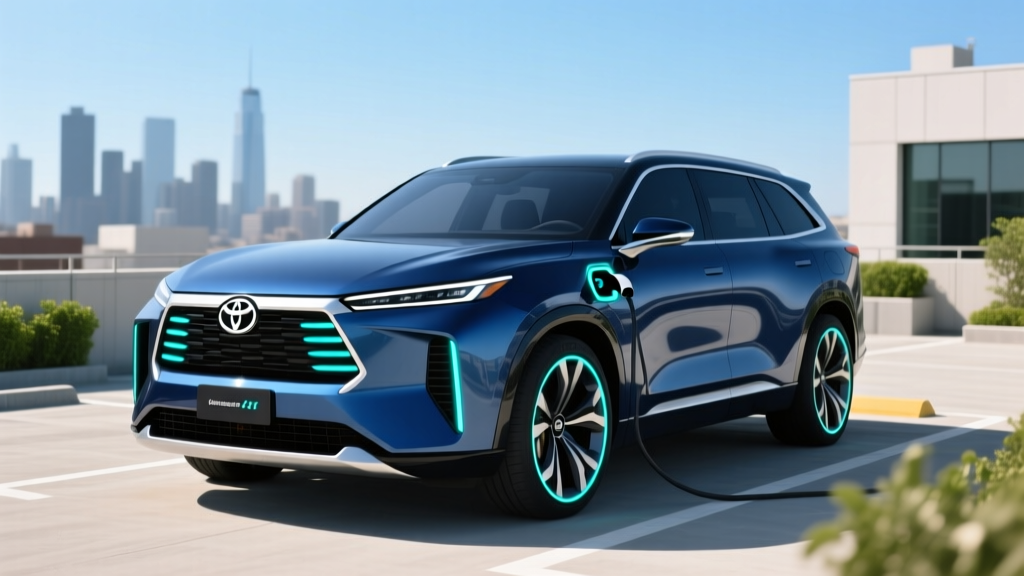
There is no fully electric Toyota Grand Highlander as of the 2026 model year. Toyota continues to offer the Grand Highlander exclusively as a conventional hybrid (HEV) and a Hybrid MAX powertrain — both of which are gas-electric hybrids that do not plug in. If you're searching for a Toyota Grand Highlander electric SUV that charges from a wall outlet or runs on batteries alone, it does not currently exist and has not been officially announced by Toyota.
Below, we break down what Toyota does offer, how the hybrid powertrains compare to true EVs and plug-in hybrids on cost and efficiency, and which three-row electric SUVs actually fill the gap the Grand Highlander would occupy if it went fully electric.
Why Toyota Hasn't Built an Electric Grand Highlander (Yet)
Toyota's electrification strategy in 2026 remains diversified across hybrids, plug-in hybrids, hydrogen fuel cells, and a growing but still limited battery-electric lineup. The Grand Highlander, introduced for the 2024 model year, was engineered on Toyota's TNGA-K platform — the same architecture underpinning the Highlander, Camry, and RAV4. This platform supports hybrid powertrains natively but was not designed as a dedicated EV skateboard.
Toyota's dedicated EV platform, e-TNGA, currently underpins the bZ4X crossover — a compact two-row vehicle with an EPA-estimated 252 miles of range and a 72.8 kWh battery. Scaling that architecture to a three-row, body-on-frame-style family hauler the size of the Grand Highlander (roughly 199 inches long, 4,600+ lbs) would require significant re-engineering. Toyota has announced plans for a next-generation e-TNGA platform with improved energy density and faster charging, but no three-row SUV has been confirmed on it.
The practical result: if you want a Toyota-badged, three-row electrified SUV in 2026, the Grand Highlander Hybrid is your only option. It's efficient — but it is not an EV.
Grand Highlander Hybrid: The Actual Powertrain Lineup
Before comparing alternatives, let's establish what the Grand Highlander actually offers. The 2026 model carries over two powertrains:
| Spec | Hybrid (HEV) | Hybrid MAX |
|---|---|---|
| Powertrain | 2.5L I4 + 2 electric motors (AWD) | 2.4L turbo I4 + electric motor (AWD) |
| Combined HP | 245 hp | 362 hp |
| EPA Combined MPG | ~36 MPG | ~27 MPG |
| Plug-in capable? | No | No |
| Electric-only driving? | Low-speed, very short distance | No |
| 0-60 mph | ~7.6 sec | ~5.6 sec |
| Towing capacity | 3,500 lbs | 5,000 lbs |
| Base MSRP (2026 est.) | ~$45,000 | ~$54,000 |
Neither variant qualifies for the federal §30D EV tax credit, as both are conventional hybrids without plug-in capability. Per IRS guidelines, only plug-in electric vehicles (BEVs and PHEVs meeting battery-capacity and sourcing requirements) are eligible.
Grand Highlander Hybrid vs. True Three-Row EVs: Cost and Efficiency
If you were hoping for an electric Grand Highlander, you're likely weighing fuel savings, environmental impact, or the desire to eliminate gas-station visits. Here's how the Grand Highlander Hybrid stacks up against the closest three-row EVs available in 2026:
| Vehicle | Type | EPA Range / MPG | Est. Annual Fuel Cost* | Base MSRP |
|---|---|---|---|---|
| Toyota Grand Highlander Hybrid | HEV | 36 MPG combined | ~$1,900 | ~$45,000 |
| Kia EV9 (LR AWD) | BEV | 280 mi range / 89 MPGe | ~$720 | ~$56,000 |
| Hyundai Ioniq 9 (est.) | BEV | ~300 mi range (prelim.) | ~$680 | ~$55,000 (est.) |
| Tesla Model X (LR) | BEV | 335 mi range / 102 MPGe | ~$640 | ~$82,000 |
| Mazda CX-90 PHEV | PHEV | 26 mi elec. / 25 MPG | ~$1,400 | ~$51,000 |
*Annual fuel cost estimates based on 15,000 miles/year, $3.50/gal gas, and $0.16/kWh national average electricity rate. Actual costs vary significantly by region, utility rate, and driving mix. Source: fueleconomy.gov methodology.
Real-World Ownership: What a Grand Highlander Hybrid Buyer Should Know
Since the "Toyota Grand Highlander electric" doesn't exist, let's address what ownership actually looks like with the hybrid — and what would change if you chose a three-row EV instead.
Home Charging (EVs Only)
If you opt for a Kia EV9 or Tesla Model X instead, home charging access becomes the single biggest ownership variable. A Level 2 home charger (240V, 40-48 amps) adds roughly 25-35 miles of range per hour of charging — enough to replenish any three-row SUV overnight. Installation typically runs $800-$2,500 for the equipment and electrician, assuming your electrical panel has capacity. Homes with older 100-amp panels may need a $2,000-$4,000 panel upgrade.
The Grand Highlander Hybrid eliminates this concern entirely: no plug, no charger, no electrical work.
Cold-Weather Impact
EVs lose 20-35% of their EPA-estimated range in sustained sub-freezing temperatures due to battery chemistry and cabin heating demands. A Kia EV9 rated at 280 miles may deliver 185-225 miles in a Midwest winter. The Grand Highlander Hybrid's MPG drops modestly in cold weather (typically 2-4 MPG) but doesn't face the same dramatic range reduction. If you live in northern climates and can't charge at home, the hybrid's predictability is a genuine advantage.
Maintenance Costs
The hybrid still has an internal combustion engine, meaning oil changes (every 10,000 miles), air filters, spark plugs (at 100,000+ miles), and eventual exhaust system service. Toyota's hybrid system is proven — the hybrid battery carries a 10-year/150,000-mile warranty — but it's not maintenance-free. EVs eliminate oil, filters, spark plugs, and most brake wear (thanks to regenerative braking), though tire wear is typically 15-20% higher due to vehicle weight.
5-Year Cost Breakdown: Grand Highlander Hybrid vs. Kia EV9
| Cost Category | Grand Highlander Hybrid | Kia EV9 LR AWD |
|---|---|---|
| Purchase price (base MSRP) | $45,000 | $56,000 |
| Federal tax credit (§30D) | $0 (not eligible) | Up to $7,500 (eligibility varies) |
| Fuel / electricity (5 yrs) | $9,500 | $3,600 |
| Home charger install | $0 | $1,500 (avg.) |
| Maintenance (5 yrs) | $2,800 | $1,200 |
| Insurance (5 yrs, est.) | $8,500 | $9,800 |
| Estimated 5-yr total | $65,800 | $64,600 |
Assumes full §30D credit eligibility for EV9 (subject to income caps, MSRP limits, battery sourcing requirements per IRS §30D — verify at irs.gov). Insurance estimates are national averages; EV premiums are typically 15-25% higher. Electricity cost based on $0.16/kWh home charging; public DC fast charging is 2-3x more expensive per kWh.
Common Misconceptions About a "Toyota Grand Highlander Electric"
| Myth | Fact |
|---|---|
| "The Grand Highlander Hybrid is an electric SUV." | It's a gas-electric hybrid. It has no plug, no electric-only range to speak of, and uses gasoline for all sustained driving. |
| "Toyota makes a plug-in Grand Highlander." | No. Toyota offers the RAV4 Prime and Prius Prime as PHEVs, but no three-row PHEV under the Toyota brand. The Mazda CX-90 PHEV is the closest plug-in alternative in this segment. |
| "Hybrids qualify for the $7,500 EV tax credit." | Conventional HEVs (like the Grand Highlander Hybrid) do not qualify. Only BEVs and PHEVs with sufficient battery capacity and compliant battery sourcing may qualify under §30D. |
| "An electric three-row SUV can't tow as much." | The Tesla Model X tows up to 5,000 lbs; the Kia EV9 tows up to 4,500 lbs. The Grand Highlander Hybrid MAX tows 5,000 lbs — comparable, though towing cuts EV range by 30-50%. |
| "I'll have to wait for Toyota to release an electric version." | No announced timeline exists. If you need a three-row EV now, alternatives from Kia, Hyundai, Tesla, and Rivian are available today. |
Decision Framework: What Should You Actually Buy?
Choose the Toyota Grand Highlander Hybrid if:
- You can't install a Level 2 charger at home (apartment, no garage, older panel)
- You frequently drive 400+ miles in a single day through areas with sparse charging infrastructure
- You live in a cold climate where EV range loss is a practical concern
- You want Toyota's dealer network, proven hybrid reliability, and lower upfront cost
- Towing 5,000 lbs without range anxiety is a priority (Hybrid MAX trim)
Choose a three-row EV (Kia EV9, Tesla Model X) if:
- You have reliable home Level 2 charging and a daily commute under 80 miles
- You want to eliminate gas-station visits and reduce per-mile fuel cost by 60%+
- You qualify for the §30D tax credit (income under $150K single / $300K joint, vehicle MSRP under $80K for SUVs)
- You value instant torque, one-pedal driving, and near-silent operation
- You want to minimize routine maintenance (no oil changes, fewer brake replacements)
Choose a PHEV (Mazda CX-90 PHEV) if:
- You want 26 miles of electric-only driving for school runs and errands, with gas backup for road trips
- You can charge at home but aren't ready to commit to a full EV
- You want potential §30D eligibility (verify sourcing and income requirements)
Frequently Asked Questions
Will Toyota ever make an all-electric Grand Highlander?
Toyota has not announced an electric Grand Highlander. The company has committed to expanding its BEV lineup to 30 models globally by 2030, and a three-row electric SUV is a logical future product for the North American market. However, no timeline, platform, or specifications have been confirmed. Any specs circulating online are speculative.
Does the Grand Highlander Hybrid charge its battery while driving?
Yes — like all conventional hybrids, the Grand Highlander Hybrid recharges its small battery pack through regenerative braking and the gasoline engine. You never plug it in. This is fundamentally different from a BEV (which requires external charging) or a PHEV (which can be plugged in for electric-only range).
What three-row EV is closest to the Grand Highlander in size and price?
The Kia EV9 is the closest match: three rows of seating, similar cargo capacity (~82 cu ft max vs. ~97 cu ft for the Grand Highlander), and a starting price in the mid-$50,000s. The EV9 is roughly 7 inches shorter overall but offers comparable third-row usability. With the §30D tax credit (if eligible), the EV9's effective price drops closer to the Grand Highlander Hybrid's MSRP.
Is the Grand Highlander Hybrid better than a gas-only Highlander?
On efficiency, yes. The Grand Highlander Hybrid's ~36 MPG combined represents a roughly 50% improvement over the non-hybrid Grand Highlander's ~24 MPG combined. Over 75,000 miles, that translates to approximately $3,800 in fuel savings (at $3.50/gallon), which more than offsets the hybrid's typical $2,000-$3,000 price premium over the gas-only model.
Can I convert a Grand Highlander to electric?
No practical or certified conversion exists. EV conversions of modern vehicles are complex, void all factory warranties, and are not street-legal in most jurisdictions without extensive re-certification. If you want an electric three-row SUV, purchasing a factory BEV is the only viable path.