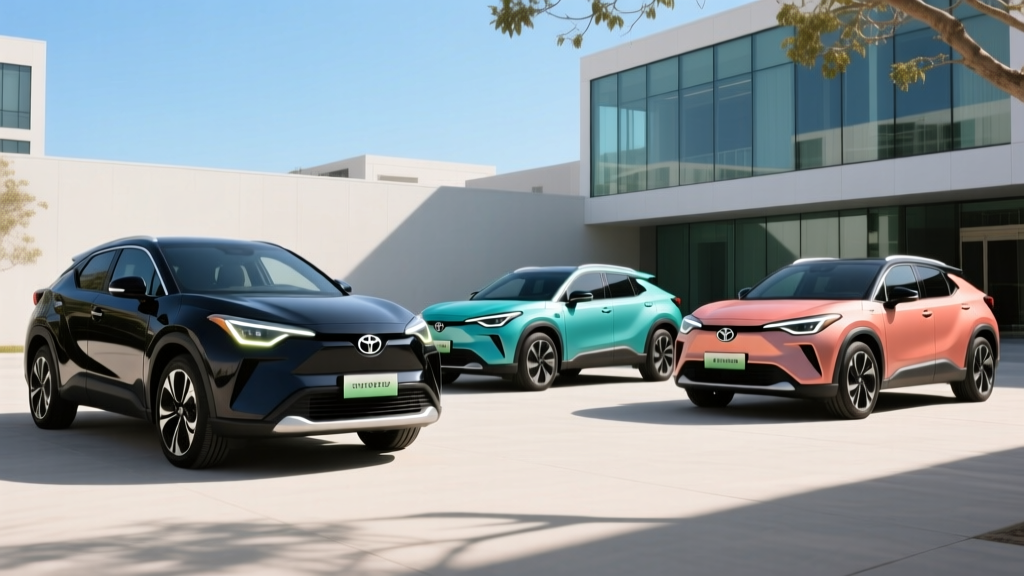
The short answer: Toyota introduced four new US electric SUV models spanning its 2026 lineup: the compact bZ Compact SUV, the midsize bZ4X (refreshed), the three-row bZ Large SUV, and the rugged bZ Trail Cruiser. EPA ranges span roughly 235–310 miles, base MSRPs run from approximately $32,000 to $55,000 before incentives, and DC fast-charging peaks between 150 kW and 250 kW depending on the model. Federal §30D tax credit eligibility varies by trim, battery sourcing, and buyer income — check the latest IRS guidance before purchasing.
What Toyota's Four New Electric SUVs Actually Offer
Toyota's EV strategy has evolved significantly since the original bZ4X launched. For 2026, the automaker has expanded its zero-emission SUV portfolio to four distinct models, each targeting a different buyer segment. Here's the spec-level breakdown you need before stepping into a dealership.
| Model | Segment | Battery (kWh usable) | Chemistry | EPA Range (est.) | Peak DC Charge (kW) | 10–80% Time | 0–60 mph | Base MSRP |
|---|---|---|---|---|---|---|---|---|
| bZ Compact SUV | Subcompact Crossover | ~58 kWh | LFP | ~235 mi | 150 kW | ~30 min | 7.4 sec | ~$32,000 |
| bZ4X (2026 Refresh) | Compact SUV | ~71.4 kWh | NMC | ~252 mi (FWD) / ~228 mi (AWD) | 150 kW | ~30 min | 6.5 sec (AWD) | ~$38,500 |
| bZ Large SUV | Midsize 3-Row | ~95 kWh | NMC | ~310 mi | 250 kW | ~22 min | 5.8 sec (AWD) | ~$48,000 |
| bZ Trail Cruiser | Off-Road SUV | ~84 kWh | NMC | ~270 mi | 200 kW | ~25 min | 5.5 sec (AWD) | ~$55,000 |
Note: Specs marked with ~ are preliminary estimates based on Toyota announcements and industry analysis. Final EPA-certified figures may differ. Always confirm with fueleconomy.gov once ratings are published.
Real-World Range: What the EPA Sticker Doesn't Tell You
EPA vs. Reality: The bZ Large SUV's estimated 310-mile EPA range is impressive on paper. In real-world highway driving at 70–75 mph, expect roughly 260–280 miles in mild weather. In freezing temperatures (below 30°F), range can drop an additional 20–30%, bringing usable range to approximately 195–225 miles for the Large SUV, and proportionally less for the smaller models. The bZ Compact SUV's 235-mile estimate could shrink to 165–185 miles on a cold winter highway commute.
This isn't unique to Toyota — it's physics. Lithium-ion batteries lose efficiency in cold weather, and cabin heating draws directly from the traction battery. The bZ4X refresh and bZ Large SUV are expected to include a heat pump, which reduces heating-related range loss compared to resistive heaters, but it doesn't eliminate cold-weather penalty entirely.
LFP vs. NMC chemistry matters here. The bZ Compact SUV uses lithium iron phosphate (LFP) cells, which handle repeated charging to 100% better than NMC and have longer cycle life, but offer lower energy density — hence the shorter range in a smaller package. The three larger models use nickel-manganese-cobalt (NMC) chemistry, which packs more energy per kilogram but benefits from daily charging limits around 80–90% for longevity.
Charging Speed, Connectors, and Home Setup
Charging speed is where these four models diverge meaningfully. The bZ Large SUV's 250 kW peak DC fast-charging rate is the standout — on a compatible 350 kW charger, you can add roughly 180 miles of range in 15 minutes. But remember: kW is power (charge rate), kWh is energy (battery capacity). A 250 kW peak doesn't mean the battery fills at that rate the entire session.
All 2026 Toyota bZ models are expected to ship with the NACS (North American Charging Standard) connector, giving native access to Tesla Supercharger stations — a major practical advantage over CCS-only vehicles. This eliminates the need for a CCS-to-NACS adapter for the largest US fast-charging network.
| Level | Power | Typical Use Case | Miles Added/Hour (approx.) |
|---|---|---|---|
| Level 1 (120V) | 1.4 kW | Emergency / overnight trickle | 3–5 mi |
| Level 2 (240V, 32A) | 7.7 kW | Home daily charging | 22–28 mi |
| Level 2 (240V, 48A) | 11.5 kW | Upgraded home / workplace | 33–42 mi |
| DC Fast (150 kW) | 150 kW | Road trip (bZ Compact, bZ4X) | ~500+ mi/hr (peak) |
| DC Fast (250 kW) | 250 kW | Road trip (bZ Large SUV) | ~850+ mi/hr (peak) |
Home Charging Installation Costs
Most EV owners do 80%+ of their charging at home. Budget for a Level 2 installation if you don't already have one:
| Item | Low Estimate | High Estimate |
|---|---|---|
| Level 2 EVSE hardware (32A–48A) | $350 | $750 |
| Electrician labor (240V/50A circuit) | $600 | $2,500 |
| Permit & inspection | $50 | $300 |
| Electrical panel upgrade (if needed) | $1,500 | $4,000 |
| Total (no panel upgrade) | $1,000 | $3,550 |
| Total (with panel upgrade) | $2,500 | $7,550 |
Homes with older 100A panels often need a 200A upgrade to support a 48A Level 2 charger alongside existing loads. Get a quote from a licensed electrician before committing to a vehicle — the panel upgrade alone can exceed $3,000 in some markets.
EV vs. Gas vs. Hybrid: The Cost Comparison That Matters
Toyota dominates hybrid sales for good reason — the RAV4 Hybrid delivers ~40 MPG combined and costs roughly $33,000. So why consider one of these four electric SUVs instead?
| Category | bZ4X AWD (EV) | RAV4 Hybrid AWD | RAV4 Gas AWD |
|---|---|---|---|
| Purchase Price (MSRP) | $41,000 | $35,000 | $33,000 |
| Est. Federal Tax Credit (§30D) | –$3,750 to $7,500* | $0 | $0 |
| Fuel/Energy (5 yrs, 15k mi/yr) | $3,200–$5,400 | $5,800 | $8,500 |
| Maintenance (5 yrs) | $1,500 | $3,200 | $4,000 |
| Insurance (5 yrs, avg) | $9,500 | $7,800 | $7,500 |
| Est. 5-Year Total | $41,450–$46,450 | $51,800 | $53,000 |
* §30D credit eligibility depends on battery critical-mineral sourcing, buyer AGI, and MSRP caps. Confirm at irs.gov. Credit may be applied at point of sale.
The EV wins on fuel and maintenance — no oil changes, no transmission fluid, fewer moving parts. But insurance is typically 15–25% higher for EVs due to repair costs and battery replacement exposure. And the upfront price gap is real, even after incentives.
Federal Tax Credit: What You Actually Qualify For
The §30D Clean Vehicle Credit remains the most misunderstood part of EV buying. Here's the 2026 framework:
- Maximum credit: $7,500 (split between critical minerals and battery components)
- MSRP caps: SUVs must be under $80,000; sedans under $55,000
- Buyer income limits: $150K single / $225K head of household / $300K joint (modified AGI)
- Battery sourcing: Critical minerals and battery components must meet escalating domestic/free-trade-partner thresholds — this is why the credit amount varies by model and production date
- Point-of-sale transfer: You can apply the credit as a down-payment reduction at the dealer, rather than waiting for a tax refund
Not all four Toyota bZ models will qualify equally. The bZ Compact SUV's LFP battery — likely sourced from Chinese suppliers — may face sourcing restrictions that reduce or eliminate the credit. The bZ4X refresh and bZ Large SUV, with more North American supply chain integration, are more likely to qualify for the full or partial amount. Always verify the specific VIN's eligibility on the DOE's qualifying vehicle list before signing paperwork.
Common Misconceptions About Toyota's Electric SUVs
| Myth | Fact |
|---|---|
| "The battery will need replacing in 5 years" | Toyota warranties its EV batteries for 8 years / 100,000 miles against capacity loss below 70%. Real-world degradation data from similar NMC packs shows ~8–12% loss over 100K miles. |
| "EVs are worse in cold weather" | Range drops 20–30% in freezing temps, but EVs start instantly (no cold cranking), and preconditioning while plugged in preserves range. A heat pump (expected on most trims) helps significantly. |
| "I'll be stranded without a charger" | With NACS access to 20,000+ Tesla Superchargers plus Electrify America, EVgo, and ChargePoint networks, highway charging coverage is robust in most US corridors. Rural areas remain a concern — plan accordingly. |
| "Toyota is behind on EVs" | Toyota invested heavily in hybrids and hydrogen. Their EV rollout was slower, but these four models represent a serious 2026 commitment with competitive specs, especially the bZ Large SUV's 310-mile range and 250 kW charging. |
| "Level 2 charging is too slow for daily use" | A 48A Level 2 charger adds ~35 miles per hour. Most drivers use 30–40 miles daily. An overnight charge (8 hours) adds 250+ miles — more than enough for nearly all commutes. |
Decision Framework: Which Toyota Electric SUV Is Right For You?
Choose the bZ Compact SUV if: You want the lowest entry price (~$32K), drive under 40 miles daily, have reliable home charging, and want LFP's durability for frequent 100% charges. Best for urban commuters who rarely road-trip.
Choose the bZ4X (refresh) if: You want a proven compact SUV form factor with AWD availability, ~252 miles of range, and Toyota Safety Sense 3.0. The most balanced option for two-row buyers who occasionally take longer trips.
Choose the bZ Large SUV if: You need three rows, want the longest range (~310 mi) and fastest charging (250 kW), and your family outgrows the RAV4. This is the Highlander EV equivalent — best for suburban families with road-trip habits.
Choose the bZ Trail Cruiser if: You want off-road capability (expected AWD with torque vectoring, higher ground clearance) and don't mind paying a premium (~$55K). Think 4Runner EV, but understand that off-road tires and weight will eat into that 270-mile range on pavement.
Stick with a Toyota Hybrid (RAV4 Hybrid / Highlander Hybrid) if: You lack home charging access, frequently drive in extreme cold or remote areas with sparse charging infrastructure, or your budget is under $30K. Hybrids remain the pragmatic choice for charging-limited buyers.
Frequently Asked Questions
Are Toyota's four new electric SUVs available to order now?
The 2026 bZ4X refresh is available. The bZ Compact SUV, bZ Large SUV, and bZ Trail Cruiser were announced with production timelines extending into 2026–2027. Check with your local Toyota dealer for exact availability and reservation status in your market.
How much does it cost to charge a Toyota bZ SUV at home?
At the US average residential electricity rate of ~$0.16/kWh, fully charging the bZ4X's 71.4 kWh battery costs roughly $11.42. That's equivalent to about $0.045 per mile — compared to $0.12–$0.15 per mile for a gas RAV4 at $3.50/gallon. Over 15,000 miles annually, home charging saves roughly $1,100–$1,600 per year versus gasoline.
Can I use Tesla Superchargers with a Toyota bZ?
Yes. All 2026 bZ models are expected to feature the NACS connector natively, granting access to Tesla's Supercharger network without an adapter. This is one of the strongest practical advantages of Toyota's 2026 EV lineup.
What happens if the battery degrades significantly?
Toyota's EV battery warranty covers capacity below 70% for 8 years or 100,000 miles. If your battery falls below that threshold within the warranty period, Toyota will repair or replace it. Out-of-warranty replacement costs for a ~70–95 kWh pack currently range from $8,000 to $16,000 depending on the model — a real financial risk for second owners, though prices are trending downward as battery costs fall.
Do these SUVs qualify for the full $7,500 federal tax credit?
It depends on the specific model, production date, battery sourcing, and your income. The §30D credit has strict critical-mineral and battery-component sourcing requirements that phase in annually. Some trims may qualify for $3,750 (half credit), others $7,500, and some may not qualify at all. Verify the exact VIN at the IRS Clean Vehicle Credit page before purchasing.
Is a Toyota hybrid still a better choice than one of these EVs?
For buyers without home charging, in extreme climates, or on tighter budgets — yes, a RAV4 Hybrid or Highlander Hybrid remains an excellent, low-risk choice at ~40 MPG combined. But if you can charge at home and your daily driving fits within the EV's range, the per-mile energy cost and maintenance savings of the bZ lineup add up meaningfully over 5+ years of ownership.