The Short Answer on Toyota's First Electric Hilux
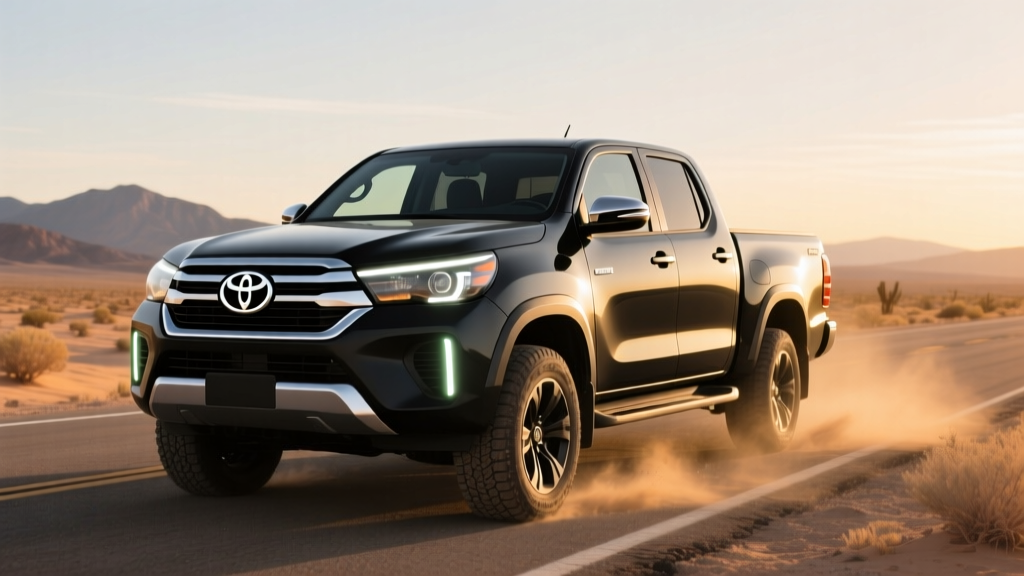
As of early 2026, Toyota has not yet released a production electric Hilux. The company has confirmed it is developing a battery-electric version of the Hilux pickup, with a concept shown in late 2023 and prototype testing underway. Toyota has not published final EPA range, battery capacity, pricing, or a firm on-sale date for the U.S. market. What we do know is that the electric Hilux will likely use a body-on-frame architecture shared with Toyota's broader EV truck platform, target a range in the 250–300 mile EPA window, and compete with mid-size electric pickups like the Ford Maverick EV (expected) and the Rivian R1T. The gas Hilux is not sold new in the U.S. (the Tacoma fills that role), so any U.S. launch would represent an entirely new product line. If you're researching Toyota's first electric Hilux from outside the U.S. — particularly in Australia, Southeast Asia, or Europe — a production reveal is widely expected before the end of 2026, with deliveries starting in 2027.
Why Toyota's First Electric Hilux Matters Now
Toyota has been cautious on full battery-electric vehicles, investing heavily in hybrids and hydrogen. That strategy is shifting. The company's multi-pathway electrification plan now includes a growing lineup of BEVs built on its dedicated EV platform. A Hilux EV fills a critical gap: the Hilux is the world's best-selling mid-size pickup, dominant in markets from Thailand to South Africa to Australia. Electrifying it signals Toyota's intent to defend that territory against incoming Chinese EV trucks (BYD Shark, MG T60 EV) and established Western competitors expanding into the segment.
For buyers, the question isn't whether an electric Hilux is coming — it's whether it will fit your use case when it arrives. Let's break down the knowns, the likely specs based on Toyota's EV architecture, and the real ownership math.
Projected Specs: Battery, Range, and Charging
Toyota has not published final specifications. The figures below are estimates based on Toyota's current EV platform capabilities (as seen in the bZ4X and Land Cruiser SE concept), the competitive landscape, and supply-chain reporting. Treat them as informed projections, not confirmed data.
| Spec | Estimated Figure | Notes |
|---|---|---|
| Battery Capacity (usable) | ~80–95 kWh | Likely NMC chemistry for energy density in a truck application |
| EPA Range (est.) | 250–310 miles | Depends on drivetrain (RWD vs AWD), cab config, and weight |
| Real-World Highway Range | ~210–260 miles | Expect 15–20% reduction at sustained 70+ mph highway speeds |
| Cold-Weather Range (20°F) | ~180–230 miles | Without heat pump preconditioning; ~25–30% loss typical |
| Peak DC Fast Charge Rate | ~150–180 kW | Toyota's current platform peaks around 150 kW; next-gen may improve |
| 10–80% DC Charge Time (est.) | ~30–40 minutes | Charge curve taper above 80% will extend session time |
| Level 2 AC Charge Rate | ~7.2–11 kW | Full charge overnight on a 48-amp home Level 2 unit |
| Towing Capacity (est.) | ~5,000–7,500 lbs | Electric trucks lose 25–40% range when towing near max capacity |
| Payload (est.) | ~1,400–1,800 lbs | Battery weight reduces payload vs gas equivalent |
| Drivetrain | Dual-motor AWD likely | Single-motor RWD possible for fleet/commercial trims |
| 0–60 mph (est.) | ~5.5–7.0 seconds | Electric torque advantage over gas Hilux (~7.5–9 sec) |
A few things to watch when Toyota publishes official numbers: the usable kWh figure (not total — manufacturers reserve a buffer to protect battery longevity), the sustained charge rate (peak kW only holds for a portion of the session), and whether a heat pump is standard or optional. Heat pumps significantly reduce cold-weather range loss, and Toyota has been inconsistent about including them across its EV lineup.
Electric Hilux vs. Gas Hilux vs. Hybrid Tacoma: The Cost Comparison
Since the gas Hilux isn't sold in the U.S., American buyers will naturally compare the electric Hilux to the Toyota Tacoma — available as a conventional gas model and the Tacoma i-FORCE MAX hybrid. In international markets, the direct comparison is the current diesel and gas Hilux.
| Cost Factor | Electric Hilux (est.) | Gas/Diesel Hilux (current) | Tacoma Hybrid (U.S.) |
|---|---|---|---|
| Estimated Base MSRP | $42,000–$52,000 | $30,000–$42,000 (intl. markets vary) | $40,940–$52,000 (2025 SR5–TRD) |
| Federal Tax Credit (U.S.) | $0–$7,500 (see eligibility below) | $0 | $0 (hybrid doesn't qualify for §30D) |
| Fuel/Energy Cost (5 yr / 75,000 mi) | $3,000–$5,500 (home charging) | $9,000–$12,000 (diesel/gas) | $7,500–$9,500 |
| Maintenance (5 yr) | $1,200–$2,000 | $3,500–$5,000 | $3,000–$4,500 |
| Insurance (5 yr avg.) | $8,000–$11,000 | $6,000–$8,500 | $7,000–$9,500 |
| Estimated Depreciation (5 yr) | 45–55% | 35–45% | 35–45% |
| Approx. 5-Year Total | $52,000–$70,000 | $48,500–$67,500 | $58,000–$75,000 |
Key takeaways: The electric Hilux will almost certainly carry a higher upfront price. The fuel savings are substantial if you charge at home (residential electricity at $0.13–$0.18/kWh is far cheaper per mile than diesel at $4.00+/gallon). But insurance for EVs tends to run 15–25% higher, and EV depreciation has been steeper than gas trucks historically — though this is normalizing as the market matures. If you can charge at home and drive under 250 miles/day, the EV wins on running costs. If you rely on public charging at $0.40–$0.60/kWh, the fuel cost advantage shrinks dramatically.
Federal Tax Credit Eligibility: The §30D Reality Check
If Toyota sells the electric Hilux in the U.S., it will need to meet IRS §30D requirements for buyers to claim up to $7,500. This is not automatic. Here's what determines eligibility:
- MSRP Cap: Pickup trucks must have an MSRP at or below $80,000 to qualify. An electric Hilux should clear this easily based on projected pricing.
- Buyer Income Limits: Modified adjusted gross income (MAGI) must not exceed $150,000 (single), $225,000 (head of household), or $300,000 (joint filers).
- Battery Component Sourcing: A percentage of battery components must be manufactured or assembled in North America. This threshold increases annually. Toyota's supply chain has historically been Asia-heavy, which could limit the credit to $3,750 (critical minerals only) or zero depending on the model year and sourcing agreements.
- Critical Minerals: A percentage of critical minerals must be sourced from the U.S. or free-trade-agreement countries. This also tightens annually.
- Point-of-Sale Transfer: As of 2024, buyers can transfer the credit to the dealer at purchase, reducing the purchase price directly rather than waiting for a tax refund. This applies if the vehicle qualifies.
- Friendly Foreign Entity (FEOC) Restriction: Vehicles with battery components from a "foreign entity of concern" (primarily Chinese suppliers) are disqualified entirely. Toyota will need to demonstrate supply-chain compliance.
Bottom line: Do not assume the electric Hilux will qualify for the full $7,500 credit. Toyota's battery sourcing will determine this, and the rules tighten every year. Consult a tax professional and check the DOE's qualifying vehicle list before purchasing.
Real-World Ownership: What First-Time EV Truck Buyers Must Know
Should You Wait for the Electric Hilux?
Choose the Electric Hilux if:
- You have access to Level 2 home charging (a 240V / 48-amp circuit adds ~25–30 miles of range per hour of charging)
- Your daily driving is under 200 miles round-trip with occasional longer trips
- You live in a moderate climate, or you're willing to accept 25–30% winter range loss
- You want lower running costs and are willing to absorb a higher purchase price
- Towing is occasional, not daily (towing near max capacity can cut range to 150–180 miles)
Stick with Gas/Hybrid (Tacoma or Hilux diesel) if:
- You regularly tow heavy loads over long distances
- You live in a rural area with limited DC fast-charging infrastructure
- You rely on street parking with no home charging option
- You operate in extreme cold (below 0°F) for extended periods
- You need maximum payload and can't sacrifice capacity to battery weight
Home Charging: The Make-or-Break Factor
For any EV truck, home charging is where the economics work. A Level 2 home charger (7.2–11.5 kW) installed on a dedicated 240V circuit can fully recharge a ~90 kWh battery overnight in 8–12 hours. Installation costs vary widely:
| Item | Cost Range |
|---|---|
| Level 2 Charger Unit (hardwired, 48-amp) | $400–$750 |
| Electrician Labor (standard install, short run) | $500–$1,500 |
| Electrical Panel Upgrade (if needed, 100A → 200A) | $1,500–$3,500 |
| Permit & Inspection | $100–$400 |
| Total (no panel upgrade) | $1,000–$2,650 |
| Total (with panel upgrade) | $2,500–$6,150 |
Get a quote from a licensed electrician before committing to any EV purchase. If your home panel is already near capacity (common in older homes), the upgrade cost is real and non-negotiable.
Public Charging: Plan for the Gaps
On road trips, you'll rely on DC fast charging. Toyota's current EVs support CCS1 connectors, but the industry is rapidly shifting to the NACS (Tesla) standard. By 2027, most new EVs sold in North America will use NACS. Toyota has committed to adopting NACS on future vehicles. The electric Hilux — if sold in the U.S. — will likely launch with NACS, giving access to Tesla Superchargers (17,000+ stalls) in addition to Electrify America, EVgo, and ChargePoint networks. At a 150 kW charger, expect a 10–80% session in roughly 30–40 minutes, but remember: peak charge rate only holds between roughly 10–50% state of charge. Above 80%, the charge curve tapers sharply to protect battery health. Plan stops accordingly.
Common Misconceptions About Electric Trucks
| Myth | Fact |
|---|---|
| "Electric trucks can't tow." | They can tow, but range drops 25–40% when towing near max capacity. A 300-mile truck becomes a 180–220-mile truck with a heavy trailer. Plan routes with charging stops. |
| "The battery will need replacing in 5 years." | Modern NMC and LFP batteries are designed for 150,000–200,000+ miles with 70–80% capacity retention. Toyota typically warrants its EV batteries for 8 years / 100,000 miles. Real-world degradation data from the bZ4X shows roughly 10–12% loss over the first 100,000 miles. |
| "EVs are worse in cold weather." | Range drops 20–30% in freezing temperatures due to battery chemistry and cabin heating demand. Preconditioning the battery while plugged in mitigates this. EVs start reliably in cold — no engine cranking issues. |
| "Charging takes too long." | At home on Level 2, you plug in at night and wake up full — no time cost. On road trips, a 30-minute DC fast-charge stop every 200 miles adds ~45 minutes to a 600-mile trip vs. gas. |
| "EVs cost more to insure." | Generally true — 15–25% higher premiums on average due to repair costs and parts pricing. Shop quotes before buying. |
| "Toyota doesn't make good EVs." | The bZ4X received mixed reviews, but Toyota's hybrid expertise (25+ years with the Prius) translates to strong battery management. The electric Hilux will benefit from lessons learned across their EV and hybrid platforms. |
Battery Longevity and Warranty: What to Expect
Toyota has historically offered strong hybrid battery warranties (10 years / 150,000 miles on current hybrid models). For the electric Hilux, expect a battery warranty of at least 8 years / 100,000 miles with a capacity retention threshold of 70% — the industry standard. Some competitors (Hyundai/Kia) offer 10 years / 100,000 miles.
Battery replacement cost, should it ever be needed out of warranty, is the biggest unknown. Current industry estimates for a ~90 kWh NMC pack range from $12,000 to $20,000 installed, though prices are declining as battery costs fall. Toyota's modular battery architecture may allow individual module replacement rather than a full pack swap, reducing costs. LFP chemistry — if Toyota opts for it on lower trims — offers longer cycle life (3,000+ cycles vs. ~1,500–2,000 for NMC) but lower energy density, meaning a heavier or lower-range pack.
Pricing, Trims, and When You Can Actually Buy One
Toyota has not announced U.S. pricing or a confirmed sale date. Based on competitive positioning and Toyota's pricing strategy:
- Base SR/SR5-equivalent trim: Estimated $42,000–$46,000 MSRP (single-motor RWD, smaller battery)
- Mid-grade (dual-motor AWD): Estimated $48,000–$52,000 MSRP
- Off-road / TRD-style trim: Estimated $54,000–$60,000 MSRP
In international markets (Australia, Thailand, South Africa), pricing will be lower in local currency terms but varies with import duties, local incentives, and whether Toyota manufactures the EV Hilux locally or imports it from Japan or a new EV plant.
Timeline estimate: A production reveal is expected in late 2026 or early 2027, with first deliveries in select markets by mid-2027. U.S. availability is uncertain — Toyota may initially limit the electric Hilux to markets where the Hilux nameplate is established, using the Tacoma EV (if developed) for North America. Watch for official announcements at major auto shows or through Toyota's upcoming vehicles page.
Frequently Asked Questions
Will the electric Hilux be sold in the United States?
Unconfirmed. Toyota does not currently sell the Hilux in the U.S. — the Tacoma serves the mid-size truck segment. Toyota could introduce the electric Hilux to the U.S., but it's equally possible they develop a Tacoma EV instead. No official U.S. announcement has been made as of early 2026.
What battery chemistry will the electric Hilux use?
Not yet confirmed. Toyota has used both NMC (nickel manganese cobalt) and is exploring LFP (lithium iron phosphate) for future models. NMC offers higher energy density (more range in a lighter pack) but higher cost and faster degradation. LFP offers longer cycle life, lower cost, and better thermal stability but is heavier for the same capacity. A dual-chemistry strategy — LFP for base trims, NMC for long-range — is possible.
How will the electric Hilux compare to the Ford Ranger EV or Rivian R1T?
The Rivian R1T is larger, more expensive ($70,000+), and more capable off-road. The electric Hilux will likely target a more affordable, global-market price point. The Ford Ranger EV (if produced) would be a closer competitor in size and price. Toyota's advantage is brand loyalty and service infrastructure in Hilux-dominant markets.
Can I tow a boat or trailer with an electric Hilux?
Yes, but plan carefully. If the electric Hilux tows 5,000–7,500 lbs, expect real-world range to drop to roughly 150–200 miles when towing at or near capacity. For short tows (under 100 miles round-trip) with home charging, it works well. For long-distance towing, a gas or diesel truck remains more practical today due to faster refueling and more predictable range under load.
Will the electric Hilux qualify for the $7,500 federal tax credit?
It depends on battery sourcing, your income, and the MSRP — all of which must meet IRS §30D requirements. Toyota's historically Asia-heavy battery supply chain makes full credit eligibility uncertain. Don't factor the full $7,500 into your budget until the vehicle is listed on the DOE's qualifying vehicles page at purchase time.
What should I do while waiting for the electric Hilux?
If you need a truck now: the Toyota Tacoma i-FORCE MAX hybrid offers strong fuel economy for a gas truck (estimated 24–26 MPG combined) with proven reliability. If you want an EV truck now: the Rivian R1T and Chevrolet Silverado EV are available, and the Ford F-150 Lightning is in its second model year. If you can wait: monitor Toyota's official channels for the production reveal and confirmed specs before making a purchase decision.