The Short Answer on Toyota's EV Truck
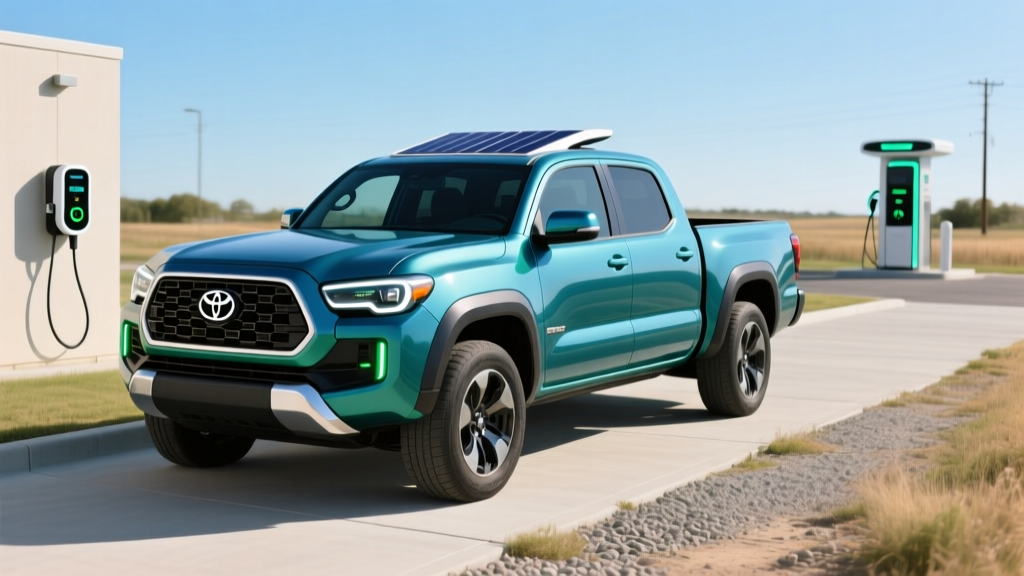
As of early 2026, Toyota does not sell a fully electric pickup truck in the U.S. The closest options are the Toyota Tacoma i-FORCE MAX hybrid (a plug-in–adjacent mild hybrid starting around $41,000) and the upcoming Toyota bZ Pickup, announced globally but not yet on sale in North America. If you need a Toyota truck today, the Tacoma hybrid delivers roughly 23–24 MPG combined. If you want a true battery-electric Toyota truck, you'll need to wait — or cross-shop the Ford F-150 Lightning, Rivian R1T, or Chevrolet Silverado EV right now.
Where Toyota's Electric Truck Plans Stand in 2026
Toyota has been cautious on full battery-electric pickups compared to Ford, GM, and Rivian. The company confirmed a next-generation EV truck concept under its "bZ" (Beyond Zero) sub-brand, previewed at global auto shows, but U.S. production timing and final specs remain unannounced. Toyota's stated strategy prioritizes a "multi-pathway" approach: hybrids, plug-in hybrids, hydrogen fuel cells, and BEVs — rather than going all-in on pure electric.
What this means for buyers: if you search for a "Toyota EV truck" today, you'll find the Tacoma i-FORCE MAX, which pairs a 2.4-liter turbocharged four-cylinder with a 48-horsepower electric motor integrated into the transmission. It's a hybrid, not a plug-in, and it cannot drive on electricity alone. The fully electric bZ pickup remains in the announced/preliminary stage.
Tacoma Hybrid vs. a True EV Truck: By the Numbers
Let's compare what you can buy today — the Tacoma hybrid — against the leading battery-electric pickups on the market. This table uses EPA figures and manufacturer MSRP data.
| Spec | 2026 Toyota Tacoma i-FORCE MAX (Hybrid) | 2026 Ford F-150 Lightning (Extended Range) | 2026 Rivian R1T (Dual-Motor, Standard) |
|---|---|---|---|
| Powertrain | 2.4L Turbo + Electric Motor (Hybrid) | Dual-Motor BEV | Dual-Motor BEV |
| Horsepower | 326 hp combined | 580 hp | 533 hp |
| EPA Range / Fuel Economy | ~23–24 MPG combined | ~320 miles (EPA est.) | ~270 miles (EPA est.) |
| Battery Capacity | N/A (small hybrid battery, ~1.8 kWh) | ~131 kWh usable (NMC) | ~95 kWh usable (NMC) |
| Max Towing | 6,000 lbs | 7,700 lbs | 11,000 lbs |
| Max Payload | ~1,700 lbs | ~1,800 lbs | ~1,760 lbs |
| Starting MSRP | ~$41,000 | ~$55,000 | ~$69,900 |
| Federal §30D Tax Credit | Not eligible (not a BEV/PHEV) | Up to $7,500 (eligibility varies) | Up to $7,500 (eligibility varies) |
| Home "Refuel" Time | 5 min at gas station | ~10 hrs (Level 2, 48A/11.5 kW) | ~9 hrs (Level 2, 48A/11.5 kW) |
Sources: fueleconomy.gov, manufacturer press sites. Tax credit eligibility depends on buyer income, MSRP caps, and battery sourcing — see IRS §30D rules.
Real Costs: Tacoma Hybrid vs. an Electric Truck Over 5 Years
One of the most common questions from truck buyers is whether the EV premium pays for itself. Let's run the numbers for 15,000 miles per year over five years (75,000 miles total), using national averages for electricity and gasoline.
| Cost Category | Tacoma Hybrid (24 MPG) | F-150 Lightning (BEV) |
|---|---|---|
| Purchase Price (base MSRP) | $41,000 | $55,000 |
| Federal Tax Credit | $0 | Up to $7,500* |
| Effective Purchase Price | $41,000 | $47,500 |
| Fuel / Electricity (5 yrs) | $10,156 (gas @ $3.25/gal) | $4,500 (electric @ $0.15/kWh, 2.2 kWh/mi) |
| Maintenance (5 yrs est.) | $3,500 | $1,800 |
| Insurance (5 yrs est.) | $7,500 | $9,000 |
| Home Charger Install | $0 | $1,200–$2,500 |
| 5-Year Total (approx.) | $62,156 | $63,800–$64,100 |
*The §30D credit has income caps ($150K single / $300K joint), MSRP caps ($80K for trucks/vans), and battery critical-mineral sourcing requirements that change annually. Consult a tax professional. Point-of-sale transfer is available at participating dealers.
The takeaway: at current prices, a Tacoma hybrid and an F-150 Lightning land in a similar 5-year cost range, but the EV requires home charging access and a higher upfront outlay. The EV wins on per-mile "fuel" cost ($0.06/mi vs. $0.14/mi) but loses on insurance premiums and charger installation. If gas prices rise above $4.00/gallon in your area, the EV's advantage grows significantly.
Real-World Ownership: What a First-Time EV Truck Buyer Must Know
If you're considering an electric truck — whether waiting for Toyota's bZ pickup or buying a Lightning/R1T/Silverado EV today — these are the practical realities that spec sheets don't show.
Home Charging Is Non-Negotiable for Most Owners
Over 80% of EV charging happens at home. Without a Level 2 (240V) home charger, you'll rely on public DC fast charging or trickle-charge on a standard 120V outlet (adding roughly 3–5 miles per hour — inadequate for a truck with a 100+ kWh battery). A Level 2 installation typically costs $1,200–$2,500 including the charger unit, electrical panel assessment, wiring, and permits. If your home has a 100-amp panel, an upgrade to 200 amps can add $1,500–$3,000.
Towing Cuts EV Range in Half
This is the single biggest shock for EV truck owners. The F-150 Lightning's 320-mile EPA range drops to roughly 150–180 miles when towing a 5,000-pound trailer. The Rivian R1T sees similar reductions. The physics are straightforward: towing adds aerodynamic drag and rolling mass, and electric motors consume energy proportionally. If you tow frequently over long distances, a hybrid or diesel truck still has a practical edge in 2026.
Cold Weather Reduces Range 20–35%
Lithium-ion batteries lose efficiency below freezing. In sustained 20°F weather, expect an EV truck to deliver 65–80% of its EPA range. Battery preconditioning (warming the pack before fast charging) helps, but it consumes energy. If you live in the Upper Midwest or Northeast and regularly drive 200+ miles in winter, plan your routes around charging infrastructure carefully.
Charging Speed Is Not a Flat Number
Manufacturers advertise peak DC fast-charge rates (e.g., "250 kW"), but that peak only holds between roughly 10–40% state of charge. Above 80%, the charge curve tapers sharply to protect battery chemistry. A "10–80% in 20 minutes" claim is realistic; an "80–100% in 10 minutes" expectation is not. Budget 30–40 minutes for a meaningful road-trip charge stop in an EV truck.
Common Misconceptions About Toyota and EV Trucks
| Myth | Fact |
|---|---|
| "Toyota already sells an electric Tacoma." | False. The Tacoma i-FORCE MAX is a hybrid, not a plug-in or BEV. It cannot drive on electric power alone and has no EV range. |
| "The Toyota bZ pickup is available now." | It has been announced as a concept/future model but is not on sale in the U.S. as of 2026. Any specs are preliminary. |
| "EV trucks can't tow anything real." | The Rivian R1T tows 11,000 lbs and the F-150 Lightning tows 7,700 lbs — competitive with many gas half-tons. Range while towing is the real limitation, not capacity. |
| "Hybrids are just as clean as EVs." | Hybrids still burn gasoline. A BEV charged on a grid with growing renewable share produces lower lifetime emissions, but the advantage depends on your local electricity mix. |
| "EV batteries need replacing every 5 years." | Modern NMC and LFP packs are warrantied for 8 years/100,000 miles (minimum 70% capacity retention). Real-world degradation data shows most packs retain 85–90% capacity after 100K miles. |
Decision Framework: Which Toyota Truck (or EV Alternative) Is Right for You?
Choose the Toyota Tacoma Hybrid If:
- You need a truck today and want Toyota reliability and resale value.
- You tow or haul moderately (under 6,000 lbs) and drive 200+ miles in a single trip regularly.
- You don't have access to home Level 2 charging (apartment, street parking, older electrical panel).
- You live in a region with limited public DC fast-charging infrastructure.
- Your budget is under $50,000 and you don't qualify for the §30D tax credit due to income or sourcing rules.
Wait for the Toyota bZ Electric Pickup If:
- You're committed to Toyota's ecosystem (dealer network, Toyota Safety Sense, resale) but want zero tailpipe emissions.
- You can wait 1–3 years for production and final pricing.
- You have home charging access and a daily commute under 150 miles.
- You want Toyota's hybrid-level reliability track record applied to a BEV powertrain.
Buy a Ford F-150 Lightning or Rivian R1T Now If:
- You want a fully electric truck today with proven range, towing, and charging infrastructure.
- You have a home garage with (or can install) a 240V/48A Level 2 circuit.
- Your daily driving is under 250 miles and you can plan road-trip charging stops.
- You qualify for the federal §30D credit (income under $150K single / $300K joint, truck MSRP under $80K, and the specific VIN meets battery-sourcing requirements).
- You value instant torque, a front trunk (frunk), and vehicle-to-load (V2L) power capability for job sites or camping.
Frequently Asked Questions
Does Toyota make a fully electric truck in 2026?
No. Toyota's current truck lineup includes the Tacoma (available with the i-FORCE MAX hybrid powertrain) and the Tundra (also available as a hybrid). Neither is a plug-in or battery-electric vehicle. Toyota has announced a future bZ-branded electric pickup, but it is not yet on sale in the United States.
What is the Tacoma i-FORCE MAX hybrid's fuel economy?
The 2026 Tacoma i-FORCE MAX achieves approximately 23–24 MPG combined depending on trim and drivetrain, per EPA estimates on fueleconomy.gov. This is a conventional hybrid — there is no electric-only driving mode and no plug-in capability.
How much would a Toyota electric truck cost when it arrives?
Toyota has not announced U.S. pricing for the bZ pickup. Based on Toyota's positioning and the current EV truck market, a reasonable estimate would place it between $45,000 and $65,000 depending on trim and battery size, but this is speculative until official specs are released.
Can I get the $7,500 federal tax credit on a Toyota Tacoma hybrid?
No. The IRS §30D credit applies only to battery-electric vehicles (BEVs) and plug-in hybrids (PHEVs) that meet battery-capacity, critical-mineral sourcing, MSRP, and buyer-income requirements. The Tacoma i-FORCE MAX is a conventional hybrid and does not qualify.
Is an electric truck practical for towing?
Electric trucks have strong towing capacity — the Rivian R1T is rated for 11,000 lbs. However, towing cuts EV range roughly in half due to aerodynamic drag and weight. If you regularly tow over 200 miles, charging logistics become challenging. For frequent heavy towing, a hybrid or diesel truck remains more practical in 2026.
What should a first-time EV truck buyer prioritize?
Three things: (1) Confirm you can install a Level 2 home charger — this is the single biggest ownership factor. (2) Understand your real-world range needs, including cold-weather and highway reductions (plan for 70–80% of EPA range in adverse conditions). (3) Research public DC fast-charging corridors along your most common road-trip routes. If all three check out, an EV truck is a strong daily driver with dramatically lower per-mile fuel costs.
Bottom Line
Toyota's EV truck future is real but not yet here. The Tacoma hybrid is a capable, fuel-efficient midsize truck you can buy today, and it will hold its value well. For a fully electric Toyota pickup, patience is required. In the meantime, the F-150 Lightning, Rivian R1T, and Silverado EV offer proven electric truck capability — if your charging situation, budget, and driving patterns align. Run your own numbers on fuel savings vs. upfront cost, and don't buy an EV truck without a confirmed home-charging plan.