The Short Answer: Which Toyota EV SUV Should You Buy?
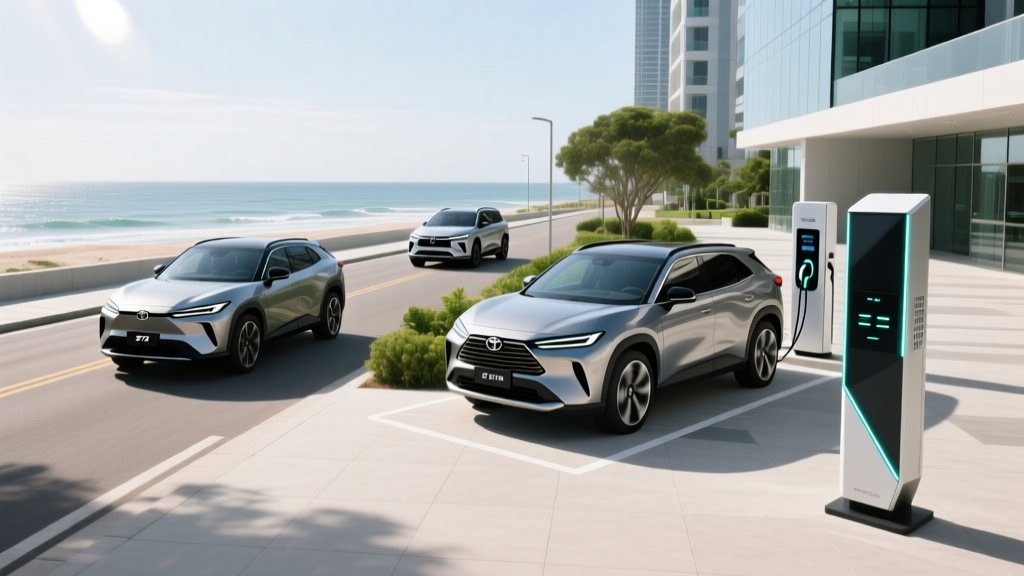
If you want a pure battery-electric Toyota SUV, the 2026 Toyota bZ4X is currently Toyota's only offering — a compact crossover with up to 252 miles of EPA range, 150 kW DC fast charging, and a starting MSRP around $37,070. However, if you need three rows, tow capacity, or live where charging infrastructure is sparse, Toyota's hybrid SUVs (Highlander Hybrid, Grand Highlander Hybrid, RAV4 Hybrid) often make more practical and financial sense in 2026. The right choice depends on your daily mileage, home charging access, and climate — which we break down with exact numbers below.
Toyota's Electrified SUV Lineup in 2026: BEV vs. Hybrid
Toyota has taken a notably cautious approach to full battery-electric vehicles compared to rivals like Hyundai, Kia, and Tesla. As of the 2026 model year, the brand offers one dedicated BEV SUV (the bZ4X) and a deep roster of hybrid (HEV) SUVs. Toyota does not currently sell a plug-in hybrid (PHEV) SUV in the U.S. — the RAV4 Prime remains on an extended hiatus due to battery supply constraints.
Here's how Toyota's electrified SUVs stack up at a glance:
| Model | Powertrain | EPA Range / MPG | Starting MSRP | Rows / Cargo |
|---|---|---|---|---|
| bZ4X (FWD) | BEV — 71.4 kWh (NMC) | 252 mi / 119 MPGe | $37,070 | 2 rows / 27.7 cu ft |
| bZ4X (AWD) | BEV — 71.4 kWh (NMC) | 228 mi / 107 MPGe | $39,120 | 2 rows / 27.7 cu ft |
| RAV4 Hybrid | HEV — 2.5L + electric motors | 39 MPG combined | $33,575 | 2 rows / 37.5 cu ft |
| Highlander Hybrid | HEV — 2.5L + electric motors | 35 MPG combined | $42,820 | 3 rows / 16.1 cu ft (all rows up) |
| Grand Highlander Hybrid | HEV — 2.4L turbo hybrid MAX | 27-36 MPG combined (trim dependent) | $47,490 | 3 rows / 20.6 cu ft (all rows up) |
Source: fueleconomy.gov and Toyota Motor Corporation U.S.A. 2026 model-year specifications.
Deep Dive: The 2026 Toyota bZ4X — Toyota's Only Electric SUV
The bZ4X (pronounced "bee-zee-four-ex") is Toyota's first ground-up battery-electric vehicle, co-developed with Subaru (which sells the mechanically similar Solterra). For 2026, Toyota has made modest updates to charging software and standard equipment, but the core hardware remains largely unchanged from its 2023 launch.
bZ4X Spec Sheet
| Battery | 71.4 kWh usable, NMC lithium-ion |
| EPA Range (FWD) | 252 miles |
| EPA Range (AWD) | 228 miles |
| Real-World Range Expectation | ~200-220 mi highway; ~165-185 mi in freezing temps (FWD) |
| Peak DC Fast Charge | 150 kW (FWD) / 150 kW (AWD) |
| 10-80% DC Charge Time | ~30 minutes (peak conditions, preconditioned) |
| Level 2 Charging | ~6.6 kW onboard charger, ~9.5 hours 0-100% |
| Motor Output (FWD) | 201 hp / 196 lb-ft torque |
| Motor Output (AWD) | 214 hp / 248 lb-ft torque |
| 0-60 mph | 7.1 sec (FWD) / 5.8 sec (AWD) |
| Connector | CCS1 (J1772 for AC) |
| Battery Warranty | 8 years / 100,000 miles (70% capacity retention) |
| Towing | Not rated for towing |
Real-World Range Reality Check
The bZ4X FWD carries a 252-mile EPA estimate, but in real-world highway driving at 70+ mph, expect closer to 200-220 miles before you need to stop. In freezing weather (below 32°F), range can drop 25-35%, putting realistic winter range around 165-185 miles for FWD. The AWD model's 228-mile sticker translates to roughly 185-200 miles highway in fair weather. The bZ4X lacks a heat pump in the U.S. market, which exacerbates cold-weather losses compared to competitors like the Hyundai Ioniq 5 or Tesla Model Y.
Charging: Adequate, Not Class-Leading
The bZ4X's 150 kW peak DC fast-charge rate trails rivals significantly. The Hyundai Ioniq 5 peaks at 240 kW (10-80% in ~18 minutes), and the Tesla Model Y can accept up to 250 kW on V3 Superchargers. The bZ4X's charging curve also tapers noticeably above 80% State of Charge (SoC) — expect a full 80-100% top-off to add another 20-25 minutes.
On Level 2 (240V home charging), the 6.6 kW onboard charger adds roughly 22-25 miles of range per hour. A full overnight charge from 10% to 100% takes about 9.5 hours, which works fine for daily commuting but means you can't quickly "top off" before an unexpected long trip.
Cost Breakdown: bZ4X vs. RAV4 Hybrid — 5-Year Ownership
One of the most common questions from Toyota SUV shoppers: does the bZ4X actually save money compared to a RAV4 Hybrid? The answer depends heavily on your local electricity rates, annual mileage, and whether you can charge at home.
| Cost Factor | bZ4X FWD (XLE) | RAV4 Hybrid (XLE) |
|---|---|---|
| Base MSRP | $37,070 | $33,575 |
| Federal Tax Credit (§30D) | Up to $7,500 (see eligibility below) | $0 (not a BEV or PHEV) |
| Effective Purchase Price | ~$29,570 (if full credit applies) | $33,575 |
| Home Charger Install (Level 2) | $500-$2,000 | $0 |
| Fuel/Energy Cost (5 yr, 60K mi) | ~$2,700 (at $0.14/kWh avg) | ~$5,400 (at $3.40/gal, 39 MPG) |
| Maintenance (5 yr) | ~$800 (no oil changes, brake wear reduced) | ~$2,200 (oil, filters, brakes) |
| Insurance (5 yr avg) | ~$9,500 (EV premium ~10-15%) | ~$8,200 |
| Est. 5-Year Total Cost | ~$42,570 - $44,070 | ~$49,375 |
Assumptions: 12,000 miles/year, $0.14/kWh home electricity (national average via EIA), $3.40/gal gasoline. Insurance estimates vary widely by driver profile and state. Tax credit eligibility requires meeting IRS §30D income, MSRP, and battery-sourcing requirements.
Key takeaway: If you qualify for the full $7,500 federal tax credit and charge primarily at home, the bZ4X can undercut the RAV4 Hybrid on 5-year total cost by roughly $5,000-$7,000. Without the credit — or if you rely on expensive public DC fast charging — the RAV4 Hybrid often wins on pure economics.
Federal Tax Credit: Does the bZ4X Qualify for §30D?
The IRS §30D Clean Vehicle Credit can provide up to $7,500 toward a new bZ4X purchase — but eligibility is not automatic. As of 2026, the credit has several gating requirements:
- MSRP cap: SUVs must have a base MSRP under $80,000 — the bZ4X clears this easily.
- Buyer income cap: Modified adjusted gross income must not exceed $150,000 (single), $225,000 (head of household), or $300,000 (joint).
- Battery sourcing: A percentage of critical minerals and battery components must be sourced from the U.S. or free-trade-agreement countries. These thresholds increase annually. Toyota's bZ4X battery supply chain has historically included Japanese and Chinese-sourced materials, which may reduce or eliminate the credit depending on the specific model year's compliance status.
- Point-of-sale transfer: Since 2024, buyers can transfer the credit to the dealer at purchase, reducing the sale price directly rather than waiting for a tax refund.
Critical caveat: Toyota's bZ4X battery sourcing compliance with §30D critical-mineral and component requirements has been inconsistent across model years. Before purchasing, verify the specific VIN's eligibility on the IRS's official clean vehicle credit list at irs.gov. Do not assume you will receive $7,500 — many bZ4X buyers have qualified for only $3,750 (half credit) or nothing at all depending on build date and sourcing.
Common Misconceptions About Toyota's Electric SUV
| Myth | Fact |
|---|---|
| "The bZ4X is just a RAV4 with a battery." | The bZ4X rides on Toyota's dedicated e-TNGA EV platform — different chassis, lower center of gravity, and distinct dimensions from the RAV4. Cargo space is actually smaller (27.7 vs. 37.5 cu ft). |
| "I'll save money no matter what." | Without the federal tax credit, the bZ4X costs more upfront than a RAV4 Hybrid. Savings depend on electricity rates, mileage, and credit eligibility. Public DC fast charging at $0.35-$0.48/kWh can erase fuel-cost advantages. |
| "Toyota's battery will need expensive replacement soon." | Toyota warranties the bZ4X battery for 8 years/100,000 miles with at least 70% capacity retention. NMC batteries typically retain 85-90% capacity at 100K miles under normal use. Full replacement (rare) would cost approximately $12,000-$16,000 out of warranty. |
| "I can charge it at any Tesla Supercharger." | As of 2026, the bZ4X uses a CCS1 connector. While Toyota has announced future NACS adoption, current bZ4X owners need a CCS-to-NACS adapter (not officially provided by Toyota as of early 2026) to access Tesla Superchargers. Verify adapter compatibility before relying on Tesla's network. |
| "Hybrids are outdated technology." | Toyota's hybrid SUVs deliver 35-41 MPG with zero charging infrastructure dependence, lower purchase prices, and proven long-term reliability. For buyers without home charging or in extreme climates, a hybrid often remains the more pragmatic electrified choice. |
Real-World Ownership: What First-Time Toyota EV Buyers Must Know
Buying the bZ4X as your first EV involves practical considerations that go beyond the spec sheet:
Home Charging Is (Almost) Mandatory
Over 80% of EV charging happens at home. If you live in an apartment, condo, or street-parking situation without access to a dedicated 240V outlet or hardwired Level 2 charger, the bZ4X becomes significantly less convenient. Relying solely on public DC fast charging adds cost ($0.35-$0.48/kWh at networks like Electrify America and EVgo), time (30+ minutes per session), and unpredictability (broken chargers, occupied stalls).
A basic Level 2 home installation (240V, 40-amp circuit, hardwired charger like a ChargePoint Home Flex or Emporia Level 2) typically costs $500-$2,000 including the unit and electrician labor — assuming your electrical panel has capacity. A panel upgrade from 100A to 200A service can add $1,500-$3,000.
Cold Climate Buyers: Proceed With Awareness
The bZ4X's lack of a standard heat pump in the U.S. market means resistive cabin heating draws directly from the traction battery in winter. Owners in northern states (Minnesota, Michigan, Maine) should budget for 25-35% range loss in sustained sub-freezing temperatures. A 252-mile FWD model may realistically deliver 165-185 miles in January. If your daily round-trip commute exceeds 80 miles in cold weather, the bZ4X's margin becomes thin.
Driving Pattern Fit
The bZ4X excels as a commuter and grocery-getter with predictable daily mileage under 60-80 miles. It struggles as a road-trip vehicle: the 150 kW charge rate and ~200-mile real-world highway range mean stops every 2-2.5 hours on long drives, with 30-minute charge sessions each time. For frequent 300+ mile road trippers, a RAV4 Hybrid (390+ mile range, 5-minute refueling) remains more practical.
Decision Framework: Which Toyota Electrified SUV Fits You?
Choose the bZ4X (BEV) if:
- You have reliable home Level 2 charging access (garage, driveway, or dedicated outlet)
- Your daily driving is under 80 miles round-trip
- You qualify for the full or partial §30D federal tax credit (verify VIN at irs.gov)
- You live in a moderate climate (rarely below 20°F for extended periods)
- You want zero tailpipe emissions and minimal maintenance (no oil, fewer brake replacements)
- You don't need to tow or carry more than 5 passengers
Choose the RAV4 Hybrid (HEV) if:
- You lack home charging access (apartment, condo, street parking)
- You regularly drive more than 200 miles in a single day
- You live in an extreme cold climate and can't tolerate range loss uncertainty
- You need more cargo space (37.5 cu ft vs. 27.7 cu ft)
- You want a lower upfront purchase price with no tax-credit eligibility complexity
- You tow occasionally (RAV4 Hybrid: up to 1,750 lbs)
Choose the Grand Highlander Hybrid if:
- You need three usable rows and adult-sized third-row seating
- You want hybrid efficiency (up to 36 MPG) without any charging dependency
- You tow up to 5,000 lbs (Hybrid MAX powertrain)
- Your budget accommodates a $47,490+ starting price
Frequently Asked Questions
Is Toyota releasing a larger electric SUV to compete with the Tesla Model X or Kia EV9?
Toyota has announced plans for a next-generation, three-row electric SUV built on an improved platform, expected around 2027-2028. As of early 2026, this vehicle is announced but not yet available, and final specs (range, pricing, charging speed) remain preliminary. If you need a three-row EV SUV today, the Kia EV9 (304-mi range, $54,900+) or Tesla Model X are the primary options.
How does the bZ4X compare to the Subaru Solterra?
The Solterra is mechanically identical to the bZ4X — same e-TNGA platform, same 71.4 kWh battery, same motors. Differences are cosmetic (styling, interior trim) and equipment-level. The Solterra comes standard with AWD (no FWD option) and includes slightly more off-road-oriented driving modes. Pricing and EPA range differ marginally. Choose based on dealer proximity, pricing, and which brand's styling you prefer.
What does it cost to charge the bZ4X at home per month?
At the U.S. average residential rate of ~$0.14/kWh (EIA data), fully charging the 71.4 kWh battery from 10% to 100% costs approximately $9.00. Driving 1,000 miles per month at the FWD model's efficiency of ~3.4 mi/kWh requires about 294 kWh, or roughly $41/month in electricity. Compare that to the RAV4 Hybrid at 39 MPG: 1,000 miles ÷ 39 MPG × $3.40/gal = $87/month in gasoline.
Does the bZ4X qualify for any state incentives?
State incentives vary widely and change frequently. Some states (California, Colorado, Massachusetts, New York) offer additional rebates of $1,000-$5,000 for new EV purchases, often with their own income and price caps. Check your state's energy office or department of environmental quality for current programs. These stack with the federal §30D credit where applicable.
Should I lease the bZ4X instead of buying?
Leasing can be a smart strategy for the bZ4X for two reasons: (1) some leases pass through a $7,500 commercial clean vehicle credit as a lease incentive, even when the buyer wouldn't qualify for §30D purchase credit due to battery-sourcing rules; (2) leasing lets you avoid long-term battery degradation risk. Toyota and Subaru dealers have frequently offered aggressive bZ4X/Solterra lease deals — check current offers in your area.
How reliable is the bZ4X compared to Toyota's hybrids?
The bZ4X is newer and has less long-term reliability data than Toyota's battle-tested hybrid powertrains, which have decades of proven durability (the Prius hybrid system routinely exceeds 200,000 miles). Early bZ4X models had a recall related to wheel hub bolts in 2022-2023, which Toyota addressed. The electric powertrain itself (motors, inverter, battery) has fewer moving parts than any internal combustion engine, but the bZ4X's overall vehicle reliability track record is still being established.
For the latest bZ4X specifications and pricing, visit Toyota's official bZ4X page. For federal tax credit eligibility, consult the IRS clean vehicle credit list and consider speaking with a tax professional before purchase.