Quick Answer: Toyota's 2026 EV Lineup at a Glance
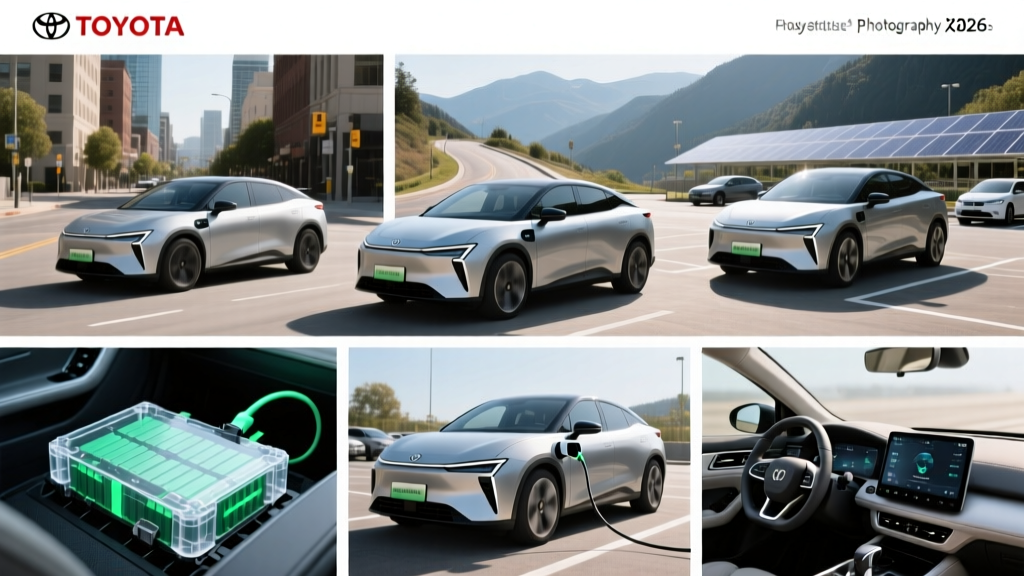
For the 2026 model year, Toyota offers two fully electric vehicles in the U.S.: the bZ4X compact SUV (EPA range up to 252 miles, starting around $38,465) and the newly introduced bZ4X Touring variant with a slightly longer wheelbase and revised battery management. Both use a 71.4 kWh (usable) lithium-ion NMC battery, support up to 150 kW DC fast charging, and qualify for partial or full federal tax credits depending on battery sourcing and buyer income. If you're cross-shopping Toyota's EVs against their hybrids, the decision hinges on whether you have reliable home charging and drive under 200 miles daily.
What Toyota EV Models Are Available in 2026?
Toyota's battery-electric strategy has been cautious compared to rivals like Hyundai and Tesla, but the 2026 lineup reflects meaningful progress. Here's what you can actually order today:
| Spec | 2026 bZ4X (FWD) | 2026 bZ4X (AWD) | 2026 bZ4X Touring (AWD) |
|---|---|---|---|
| EPA Range | 252 mi | 228 mi | 235 mi |
| Battery (usable) | 71.4 kWh NMC | 71.4 kWh NMC | 71.4 kWh NMC |
| Horsepower | 201 hp | 214 hp | 214 hp |
| 0-60 mph | 7.1 sec | 6.5 sec | 6.5 sec |
| Max DC Charge Rate | 150 kW | 150 kW | 150 kW |
| 10-80% DC Fast Charge | ~30 min | ~30 min | ~30 min |
| Level 2 Charge Rate | 6.6 kW | 6.6 kW | 6.6 kW |
| MPGe (combined) | 131 MPGe | 114 MPGe | 116 MPGe |
| Base MSRP | $38,465 | $42,465 | $44,200 |
| Battery Warranty | 8 yr / 100,000 mi | 8 yr / 100,000 mi | 8 yr / 100,000 mi |
Source: fueleconomy.gov and Toyota Motor Corporation press materials.
Toyota has also announced a broader "bZ" EV family expansion through 2028, including a three-row SUV and a compact crossover, but those remain unreleased as of early 2026. Only the bZ4X and bZ4X Touring are currently purchasable.
Real-World Range vs. EPA Sticker: What to Actually Expect
EPA Sticker: 252 miles (FWD) / 228 miles (AWD)
Real-World Highway (70-80 mph): Expect 210-230 miles (FWD), 190-210 miles (AWD)
Cold Weather (below 32°F): Subtract 15-25%, yielding roughly 175-215 miles (FWD)
Combined Mixed Driving: Most owners report 220-240 miles (FWD) on a full charge
The bZ4X's efficiency of 131 MPGe (FWD) is competitive but not class-leading. The Hyundai Ioniq 5 achieves 134 MPGe on its standard-range model and offers faster charging. In real-world highway testing, the bZ4X FWD typically delivers around 3.5-3.8 kWh/mile, meaning a full 71.4 kWh battery yields roughly 210-220 miles at sustained 75 mph. Cold weather compounds this — the bZ4X lacks a standard heat pump in base trims (it's optional on some configurations), which means cabin heating in winter draws heavily from the traction battery.
If your daily commute is under 80 miles round-trip and you can charge at home overnight, the real-world range is more than adequate. If you regularly drive 200+ miles between charges or live in a cold northern climate, the AWD model's reduced range (228 EPA) may feel tight on road trips.
Charging Speeds: Home and DC Fast Charging
| Charging Level | Power | Miles Added per Hour | Typical Use Case |
|---|---|---|---|
| Level 1 (120V) | 1.4 kW | ~4-5 mi/hr | Emergency / overnight trickle |
| Level 2 (240V, 32A) | 6.6 kW | ~22-25 mi/hr | Home / workplace daily charging |
| DC Fast Charge | Up to 150 kW peak | ~150 mi in 30 min (10-80%) | Road trips |
The bZ4X's 150 kW peak DC fast-charge rate is a notable limitation. Competitors like the Hyundai Ioniq 5 (peak 240 kW on 800V architecture) and Tesla Model Y (peak ~250 kW) charge significantly faster on compatible infrastructure. In practice, the bZ4X sustains roughly 100-120 kW through the 20-60% state of charge window, then tapers sharply above 80%. A 10-80% session takes approximately 30 minutes at a 150+ kW charger — adequate, but not quick enough to make road-trip stops feel seamless.
For home Level 2 charging, the 6.6 kW onboard charger means a full 0-100% charge takes about 11 hours. Most owners charging from 20-80% daily will need roughly 6-7 hours on a Level 2 home station, which works well for overnight charging.
Common Misconceptions About Toyota's EVs
| Myth | Fact |
|---|---|
| "Toyota doesn't make EVs" | The bZ4X has been on sale since 2023; the Touring variant launched for 2026. |
| "EV batteries need replacing every 5 years" | Toyota warranties the bZ4X battery for 8 years/100,000 miles against capacity loss below 70%. Industry data shows NMC batteries typically retain 85-90% capacity at 100,000 miles. |
| "Charging is more expensive than gas" | At the U.S. average electricity rate of $0.17/kWh, charging the bZ4X costs roughly $0.045/mile. A 30 MPG gas car at $3.40/gallon costs $0.113/mile — EV fueling is about 60% cheaper per mile. |
| "The bZ4X qualifies for the full $7,500 tax credit" | Eligibility depends on battery mineral sourcing, buyer income, and MSRP caps. Check current IRS §30D rules before assuming full credit. |
EV vs. Hybrid vs. Gas: How Does the bZ4X Compare?
Toyota is the undisputed hybrid leader, and many buyers are weighing the bZ4X against models like the RAV4 Hybrid or RAV4 Prime PHEV. Here's the data-driven comparison:
| Metric | 2026 bZ4X (FWD) | 2026 RAV4 Hybrid (AWD) | 2026 RAV4 Prime (PHEV) |
|---|---|---|---|
| EPA Range / MPG | 252 mi / 131 MPGe | 40 MPG combined | 42 mi electric + 38 MPG gas |
| Fuel/Energy Cost per Mile | ~$0.045 (home charging) | ~$0.085 ($3.40/gal) | ~$0.04 electric / $0.089 gas |
| Base MSRP | $38,465 | $33,875 | $44,590 |
| Fed. Tax Credit (est.) | Up to $7,500* | None (HEV) | Up to $7,500* |
| After-Credit Price | ~$30,965 | $33,875 | ~$37,090 |
| Annual Maintenance (est.) | ~$300 | ~$550 | ~$450 |
| Home Charging Needed? | Strongly recommended | No | Recommended for EV-mode use |
* Federal tax credit subject to IRS §30D eligibility — income caps, MSRP limits, and battery sourcing requirements apply. See IRS.gov for current rules.
The numbers reveal a clear pattern: if you qualify for the full $7,500 credit and have home charging, the bZ4X undercuts the RAV4 Hybrid on effective purchase price and operating cost. If you lack home charging, live in an apartment, or drive in extreme cold frequently, the RAV4 Hybrid or RAV4 Prime removes the charging-logistics risk entirely.
Total Ownership Cost: 5-Year Breakdown
| Cost Category (5 yr / 75,000 mi) | bZ4X FWD | RAV4 Hybrid AWD |
|---|---|---|
| Purchase (after est. credit) | $30,965 | $33,875 |
| Energy / Fuel | $3,375 (home charging) | $6,375 |
| Maintenance | $1,500 | $2,750 |
| Insurance (est. avg) | $7,500 | $6,250 |
| Depreciation (est.) | $12,000 | $10,500 |
| Total 5-Year Cost | $55,340 | $59,750 |
The bZ4X wins on fuel and maintenance savings — EVs eliminate oil changes, have fewer moving parts, and use regenerative braking to extend brake-pad life. However, EV insurance premiums run 15-25% higher on average due to battery replacement costs in collision claims, and EV depreciation has been steeper than hybrids in the 2024-2025 market correction. Your actual results will vary by state, driving habits, and electricity rates.
Federal Tax Credit: Does the bZ4X Qualify?
The IRS §30D clean vehicle credit offers up to $7,500 for qualifying new EVs, but eligibility is not automatic. Here's the current checklist for 2026:
- MSRP Cap: SUVs must be under $80,000 — the bZ4X qualifies (base $38,465).
- Buyer Income Cap: AGI must not exceed $150,000 (single), $225,000 (head of household), or $300,000 (joint).
- Battery Sourcing: A percentage of critical minerals and battery components must be sourced from the U.S. or FTA partners. This requirement tightens annually. Verify the specific VIN's eligibility at fueleconomy.gov.
- Point-of-Sale Transfer: As of 2024, you can transfer the credit to the dealer at purchase, reducing the sale price directly rather than waiting for a tax refund.
- Assembly: The bZ4X is assembled in Japan, which has impacted eligibility in prior years. Confirm the current status before purchasing.
Because sourcing rules change and are model-specific, always verify the exact VIN on the IRS portal or fueleconomy.gov before committing to a purchase. Do not assume the full $7,500 applies.
Decision Framework: Is a 2026 Toyota EV Right for You?
Choose the bZ4X if:
- You have Level 2 home charging (or can install it — budget $500-$1,800 for a 240V/32A circuit)
- Your daily driving is under 150 miles round-trip
- You qualify for the federal tax credit based on income and the VIN's sourcing eligibility
- You want lower per-mile operating costs and reduced maintenance
- You prefer Toyota's dealer network and Safety Sense ADAS suite
Choose the RAV4 Hybrid or RAV4 Prime instead if:
- You live in an apartment or lack reliable home/workplace charging
- You regularly drive 250+ miles in a day or take frequent road trips through charging deserts
- You live in an extremely cold climate (consistently below 20°F) where EV range loss is significant
- You don't qualify for the federal tax credit due to income limits
- You want maximum cargo space and towing capability (RAV4: 1,500 lbs; bZ4X: not rated for towing)
What First-Time Toyota EV Buyers Should Know
1. kW vs. kWh — don't confuse them. kW (kilowatts) measures charging power — how fast energy flows into the battery. kWh (kilowatt-hours) measures energy capacity — how much the battery holds. The bZ4X has a 71.4 kWh battery and charges at up to 150 kW. Think of kWh as your "tank size" and kW as your "pump speed."
2. The charge curve matters more than peak kW. The bZ4X's 150 kW peak only applies in a narrow state-of-charge window (roughly 20-50%). Above 80%, charging slows dramatically to protect battery health. On road trips, plan to charge from 10-80% (~30 min) and drive on — don't wait for a full 100%.
3. Preconditioning improves fast charging. If your bZ4X has navigation-based preconditioning, entering a DC fast-charger as your destination will warm the battery for optimal charge speed, especially in cold weather. Without preconditioning, a cold battery may only accept 50-80 kW initially.
4. Home charging is the backbone. Over 80% of EV charging happens at home. A Level 2 home charger (240V, 32A) costs roughly $300-$600 for the unit plus $500-$1,200 for professional installation, depending on your electrical panel. If your panel is older or maxed out, a 200A service upgrade can add $1,500-$3,000. Consult a licensed electrician for a site-specific quote.
5. Toyota Safety Sense 3.0 is Level 2 driver-assist — not self-driving. The bZ4X comes with Toyota Safety Sense 3.0, which includes adaptive cruise control, lane-keeping assist, and pre-collision braking. This is SAE Level 2 automation — you must keep your hands on the wheel and eyes on the road at all times. It reduces fatigue on highways but does not drive the car for you.
Frequently Asked Questions
Does Toyota have other EVs coming in 2026 or 2027?
Toyota has announced plans for a broader bZ lineup, including a compact SUV and a three-row electric SUV, but as of early 2026, only the bZ4X and bZ4X Touring are confirmed for U.S. sale. Any additional models remain preliminary with no firm pricing or specs.
How much does it cost to charge the bZ4X at home?
At the U.S. average residential electricity rate of ~$0.17/kWh, a full charge of the 71.4 kWh battery costs approximately $12.14. For a typical 20-80% daily charge, expect about $7.30. That's roughly 200 miles of range for the cost of a fast-food lunch.
Is the bZ4X reliable compared to Toyota's gas cars?
Early bZ4X model years (2023-2024) had some software and charging-related recalls. The 2026 model benefits from those fixes. EVs have fewer mechanical failure points than gas cars (no transmission, no exhaust, no timing belt), but long-term reliability data specific to the bZ4X is still limited compared to Toyota's decades of hybrid track record.
What happens if the battery degrades?
Toyota warranties the high-voltage battery for 8 years or 100,000 miles against capacity dropping below 70%. Industry-wide, NMC batteries in liquid-cooled EVs typically retain 85-92% capacity at 100,000 miles. Full battery replacement outside of warranty, if ever needed, is estimated at $12,000-$18,000 based on current parts pricing — though costs are expected to decline as battery technology matures.
Can I road-trip the bZ4X across the country?
Yes, but plan carefully. The 150 kW charge rate and ~220-mile real-world highway range mean stops every 2-2.5 hours. Use PlugShare or your vehicle's built-in route planner to confirm DC fast-charger availability along your route. In rural areas of the Mountain West and Great Plains, charging gaps of 100+ miles still exist.