Toyota EV Cars: The Quick Answer
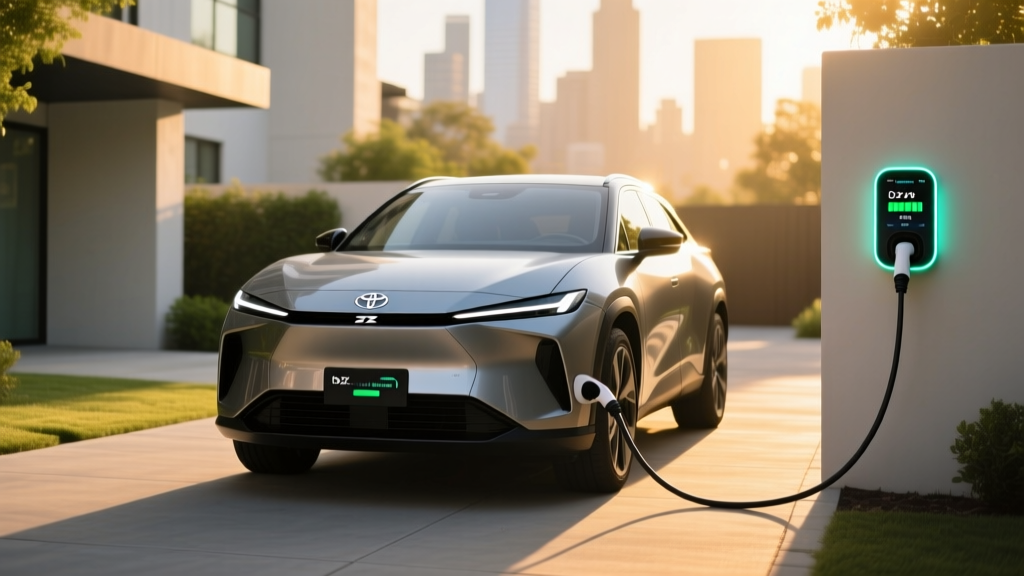
As of the 2026 model year, Toyota's only fully electric vehicle on sale in the U.S. is the bZ4X, a compact crossover SUV. It offers an EPA-estimated range of up to 252 miles (FWD XLE trim), starts at approximately $38,465 (including destination), and qualifies for a partial $3,750 federal tax credit under current IRS §30D rules — subject to income, battery-sourcing, and MSRP caps. Toyota's broader electrified lineup is dominated by hybrids and PHEVs, which still outsell its BEV offerings by a wide margin. If you're loyal to Toyota and want a battery-electric car today, the bZ4X is your option. If range, charging speed, or price are top priorities, competitors like the Hyundai Ioniq 5 or Tesla Model Y may serve you better.
The 2026 Toyota bZ4X: Specs at a Glance
Toyota entered the dedicated BEV market cautiously with the bZ4X, co-developed with Subaru (which sells a near-identical version called the Solterra). The 2026 model year carries over the core powertrain with minor software and packaging updates. Here's what the numbers look like across the two available trims.
| Spec | bZ4X XLE (FWD) | bZ4X Limited (AWD) |
|---|---|---|
| Base MSRP (incl. destination) | ~$38,465 | ~$44,165 |
| Battery (usable) | 71.4 kWh (NMC lithium-ion) | 71.4 kWh (NMC lithium-ion) |
| EPA Range | 252 miles | 228 miles |
| Combined MPGe | 119 MPGe | 102 MPGe |
| Motor Output | 201 hp / 196 lb-ft | 214 hp / 248 lb-ft |
| 0–60 mph | ~7.1 sec | ~5.8 sec |
| Max DC Fast Charge Rate | 150 kW (peak) | 150 kW (peak) |
| 10–80% DCFC Time | ~30 min | ~30 min |
| Level 2 Charging (240V, 32A) | ~9.5 hours (0–100%) | ~9.5 hours (0–100%) |
| Connector | CCS1 (J1772 combo) | CCS1 (J1772 combo) |
| Battery Warranty | 8 yr / 100,000 mi | 8 yr / 100,000 mi |
Sources: EPA / fueleconomy.gov, Toyota.com bZ4X specifications.
Real-World Range vs. the EPA Sticker
The EPA's 252-mile figure for the FWD XLE is measured under controlled laboratory conditions. In real-world driving, expect variation:
EPA sticker: 252 miles (FWD) / 228 miles (AWD)
Real-world highway (70–75 mph, mild weather): ~210–230 miles
Cold weather (below 32°F, cabin heat): ~170–200 miles
Mixed city/highway, moderate temps: ~230–250 miles
The bZ4X's NMC battery lacks a heat pump on the FWD trim (it's standard on the AWD Limited). Without a heat pump, cabin heating in winter draws directly from the traction battery using resistive elements, which can knock 20–30% off your range. If you live in a cold climate and commute long distances, this matters. Competitors like the Hyundai Ioniq 5 include a heat pump standard across all trims, giving them an edge in winter efficiency.
On the highway, the bZ4X's efficiency hovers around 2.9–3.1 kWh/mile (roughly 102–119 MPGe depending on trim). That's respectable but not class-leading — the Ioniq 5 RWD achieves about 132 MPGe combined, and the Tesla Model Y Long Range hits 123 MPGe with far more range.
Charging the bZ4X: What to Expect
Toyota uses the CCS1 connector for the bZ4X. With the North American Charging Standard (NACS) becoming the dominant connector for most new EVs starting in 2025–2026, CCS1 owners will increasingly rely on adapters to access Tesla Superchargers. Toyota has confirmed that a NACS adapter is available for bZ4X owners, enabling access to the Supercharger network — a significant practical advantage.
| Charging Level | Power | Time | Miles Added per Hour |
|---|---|---|---|
| Level 1 (120V, 12A) | ~1.4 kW | ~50+ hours (0–100%) | ~3–4 mi/hr |
| Level 2 (240V, 32A) | ~7.7 kW | ~9.5 hours (0–100%) | ~25–27 mi/hr |
| DC Fast Charge (CCS1) | 150 kW peak | ~30 min (10–80%) | Up to ~300 mi/hr at peak |
A critical detail for road-trippers: the bZ4X's DC fast-charging curve tapers noticeably above 80% state of charge (SoC). The 150 kW peak is achieved only between roughly 10–50% SoC under ideal battery temperatures. From 80–100%, charging drops to under 30 kW. This is normal for lithium-ion batteries, but it means a 10–80% top-up is the practical fast-charging window — plan your road-trip stops accordingly.
Home charging reality: Most bZ4X owners will install a Level 2 wallbox (240V, 32A or 48A circuit). Expect to pay $500–$1,200 for the charger hardware (e.g., ChargePoint Home Flex, Emporia Level 2) and $800–$2,500 for professional electrician installation, depending on whether your electrical panel needs an upgrade. A full overnight charge from empty takes about 9.5 hours — easily enough for daily use.
Toyota EV vs. Toyota Hybrid: Cost and Ownership Comparison
Toyota's reputation is built on hybrids, and many shoppers searching for "Toyota EV cars" may actually be better served by a RAV4 Hybrid or RAV4 Prime PHEV. Here's how the bZ4X stacks up against Toyota's own best-sellers on cost.
| Factor | bZ4X XLE (BEV) | RAV4 Hybrid XLE (HEV) | RAV4 Prime SE (PHEV) |
|---|---|---|---|
| Base MSRP | ~$38,465 | ~$34,075 | ~$44,590 |
| Federal Tax Credit (§30D) | Up to $3,750* | $0 | Up to $7,500* |
| Effective Starting Price | ~$34,715 | ~$34,075 | ~$37,090 |
| EPA Range / MPG | 252 mi / 119 MPGe | 39 MPG combined | 42 mi EV + 38 MPG |
| Annual Fuel/Energy Cost** | ~$550 | ~$1,550 | ~$850 (mixed EV/gas) |
| 5-Year Fuel/Energy Cost | ~$2,750 | ~$7,750 | ~$4,250 |
| Maintenance (5-yr est.) | ~$1,200 | ~$2,800 | ~$2,400 |
*Tax credit eligibility depends on buyer income, battery critical-mineral sourcing, and MSRP caps per IRS §30D rules. The bZ4X currently qualifies for $3,750 (partial credit — battery sourcing does not fully meet critical-mineral thresholds). The RAV4 Prime qualifies for up to $7,500. Always verify current eligibility before purchasing.
**Annual fuel/energy estimates based on 12,000 miles/year, $0.16/kWh national average electricity, and $3.50/gallon gasoline. Your costs will vary by local utility rates and gas prices.
5-Year Total Cost Snapshot (Purchase + Energy + Maintenance)
| bZ4X XLE | RAV4 Hybrid XLE | RAV4 Prime SE | |
|---|---|---|---|
| Net Price (after credit) | ~$34,715 | ~$34,075 | ~$37,090 |
| 5-Yr Energy/Fuel | $2,750 | $7,750 | $4,250 |
| 5-Yr Maintenance | $1,200 | $2,800 | $2,400 |
| 5-Year Total | ~$38,665 | ~$44,625 | ~$43,740 |
Note: Excludes insurance (typically $100–$300/year more for BEVs), registration, depreciation, and state/local incentives. Insurance premiums for the bZ4X average ~10–15% higher than the RAV4 Hybrid due to higher repair costs for EV-specific components.
The bZ4X wins on operating costs over five years, saving roughly $5,000–$6,000 in fuel and maintenance versus the RAV4 Hybrid. However, the RAV4 Prime PHEV is a compelling middle ground — it offers 42 miles of electric-only driving for most commutes, qualifies for the full $7,500 credit, and eliminates range anxiety on road trips.
Tax Credit Eligibility: What the bZ4X Actually Qualifies For
The federal EV tax credit under IRS §30D is not a flat $7,500 for every EV. For the 2026 Toyota bZ4X, the credit breaks down as follows:
- Critical Minerals Requirement (up to $3,750): The bZ4X's battery sourcing partially meets this threshold, earning $3,750.
- Battery Components Requirement (up to $3,750): The bZ4X does not currently meet the domestic battery-component manufacturing threshold, so this $3,750 portion is not awarded.
- Total Available Credit: $3,750 (not the full $7,500).
- Buyer Income Caps: Modified AGI must not exceed $150,000 (single), $225,000 (head of household), or $300,000 (joint).
- MSRP Cap: The bZ4X is an SUV, so the cap is $80,000 — all trims qualify.
- Point-of-Sale Transfer: You can transfer the credit to the dealer at purchase, reducing your out-of-pocket cost immediately rather than waiting for a tax refund.
Always confirm current eligibility on the IRS website or with your tax professional before finalizing a purchase. Sourcing requirements tighten annually, and credit amounts can change model year to model year.
Common Misconceptions About Toyota EV Cars
| Myth | Fact |
|---|---|
| "Toyota doesn't make electric cars." | Toyota sells the bZ4X BEV in the U.S. since the 2023 model year. It's a dedicated EV platform, not a converted gas car. |
| "The bZ4X has terrible range." | 252 miles EPA is adequate for most daily driving. It trails class leaders (Ioniq 5 at 318 mi, Model Y at 320 mi) but is competitive with the VW ID.4 (291 mi) and Subaru Solterra (227 mi). |
| "I can't use Tesla Superchargers." | With a NACS adapter (available from Toyota), bZ4X owners can access Tesla's Supercharger network — the largest DC fast-charging network in the U.S. |
| "EV batteries need replacing every few years." | Toyota warranties the bZ4X battery for 8 years/100,000 miles against dropping below 70% capacity. Industry data from sources like Recurrent Auto shows most modern NMC batteries retain 90%+ capacity after 5 years of typical use. |
| "EVs cost more to insure." | Generally true — bZ4X insurance averages 10–15% more than a RAV4 Hybrid, primarily due to higher collision-repair costs for battery-adjacent components. Shop quotes from multiple insurers. |
| "A Toyota hybrid is basically the same as an EV." | Hybrids still burn gasoline (39 MPG in the RAV4 Hybrid) and produce tailpipe emissions. A BEV like the bZ4X eliminates tailpipe emissions entirely, though upstream electricity generation still has a carbon footprint that varies by your local grid mix. |
Decision Framework: Is the Toyota bZ4X Right for You?
Choose the Toyota bZ4X if:
- You're a Toyota-loyal buyer who wants a BEV from a brand you trust for long-term reliability and dealer support.
- Your daily commute is under 80 miles round-trip and you have access to Level 2 home or workplace charging.
- You value Toyota Safety Sense 3.0 (standard adaptive cruise, lane-keep, pre-collision) and Toyota's dealer network for service.
- You live in a mild climate where cold-weather range loss is less of a concern.
- You want a compact crossover with reasonable cargo space (27.7 cu ft behind rear seats, 56.9 cu ft folded).
Look elsewhere if:
- Range is paramount: The Hyundai Ioniq 5 (318 mi EPA, 240 kW peak charging) or Tesla Model Y Long Range (320 mi) offer significantly more range and faster DC charging.
- You need a third row: The bZ4X is a 5-seat crossover. Consider the Kia EV9 or wait for Toyota's announced three-row bZ Large SUV (expected 2027).
- You take frequent 400+ mile road trips: The bZ4X's 150 kW peak charge rate means ~30-minute stops every 200 miles. Competitors with 250–350 kW charging (Ioniq 5, Tesla Model Y, Lucid Air) make road-tripping noticeably faster.
- You live in extreme cold: Without a standard heat pump (FWD trim), expect 20–30% range loss. The AWD Limited includes one, but the RAV4 Prime PHEV eliminates range anxiety entirely in winter.
- Budget is tight: At ~$38,465 before the $3,750 credit, the bZ4X is pricier than a RAV4 Hybrid ($34,075). If you can't charge at home, a hybrid is the more practical choice.
What Toyota Has Announced for the Future
Toyota has signaled a broader EV rollout, but as of early 2026, only the bZ4X is on sale. Announced or expected models include:
- bZ Compact SUV (announced): A smaller crossover concept previewed in 2022. No confirmed U.S. on-sale date or final specs.
- bZ Large SUV (announced, expected ~2027): A three-row electric SUV targeting the U.S. family market. Specs are preliminary.
- Next-gen battery tech: Toyota has publicized solid-state battery R&D, claiming potential for 600+ mile range and 10-minute charging. However, no production timeline or pricing has been confirmed, and solid-state remains pre-commercial for mass-market vehicles.
None of these models are currently available for purchase. Treat all specs as preliminary until Toyota confirms production details.
Frequently Asked Questions
Does Toyota make any fully electric cars besides the bZ4X?
Not in the U.S. market as of 2026. The bZ4X is Toyota's only dedicated BEV sold stateside. In other markets (China, Japan), Toyota offers additional bZ-series models, but they are not currently imported to the U.S. Toyota's U.S. electrified lineup is otherwise dominated by hybrids (Prius, Camry Hybrid, RAV4 Hybrid, Highlander Hybrid) and one PHEV (RAV4 Prime).
How does the bZ4X compare to the Subaru Solterra?
They share the same e-TNGA platform, 71.4 kWh battery, and most mechanical components. The Solterra comes standard with AWD (the bZ4X offers FWD on the XLE trim, giving it a range advantage). The Solterra's EPA range is slightly lower at 227 miles (all trims AWD). Pricing is similar. If you want FWD for maximum range, choose the bZ4X. If you want standard AWD, the Solterra is equivalent to the bZ4X Limited AWD.
Can I charge the bZ4X at Tesla Superchargers?
Yes, with a NACS adapter. Toyota offers a CCS-to-NACS adapter that allows bZ4X owners to use Tesla Superchargers. Keep in mind that the bZ4X's peak charge rate is 150 kW, so you won't see the full speed of a V3 Supercharger (250 kW), but you'll still charge at the bZ4X's maximum rate. You'll need to use the Tesla app or an adapter-compatible payment method to initiate sessions.
What happens if the bZ4X battery degrades?
Toyota covers the high-voltage battery for 8 years or 100,000 miles against falling below 70% of original capacity. If degradation exceeds that threshold within the warranty period, Toyota will repair or replace the battery at no cost. Out-of-warranty replacement costs are estimated at $8,000–$14,000 depending on labor, though this figure may decrease as the EV supply chain matures. Industry data suggests most bZ4X owners will not need a battery replacement within the vehicle's typical ownership period.
Is the bZ4X a good first EV for someone switching from gas?
It depends on your situation. If you have reliable home Level 2 charging, a commute under 80 miles, and live in a moderate climate, the bZ4X is a straightforward transition. The driving experience is smooth and quiet, and you'll save significantly on fuel and maintenance. However, if you lack home charging access, regularly drive 300+ miles in a day, or live in extreme cold, a Toyota hybrid (RAV4 Hybrid) or PHEV (RAV4 Prime) is a more forgiving first step into electrification.
Does the bZ4X qualify for state EV incentives?
Possibly, but this varies by state. Some states (e.g., California, Colorado, New York) offer additional rebates or tax credits for new EV purchases, often ranging from $1,000 to $7,500 depending on income and vehicle eligibility. Check your state's energy or environmental agency website for current programs. State incentives can stack with the federal §30D credit, further reducing your effective purchase price.
The Bottom Line on Toyota EV Cars
The 2026 Toyota bZ4X is a competent, if not class-leading, compact electric crossover. It delivers adequate range for daily use, Toyota's well-regarded safety suite, and access to a growing charging ecosystem via NACS adapters. Its weaknesses — moderate DC charging speed, cold-weather range loss on FWD trims, and a partial federal tax credit — keep it from matching the Hyundai Ioniq 5 or Tesla Model Y in overall value for dedicated EV buyers.
For Toyota-loyal shoppers who aren't ready to go fully electric, the RAV4 Prime PHEV remains one of the most practical electrified vehicles on the market: 42 miles of electric commuting, 38 MPG on gas road trips, and a full $7,500 federal credit. The best "Toyota EV" for you might not be a BEV at all — it depends on your charging access, driving patterns, and climate. Use the decision framework above to match the right Toyota electrified vehicle to your real-world needs.