The Quick Answer
As of the 2026 model year, Toyota's primary fully electric vehicle in the U.S. market is the bZ4X, a compact crossover SUV with an EPA-estimated range of up to 252 miles (FWD), a starting MSRP around $37,070, and DC fast-charging capability up to 150 kW (CCS/NACS). It qualifies for a $7,500 federal tax credit under IRS §30D for eligible buyers, which can now be applied at the point of sale. For most buyers, the bZ4X is best suited as a daily commuter with reliable home-charging access — its real-world highway range drops to roughly 210–225 miles, and DC charging speeds trail rivals like the Hyundai Ioniq 5 and Tesla Model Y. Toyota also offers a far broader lineup of hybrids (HEVs) and plug-in hybrids (PHEVs) that may better serve drivers without home charging or those covering long highway routes.
Toyota's EV Lineup for 2026: What's Available
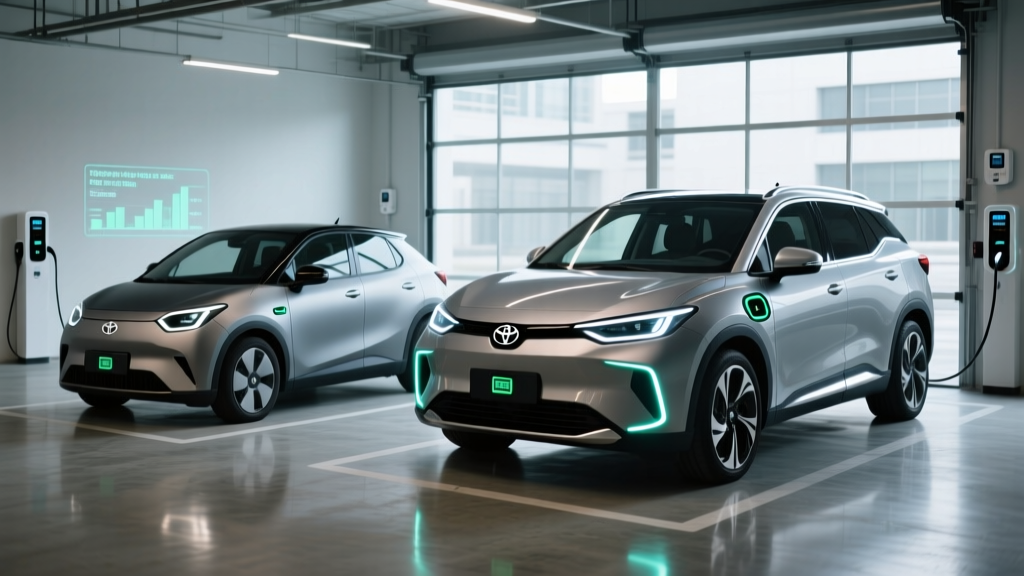
Toyota has taken a measured approach to battery-electric vehicles compared to competitors. The current U.S. lineup centers on one production BEV:
| Spec | 2026 Toyota bZ4X FWD | 2026 Toyota bZ4X AWD |
|---|---|---|
| EPA Range | 252 miles | 228 miles |
| Battery Capacity | 71.4 kWh (NMC) | 72.8 kWh (NMC) |
| Horsepower | 201 hp | 214 hp |
| 0–60 mph | ~7.1 sec | ~5.8 sec |
| DC Fast Charge Peak | ~150 kW | ~150 kW |
| 10–80% DC Time | ~32 min | ~30 min |
| Level 2 Charge Rate | 7.2 kW (onboard) | 7.2 kW (onboard) |
| MPGe (Combined) | 119 MPGe | 106 MPGe |
| Starting MSRP | $37,070 | $40,570 |
| Battery Warranty | 8 yr / 100,000 mi | 8 yr / 100,000 mi |
The bZ4X is built on Toyota's e-TNGA platform, co-developed with Subaru (the mechanically similar Solterra). The FWD model uses a single front motor, while the AWD variant employs dual motors with X-MODE off-road tuning. Both use lithium-ion NMC (nickel manganese cobalt) battery packs — Toyota has not yet introduced LFP chemistry in its U.S. EVs.
Real-World Range Reality Check
The EPA rates the bZ4X FWD at 252 miles, but real-world testing consistently shows highway driving at 70–75 mph yields approximately 210–225 miles in moderate temperatures. In cold weather (below 32°F), expect a further 20–30% reduction, bringing usable range down to 155–180 miles. If your commute or road-trip pattern regularly exceeds 200 miles one-way, the bZ4X will require mid-route DC fast charging — plan accordingly using fueleconomy.gov data and apps like PlugShare.
Charging the bZ4X: Speeds, Connectors, and Home Setup
Understanding the difference between kW (charging power — how fast energy flows) and kWh (battery energy — how much the battery holds) is essential. The bZ4X's ~72 kWh battery stores energy; the charger's kW rating determines how quickly you refill it.
| Charging Level | Power | Miles Added per Hour | Typical Use Case |
|---|---|---|---|
| Level 1 (120V) | ~1.4 kW | ~4–5 mi/hr | Emergency / overnight trickle |
| Level 2 (240V) | 7.2 kW (max onboard) | ~24–28 mi/hr | Home / workplace daily charging |
| DC Fast Charge | Peak ~150 kW | Up to ~130 mi in 10 min (peak) | Road trips, quick top-ups |
Charging curve reality: The bZ4X peaks near 150 kW only at a low state of charge (roughly 10–25% SoC) and with battery preconditioning active. Above 60% SoC, the rate tapers significantly — to roughly 60–70 kW by 80%. This is why the 10–80% time is around 30–32 minutes, not a linear calculation. Competitors like the Hyundai Ioniq 5 (which peaks at 240 kW on 800V architecture) complete the same 10–80% session in approximately 18 minutes.
Connector note: For 2026, the bZ4X ships with a CCS1 port. Toyota has announced a transition to the NACS (Tesla-style) connector for future models, and adapters are available for accessing Tesla Supercharger networks. Always verify connector compatibility with your local public chargers.
Cost Breakdown: bZ4X vs. Toyota's Hybrids vs. Gas Equivalents
The bZ4X competes against Toyota's own extensive hybrid lineup and conventional gas vehicles. Here's how the economics compare over a 5-year ownership horizon (assuming 15,000 miles/year, national average electricity and fuel prices):
| Cost Factor | 2026 bZ4X FWD | 2026 RAV4 Hybrid AWD | 2026 RAV4 LE AWD (Gas) |
|---|---|---|---|
| Base MSRP | $37,070 | $33,675 | $30,375 |
| Fed. Tax Credit (§30D) | Up to $7,500* | $0 | $0 |
| Effective Price (after credit) | ~$29,570 | $33,675 | $30,375 |
| Energy/Fuel Cost (5 yr) | ~$3,800 (home L2) | ~$6,200 | ~$9,500 |
| Maintenance (5 yr est.) | ~$1,500 | ~$2,800 | ~$3,200 |
| Insurance (5 yr est.) | ~$9,000 | ~$7,800 | ~$7,500 |
| Est. 5-Yr Total Cost | ~$43,870 | ~$50,475 | ~$50,575 |
*Federal tax credit eligibility under IRS §30D depends on buyer income caps ($150K single / $300K joint AGI), vehicle MSRP caps ($80K for SUVs), and battery critical-mineral/battery-component sourcing requirements. The credit can be transferred to the dealer at point of sale as a purchase-price reduction. Verify eligibility with a tax professional — rules are subject to legislative change.
Key takeaway: With the $7,500 credit applied, the bZ4X's effective purchase price undercuts the RAV4 Hybrid, and lower energy and maintenance costs widen the savings gap over time. However, EV insurance premiums run 15–25% higher on average, partially offsetting the advantage. Your actual savings depend heavily on electricity rates, annual mileage, and whether you charge primarily at home (cheapest) or on public DC fast chargers (which can cost 2–3× more per kWh).
bZ4X vs. Gas and Hybrid: Who Should Buy What?
| Factor | bZ4X (BEV) | RAV4 Hybrid (HEV) | RAV4 Prime (PHEV) |
|---|---|---|---|
| Electric-only range | 252 mi (full) | 0 mi | 42 mi |
| Fuel/energy flexibility | Electric only | Gas only | Gas + electric |
| Home charging needed? | Strongly recommended | No | Recommended |
| Cold-weather impact | 20–30% range loss | Minimal MPG impact | Reduced EV range |
| Road-trip convenience | Plan DC stops; 30+ min | Gas station; 5 min | Gas station; 5 min |
| Tailpipe emissions | None | Low | Low (when using gas) |
| Fed. tax credit | Up to $7,500 | None | Up to $7,500 |
Decision Framework: Which Toyota Electrified Vehicle Fits You?
- Choose the bZ4X if: You have reliable Level 2 home charging, your daily round-trip commute is under 150 miles, you want zero tailpipe emissions, and you want to maximize federal tax-credit savings.
- Choose the RAV4 Prime (PHEV) if: You want 42 miles of electric-only commuting but also need gas-engine flexibility for road trips, lack reliable home charging, or live in extreme cold climates where BEV range loss is a concern.
- Choose the RAV4 Hybrid if: You don't have access to any charging, you drive long highway routes frequently, you want the simplest ownership experience with no charging logistics, or your budget is tighter upfront.
Common Misconceptions About Toyota's EVs
| Myth | Fact |
|---|---|
| "The bZ4X battery will need expensive replacement within a few years." | Toyota warranties the battery for 8 years / 100,000 miles against capacity loss below 70%. NMC batteries in modern thermal-managed packs typically lose 10–15% capacity over 8–10 years based on industry degradation data. Full replacement costs range from $8,000–$14,000 but are rarely needed within the warranty period. |
| "I can't road-trip in an EV because chargers are unreliable." | Public DC charging reliability has improved but remains inconsistent. Electrify America, EVgo, and ChargePoint networks cover most U.S. interstates. However, plan for 10–15% of chargers potentially being offline — always have a backup charger mapped. The bZ4X's CCS connector works on most non-Tesla networks. |
| "EVs are worse in winter." | Range drops 20–30% in sub-freezing temperatures due to battery chemistry and cabin heating demands. The bZ4X uses a heat pump (on select trims) to reduce HVAC energy draw. Preconditioning the battery while plugged in mitigates both range loss and slow charging. |
| "The bZ4X is just as fast-charging as competitors." | At 150 kW peak and ~32 minutes for 10–80%, the bZ4X trails the Hyundai Ioniq 5 (~18 min at 240 kW), Kia EV6 (~18 min at 240 kW), and Tesla Model Y (~25 min at 250 kW). If fast-charging speed is your top priority, these alternatives outperform on road trips. |
| "I'll get $7,500 off no matter what." | Eligibility requires meeting IRS income caps, MSRP limits, and battery-sourcing requirements. The credit phases or can change with legislation. Always check current IRS rules before purchasing. |
Real-World Ownership: What First-Time EV Buyers Must Know
Before purchasing any Toyota EV — or any BEV — evaluate these practical factors:
Home Charging Access Is the Single Biggest Factor
Charging at home on a Level 2 (240V) circuit is the cheapest and most convenient way to own an EV. Expect to pay $500–$2,500 for a quality Level 2 charger (e.g., ChargePoint Home Flex, Emporia Level 2) and $800–$3,000+ for professional electrical installation, depending on whether your panel needs an upgrade to support a 40–50A circuit. If you live in an apartment or lack off-street parking, rely on public charging, which costs significantly more ($0.30–$0.60/kWh at DC fast chargers vs. ~$0.13–$0.17/kWh residential average).
Preconditioning Matters
The bZ4X supports battery preconditioning — warming the battery before a DC fast-charge session. Enable navigation to a charger in the vehicle's system to trigger preconditioning automatically. Skipping this step, especially in cold weather, can slow your DC charge rate substantially and extend your stop from 30 minutes to 45+ minutes.
Insurance Costs More for EVs
EV insurance premiums run higher due to battery replacement costs in collisions and specialized repair requirements. Budget an additional $200–$500/year compared to an equivalent gas vehicle. Shop quotes from multiple insurers — some now offer EV-specific discounts.
Toyota Safety Sense and Driver Assistance
The bZ4X comes equipped with Toyota Safety Sense 3.0, which includes adaptive cruise control, lane-tracing assist, pre-collision braking, and road-sign assist. This is a Level 2 SAE driver-assistance system — meaning the driver must remain fully engaged with hands on the wheel and eyes on the road at all times. It is not autonomous or self-driving.
ADAS Limitation Warning: Toyota Safety Sense is an SAE Level 2 system. It assists with steering, acceleration, and braking under specific conditions but does not replace the driver. You are legally and physically responsible for the vehicle at all times. Never treat it as a self-driving system.
What's Next for Toyota's Electric Vehicles
Toyota has announced a broad EV roadmap including next-generation battery-electric models built on a new dedicated EV platform with improved energy density and faster charging. The company has also referenced solid-state battery technology targeting 2027–2028 production, which could offer significantly higher range and faster charge times. However, these remain announced/preliminary — no U.S. pricing, EPA range figures, or firm availability dates are confirmed. For now, the bZ4X and the expanded hybrid/PHEV lineup represent Toyota's actual purchasable electrified offerings.
Frequently Asked Questions
Does Toyota make any other fully electric vehicles besides the bZ4X?
As of 2026, the bZ4X is Toyota's only mass-market BEV sold in the U.S. The bZ3X sedan is available in China, and Toyota has announced additional bZ models globally, but U.S. availability has not been confirmed. Toyota's broader electrified lineup includes over a dozen hybrid (HEV) and plug-in hybrid (PHEV) models.
How long does it take to charge the bZ4X at home?
On a Level 2 (240V, 32A) home charger delivering the bZ4X's maximum 7.2 kW acceptance rate, a full 0–100% charge takes approximately 10–11 hours. Most owners charge from 20–80% overnight, which takes roughly 6 hours — easily completed during a typical night at home.
Can I use Tesla Superchargers with the bZ4X?
Yes, with a CCS-to-NACS adapter. Toyota has partnered to provide Supercharger network access for CCS-equipped vehicles. Verify adapter availability and compatibility with your specific model year before relying on this for road trips.
Is the bZ4X a good first EV for someone switching from gas?
It can be, provided you have home Level 2 charging and your daily driving stays within ~150 miles round-trip. The bZ4X offers a familiar crossover driving experience, Toyota's reliability reputation, and strong safety ratings. However, if you regularly drive 300+ miles between stops, live in extreme cold, or lack home charging, a PHEV like the RAV4 Prime may be a more practical first step into electrification.
What happens if the bZ4X battery degrades?
Toyota's battery warranty guarantees at least 70% capacity retention for 8 years or 100,000 miles. Real-world NMC degradation data from similar EVs suggests 10–15% capacity loss over 8–10 years of normal use. If the battery falls below the 70% threshold within the warranty period, Toyota will repair or replace it at no cost. Out-of-warranty replacement costs are estimated at $8,000–$14,000, though prices are expected to decline as battery manufacturing scales.