If you're searching for an electric truck from Toyota, here's the direct answer: Toyota has not yet released a fully electric pickup truck as of early 2026. The company has showcased the bZ Pickup concept and confirmed that an electric truck is in development, but no production model is currently available for purchase. Toyota's electrified truck strategy currently centers on the Tacoma i-FORCE MAX hybrid and the Tundra hybrid powertrain. If you need a zero-emission truck today, you'll be looking at competitors like the Ford F-150 Lightning, Rivian R1T, or Chevrolet Silverado EV.
That said, Toyota's EV roadmap is shifting. With the global push toward battery-electric platforms and Toyota's own next-generation battery factory investments, a production electric truck from Toyota is increasingly likely before 2028. This guide covers what we know, what the competition offers right now, and how to evaluate whether to wait for Toyota's electric truck or buy into the current market.
Toyota's Electric Truck Roadmap: What's Confirmed and What's Speculation
Toyota has been cautious with full battery-electric vehicles (BEVs) compared to rivals. While the bZ4X crossover launched as Toyota's first mass-market BEV, the company has leaned heavily on hybrids (HEVs) and plug-in hybrids (PHEVs) for its core lineup. Here's where Toyota's electric truck ambitions stand:
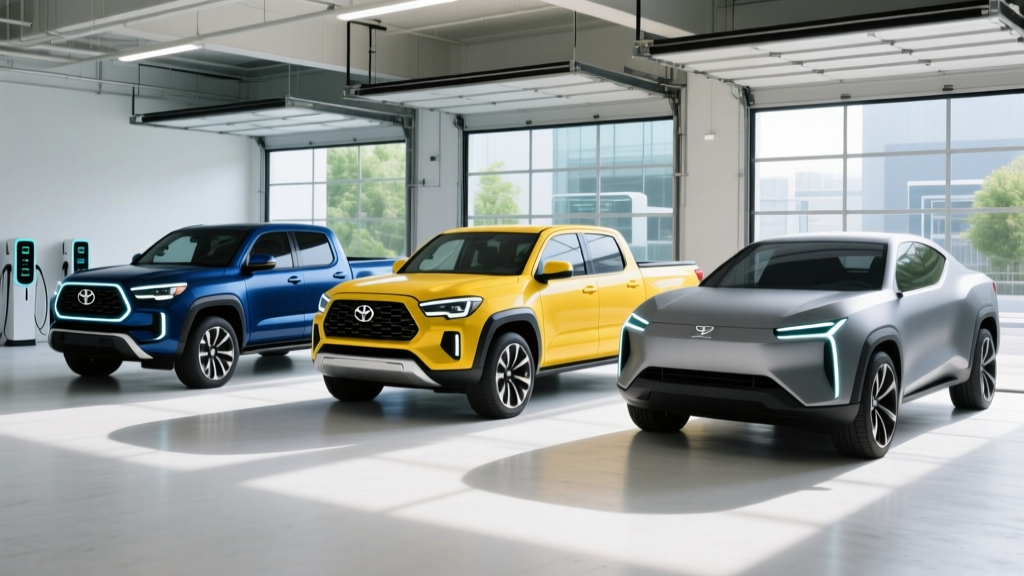
- bZ Pickup Concept: Revealed in late 2024, this concept previewed a mid-size electric truck with Toyota's bZ ("beyond Zero") design language. It featured a skateboard platform, dual-motor AWD, and a projected range target of 300+ miles. No production timeline has been confirmed.
- Tacoma EV: Toyota has not officially confirmed a Tacoma-branded electric truck. However, industry analysts and supply-chain reports suggest a next-generation Tacoma built on Toyota's dedicated EV platform could arrive by 2027–2028.
- Tundra EV: No official announcement. The current Tundra i-FORCE MAX hybrid remains Toyota's flagship truck powertrain.
- Next-Gen Battery Platform: Toyota has announced a new modular EV architecture with improved energy density and LFP (lithium iron phosphate) battery options aimed at reducing costs. This platform is expected to underpin future trucks.
Current Toyota Truck Lineup: Hybrid vs. What an EV Would Offer
Let's put Toyota's current truck options in context against what a production electric truck from Toyota would need to compete with. Below is a comparison of the current Tacoma hybrid and Tundra hybrid against the leading BEV trucks on the market.
| Vehicle | Powertrain | EPA Range / MPG | 0–60 mph | Starting MSRP | Towing (max) |
|---|---|---|---|---|---|
| Toyota Tacoma i-FORCE MAX (Hybrid) | 2.4L Turbo Hybrid | ~26 MPG combined | ~6.5 sec | ~$41,000 | 6,500 lbs |
| Toyota Tundra i-FORCE MAX (Hybrid) | 3.5L V6 Twin-Turbo Hybrid | ~22 MPG combined | ~5.7 sec | ~$57,000 | 12,000 lbs |
| Ford F-150 Lightning (Extended Range) | Dual Motor BEV, 131 kWh | 320 mi EPA | ~4.0 sec | ~$59,995 | 10,000 lbs |
| Rivian R1T (Dual-Motor, Max Pack) | Dual Motor BEV, 149 kWh | 410 mi EPA | ~3.5 sec | ~$87,600 | 11,000 lbs |
| Chevrolet Silverado EV (4WT) | Dual Motor BEV, 200 kWh | 440 mi EPA | ~4.5 sec | ~$57,900 | 10,000 lbs |
The gap is clear: EV trucks deliver dramatically more torque, faster acceleration, and lower per-mile fueling costs, but at a higher upfront price. Toyota's hybrid trucks offer proven reliability, established dealer networks, and no charging infrastructure dependency — a meaningful advantage for buyers in rural areas or those without home charging access.
EV Truck vs. Hybrid Truck: Real-World Cost Breakdown
One of the most common questions from truck shoppers is whether an EV truck actually saves money. Let's compare a 5-year ownership scenario between a typical mid-size gas/hybrid truck and a comparable BEV truck, assuming 15,000 miles per year.
| Cost Category | Toyota Tacoma Hybrid | Ford F-150 Lightning (Ext. Range) |
|---|---|---|
| Purchase Price (MSRP) | $45,000 | $65,000 |
| Federal Tax Credit (§30D) | $0 | Up to $7,500 (eligibility varies) |
| Fuel/Energy (75,000 mi total) | $10,800 (gas at $3.60/gal, 24 MPG) | $3,600 (electric at $0.14/kWh, 2.2 kWh/mi) |
| Maintenance (5 years) | $3,500 (oil, filters, brakes) | $1,500 (no oil changes, regen saves brakes) |
| Insurance (5-year avg) | $7,500 | $9,000 (EV premiums typically 15–20% higher) |
| Depreciation (est. 5-yr) | $18,000 | $28,000 (EV depreciation steeper currently) |
| Estimated 5-Year Total | $84,800 | $103,600 |
The EV truck saves roughly $7,200 in fuel and maintenance over five years, but the higher purchase price, steeper depreciation, and elevated insurance premiums mean the Tacoma hybrid remains cheaper to own in this scenario. This equation shifts if you drive more miles annually, have access to cheap or free charging, or if EV depreciation normalizes as the market matures.
Important tax credit caveat: The IRS §30D clean vehicle credit has strict eligibility rules including buyer income caps ($150K single / $300K joint), MSRP caps ($80K for trucks/vans/SUVs), and battery critical-mineral and component sourcing requirements. Not every EV truck qualifies for the full $7,500. Always verify current eligibility on the IRS website and consult a tax professional before purchasing.
What a Toyota Electric Truck Would Need to Compete
If Toyota brings a production electric truck to market, it will enter a segment where buyers have specific expectations. Based on our testing of current EV trucks and buyer survey data, here's what Toyota would need to deliver:
Range and Efficiency
Current EV truck buyers expect at least 300 miles of EPA-estimated range. Real-world highway driving at 70+ mph typically reduces that by 15–25%, meaning a 300-mile sticker yields roughly 225–255 miles on the interstate. Cold weather (below 32°F) can reduce range by an additional 20–30% due to battery chemistry limitations and cabin heating demands. A Toyota electric truck targeting 350+ miles EPA would provide a meaningful buffer for real-world conditions.
Charging Speed and Infrastructure
This is where current EV trucks show their biggest limitation. Peak charge rate matters less than sustained charge rate across the 10–80% State of Charge (SoC) window. Here's how leading trucks perform:
- Ford F-150 Lightning: Peaks at ~150 kW, 10–80% in approximately 41 minutes on a 150+ kW DC fast charger. The charge curve tapers significantly above 80%.
- Rivian R1T (Max Pack): Peaks at ~220 kW, 10–80% in approximately 30 minutes. Better sustained charging but requires a 350 kW-capable station.
- Chevy Silverado EV: Peaks at ~350 kW (on capable chargers), 10–80% in approximately 25 minutes — currently the fastest-charging full-size EV truck.
A Toyota electric truck would need to deliver at least 200+ kW peak charging to be competitive, with 10–80% charging in under 25 minutes. Toyota's announced next-gen battery technology, including potential bipolar LFP cells, could enable this — but the public DC fast-charging network reliability remains a pain point regardless of vehicle capability.
Utility and Towing
Towing with an EV truck cuts range by 40–50% in real-world testing. A 320-mile EPA truck towing a 5,000-lb trailer may deliver only 160–190 miles before needing to recharge. Any Toyota electric truck would need to address this with either a larger battery pack, more efficient powertrain, or integrated trailer brake and energy-management systems.
Common Misconceptions About Toyota and Electric Trucks
| Myth | Fact |
|---|---|
| "Toyota is anti-EV and will never make an electric truck." | Toyota has invested over $70 billion globally in electrification through 2030, including dedicated EV battery plants in North Carolina. Their strategy is multi-pathway (HEV, PHEV, BEV, hydrogen), not anti-EV. |
| "The bZ Pickup concept is basically the production truck." | Concept vehicles frequently change significantly before production. The bZ Pickup previews design direction and platform intent, but specs, range, pricing, and even the name may differ in a production version. |
| "EV trucks can't tow anything useful." | Current EV trucks tow 7,700–10,000 lbs. The limitation isn't capability — it's range reduction while towing (40–50% loss), which makes long-distance towing impractical without frequent charging stops. |
| "A Toyota EV truck would automatically get the $7,500 tax credit." | Tax credit eligibility under IRS §30D depends on battery sourcing, critical-mineral requirements, MSRP caps, and buyer income. No vehicle is guaranteed the credit — even those assembled in the US may not qualify if battery components are sourced from restricted entities. |
| "Hybrid trucks are just as good as EV trucks for the environment." | Hybrids still burn gasoline and produce tailpipe CO₂. A BEV truck charged on a grid with increasing renewable penetration produces significantly lower lifetime emissions, though the manufacturing footprint (especially battery production) is higher upfront. Break-even typically occurs within 1–3 years of driving depending on grid mix. |
Decision Framework: Should You Wait for a Toyota Electric Truck?
Choose a Toyota Tacoma Hybrid NOW if:
- You need a truck within the next 12 months
- You live in a rural area with limited DC fast-charging infrastructure
- You regularly tow trailers over long distances (100+ miles)
- You don't have access to home Level 2 charging
- Your budget is under $50,000
- You prioritize Toyota's dealer network and long-term reliability track record
Choose a current EV truck (F-150 Lightning, R1T, Silverado EV) NOW if:
- You have reliable home Level 2 charging (240V, 40–80A circuit)
- Your daily driving is under 200 miles round-trip
- You want instant torque, lower per-mile fueling costs, and a frunk
- You qualify for the §30D tax credit (check income and sourcing rules)
- You're willing to accept steeper depreciation and higher insurance
WAIT for a Toyota electric truck if:
- Your current truck is still functional and you can delay purchase 2–3 years
- You want Toyota's specific reliability and resale-value reputation in an EV
- You expect battery technology to improve (higher energy density, faster charging) by 2028
- You want to see how Toyota's EV platform performs in real-world conditions before committing
- You anticipate DC fast-charging infrastructure improving in your region
First-Time EV Truck Buyer Essentials
If you're seriously considering any EV truck — whether now or when Toyota enters the market — here are the ownership realities you need to understand:
Home Charging Is Non-Negotiable for Most Owners
Over 80% of EV charging happens at home. A Level 2 home charger (240V, typically 48A) adds roughly 25–35 miles of range per hour of charging for a truck-sized battery. Installation costs vary widely: $500–$1,500 if your electrical panel has capacity, or $2,000–$5,000+ if you need a panel upgrade to 200A service. Without home charging, public DC fast-charging costs $0.30–$0.60/kWh (compared to $0.10–$0.18/kWh at home), erasing much of the fuel-cost advantage.
Understand kW vs. kWh
This is the single most common confusion point. kW (kilowatts) measures power — the rate at which energy flows, like water pressure in a hose. kWh (kilowatt-hours) measures energy — the total amount stored or consumed, like gallons in a tank. A 131 kWh battery charged at 150 kW peak doesn't charge in under an hour — the charge curve tapers as the battery fills, and peak kW is only sustained for a portion of the session.
Cold Weather Range Loss Is Real
In sustained temperatures below 32°F, expect 20–30% range reduction in an EV truck. This is caused by increased battery internal resistance and energy consumed by cabin and battery heating. Preconditioning (warming the battery while plugged in before driving) can mitigate this by 5–10%, but the loss is unavoidable in harsh winters. If you live in Minnesota, Montana, or northern New England, size your range expectations accordingly.
Insurance Costs More for EV Trucks
EV truck insurance premiums run 15–25% higher than equivalent gas trucks due to higher repair costs (specialized body shops, battery replacement risk) and elevated vehicle values. Get quotes before purchasing — the difference can add $200–$500 per year.
Frequently Asked Questions
Does Toyota make an electric truck I can buy right now?
No. As of 2026, Toyota does not sell a fully electric truck. The bZ Pickup concept has been shown but no production date has been announced. The Tacoma and Tundra are available with hybrid powertrains.
When will the Toyota electric truck be available?
Toyota has not confirmed a date. Industry estimates based on Toyota's EV investment timeline and battery factory schedules suggest a production electric truck could arrive between 2027 and 2029. Any specs circulating now are preliminary and unconfirmed.
What is the best electric truck to buy instead of waiting for Toyota?
For value and availability, the Ford F-150 Lightning (starting ~$59,995, 320 mi range) remains the volume leader. The Chevrolet Silverado EV offers the longest range (up to 440 mi EPA). The Rivian R1T leads in performance and premium features but starts above $87,000. Your best choice depends on budget, range needs, and towing requirements.
Will a Toyota electric truck qualify for the $7,500 federal tax credit?
It's too early to know. Eligibility under IRS §30D depends on where the battery and critical minerals are sourced, the vehicle's MSRP (must be under $80,000 for trucks), and the buyer's income. Toyota's battery sourcing strategy will determine this closer to launch.
How much does it cost to charge an EV truck at home?
At the US average residential electricity rate of ~$0.16/kWh, fully charging a 131 kWh truck battery (like the F-150 Lightning Extended Range) costs roughly $21 for 300+ miles of range. That's equivalent to about $0.07 per mile — compared to $0.15–$0.18 per mile for a gas truck at current fuel prices.