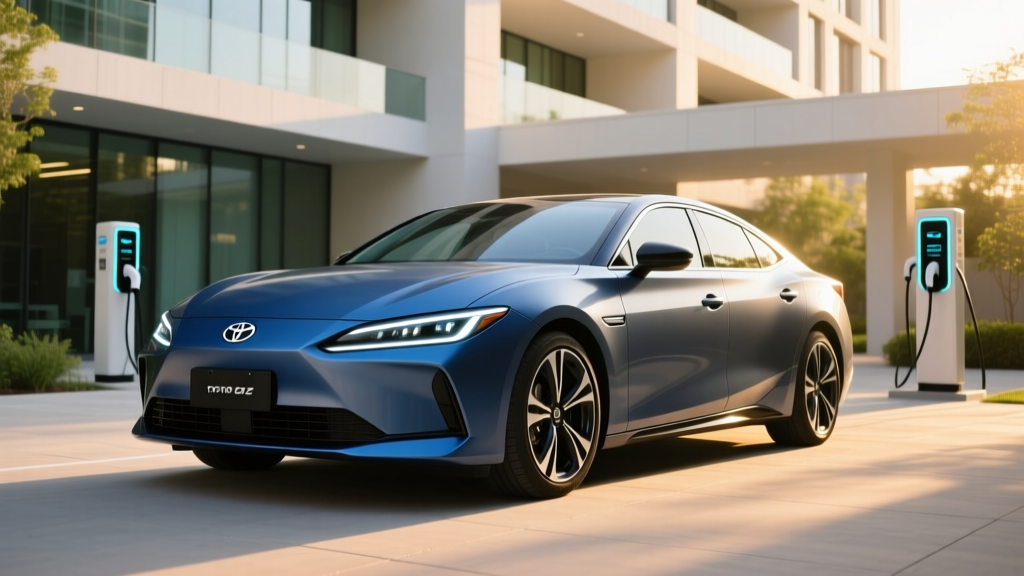
Quick Answer: Toyota's primary electric sedan offering in 2026 is the bZ5, a China-market BEV sedan developed through the BYD-Toyota joint venture. As of early 2026, Toyota does not sell a battery-electric sedan in the United States. US buyers seeking a Toyota sedan with electrification are currently limited to the Camry Hybrid and Crown Hybrid. If you're searching for a "Toyota electric sedan" in the US market, you'll need to decide between Toyota's proven hybrid sedans, waiting for a potential US-market bZ sedan, or cross-shopping BEV sedans from Tesla, Hyundai, BMW, and others.
The State of Toyota's Electric Sedan Lineup in 2026
Toyota's path to battery-electric sedans has been notably cautious compared to competitors. While the bZ4X crossover launched in the US for the 2023 model year, Toyota's battery-electric sedan strategy has largely played out in China, where regulatory pressure and market demand have moved faster.
The bZ5, unveiled in 2025, is a mid-size electric sedan built on Toyota's e-TNGA platform with BYD-supplied Blade battery technology (LFP chemistry). Preliminary specs from the Chinese launch indicate:
| Spec | bZ5 (China Market) |
|---|---|
| Battery | ~73 kWh LFP (BYD Blade) |
| CLTC Range | ~550 km (~342 mi CLTC / est. ~280 mi EPA equivalent) |
| Peak DC Charge Rate | ~150 kW |
| Power | ~201 hp (single motor, FWD) |
| 0-100 km/h | ~7.5 sec |
Critical context: CLTC range figures used in China are significantly more optimistic than US EPA testing. A 550 km CLTC rating typically translates to roughly 270-290 EPA miles. This sedan is not confirmed for US sale, and Toyota has not announced a bZ sedan for the American market as of early 2026.
What US Buyers Actually Have: Toyota Hybrid Sedans vs. EVs
Since a Toyota BEV sedan isn't available in the US, the practical question becomes: how do Toyota's hybrid sedans compare to going full electric with a competitor? Let's break this down with real numbers.
| Metric | 2026 Toyota Camry Hybrid LE | 2026 Tesla Model 3 RWD | 2026 Hyundai Ioniq 6 SE LR |
|---|---|---|---|
| Powertrain | 2.5L HEV | BEV (NMC) | BEV (NMC) |
| EPA Combined | 51 MPG | 132 MPGe | 140 MPGe |
| EPA Range | ~572 mi (13.2 gal tank) | 272 mi | 361 mi |
| Base MSRP | ~$29,990 | ~$38,990 | ~$38,650 |
| Federal Tax Credit (§30D) | None (not a BEV/PHEV) | Up to $7,500* | Up to $7,500* |
| Effective Price (after credit) | ~$29,990 | ~$31,490* | ~$31,150* |
| Fuel/Energy Cost per Mile | ~$0.07 (at $3.50/gal) | ~$0.04 (at $0.13/kWh) | ~$0.04 (at $0.13/kWh) |
| Home Charging Needed? | No | Strongly recommended | Strongly recommended |
* §30D credit eligibility depends on buyer income caps, MSRP caps (sedans: $55,000), battery sourcing, and critical mineral requirements. Verify current rules at IRS.gov. Credit can be applied as a point-of-sale discount through eligible dealers.
The Camry Hybrid's 51 MPG combined is genuinely difficult to beat on cost-per-mile when you factor in the lower purchase price and zero charging infrastructure requirements. At 15,000 miles/year, the Camry Hybrid costs roughly $1,050/year in fuel. A Model 3 charged at home at $0.13/kWh runs about $550/year in electricity — a ~$500 annual savings, but it takes years to recoup the higher purchase price even after the tax credit.
Real Costs of EV Ownership vs. Toyota Hybrids
Let's project 5-year ownership costs for a realistic comparison. These figures assume 15,000 miles/year, $0.13/kWh home electricity, $3.50/gallon gas, and standard maintenance schedules.
| Cost Category | Camry Hybrid LE | Tesla Model 3 RWD |
|---|---|---|
| Purchase Price (after credit) | $29,990 | $31,490 |
| 5-Year Fuel/Energy | $5,250 | $2,750 |
| 5-Year Maintenance (est.) | $2,500 | $1,200 |
| 5-Year Insurance (est. avg) | $7,500 | $9,500 |
| Home Charger Install | $0 | $1,200 (Level 2) |
| Estimated 5-Year Depreciation | $12,000 | $15,000 |
| Total 5-Year Cost | $57,240 | $61,140 |
Sources: EPA fueleconomy.gov for efficiency data; insurance estimates based on industry averages — actual rates vary significantly by driver, location, and provider.
Key takeaways from this breakdown:
- Energy savings are real but modest. You save roughly $2,500 on fuel over 5 years with the EV, but...
- Insurance eats those savings. EV insurance premiums run 15-30% higher on average, costing ~$2,000 more over 5 years for the Model 3.
- Maintenance favors EVs. No oil changes, fewer brake replacements (regen braking saves pads), and simpler drivetrains. Expect ~$1,300 less in maintenance.
- Depreciation remains uncertain. EV depreciation has been volatile — early Tesla Model 3s held value well, but recent price cuts have hammered resale values across the EV market.
Real-World Ownership: What First-Time EV Buyers Must Know
If you're considering moving from a Toyota hybrid to a BEV sedan from another brand, these practical realities matter more than spec sheets:
Home Charging Is Non-Negotiable for Most Owners
Over 80% of EV charging happens at home. Without a garage or dedicated parking spot where you can install a Level 2 charger (240V, typically 7-11 kW), EV ownership becomes significantly more inconvenient and expensive. Public DC fast charging costs $0.30-$0.50/kWh — roughly 2-4x home rates — and requires 20-40 minute stops for a 10-80% session.
Level 2 home install costs: Expect $800-$2,500 for a quality charger and electrician installation if your panel has capacity. If you need a 200-amp panel upgrade, add $1,500-$3,000.
Cold Weather Cuts Range 20-30%
If you live where temperatures regularly drop below freezing, expect to lose 20-30% of your EPA-rated range in winter. A 272-mile EPA Model 3 may deliver only 190-210 miles on a cold highway drive. Heat pumps (standard on most 2026 BEVs) help, but physics is physics — battery chemistry slows in cold, and cabin heating draws significant energy.
Charging Curves Aren't Linear
A "150 kW peak charge rate" doesn't mean you charge at 150 kW the whole session. Most BEVs hit peak rate only between 10-40% State of Charge (SoC), then taper significantly. A typical 10-80% session on a 150 kW-capable sedan takes 25-35 minutes, not the ~20 minutes marketing sometimes implies. Above 80%, charging slows dramatically to protect battery health — that last 20% can take as long as the first 60%.
Battery Degradation Is Manageable but Real
Most 2026 BEV batteries lose roughly 8-12% capacity over 5 years / 75,000 miles, depending on chemistry, climate, and charging habits. LFP batteries (like those in base Model 3 and the China-market bZ5) tolerate regular 100% charging better than NMC and may degrade slightly less. All major manufacturers warrant the battery for 8 years / 100,000 miles with a minimum 70% capacity retention threshold.
Common EV Misconceptions — Corrected with Data
| Myth | Fact |
|---|---|
| "EVs are always cheaper to own than hybrids" | Not always. At current prices, a 51 MPG Camry Hybrid can have lower 5-year total cost than a BEV sedan, especially if you drive under 12,000 miles/year or lack home charging. |
| "You'll never need to stop on road trips" | A 272-mile EPA sedan realistically gives 200-230 highway miles before needing a charge (you don't run batteries to 0%). On a 600-mile trip, expect 2-3 DC fast-charge stops of 25-35 min each. |
| "EV batteries need replacing every few years" | Data from fueleconomy.gov and fleet studies show most BEV batteries retain 85-90% capacity at 100,000 miles. Full replacement is rare and covered under the 8-year/100k warranty if capacity drops below 70%. |
| "The $7,500 tax credit applies to everyone" | §30D has strict limits: buyer AGI caps ($150k single / $300k joint), sedan MSRP cap of $55,000, and battery sourcing/critical mineral requirements that disqualify some trims. Always verify at IRS.gov before purchasing. |
| "Toyota doesn't make EVs" | Toyota sells the bZ4X BEV crossover in the US and the bZ3/bZ5 sedans in China. A US-market Toyota BEV sedan has not been confirmed but is widely expected as Toyota scales its battery supply chain. |
Decision Framework: Should You Buy a Toyota Hybrid Sedan or a Competitor's BEV?
Use this framework to decide which path makes sense for your situation:
Choose the Toyota Camry/Crown Hybrid if:
- You don't have reliable home charging access (apartment, street parking, no garage)
- You regularly drive in extreme cold (below 10°F) where range loss compounds
- You take frequent road trips over 400 miles and don't want to plan around charging
- Your budget is under $32,000 and you want lower upfront cost
- You plan to keep the car 10+ years and value Toyota's long-term reliability track record
- You drive under 12,000 miles/year (fuel savings from EV won't offset higher purchase price)
Choose a BEV sedan (Tesla Model 3, Hyundai Ioniq 6, BMW i4) if:
- You have a garage/driveway where you can install a Level 2 home charger
- Your daily commute is under 80 miles round-trip (home charging covers 95%+ of driving)
- You qualify for the §30D federal tax credit (check income and sourcing requirements)
- You drive 15,000+ miles/year — higher mileage accelerates the fuel-cost payback
- Your local electricity rates are below $0.15/kWh
- You want lower maintenance costs and fewer scheduled service visits
- Access to HOV lanes or local EV incentives matters in your state
Wait for a US-market Toyota BEV sedan if:
- You want Toyota's dealer network and reliability reputation in a battery-electric package
- You're not in a hurry — Toyota has signaled expanded BEV launches for 2026-2028
- You want LFP battery chemistry (better longevity, lower cost) which Toyota is adopting via its BYD partnership
What to Watch: Toyota's Upcoming US Electric Sedan Plans
Toyota has committed to launching 30 BEV models globally by 2030, with next-generation battery technology including solid-state cells targeted for 2027-2028. Industry analysts expect a US-market bZ sedan — potentially based on the bZ5 architecture but adapted for EPA testing and US crash standards — to arrive no earlier than the 2027 model year.
When it does arrive, expect:
- Range: 280-340 EPA miles (depending on battery size and trim)
- Charging: 150-200 kW peak DC rate, 10-80% in ~25-30 minutes
- Battery: Likely LFP for base trims, NMC for long-range variants
- Pricing: Estimated $35,000-$48,000 MSRP range, potentially qualifying for §30D credit depending on battery sourcing
These are preliminary estimates based on Toyota's announcements and the China-market bZ5 specs. Final US specifications, pricing, and tax credit eligibility will not be confirmed until Toyota makes an official US announcement.
Frequently Asked Questions
Does Toyota sell an electric sedan in the US?
No. As of early 2026, Toyota does not sell a battery-electric sedan in the United States. The bZ3 and bZ5 electric sedans are currently limited to the Chinese market. Toyota's US electrified sedan lineup consists of the Camry Hybrid and Crown Hybrid.
How does a 51 MPG Camry Hybrid compare to an EV on fuel costs?
At $3.50/gallon, the Camry Hybrid costs roughly $0.07/mile in fuel. A BEV sedan charged at home at $0.13/kWh costs about $0.04/mile. Over 15,000 miles/year, that's ~$1,050 vs. ~$550 — a $500/year savings for the EV. However, the EV's higher purchase price, insurance, and charger installation costs mean the total-cost breakeven point is typically 5-7 years.
Is it worth buying a Tesla Model 3 instead of waiting for a Toyota electric sedan?
If you need an EV now and have home charging access, the Model 3, Ioniq 6, or similar BEV sedan makes sense — you'll benefit from current §30D tax credits and start saving on fuel immediately. If you're not in a rush and prefer Toyota's dealer network and track record, waiting 1-2 years for a potential US-market Toyota BEV sedan is reasonable, but understand that specs, pricing, and credit eligibility remain unconfirmed.
What's the difference between kW and kWh?
This is the most common EV confusion. kW (kilowatt) measures power — the rate at which energy flows. A 150 kW DC fast charger delivers energy quickly. kWh (kilowatt-hour) measures energy capacity — how much the battery holds. A 75 kWh battery stores enough energy to drive roughly 250-300 miles depending on efficiency. Think of kW as "how fast you're filling the tank" and kWh as "how big the tank is."
Do I qualify for the $7,500 federal EV tax credit?
It depends. The §30D credit has multiple requirements: your adjusted gross income must be under $150,000 (single) or $300,000 (joint), the sedan's MSRP must be under $55,000, and the vehicle must meet battery component and critical mineral sourcing requirements that change annually. Some trims qualify for the full $7,500, some for $3,750, and some for nothing. Check the current eligible vehicle list at IRS.gov and consult a tax professional for your specific situation. The credit can be transferred to the dealer at point of sale as an instant discount.
How long do EV batteries actually last?
Based on fleet data and manufacturer testing, most modern BEV batteries retain 85-92% of original capacity after 100,000 miles. LFP chemistry (used in base Tesla Model 3 and the China-market Toyota bZ5) generally shows slightly less degradation than NMC. All major automakers warrant batteries for 8 years / 100,000 miles with a minimum 70% capacity retention threshold. Complete battery failure before 150,000 miles is rare. If replacement is needed out of warranty, expect $8,000-$18,000 depending on pack size.