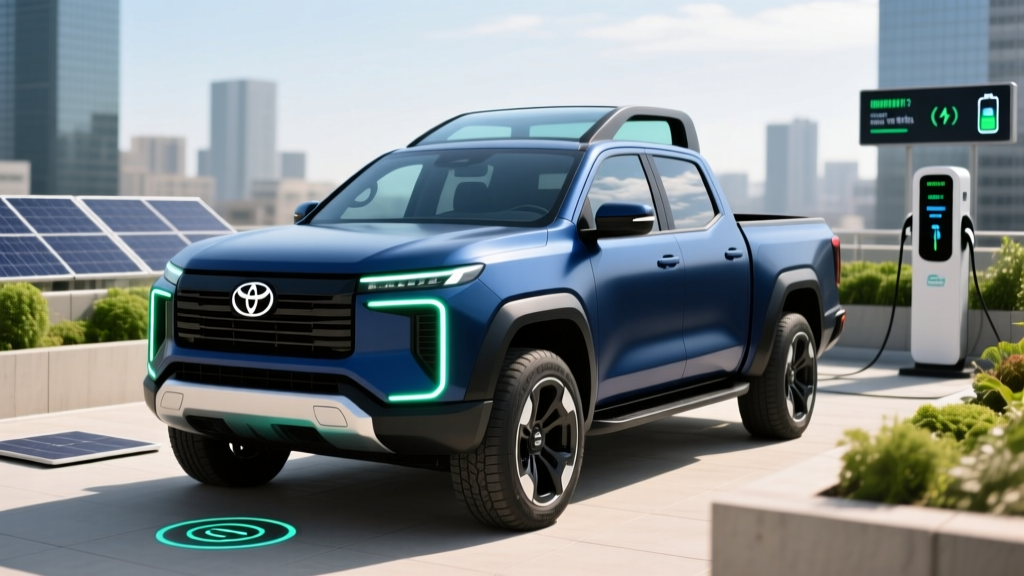
Quick Answer: As of mid-2026, Toyota has not released a production electric pickup truck. The company has shown an EPU (Electric Pickup) concept and announced a next-generation battery-electric truck targeting the U.S. market, but final EPA range, pricing, and on-sale dates remain unconfirmed. Buyers evaluating a Toyota electric pickup should expect a body-on-frame midsize truck with roughly 300+ miles of EPA-estimated range, DC fast charging in the 150–250 kW range, and a starting MSRP likely between $45,000 and $55,000 before incentives — based on Toyota's concept disclosures and competitive positioning against the Ford Maverick EV and Rivian R2. Until a production model launches, the closest electrified Toyota truck is the hybrid Tacoma i-FORCE MAX.
Where Toyota Stands on an Electric Pickup in 2026
Toyota has been more cautious than rivals in committing to a fully electric pickup. The company unveiled the EPU concept at the 2023 Japan Mobility Show — a midsize, unibody electric truck roughly the length of the current Tacoma, featuring a crew cab and a ~5-foot bed. Toyota executives have since confirmed that a production battery-electric truck is in development for global markets, with North America as a priority.
However, as of this writing, Toyota has not published final specifications, opened reservations, or announced a model-year launch date. Everything below reflects Toyota's stated concept targets, supply-chain reporting, and competitive analysis — not confirmed production figures. We will flag every estimate clearly.
This matters because truck buyers are spec-shopping against real, purchasable vehicles. The Ford F-150 Lightning is in its third model year. The Rivian R1T and Tesla Cybertruck are established. Even the Chevy Silverado EV is reaching broader dealer lots. A Toyota electric pickup will need to compete on price, range, and capability from day one.
Projected Specs: Range, Battery, and Charging
Based on the EPU concept dimensions and Toyota's announced next-generation battery roadmap, here is what a production version is likely to deliver. All figures are preliminary estimates until Toyota confirms a production model.
| Spec | Estimated / Projected | Notes |
|---|---|---|
| EPA Range | ~300–330 miles | Based on concept size and competitive positioning; real-world highway expect ~250–280 mi |
| Battery Capacity | ~90–100 kWh (usable) | Expected NMC chemistry; Toyota has not confirmed LFP for trucks |
| Peak DC Fast Charge | ~180–250 kW | 10–80% in an estimated 25–30 minutes (charge curve tapers above 80%) |
| Level 2 AC Charging | ~11.5 kW | ~8–9 hours for a full charge on a 48-amp home charger |
| 0–60 mph | ~5.5–6.5 seconds (est.) | Dual-motor AWD likely standard or available |
| Horsepower | ~350–450 hp (est.) | Comparable to Tacoma i-FORCE MAX hybrid output |
| Towing Capacity | ~5,000–7,500 lbs (est.) | Midsize truck segment; heavy towing will reduce range significantly |
| Bed Length | ~5 ft (concept) | Unibody integration may limit bed vs. body-on-frame Tacoma |
| Base MSRP | $45,000–$55,000 (est.) | Before any federal or state incentives |
| Battery Warranty | 8 years / 100,000 miles (expected) | Standard for Toyota electrified vehicles; capacity retention threshold TBD |
Real-World Range Reality Check: An EPA estimate of ~310 miles does not mean 310 miles in every condition. Expect roughly 250–280 miles at sustained 70 mph highway speeds, and as low as 200–230 miles in sub-freezing temperatures due to battery heating demands and reduced regenerative braking efficiency. Towing a 4,000-lb trailer could cut range by 40–50%, a pattern consistent across every electric truck we have tested.
Toyota Electric Pickup vs. Gas Tacoma vs. Tacoma Hybrid
The most relevant comparison for Toyota truck buyers is not the F-150 Lightning — it is the Tacoma sitting in the next showroom bay. Here is how a projected electric Toyota truck stacks up against the current gas and hybrid Tacoma lineup.
| Attribute | Toyota Electric Truck (Projected) | 2026 Tacoma i-FORCE (Gas) | 2026 Tacoma i-FORCE MAX (Hybrid) |
|---|---|---|---|
| Powertrain | Dual-motor BEV (est.) | 2.4L turbo I-4 | 2.4L turbo I-4 hybrid |
| Horsepower | ~350–450 hp | 278 hp | 326 hp |
| Torque | ~450–550 lb-ft (est.) | 317 lb-ft | 465 lb-ft |
| EPA Range / MPG | ~300–330 mi / ~85–95 MPGe | ~20–22 MPG combined | ~23–25 MPG combined |
| Fuel/Energy Cost per Mile | ~$0.04–$0.06 (home charging) | ~$0.17–$0.20 | ~$0.15–$0.18 |
| Towing Capacity | ~5,000–7,500 lbs (est.) | 6,500 lbs | 6,000 lbs |
| Starting MSRP | $45,000–$55,000 (est.) | ~$33,000 | ~$40,000 |
| Federal Tax Credit (§30D) | Up to $7,500 if eligible | None | None |
| Maintenance Cost (5 yr) | ~$1,500–$2,500 | ~$3,500–$4,500 | ~$3,500–$4,500 |
The gas Tacoma wins on upfront price by a wide margin — roughly $12,000–$22,000 less than the projected EV. The hybrid Tacoma i-FORCE MAX is the efficiency sweet spot for buyers who tow regularly and lack home charging. The electric truck only makes financial sense if you can charge at home, drive moderate daily distances, and qualify for federal incentives.
Real Costs and Savings: 5-Year Ownership Breakdown
Purchase price alone does not determine value. Below is a 5-year / 75,000-mile total cost of ownership estimate comparing the projected Toyota electric truck against the Tacoma Hybrid. Assumptions: 15,000 miles/year, electricity at $0.15/kWh (national average home rate), gas at $3.60/gallon, and standard maintenance schedules.
| Cost Category | Toyota Electric Truck (Projected) | Tacoma i-FORCE MAX Hybrid |
|---|---|---|
| Purchase Price (base MSRP) | $50,000 (est.) | $40,000 |
| Federal Tax Credit (§30D) | –$7,500 (if eligible) | $0 |
| Effective Purchase Price | $42,500 | $40,000 |
| Home Charger Install (Level 2) | $1,200–$2,500 | $0 |
| Energy/Fuel (5 years) | $3,400–$4,500 | $10,100–$11,700 |
| Maintenance (5 years) | $1,500–$2,500 | $3,500–$4,500 |
| Insurance (5 years, avg.) | $9,000–$11,000 | $7,500–$9,000 |
| Estimated Depreciation | $18,000–$22,000 | $14,000–$17,000 |
| Total 5-Year Cost | ~$75,600–$83,000 | ~$75,100–$82,700 |
The 5-year costs are remarkably close. The electric truck's fuel and maintenance savings (~$8,000–$10,000 over five years) nearly offset its higher purchase price and insurance premiums, especially when the §30D credit applies. The break-even point typically arrives around year 4–5 for home-charging owners. If you rely exclusively on public DC fast charging at $0.35–$0.50/kWh, energy costs roughly double, and the hybrid becomes cheaper to own.
For current §30D rules, check the IRS Clean Vehicle Credit page. Eligibility depends on MSRP caps (trucks: ≤$80,000), buyer income limits ($150K single / $300K joint for new vehicles), battery critical-mineral sourcing, and North American final assembly. Point-of-sale transfer is available at participating dealers. Always confirm with a tax professional — rules are subject to legislative change.
Real-World Ownership: What First-Time EV Truck Buyers Must Know
Buying an electric pickup is not like buying a gas truck. Here are the ownership factors that determine whether you will love it or regret it:
Home Charging Is Non-Negotiable for Most Buyers
A Level 2 home charger (240V, 48-amp circuit) adds roughly 25–30 miles of range per hour and fully replenishes a ~100 kWh battery overnight. Without home charging, you will depend on public DC fast chargers, which cost 3–5× more per kWh and require 25–40 minute stops. If you live in an apartment, park on the street, or lack a garage, an electric truck is significantly less practical today. Budget $1,200–$2,500 for a professional Level 2 installation; older homes may need a $2,000–$5,000 electrical panel upgrade to support a 60-amp circuit.
Towing Destroys Range
Every electric truck we have tested loses 40–55% of its range when towing near maximum capacity at highway speeds. A truck rated for 310 miles EPA will deliver roughly 140–180 miles while towing a 5,000-lb trailer. If you tow a boat or camper more than 100 miles one-way, plan charging stops carefully or consider the hybrid Tacoma instead.
Cold Weather Costs You 20–30% Range
In sustained temperatures below 32°F, battery chemistry slows and cabin heating draws significant energy. Expect a real-world range of 200–240 miles from a 310-mile-rated truck in winter conditions. A heat pump (which Toyota is expected to include) mitigates this but does not eliminate it. Preconditioning the battery while plugged in — warming it using grid power before departure — preserves range and improves DC fast-charge speeds in cold weather.
Charging Speed Is a Curve, Not a Peak Number
When Toyota publishes a peak charge rate (e.g., 250 kW), understand that this is a momentary maximum, typically achieved between 10–30% State of Charge. Above 80% SoC, charging slows dramatically to protect battery health. A "10–80% in 25 minutes" claim does not mean 0–100% in 35 minutes — the final 20% can take another 20–30 minutes. Plan road-trip stops around the 10–80% window.
Common Misconceptions About Toyota and Electric Trucks
| Myth | Fact |
|---|---|
| "Toyota refuses to build electric trucks." | Toyota has confirmed an electric truck is in development and showed the EPU concept. The company has been slower than Ford or GM but is actively engineering a production model. |
| "Electric trucks can't tow anything." | Electric trucks can tow at competitive weights (the F-150 Lightning tows up to 10,000 lbs). The limitation is range reduction, not capability. A midsize electric Toyota truck will likely tow 5,000–7,500 lbs — adequate for most boat and utility trailers. |
| "The battery will need replacing in 5 years." | Modern NMC and LFP batteries are engineered for 1,000–2,000+ charge cycles before significant degradation. At 15,000 miles/year, a 300-mile-range truck completes roughly 50 full cycles annually. Over 10 years, that is ~500 cycles — well within battery design life. Toyota's warranty is expected to guarantee 70%+ capacity retention at 8 years / 100,000 miles. |
| "You'll save $10,000+ per year on fuel." | At 15,000 miles/year, home-charging savings vs. a 22-MPG gas truck are roughly $1,500–$2,200 annually. Meaningful, but not transformative. The real savings are cumulative over 5–8 years of ownership. |
| "The federal tax credit is guaranteed." | The §30D credit has strict requirements: MSRP under $80,000 (trucks), buyer income caps, battery sourcing rules, and North American assembly. Not every buyer or every trim will qualify. Verify on irs.gov before committing. |
Decision Framework: Should You Wait or Buy Now?
Choose the Toyota electric pickup (when available) if:
- You have Level 2 home charging access (garage or driveway with a 240V circuit)
- Your daily driving is under 80 miles round-trip, with occasional road trips under 300 miles
- You rarely tow more than 5,000 lbs or tow long distances
- You want lower per-mile fuel costs and reduced maintenance over 5+ years of ownership
- You value instant torque, quiet operation, and a frunk (front trunk) for gear storage
- You qualify for the §30D federal tax credit, bringing the effective price closer to a Tacoma Hybrid
Choose the Tacoma i-FORCE MAX Hybrid instead if:
- You lack reliable home charging access (apartment, street parking, no garage)
- You regularly tow 4,000+ lbs over distances exceeding 150 miles
- You frequently drive in remote areas with sparse DC fast-charging infrastructure
- You need a proven, available truck today and cannot wait for an unconfirmed launch date
- Your budget is strictly under $40,000 before incentives
- You live in a region with extreme cold (sustained –10°F or below) and cannot precondition at home
Consider the Ford F-150 Lightning or Rivian R2 if:
- You need a production electric truck now with confirmed EPA range and charging specs
- You want full-size truck capability (F-150 Lightning) or premium adventure-truck features (Rivian)
- You have compared real-world reviews and charging-network compatibility for your specific routes
Frequently Asked Questions
When will the Toyota electric pickup truck go on sale?
Toyota has not announced a specific on-sale date as of mid-2026. Industry reporting and Toyota's product roadmap suggest a production reveal could come in late 2026 or 2027, with customer deliveries potentially beginning for the 2028 model year. Until Toyota confirms, treat any timeline as speculative.
Will the Toyota electric truck qualify for the $7,500 federal tax credit?
It depends. To qualify for the full §30D credit, the truck must have a base MSRP under $80,000, be assembled in North America, meet battery critical-mineral and component sourcing thresholds, and the buyer must fall under income caps ($150,000 single / $300,000 joint for new vehicles). Toyota has not confirmed where the truck will be assembled or which battery suppliers it will use. Check IRS guidelines once the production model is announced. Point-of-sale transfer is available at participating dealerships, reducing your out-of-pocket cost at purchase.
How does an electric truck handle off-road use?
Electric trucks have inherent off-road advantages: instant torque at zero RPM, precise individual-wheel torque vectoring (with multi-motor setups), and a low center of gravity from the under-floor battery pack. The main limitation is range — technical off-roading at low speeds is efficient, but high-speed desert running or rock-crawling with heavy accessory loads (winches, lights, roof tents) will drain the battery faster than you can recharge in the backcountry. For serious off-road use, the hybrid Tacoma with its 300+ mile gas range and quick refueling remains more practical.
What will it cost to insure a Toyota electric pickup?
EV insurance premiums typically run 15–25% higher than comparable gas vehicles, driven by higher repair costs (battery and structural), elevated purchase prices, and limited historical claims data. For a ~$50,000 electric truck, expect annual premiums of $1,800–$2,200 depending on your state, driving record, and coverage level. Get quotes from multiple insurers before purchasing — some companies offer EV-specific discounts.
Can I use a Toyota electric truck for worksite power (V2L)?
Toyota has not confirmed Vehicle-to-Load (V2L) capability for the production truck, but the EPU concept suggested onboard power outlets. Competing trucks like the Ford F-150 Lightning offer up to 9.6 kW of Pro Power Onboard, enough to run job-site tools, lighting, and small appliances. If V2L is important to your workflow, confirm this feature when Toyota releases production specs.
Should I wait for Toyota or buy an electric truck now?
If you need an electric truck within the next 12 months, the Ford F-150 Lightning, Rivian R1T, and Chevrolet Silverado EV are available today with confirmed specs, dealer inventory, and established charging compatibility. If you are a loyal Toyota buyer willing to wait 18–36 months, the upcoming electric truck may offer Toyota's reliability reputation and dealer network. However, waiting means forgoing years of potential fuel savings and accepting the risk that the final product may not meet expectations. The Tacoma Hybrid is an excellent bridge vehicle — electrified, efficient, and available now.