The Short Answer on Toyota's 2022 Electric Cars
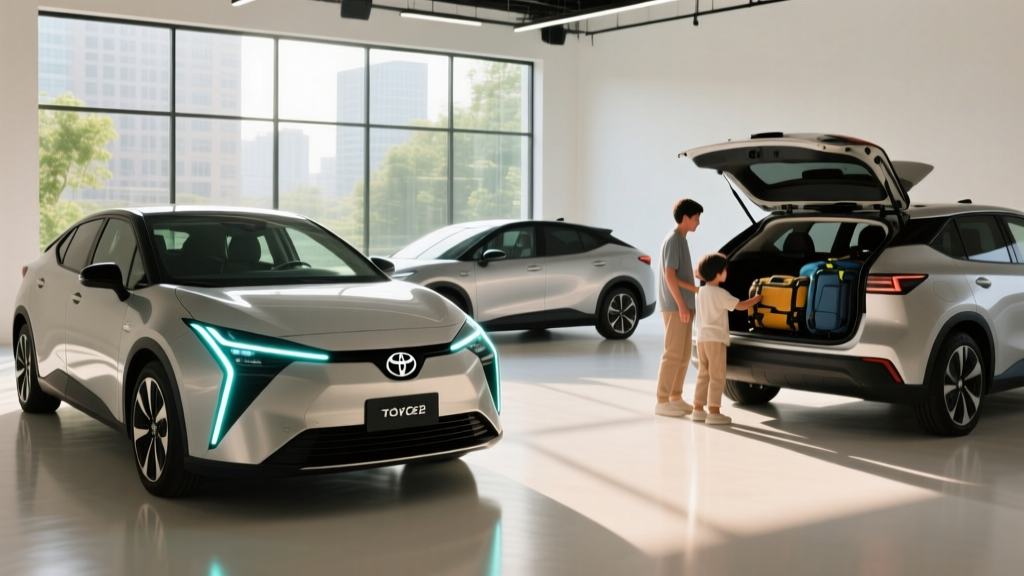
Toyota offered exactly one battery-electric vehicle for the 2022 model year: the bZ4X crossover SUV, which launched in limited markets in late 2022 as an early-2023 model. If you're shopping for a used 2022-era Toyota EV today, you're looking at the first-generation bZ4X with an EPA-estimated 252 miles of range (FWD), a 71.4 kWh battery, and DC fast charging that peaks around 150 kW. It's a competent but conservative entry that trails key rivals on charging speed and efficiency. For 2026, Toyota has expanded its EV lineup, making the original bZ4X a value-oriented used option rather than a segment leader.
Toyota's 2022 EV Lineup: Just the bZ4X
Unlike competitors that offered multiple electric models by 2022, Toyota's battery-electric portfolio consisted of a single vehicle. The bZ4X was co-developed with Subaru (which sells it as the Solterra) and built on Toyota's e-TNGA platform. The Prius Prime plug-in hybrid and various conventional hybrids rounded out Toyota's electrified offerings, but the bZ4X was the brand's first dedicated BEV for the U.S. market.
Here's what the original bZ4X brought to the table:
| Specification | XLE FWD | XLE AWD | Limited AWD |
|---|---|---|---|
| EPA Range | 252 mi | 228 mi | 222 mi |
| Battery (usable) | 71.4 kWh, lithium-ion (NMC chemistry) | ||
| Motor Output | 201 hp / 196 lb-ft | 214 hp / 248 lb-ft | |
| 0-60 mph | ~7.1 sec | ~5.8 sec | |
| DC Fast Charge Peak | ~150 kW (CCS1 connector) | ||
| 10-80% DC Charge | ~30 minutes (under ideal conditions) | ||
| Level 2 Charge Rate | 6.6 kW onboard charger | ||
| Combined MPGe | 131 MPGe | 114 MPGe | 112 MPGe |
| Base MSRP (at launch) | $42,000 | $44,080 | $46,700 |
| Battery Warranty | 8 years / 100,000 miles (70% capacity retention) | ||
Real-World Range: What the EPA Number Doesn't Tell You
EPA Sticker: 252 miles (XLE FWD) / 228 miles (AWD)
Real-World Highway Expectation: ~210-230 miles at 70 mph in moderate temperatures
Cold-Weather Expectation: ~170-200 miles in sub-freezing conditions
The bZ4X's range was middling at launch and remains so. The FWD model's 252-mile EPA figure is usable for daily commuting and moderate road trips, but the AWD variants drop below 230 miles — tight for a segment where the Hyundai Ioniq 5 and Tesla Model Y deliver 260-330 miles. The bZ4X lacks a heat pump on early U.S. models (standard on the Subaru Solterra and added to later Toyota model years), meaning cold-weather range loss can be more pronounced than competitors that use heat-pump thermal management.
On a practical level: if your daily round-trip commute is under 60 miles and you charge at home, range is a non-issue. For road trips exceeding 200 miles between charging stops, you'll need to plan more carefully than you would in a Model Y Long Range (330 mi EPA) or even an Ioniq 5 (303 mi EPA on RWD).
Charging Speed: The bZ4X's Biggest Limitation
This is where the 2022-era bZ4X falls notably behind. Its ~150 kW peak DC fast charging rate on the CCS1 connector is conservative by 2026 standards. More critically, the bZ4X's charge curve tapers early and steeply:
- 10-80%: Approximately 30 minutes at a 150+ kW station under ideal battery temperatures
- Above 80% SoC: Charging slows dramatically — expect 45-60+ minutes total for a full charge
- Cold-weather DC charging: Without robust battery preconditioning, cold-soaked batteries may peak well below 150 kW initially
For comparison, the Hyundai Ioniq 5 (2022-2026 with 800V architecture) peaks at 240 kW and charges 10-80% in roughly 18 minutes. The Tesla Model Y on a V3 Supercharger peaks around 250 kW with a 10-80% time near 20-22 minutes. That 10-12 minute gap per charging stop compounds on long road trips.
At home on Level 2 (240V, 6.6 kW onboard charger), the bZ4X adds roughly 25-28 miles of range per hour of charging. A full overnight charge from 20% to 100% takes about 10-11 hours — adequate for daily replenishment but slower than the 11.5 kW Level 2 capability found in some competitors.
Cost Comparison: bZ4X vs. Gas and Hybrid Alternatives
Let's put real numbers on ownership costs. We'll compare a used 2023 bZ4X XLE FWD (current used-market pricing around $24,000-$28,000) against a new 2026 Toyota RAV4 Hybrid and a 2026 Toyota RAV4 gas model over 5 years / 75,000 miles.
| Cost Category | Used bZ4X XLE FWD | 2026 RAV4 Hybrid (LE AWD) | 2026 RAV4 Gas (LE FWD) |
|---|---|---|---|
| Purchase Price (est.) | $26,000 (used) | $33,000 (new) | $30,000 (new) |
| Fuel / Energy Cost | $3,750 (home charging at $0.14/kWh) | $6,250 (40 MPG, $3.50/gal) | $8,750 (30 MPG, $3.50/gal) |
| Maintenance | $1,500 (no oil changes, fewer wear items) | $3,500 | $4,000 |
| Insurance (avg.) | $9,500 ($1,900/yr) | $7,500 ($1,500/yr) | $7,000 ($1,400/yr) |
| Estimated Depreciation | $8,000 | $12,000 | $13,000 |
| 5-Year Total | $48,750 | $62,250 | $62,750 |
Note: Energy costs assume 85% home charging at $0.14/kWh and 15% public DC charging at $0.40/kWh. Gas costs are national averages. Insurance varies significantly by driver profile, ZIP code, and insurer. Used EV purchase prices reflect early-2026 market data. Source: fueleconomy.gov for efficiency figures.
The used bZ4X wins on operating costs — you'll save roughly $2,500-$5,000 on fuel/energy and maintenance over five years compared to the hybrid or gas RAV4. However, EV insurance premiums run 15-35% higher on average, which partially offsets those savings. The purchase-price advantage of buying used is the biggest economic lever here.
Federal Tax Credits and Incentives: What Applies
If you're buying a used bZ4X from a dealer in 2026, you may qualify for the Used Clean Vehicle Credit under IRS §25E — up to $4,000 or 30% of the sale price (whichever is lower). Key requirements:
- Sale price must be $25,000 or less
- Buyer income caps: $75,000 single / $112,500 head of household / $150,000 joint
- Vehicle must be at least 2 model years old (a 2023 model year bZ4X qualifies in 2026)
- Must purchase from a licensed dealer (private-party sales don't qualify)
- Credit can be transferred to the dealer at point of sale as a price reduction
The original $7,500 new-vehicle credit (§30D) no longer applies to a 2022/2023 bZ4X purchase since you'd be buying used. Always verify current eligibility rules at IRS.gov and consult a tax professional — credit rules and battery-sourcing requirements change frequently.
Common Misconceptions About Toyota's EVs
| Myth | Fact |
|---|---|
| "Toyota doesn't make electric cars" | Toyota launched the bZ4X for the 2023 model year and has expanded the bZ lineup through 2026, including the bZ4X three-row variant and redesigned models. |
| "The bZ4X battery will degrade quickly" | Toyota warranties the battery for 8 years/100,000 miles with a 70% capacity-retention threshold. Early real-world data shows NMC packs in the bZ4X holding up comparably to industry norms — expect 85-90% capacity at 100k miles with normal use. |
| "You can't road-trip an EV" | You can, but the bZ4X's 150 kW charging and 222-252 mi range means more planning and longer stops than in a Tesla or 800V Hyundai/Kia. It's viable, just slower. |
| "EVs cost more to insure always" | EV insurance is higher on average (15-35%), but the gap narrows by model. Shop quotes from multiple insurers — some now offer EV-specific discounts. |
| "Home charging requires expensive upgrades" | A basic Level 2 (240V/32A) home charger install runs $500-$2,000 if your panel has capacity. A 200A panel upgrade adds $1,500-$3,000. Many homes need no upgrade at all. |
Decision Framework: Is a Used Toyota bZ4X Right for You?
Choose the used bZ4X if:
- You have reliable home Level 2 charging and commute under 80 miles daily
- You want a Toyota dealer service network and proven long-term reliability support
- Your budget is $22,000-$28,000 and you want a modern crossover with low operating costs
- Most of your driving is local or regional — road trips under 200 miles between stops
- You value the 8-year/100,000-mile battery warranty still being in effect on low-mileage examples
Look elsewhere if:
- You regularly drive 300+ mile road trips and need fast DC charging (consider Ioniq 5, Model Y, or EV6)
- You live in a cold climate and need maximum range retention (bZ4X's lack of a heat pump on early models hurts here)
- You want over 300 miles of range from a new vehicle (Tesla Model Y, Chevrolet Equinox EV, Hyundai Ioniq 5 all exceed this)
- You need three-row seating — the bZ4X is a compact two-row crossover
- Fastest possible home charging matters (the 6.6 kW onboard charger is slower than the 11.5 kW units in many competitors)
What a First-Time EV Buyer Should Know
If the bZ4X is your entry into electric ownership, here are the practical realities that spec sheets don't convey:
Charging is mostly a home game. Over 80% of EV charging happens at home. If you have a garage or driveway with access to a 240V outlet (or can install one), daily charging takes seconds — plug in when you park, wake up to a full battery. Public charging is for road trips and apartment dwellers.
kW and kWh are not the same thing. kWh (kilowatt-hours) measures battery capacity — how much energy the car stores, like a gas tank size. The bZ4X has 71.4 kWh usable. kW (kilowatts) measures power flow — how fast energy moves into the car, like the flow rate of a gas pump. The bZ4X accepts up to 150 kW on DC fast charging.
The charge curve matters more than peak speed. The bZ4X may peak at 150 kW, but it doesn't sustain that rate. Expect it to hold peak power from roughly 10-40% SoC, then taper to 80-100 kW through 60%, and drop further above 80%. This is why 10-80% time (30 minutes) is the standard metric — not peak kW.
Plan for winter. All EVs lose range in cold weather due to battery chemistry and cabin heating demands. Expect 20-30% range reduction in sustained sub-freezing temperatures. The bZ4X's 228-mile AWD range could drop to 160-185 miles in harsh winter conditions. Preconditioning the battery while plugged in helps mitigate this.
Frequently Asked Questions
Did Toyota make any other electric cars in 2022?
No. The bZ4X was Toyota's only battery-electric vehicle for the 2022 model year globally (sold as a 2023 model in the U.S.). Toyota also offered the Prius Prime plug-in hybrid (25 miles electric-only range) and several conventional hybrids, but no other BEV.
How does the bZ4X compare to the Subaru Solterra?
They share the e-TNGA platform, battery, and powertrain. Key differences: the Solterra includes standard AWD and a heat pump (better cold-weather performance), while the bZ4X offers a FWD option with slightly higher EPA range. The Solterra's range is rated at 222-228 miles across trims. Interior design, infotainment interfaces, and suspension tuning differ subtly.
Is the bZ4X eligible for any tax credits in 2026?
As a used purchase, it may qualify for the §25E Used Clean Vehicle Credit — up to $4,000 if the sale price is $25,000 or less and you meet income limits. The $7,500 new-vehicle §30D credit does not apply to used purchases. Verify current rules at IRS.gov.
What's the bZ4X's real charging cost per mile?
At the national average residential electricity rate of ~$0.16/kWh and the bZ4X's efficiency of roughly 3.0 miles/kWh (FWD), home charging costs about $0.053 per mile. Compare that to a 30 MPG gas car at $3.50/gallon: $0.117 per mile. You'll save roughly $0.06 per mile on energy, or about $4,500 over 75,000 miles.
Should I buy a used bZ4X or a new 2026 EV?
If budget is the priority, a used bZ4X at $22,000-$28,000 offers strong value with low operating costs and remaining factory warranty. If you need more range, faster charging, or the latest tech, new 2026 options like the redesigned bZ4X, Hyundai Ioniq 5, or Tesla Model Y offer meaningful improvements — at $38,000-$50,000+ before credits. The right answer depends on your driving patterns, charging access, and budget.