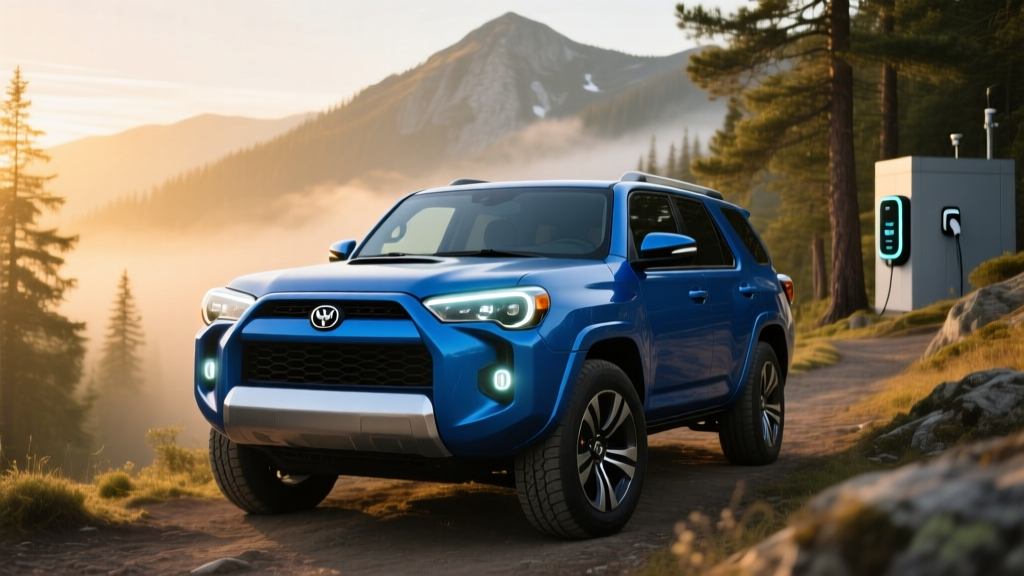
If you're searching for an electric 4Runner, here's the quick answer: Toyota does not currently sell a fully electric 4Runner. As of the 2026 model year, the Toyota 4Runner remains a body-on-frame SUV powered by a gasoline engine or the i-FORCE MAX hybrid powertrain. There is no battery-electric (BEV) 4Runner in Toyota's announced lineup through 2026. If you want Toyota off-road capability with electrification, your best current option is the 4Runner i-FORCE MAX hybrid—or you'll need to look at competitors like the Rivian R1S or the upcoming electric body-on-frame SUVs from other manufacturers.
The 2026 Toyota 4Runner: What's Actually Available
The sixth-generation 4Runner debuted for the 2025 model year on Toyota's TNGA-F platform (shared with the Tacoma, Land Cruiser, and Tundra). For 2026, Toyota continues to offer two powertrains:
- i-FORCE (gas): 2.4L turbocharged 4-cylinder, 278 hp, 317 lb-ft torque. EPA-estimated ~21 MPG combined.
- i-FORCE MAX (hybrid): 2.4L turbo + electric motor integrated into the 8-speed automatic, 326 hp, 465 lb-ft torque. EPA-estimated ~24 MPG combined. A 1.87 kWh nickel-metal hydride (NiMH) battery pack supports mild electric assist—it is not a plug-in hybrid and cannot drive on electric power alone for any meaningful distance.
Neither powertrain can be plugged in. The i-FORCE MAX is a conventional hybrid (HEV), meaning it recovers energy through regenerative braking and uses the electric motor to supplement the gas engine. This is fundamentally different from a plug-in hybrid (PHEV) or battery-electric vehicle (BEV).
| Spec | i-FORCE (Gas) | i-FORCE MAX (Hybrid) |
|---|---|---|
| Engine | 2.4L Turbo I4 | 2.4L Turbo I4 + Electric Motor |
| Horsepower | 278 hp | 326 hp |
| Torque | 317 lb-ft | 465 lb-ft |
| EPA MPG (combined) | ~21 MPG | ~24 MPG |
| Battery | 12V only | 1.87 kWh NiMH (not plug-in) |
| Towing Capacity | Up to 6,000 lbs | Up to 6,000 lbs |
| Starting MSRP | ~$42,220 | ~$48,985 |
| Federal EV Tax Credit | Not eligible | Not eligible (HEV, not PHEV/BEV) |
Source: Toyota 4Runner Official Page, fueleconomy.gov. MSRP and MPG figures are estimates and vary by trim and driving conditions.
Why Toyota Hasn't Built an Electric 4Runner (Yet)
Toyota's electrification strategy has been notably cautious compared to competitors. The company has publicly favored a "multi-pathway" approach that includes hybrids, plug-in hybrids, hydrogen fuel cells, and battery-electric vehicles—rather than going all-in on BEVs. Several factors explain the absence of an electric 4Runner:
- Body-on-frame complexity: Adapting a rugged, off-road-capable, body-on-frame platform for a large battery pack is engineering-intensive. The TNGA-F platform wasn't designed from the ground up for a 100+ kWh battery.
- Off-road and towing demands: The 4Runner's core buyers tow boats and trailers and drive in remote areas where charging infrastructure is sparse. Toyota has been hesitant to commit to BEV in this use case.
- Hybrid as a bridge: The i-FORCE MAX delivers tangible fuel savings (roughly 14% improvement over the gas model) without range or infrastructure concerns.
- Toyota's bZ EV lineup is still maturing: Toyota's dedicated BEV efforts (the bZ4X crossover) have had a rocky launch with limited range and slow charging. Scaling up to a full-size off-road SUV is a larger leap.
Toyota has announced plans for a next-generation EV lineup, but no electric 4Runner or electric body-on-frame SUV has been officially confirmed for production before 2028 at the earliest.
Electric 4Runner Alternatives: What You Can Actually Buy
If zero-tailpipe-emission, off-road-capable, three-row (or spacious two-row) SUV capability is what you're after, here's how the real alternatives stack up:
| Vehicle | Type | EPA Range / MPG | Starting MSRP | Off-Road Capability |
|---|---|---|---|---|
| Rivian R1S (Dual-Motor) | BEV | ~352 mi (Standard Pack) / ~410 mi (Max Pack) | ~$79,900 | Excellent (air suspension, quad-motor option) |
| Toyota 4Runner i-FORCE MAX | HEV | ~24 MPG combined | ~$48,985 | Excellent (body-on-frame, locking diffs, crawl control) |
| Jeep Wrangler 4xe | PHEV | ~22 mi electric-only / ~49 MPGe | ~$53,995 | Excellent (solid axles, Rubicon trim) |
| Ford Bronco (2.7L EcoBoost) | Gas | ~18 MPG combined | ~$40,895 | Excellent (Badlands/Raptor trims) |
| Cadillac Escalade IQ | BEV | ~450 mi (est.) | ~$130,000+ | Moderate (luxury-oriented, not a rock crawler) |
Source: fueleconomy.gov, manufacturer specifications. Prices and specs reflect 2025–2026 model year data where available.
Real Cost Comparison: 4Runner Hybrid vs. Rivian R1S
To understand the financial picture, let's compare five-year ownership costs for the 4Runner i-FORCE MAX hybrid versus the Rivian R1S Dual-Motor Standard Pack. This comparison highlights the tension between lower upfront cost (Toyota) and lower operating cost (Rivian).
| Cost Category | Toyota 4Runner i-FORCE MAX | Rivian R1S Dual-Motor |
|---|---|---|
| Purchase Price (base MSRP) | $48,985 | $79,900 |
| Federal Tax Credit (§30D) | $0 (not eligible—HEV) | Up to $7,500 (if income/sourcing rules met)* |
| Fuel / Electricity (5 yrs, 15k mi/yr) | ~$14,200 (gas at $3.50/gal, 24 MPG) | ~$4,800 (home charging at $0.14/kWh, 2.2 kWh/mi) |
| Maintenance (5 yrs) | ~$3,500 | ~$1,200 |
| Insurance (5 yrs, avg.) | ~$9,000 | ~$12,500 |
| Estimated 5-Year Total | ~$75,685 | ~$98,400 (before credit) / ~$90,900 (with credit) |
*The §30D federal EV tax credit has income caps ($150K single / $300K joint), MSRP caps ($80K for SUVs), and battery-sourcing requirements that change annually. Verify eligibility at irs.gov before purchasing. The R1S MSRP may exceed the $80K SUV cap depending on trim and options.
Even with the tax credit, the Rivian R1S costs roughly $15,000–$22,000 more over five years. The 4Runner's advantage is its significantly lower purchase price and proven long-term reliability. The Rivian's advantage is dramatically lower fuel and maintenance costs—and zero tailpipe emissions.
Common Misconceptions About an Electric 4Runner
| Myth | Fact |
|---|---|
| "The 4Runner hybrid is a plug-in. You can charge it at home." | The i-FORCE MAX is a conventional hybrid (HEV). It has no plug and no meaningful electric-only range. The 1.87 kWh battery charges only through regenerative braking and the engine. |
| "Toyota is releasing an electric 4Runner in 2026." | No electric 4Runner has been officially announced for 2026 or 2027. Toyota's announced BEV roadmap focuses on sedans and crossovers (bZ series), not body-on-frame SUVs. |
| "An electric SUV can't handle real off-roading." | The Rivian R1S has completed the Rubicon Trail, and EVs offer instant torque and precise wheel-by-wheel control (especially quad-motor setups). The real limitation is charging access in remote areas, not capability. |
| "I'll save money buying the hybrid over an EV." | The hybrid saves money upfront (~$30K less than an R1S), but you'll spend ~$9,400 more on fuel over 5 years. Whether the total cost favors the hybrid depends on how long you keep the vehicle and whether you qualify for the tax credit. |
| "The 4Runner qualifies for the $7,500 EV tax credit." | Neither the gas nor the hybrid 4Runner qualifies for the §30D Clean Vehicle Credit. That credit applies only to plug-in vehicles (BEVs and PHEVs meeting battery-sourcing and MSRP/income requirements). See IRS guidelines. |
Decision Framework: Should You Buy a 4Runner, Wait, or Go Electric?
Your best move depends on your driving patterns, budget, and charging situation. Use this framework to decide:
Choose the Toyota 4Runner i-FORCE MAX if:
- You need proven off-road capability and 6,000-lb towing today
- You regularly drive in remote areas with no charging infrastructure
- Your budget is under $55,000
- You want Toyota's long-term reliability track record and dealer network
- You don't have access to home charging (Level 2)
Choose the Rivian R1S if:
- You have reliable home Level 2 charging (240V, 40A+ circuit)
- Your daily driving is under 300 miles round-trip (well within the R1S range)
- You want zero tailpipe emissions and lower operating costs
- Your budget extends to $80,000+ and you can absorb higher insurance premiums
- You value over-the-air updates and modern EV tech (frunk, gear tunnel, camp kitchen)
Choose the Jeep Wrangler 4xe if:
- You want a plug-in with electric-only commuting (22 mi) plus gas for long trips
- Off-road capability is a top priority (Rubicon 4xe is exceptional)
- You can charge at home but also need unlimited range for road trips
- Your budget is in the $54,000–$65,000 range
Wait for a future electric 4Runner if:
- You're committed to the Toyota brand and body-on-frame durability
- Your current vehicle has several years of life left
- You want to see how Toyota's next-gen BEV platform performs before committing
- You expect better charging infrastructure in rural/off-road areas by 2028–2030
Real-World Ownership Considerations for EV-Curious 4Runner Buyers
If you're considering jumping to an electric alternative, be honest about these practical factors:
Home charging access: This is the single biggest factor in EV satisfaction. If you can install a Level 2 charger (240V, typically 40–48A) at home, daily EV ownership is effortless—you wake up "full" every morning. Installation costs $500–$2,000 depending on your electrical panel. If you're in an apartment or rely on street parking, public DC fast charging becomes your lifeline, and that's significantly more expensive ($0.30–$0.50/kWh vs. $0.12–$0.16/kWh at home).
Cold-weather range loss: If you live in northern climates, expect 20–35% range reduction in sub-freezing temperatures. A Rivian R1S rated for 352 miles may deliver 230–280 miles in January in Minnesota. The 4Runner hybrid doesn't suffer this—it runs on gasoline regardless of temperature.
Towing range penalty: Towing a 4,000-lb trailer cuts EV range roughly in half. The R1S towing 4,500 lbs may achieve only 150–180 miles before needing a charge. The 4Runner will see a fuel-economy drop too (perhaps 14–16 MPG while towing), but gas stations are everywhere, including near trailheads and campgrounds.
Charging on road trips: The Rivian R1S can access the Tesla Supercharger network (via NACS adapter, standard on 2025+ models) plus Rivian's own Adventure Network. But in truly remote areas—think Moab, the Sierra Nevadas, or the Appalachian backcountry—DC fast chargers are scarce. The 4Runner's 350+ mile gas range and 5-minute fill-ups remain a practical advantage for expedition-style driving.
Frequently Asked Questions
Will Toyota ever make a fully electric 4Runner?
Toyota has not announced an electric 4Runner. The company has committed to expanding its BEV lineup, and a body-on-frame electric SUV is plausible on a future platform. However, nothing has been confirmed for production before 2028–2029. Toyota's current electrification focus for trucks and SUVs is the i-FORCE MAX hybrid system.
Does the 4Runner hybrid need to be plugged in?
No. The i-FORCE MAX is a conventional hybrid (HEV), not a plug-in hybrid (PHEV). Its small 1.87 kWh battery charges through regenerative braking and the gasoline engine. You fuel it exactly like a standard gas vehicle.
What's the most off-road-capable electric SUV available now?
The Rivian R1S (especially the quad-motor variant) is widely considered the most capable electric off-road SUV. It features adjustable air suspension (up to 14.9 inches of ground clearance), tank turns, and precise torque vectoring. The GMC Hummer EV SUV is also extremely capable but significantly larger and more expensive.
How much does it cost to charge an electric SUV at home vs. fueling a 4Runner?
At the US average electricity rate of ~$0.14/kWh, charging a vehicle like the Rivian R1S (consuming ~2.2 kWh/mile equivalent) costs roughly $0.06–$0.07 per mile. Fueling a 4Runner i-FORCE MAX at 24 MPG with gas at $3.50/gallon costs about $0.15 per mile. Over 15,000 miles per year, that's roughly $960 for electricity vs. $2,188 for gasoline—a savings of ~$1,200 annually with the EV.
Is the Jeep Wrangler 4xe a good compromise between electric and gas?
The Wrangler 4xe is an excellent compromise if your commute is under 22 miles (you can do it on electric only) and you still want unlimited range and serious off-road capability for weekends. However, once the battery is depleted, fuel economy drops to roughly 20 MPG combined—only marginally better than the gas-only Wrangler. It also qualifies for the §30D federal tax credit (subject to income and sourcing rules), which can reduce the effective price significantly.